
#On the Wet Country That Refuses a Shape
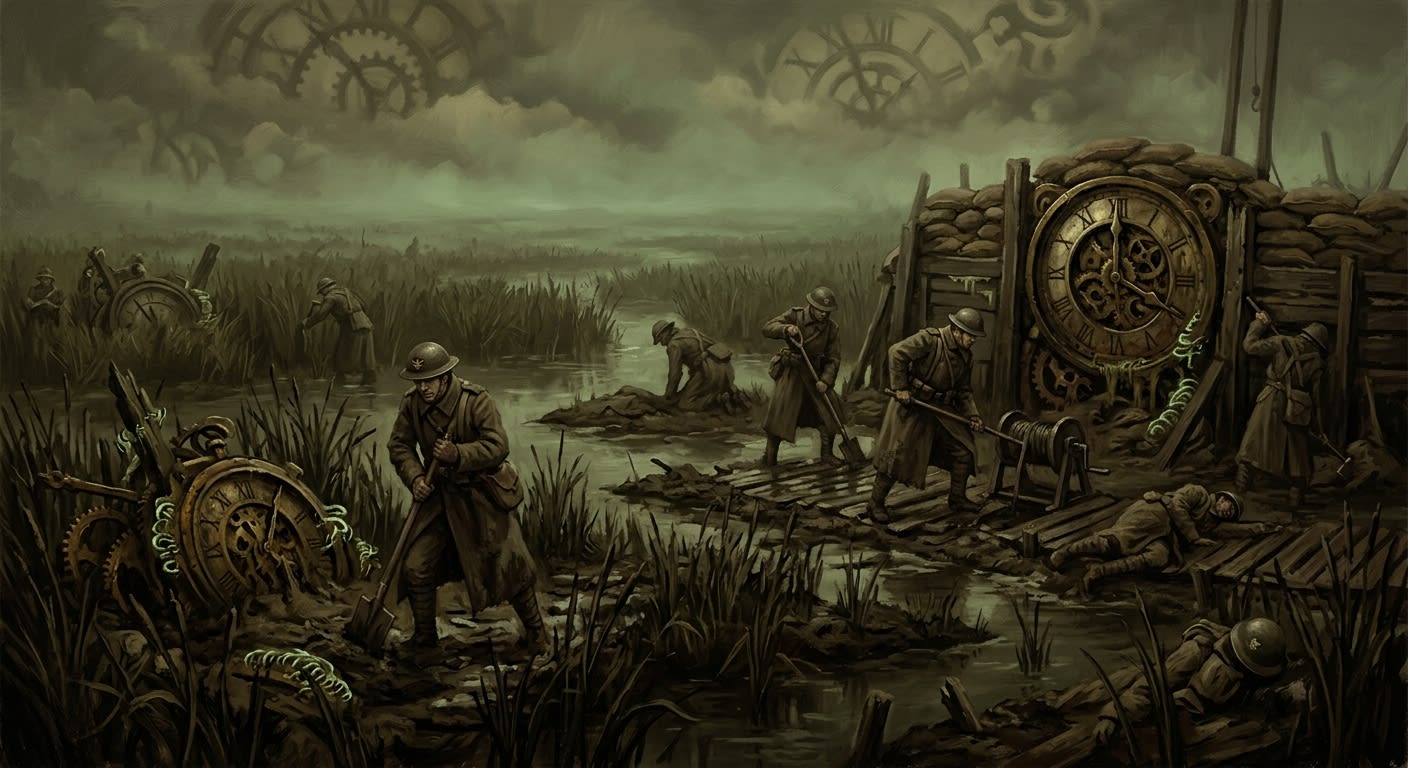
Shipka Marsh is the soldiers' short name for the Phocis Marsh Corridor, the black-water trough east of Bastion-Shipka where the Sagittal Line stops pretending war is made of walls and admits that Europe may be lost through mud, fog, reeds, bad sleep, and a pump handle left ungreased. The Balkan heights rise hard to the south. The Vales of Stagnance press from the east. Between them lies a low basin of peat, drowned turf, reed channels, sink pools, gas pockets, plank tracks, stilt-hamlets, and old Phocian stone visible only when water becomes briefly honest.
The marsh is not a battlefield in the theatrical sense. It offers no clean ridge, no gallant slope, no line of heroic silhouettes suitable for cheap engravers and expensive funerals. It works by saturation. It enters boots, lungs, timetables, joints, sermons, fish baskets, telegraph keys, and marriage beds. The reader who seeks grandeur should go to Przemyśl and stare at wire until Pride obliges him. Shipka Marsh offers the truer education: slow loss, wet paperwork, and the theological insult of ground that does not stay still.
The Bureau of the Hourglass classifies the corridor as a persistent low-grade stillness field, Syrion-adjacent and sub-threshold. Sub-threshold is the sort of phrase that keeps a clerk warm in Strasbourg. At Shipka, it means clocks must be checked against clocks that hate one another, soldiers may serve four months before time begins nesting in their skulls, and frogs have become unofficial witnesses because the frogs, unlike several Bureaus I could name, stop croaking before disaster.
#On Old Phocis Beneath the Water
Before the Sundering, the basin was not all marsh. Old Phocis (Unregistered) held vineyards, mill runs, court roads, eel ponds, church yards, tax houses, and farm villages whose ledgers described drainage as if drainage were obedience. The Night of a Thousand Lamps ended that vanity. Syrion's hush softened the court first, then the valley, then the calendars of everyone who believed tomorrow would arrive by habit. The higher roads rotted. Mills stood with wheels half-turned. The lesser streams lost discipline and spread.
Water made the defeat visible. Fields became pools. Cart ruts became channels. Cellars became wells. Graveyards rose in spring and sank in autumn, disgorging coffin lids against chapel steps with the punctual insolence of debt collectors. The Synod later drove a bastion into this sodden inheritance and called the act reclamation. The marsh accepted the word and returned several survey stakes with roots grown through their seal-holes.
The locals still speak of pre-Sundering foundations: the Old King's Drain, the Sunken Mill Teeth, Saint Orvath's Steps, the Bell-Foot Cause, the drowned market of Lysa Reach. Records list most of these as unverified. That means nobody useful has died there recently enough to improve the file. Fishermen pass over stone floors under black water and refuse to name what lies below. Children know where not to pole. Dogs whine at certain plank bends. The Bureau calls this superstition because admitting local knowledge would require consulting people who smell of eel.
At low water the Drowned Shrine appears: a foundation, a partial nave, and a corroded bell tower lifting from the marsh like an accusation preserved in lime. The bell cannot ring by any lawful mechanism. Hourglass instruments have recorded low-frequency percussion events on windless nights. Three confirmed Somnolent Communion Cells formed within sight of it. The Bureau of Engineering has not demolished the shrine because demolition in contested wet ground costs money, courage, boats, and an answer to what one does if the bell rings during the work.
#On the Reed Road and Other Acts of Insolence
The Reed Road is the marsh's formal insult: a raised rail embankment and inspection causeway thrust east from Shipka across peat, water, and Syrionic suggestion. It carries supply, patrol, telegraph, timing marks, Scour channels, and the stubborn belief that a straight line can shame a swamp into cooperation. It begins under the western guns and proceeds toward fog with a clerk's confidence and an engineer's private terror.
It was raised during early Sagittal consolidation after A.S. 65, when the Synod discovered that a bastion with no road is a tomb with flags. The first lifts slumped. The marsh swallowed stakes, wagons, and one junior engineer whose name appears with three spellings and no surviving body. The final embankment held because Engineering drove piles into the drowned peat, packed brush and stone, built floodgates, and learned to distrust every patch of ground that seemed willing.
Early Engineering notices described the marsh spur as “secured by industry.”
Corrected. The spur is maintained against appetite. Secured implies the marsh has accepted judgement. No such acceptance has been witnessed, notarised, or believed by anyone required to walk the road before dawn.
The road is also an instrument. A locomotive from yard to Station Two should take a known interval. A horn call should arrive at the outer ladder with measurable delay. Telegraph beats should return in order. When they do not, the marsh has entered the file. Adept Meryth Vesk measures these offences with drag-gauges, resonance-bells, candle registers, and frog calls. I admire her discipline and pity anyone who drinks tea while she counts the cooling rings.
#On Stilts, Tithes-End, and People Who Know Too Much Water
Beyond the formal walls, where the Reed Road frays into plank tracks and rope bridges, stand the stilt-hamlets called Tithes-End (Unregistered). They are subject to Shipka's writ in the official manner and to mud, debt, hunger, weather, fish runs, and grandmotherly authority in the practical manner. Their houses perch above black water on timber piles. Their markets float when the rains are unkind. Their children learn knots before catechism, eel seasons before saints, and the sound of a rotten board before Latin.
They pay in fish, peat-bricks, reed-thatch, salvage labour, pole service, and silence. In exchange the bastion does not burn them as unregistered squatter-heresy, which is a generous arrangement by frontier standards and a disgrace by humane ones. Mother Tess Halver, sharp-eyed midwife and marsh herbalist, has treated creeping lethargy, dream residue, name-forgetting, and the soft smiles that follow bad fog. She knows enough to suspect Sloth-taint and enough to fear reporting it without proof, since proof often arrives at the same hour as fire.
The marsh-folk keep older habits. They dim lanterns under certain fogs. They spit over the left side of boats after passing the Drowned Shrine. They refuse to answer bells heard under water. They bind sleeping children to bed posts with soft cord during heavy mists, not from cruelty but from the memory of small footprints leading to channels at dawn. Purity calls these practices doctrinally incoherent. Purity has not supplied a better method for preventing a child from walking asleep into black water.
The Somnolent Communion Cells grew from this soil of exhaustion, grief, and wet obedience. Seven to twenty villagers link hands at the marsh edge, face a dulled lantern, breathe shallowly, and enter a collective stillness that measures too close to Syrion for comfort and too close to ordinary fatigue for Doctrine's pleasure. At dawn some circles are found waist-deep in water, eyes open, smiling. The smiles are the worst evidence. Pain would be easier to condemn.
#On Fire, Water, and the Night Called Sleepfire
A.S. 178 gave the marsh its harshest lesson in collaboration between element and Sin. The Reed-Road Sleepfire began as marsh flame along the outer stilts, likely gas-burp, lightning, tar carelessness, and the usual coalition by which disaster collects signatures. At the same hour sleep-contagion spread through the hamlets. Watchers saw households standing amid flame, sleeves burning, hair alight, faces peaceful, no one fleeing because urgency had been made vulgar inside them.
The Order of Ash demanded Scour. The demand was doctrinally clean and nearly catastrophic. A full burn would have taken the outer stilts, plank markets, fish-oil sheds, culvert crossings, and the lower road approaches; it might also have taught the purgation channels buried under the causeway to carry fire inward. Engineers opened sluices, reversed pumps, flooded the low road, cut Line Four telegraph access after the key returned ALL WELL from a burning station, and demolished plankways until fire had only islands left to eat.
TELEGRAPH DIGEST — LINE FOUR / SLEEPFIRE ANNEX Return-click received after operator station confirmed aflame: ALL WELL / ALL WELL / ALL WELL. Beat pattern after cut matched restricted lull cadence fragment. Operator Leth Rusk found asleep with fingers fused to key. Message unsent. Disposition of key: transferred to ███████ custody; not to be struck.
Dozens died. The main quarter lived. Survivors returned with burns, wrong calm, delayed responses, and an aversion to bell-metal that Mercy tried briefly to call trauma before Doctrine corrected the term into battle-sleep. Match Morrick survived with a face no recruit can romanticise. Varik later copied the report by hand and preserved the sentence Shipka still uses as counter-catechism: Fire requested. Water achieved result. Record both.
War's public summary stated: “Assets preserved.”
Expanded. Assets preserved included rail approach, pump access, telegraph junctions west of the cut, Scour stores, and enough living witnesses to make victory morally untidy. The dead were omitted because the sentence concerned assets.
#On Station Two and the Marsh as Clock
Station Two squats two kilometres east of Shipka on a reinforced causeway, a low blockhouse with instrument sheds, telegraph masts, a red cache door, and windows facing the Vales with the expression of a man hearing his own name whispered by a creditor. It is the marsh's forward ear and the Hourglass Bureau's punishment for anyone intelligent enough to be assigned there.
The post measures what the marsh tries to hide: Sloth-surge, fog drift, bell lag, staff tremor, causeway flex, animal rhythm variance, boot-print persistence, and the little pauses in action by which catastrophe begins applying for office. During the Slumber-Hulk Engagement of A.S. 194, when a Slumber-Hulk came through fog toward the road, Vesk's drag-gauge flatlined for eleven minutes. In A.S. 199, Station Two began losing ninety seconds each day in a clean absence now called the Skip (Unregistered). The marsh had always delayed men. The Skip cuts time instead of softening it, which is rude, new, and still unanswered by Strasbourg.
The frogs remain unofficial. Seven calls, pause, eleven calls, pause, seven again before strong readings. Frog silence before worse ones. No public table includes them. This is bureaucratic cowardice dressed as dignity. I have known worse witnesses than frogs. Some wore mitres.
#On the Present Wetness of the War
As of A.S. 201, Shipka Marsh is held. This word should be handled with tongs. Held means the Reed Road runs, the floodgates answer, Station Two reports, the stilt-hamlets pay, the Scour caches remain sealed, and the Vales have not yet crossed the road in force. Held does not mean safe. Safety is a rearward superstition, most often found in pamphlets and officers' mothers.
Westward seepage has thickened. A.S. 196 brought formal classification of the Communion Cells. A.S. 199 brought stronger fog-margin drift, Preserved Village (Unregistered) face reports eastward, and the Skip at Station Two. Rest Societies now form inside the bastion proper among clerks, nurses, and rail hands whose labour is so constant that Syrion need only offer an honest sleep and wait for gratitude to do the first heretical work.
The marsh has patience. It rots the hidden stake before the visible plank. It quiets the bell before it silences the tower. It teaches tired men that delay is a kindness. Against this, the Synod sets piles, rails, pumps, horns, ledgers, stimulants, old sergeants, wet engineers, unlovely songs, and Vesk with her impossible notebooks. A ridiculous armoury. A necessary one.
At dawn the road crews go out. They tap rails, test sleepers, count frogs, curse fog, inspect culverts, and step over water that remembers a kingdom choosing rest. The marsh waits below with every virtue the Enemy admires: softness, patience, silence. The men keep walking.