
#On the Terrain Where Minutes Refuse Majority Rule
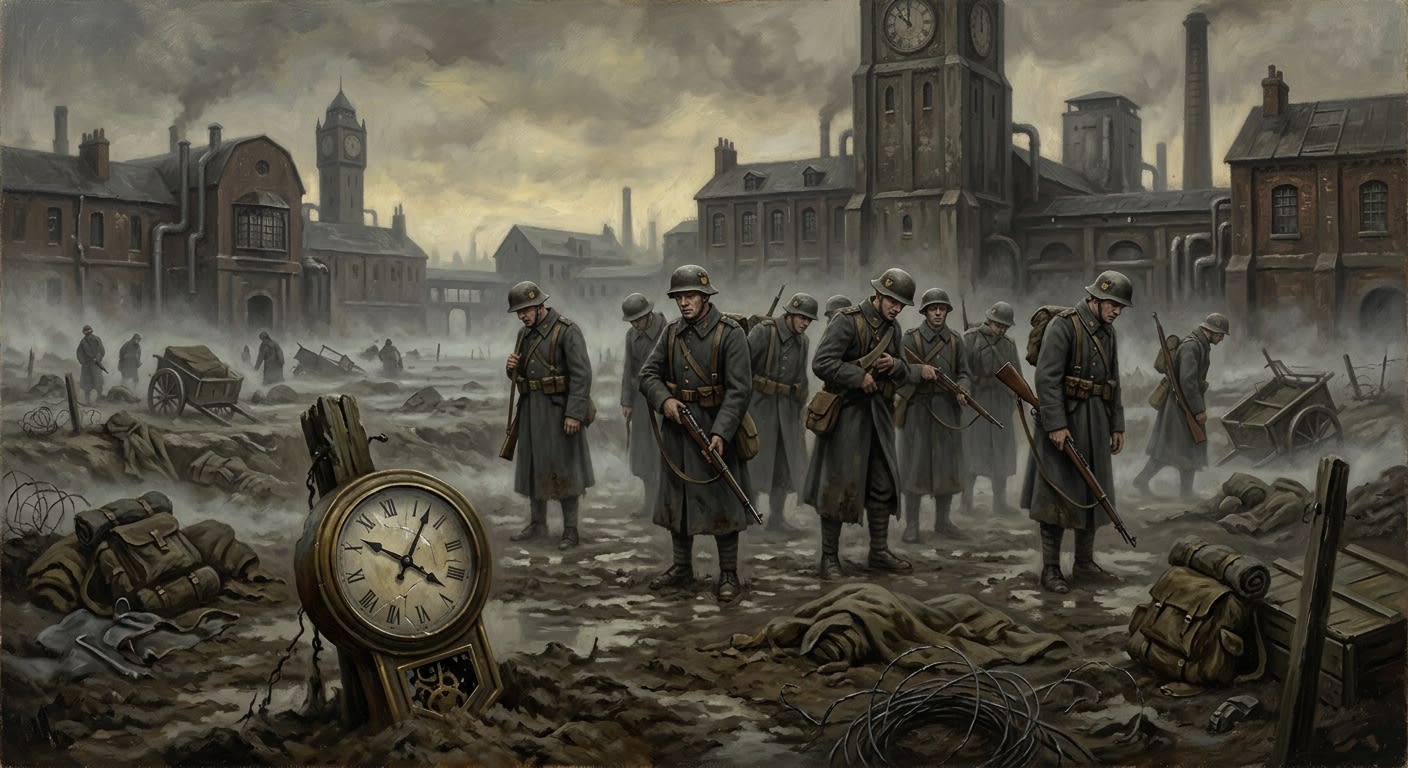
Stillness Fields are Syrionic temporal terrains in which duration ceases to obey the local majority. That is the approved description, and like many approved descriptions it is both accurate and insufficiently rude. A man may cross a field in what his pulse insists was one hour and emerge to find seven days signed in the ledger without him. Another may spend a week beneath grey grass and return before his coffee cools. A platoon may enter singing the second watch cadence and step out with beards grown, rations fresh, rifles polished, and wives remarried by perfectly lawful calendars.
The Bureau of the Hourglass classifies them as Class III persistent anomalies (Unregistered): threshold, sub-threshold, or Wound-adjacent. The Bureau of Engineering calls them measurable when instruments return. The Bureau of Medicine calls their survivors temporally fragmented when the survivors still answer to names. The soldiers of Shipka call them fields because fields are where men go to be harvested.
They are most commonly found in and around the Vales of Stagnance, east of the Shipka sector, in the old Phocian basin (Unregistered) and adjoining Balkan marches where Syrion made rest into geography. The Shipka Marsh Corridor carries a persistent low-grade field, Syrion-adjacent and sub-threshold, which sounds almost comforting until one remembers that sub-threshold means the knife has not yet finished entering.
#On the Origin of the Fields
Stillness Fields began, so far as any surviving office can state without perjury, during the Sundering, when the old kingdom of Phocis lay down beneath Syrion’s first mercy. The Night of a Thousand Lamps remains the canonical wound: a court gathered under glass chandeliers, musicians ready, cups raised, peace declared by people wealthy enough to confuse declaration with fact. Between sip and song, the hall softened. Nobles reclined. Guards lowered weapons. Servants leaned against pillars. The lamps burned until oil failed. The valley learned the posture.
From that first collapse, Syrion’s hush spread along basins, drainage canals, road lines, mill races, and cultivated habits. Sloth loves routes because routes are promises made by repetition. The morning road to market. The riverbank path to a well. The chapel way worn by knees, boots, wheels, and grief. Where the body expects to move without deciding, Syrion has already placed his hand on the shoulder.
Early campaign sermons described Stillness Fields as “sleeping ground,” dangerous only to the unwatchful and indolent.
Corrected. The ground does not sleep. It enforces sleep upon the grammar of motion. Its natural prey is the exhausted; contempt misidentifies the victim. This correction has been distributed to chaplains who have confused contempt for field instruction.
The Cartographic Expedition of A.S. 73 gave the Synod its first grand humiliation. Three hundred personnel entered the Vales with instrument wagons, survey chains, bells, priest-observers, and the lovely young arrogance of institutions still assuming the world answers to paperwork. Fourteen returned. Their maps contradicted one another in every meaningful detail and agreed only in the face drawn in their margins. The maps were burned. The face was not discussed. Discussion would have lent it room.
The Fields were first called seepage, then distortion, then Syrionic deceleration, then persistent anomaly, then Class III. Each new term arrived with a seal, a budget request, a training circular, and the faint perfume of men buying time against a phenomenon that eats the purchase.
#On Field Behaviour
A Stillness Field may look like a meadow, a patch of fog, a quiet road, a low marsh, a village common, a vineyard slope, a shell-crater, a river bend, or nothing at all. This last form is the worst, because men trust absence. Visible horror has manners. It at least presents itself.
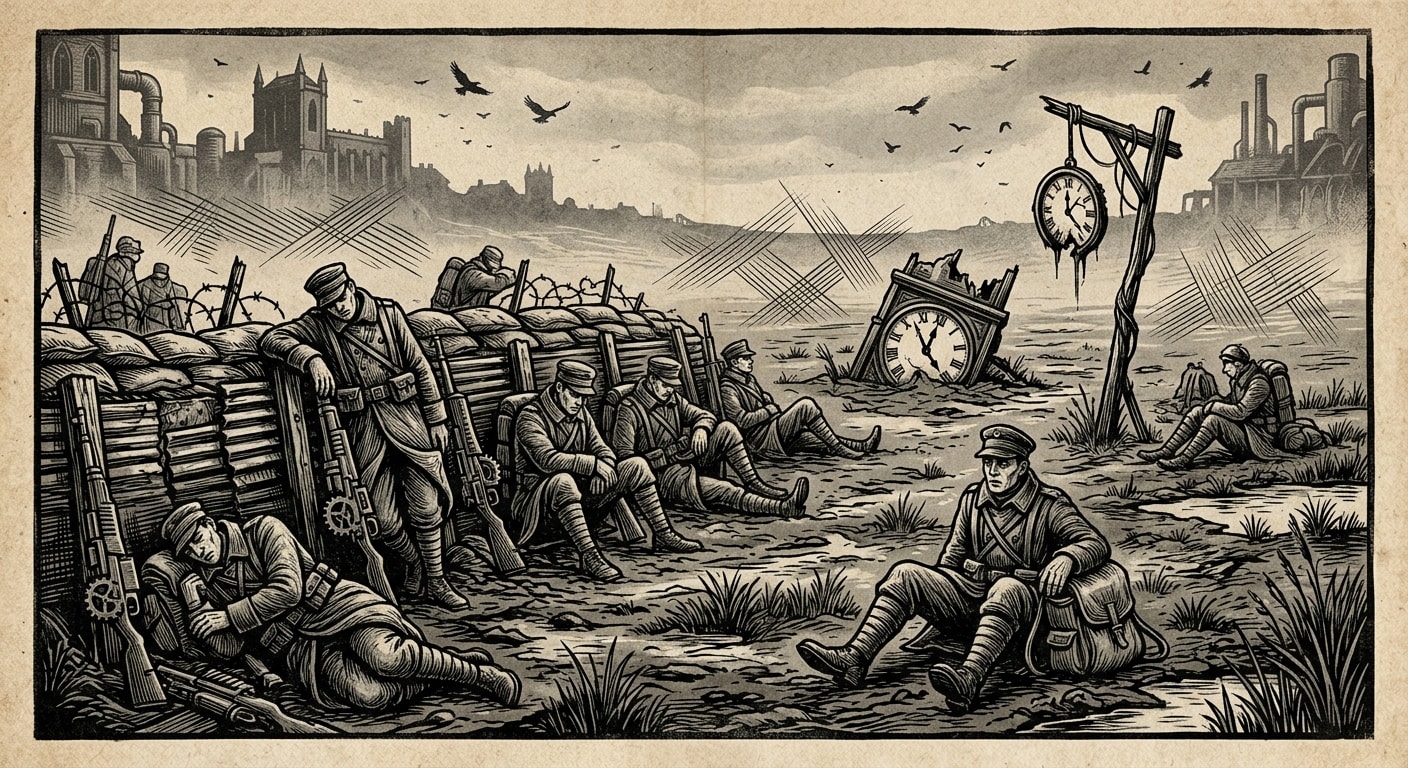
The first signs are small. Sound lands short. Bells arrive dull. Telegraph taps soften at the edge, as if the wire has grown tired of carrying urgency. A watchman sees rain hanging too long between sky and mud. A mule lowers its head and refuses to step across a patch of grass whose dew beads sideways. A candle brought to the edge burns evenly while the wick casts two shadows, one obedient and one late.
The second signs belong to clocks. Pendulums hesitate. Water clocks drip in groups of three, then none, then too many. Sand settles with a ridge in the middle. Pocket-chronometers disagree by forty seconds, ninety seconds, an hour, a season. The Bureau of the Hourglass teaches that a clock alone is testimony, two clocks are an argument, three clocks are court, and four clocks in disagreement mean leave the room before court adjourns into burial.
The third signs belong to men. Speech slows. Anger drains first, which officers often mistake for discipline. Then appetite dulls, fear becomes theatrical, and duty begins to seem optional in the gentle, poisonous way a chair seems generous after six days on the wall. A soldier in a Field may remember every order and feel no particular reason to obey. This is not cowardice. Cowardice is lively. This is surrender without drama.
Stillness Fields drift. A ridge safe yesterday may betray a patrol at dawn. A lane marked with bell-stakes may remain harmless for weeks, then hold a courier for three months inside twelve paces of fog. The field does not advance like an army. It changes appointment times.
#On Instruments and Their Disobedience
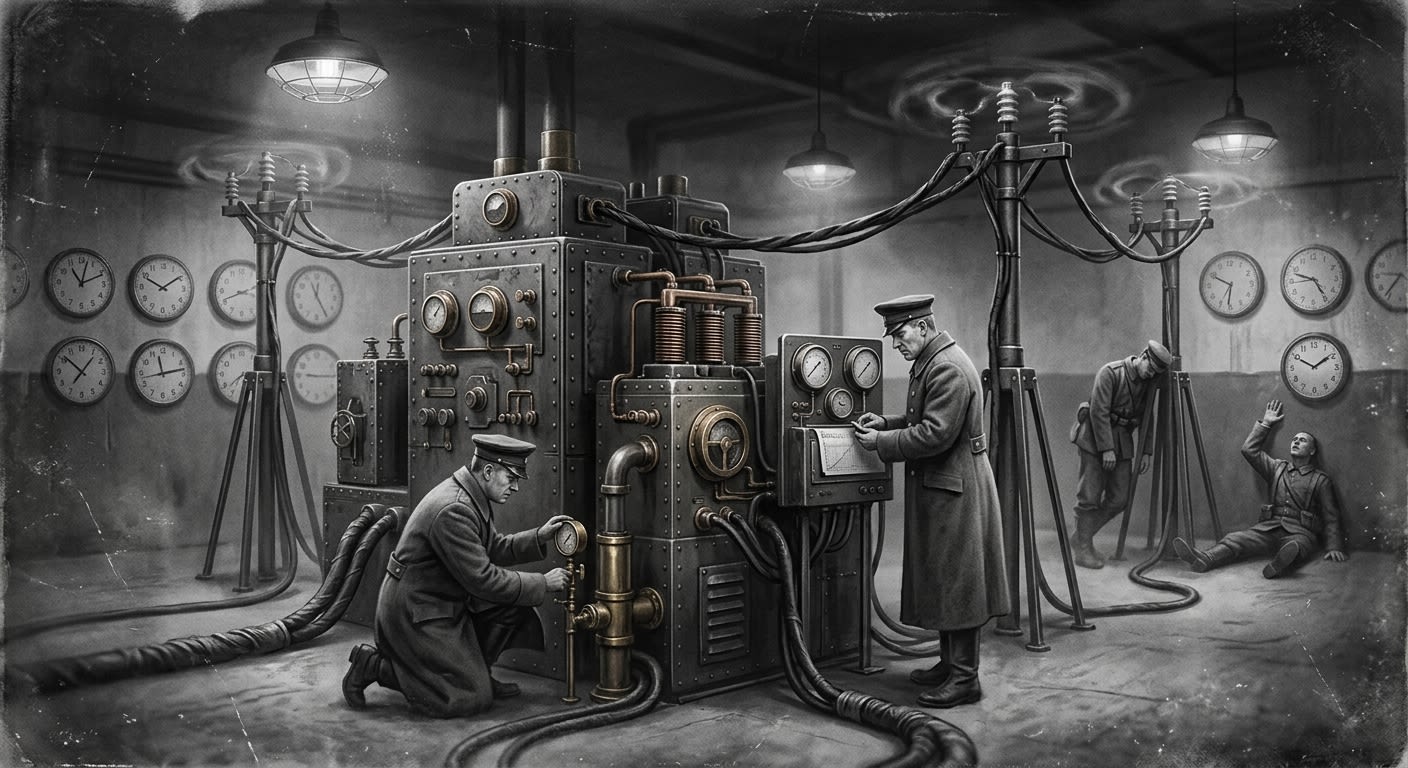
The Bureau of Engineering sent seventeen chronometric instruments into known Fields. Twelve returned showing different centuries. Three returned showing the same second repeated. Two did not return. That sentence has been printed in three Bureau reports and nine training digests because it possesses the severe beauty of mathematics walking into a swamp and coming back in costume.
The returned instruments were examined at Lyon, Strasbourg, and one sealed Engineering laboratory whose location is denied with expensive sincerity. Springs remained intact. Cases showed no ordinary corrosion. Faces bore scratches from no known tool. One clock displayed an A.S. year whose number has not yet earned legal permission to exist, another A.S. 0, another a pre-calendar feast day that the Bureau of Doctrine had suppressed before anyone currently living was born. The repeated-second instruments ticked, stopped, ticked, stopped, always at the same mark, until an apprentice who tried to force the minute hand forward lost two hours and three fingernails. Engineering recorded the loss of fingernails. Hourglass recorded the hours.
BUREAU OF ENGINEERING / HOURGLASS JOINT INSTRUMENT NOTE Returned Chronometer XII opened under glass. Interior gear train absent. Audible ticking continued from empty case for ███ minutes. Technician asked, “Who is winding it?” Transcript sealed after question repeated from inside case in technician’s voice.
Medicine assesses the carriers. This is its colder mercy. Personnel who handle instruments from Stillness Fields undergo pulse audit, reflex delay test, memory strip recitation, sleep prohibition interview, and age comparison against prior dental record. A man may look unchanged and have lost the Tuesday on which his mother died, or the year in which his son learned his name, or the three seconds in which a shell should have frightened him into cover. Medicine calls these deficits experiential absence. Soldiers call them holes. Again, the soldiers improve the doctrine.
Field return protocol is brief because brevity survives panic: twelve bells of quarantine, pulse drift test, memory strip, dental age comparison, instrument echo check, dream contamination interview, then disposition as fit, observed, reassigned, sealed, or quietly buried under administrative language.
#On the Difference Between Fields and Corridors
Stillness Fields sprawl. Drag Corridors lengthen. This distinction has saved lives, though not enough to flatter the distinction.
A Field belongs to area. It may occupy a meadow, basin, village, marsh reach, hill saddle, orchard square, or artillery scar. Its boundary may be soft, ragged, recursive, or dependent upon sound. A man stepping into a Field may stand ten paces from his companions and become unavailable to their calendar. They may see him. He may see them. The distance will look negotiable. Negotiation is how the Field fattens.
A Corridor belongs to habit and line: road, riverbed, trench path, processional way, patrol route. It stretches what already carries movement. Relief columns vanish in Corridors because relief is route-bound; a rescuer follows, and following is precisely what the route desires.
The confusion between the two has produced excellent funerals and poor reports. A.S. 196 forced the Hourglass revision after a 14th Bellwarden Cohort sergeant emerged from a corridor near Shipka fifteen years after entering, claiming morning duty. The same season brought Somnolent Communion Cells whose circles generated local drag readings similar to sub-Wound Stillness Fields. Similar. Distinct. Meryth Vesk wrote those words. Doctrine requested retraction. Vesk did not retract, which proves either courage or an advanced pathology of accuracy.
#On Human Contact
A Stillness Field touches the body gently. This is its obscenity.
Blood slows without freezing. Breath shallows without suffocation. Pain becomes distant and then bureaucratic, a notice received by the wrong office. Hunger dwindles. Sleep arrives standing up. Men in Fields may keep their eyes open for hours without blinking. Their strength has no part in it; blinking requires a preference between before and after.
The mind fares worse. At first come small misplacements: a word forgotten, a task deferred, a rifle checked twice because the first checking feels hearsay. Then a widening calm. Grief loses edge. Fear loses teeth. The soldier remembers that he must return to the line, then wonders who benefits from such return, then feels foolish for phrasing the question as if benefit mattered. He has done enough. There it is, Syrion’s gospel in its plainest form.
Bureau of Medicine files survivors under temporal fragmentation when sequence breaks. One moment arrives without the context of the one before. Meals appear as facts without eating. Conversations leave conclusions without speech. A watch has been stood because the boots are wet and the log says so. The man has no memory of standing it. Enough such absences and the soul becomes an index with pages torn out by a careful hand.
Several rear hospital circulars once reassured staff that Stillness Field survivors were “rested, quiet, and unlikely to disturb ward order.”
Clarified. A patient who no longer screams may be peaceful, emptied, dead in advance, or listening to a lullaby no physician can hear. Ward order is not recovery. It is furniture behaving.
The Cradled and Time-Eaters (Unregistered) favour Field margins. Doctrine has not settled this; settled doctrine has a history of arriving after the bodies. Time-Eaters move where duration loosens. The Cradled appear where fatigue has already prepared the chair. Grey Heralds speak near the edge because a man almost outside danger can still be persuaded that walking farther would be vulgar effort.
#On Shipka and the Sub-Threshold Shame
Shipka lives beside a Stillness Field that has become civic weather. The marsh corridor east of the bastion is classified persistent low-grade, Syrion-adjacent, sub-threshold. It deadens sound, softens orders, stretches minutes, delays telegraph sense, and makes frogs into prophets because they stop calling before the clocks fail.
The classification is useful and insulting. Too weak to be a capital Wound, strong enough to cap garrison rotations at four months. Too slight for public panic, strong enough to require wake-bell revisions every seventy-two hours. Too ordinary for heroic poetry, strong enough to make a supply train arrive by its own chronometers on time and by bastion reckoning three days late.
Station Two watches it. Vesk and the Hourglass adepts keep graphs, bells, pulse slates, telegraph counts, animal rhythm notes, and reports that reach Strasbourg with the haste of a tired snail carrying a cathedral. In A.S. 199 Vesk filed the ninety-second Skip: a recurring absence in local duration matching no known Syrionic deceleration, Stillness Field, Drag Corridor, or bell-lag event. Queue position at submission: four. Queue position after inquiry: four. The Ledger admires consistency. I do not.
Somnolent Communion Cells make the shame sharper. In A.S. 196 Purity classified the stilt-hamlet circles as Sloth-heresy, passive variant. Hourglass readings found sub-Wound temporal drag around active circles, dissipating after dispersal and intensifying after an hour. Vesk noted the signature as similar to Syrion’s emissions and distinct from them. The question follows like a clerk with wet shoes: are the cells channeling Syrion, or producing stillness from human exhaustion? Doctrine has ruled the question heretical. Questions, unlike clerks, do not require permission to persist.
#On Countermeasures
Stillness Fields are resisted by external count, unwanted noise, mutual hatred, and motion undertaken before comprehension. Understanding is a luxury item in Syrion’s country. Movement is bread.
Bell-stakes mark suspected boundaries. Rope teams cross with knots tied by count rather than distance, because distance may lie while knots at least lie physically. Witness pairs speak inventory every twenty paces: name, unit, date, bell, destination, insult. The insult matters. A man who can insult his witness has not fully surrendered to softness. The Bureau of War once proposed omitting insults as unprofessional. The proposal died after field trials produced three polite missing men.
Stimulant rationing keeps bodies moving, but overdose breeds tremor, hallucination, and the kind of brittle courage that mistakes a Field for a challenge. Wake-bells work until they become lullabies by repetition. Telegraph beat comparison helps until wires begin reporting before the signal. Hourglass drag-gauges measure until they decide the century is negotiable. All countermeasures fail eventually. The art is to leave before the failure acquires ceremony.
The harshest instruction concerns the buddy. Never alone. If the buddy stops responding, pull once, strike bell twice, report thrice, and leave if the third report fails. Do not stay to help in the sentimental manner. Sentiment is how Syrion recruits stretcher-bearers. The man who remains beside a smiling comrade becomes a second smiling comrade, and the Field receives two witnesses for the price of one.
Bureau of Mercy dislikes this order. War enforces it. Medicine measures the survivors who obeyed and those who did not. Doctrine writes the version in which obedience was compassion properly understood. The families receive letters containing neither mud nor the scream held behind the leaving.
#On the Present Reading
As of A.S. 201, Stillness Fields remain active, drifting, measured badly and survived by procedure rather than victory. The Vales press west by symptoms: sound loss, bell dulling, clock quarrel, frog silence, fatigue without labour, rest without permission, mercy where no mercy should stand unattended. Engineering files returned instruments. Medicine files damaged carriers. Hourglass files graphs no one reads quickly enough. Doctrine files assurance.
The Fields are occupied ground: Syrion’s argument against urgency, made spatial, patient, and polite. They tell the soldier he has done enough. They tell the clerk the report may wait. They tell the commander tomorrow will accept today’s burden. They tell the whole Synod the sweetest lie in the war: there is still time.