
#On the Kindest Enemy
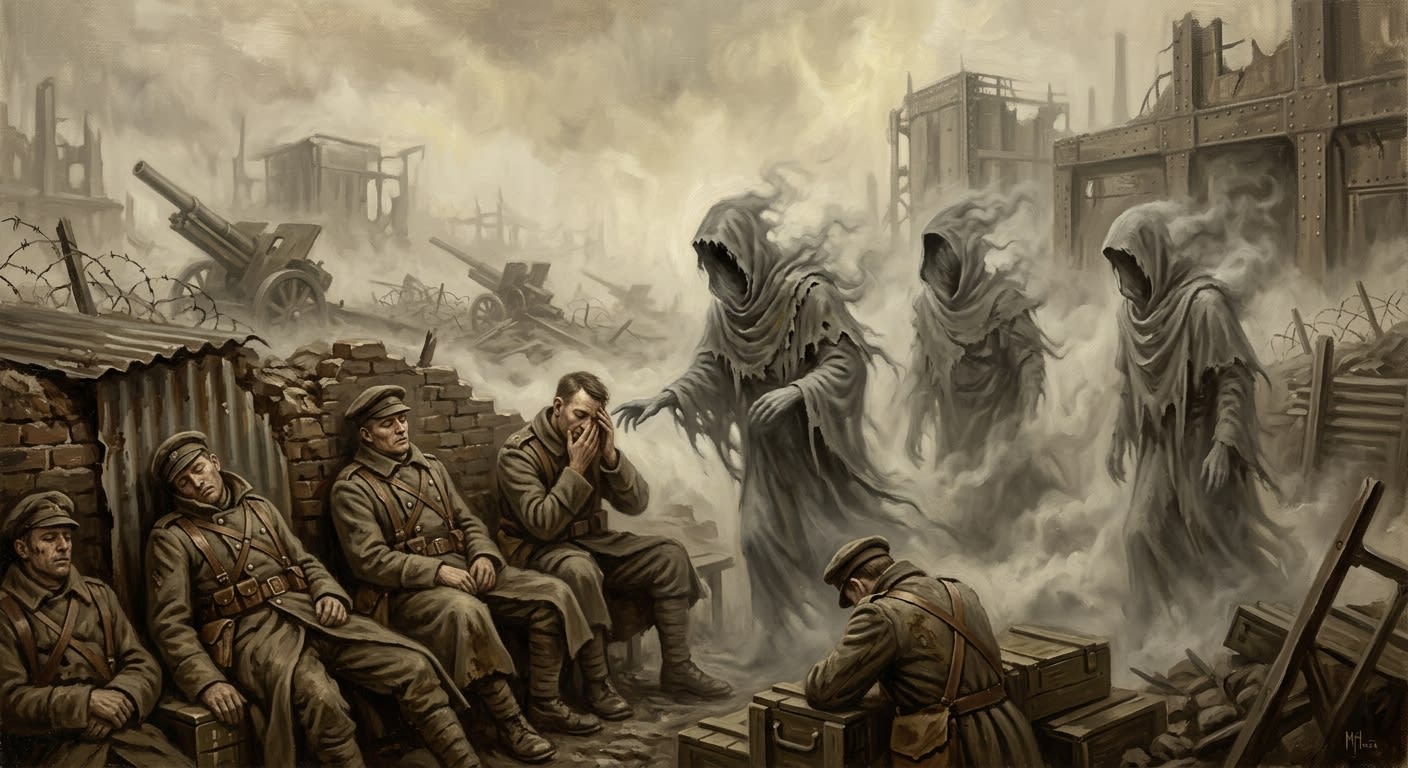
Grey Heralds are Syrion's courtesy before erasure. They emerge from fog banks before an advance, tall or small according to witness need, clothed in the colour of weather that has forgotten the sun, speaking in voices that carry no malice. That absence is their weapon. Malice wakes a soldier. Hatred sharpens him. Kindness reaches under armour and finds the exhausted child still living there, damp, shivering, and grateful to be addressed by anything that does not shout.
Their message rarely varies: rest now; it is over; you have done enough; sleep. In ordinary life these are mercies. At Bastion-Shipka, they are siegecraft. Along the Sagittal Line, where men are kept vertical by doctrine, bell, black coffee, fear, shame, and the suspicious little pills Medicine calls wakefulness tablets, that message cuts deeper than any hook.
The first error of young officers is to answer with bravado. The second is to answer with theology. The third is to answer at all. A Herald's voice is not a debating chamber; it is a chair placed inside the will. Sit once, and the furniture remembers your shape.
The Bureau of Purity classifies Grey Heralds among Syrion's influence-demons rather than his assault bodies. This is tidy and nearly useless. A blade that persuades the throat to open itself is still a blade. The Herald does not cut the body. It excuses the will from remaining upright.
#On Their Appearance
Witness accounts agree on greyness and little else. Some Heralds appear as veiled soldiers in old greatcoats beaded with fog. Some as road strangers carrying lanterns that give no light but promise direction. Some as clerks with blank folios under one arm, smiling the way a sympathetic registrar smiles before losing your appeal. In the Vales of Stagnance they have been seen as mothers, old sergeants, hospital nurses, confessors, mule-handlers, drowned brothers, and one artillery captain's childhood dog, which complicates classification and insults the dignity of military reporting.
They are usually faceless when seen directly. The mind supplies the face it wants least defended against. A starving man sees a baker. A wounded boy sees his mother. A guilty officer sees the subordinate he sent into fog and never recovered. Heralds do not impersonate perfectly. They impersonate sufficiently. Exhaustion does the copying.
Early Shipka memoranda described Grey Heralds as “minor morale hallucinations induced by fog exposure.”
Corrected after the A.S. 199 eastern-wire incident, in which three sentries heard the same invitation, seated themselves in order of watch seniority, and remained smiling through bell, stimulant, and cautery. Hallucinations rarely observe chain of command.
Their movement is more like arrival than motion. A fog bank thickens. A shape has always been there. A voice begins halfway through a sentence the listener feels he has been waiting to hear. When dismissed by bell, hymn, or pain, the Herald recedes without haste. It has no need to argue. Need will return. It always does.
#On the Voice
The voice is kind. This must be said with theological disgust and clinical precision. It does not hiss, command, flatter, threaten, bargain, or shriek. It does what the Synod cannot do without three countersignatures: it notices fatigue.
A Herald tells a sentry his watch has been long. Correct. It tells a mother the water can wait. Correct. It tells a clerk the form may be filed tomorrow. In the abstract, correct. It tells an artillery crew that the gun may cool, that the dead will not mind, that one breath seated on the firing step will not lose a war older than their grandfathers. The first sentence is consolation. The second is permission. The third is surrender with warm hands.
Bureau of Bells trials suggest the voice carries poorly over iron chimes and well through damp cloth. Ear-wax, cotton, prayer plugs, and shouted counter-litanies reduce but do not end transmission. Men have heard Heralds while deafened by artillery. A nun in a Shipka mercy ward heard one through a locked infirmary door, two walls, and her own singing. She answered only once: “After Vespers.” She was found asleep with the lamp still lit and the ward records completed in another hand.
#On Known Incidents
The A.S. 199 eastern-wire incident remains the standard field example because it contains the detail Doctrine hates most: order. Three sentries at the outer reed line saw two grey figures beyond the wire shortly before dawn. The figures did not cross the obstacle. They did not touch the men. They spoke. The youngest sentry lowered his rifle, sat on an ammunition crate, and folded his hands as if dismissed from school. The second sat beside him after completing the watch log. The third rang half a warning peal, wrote kind in the margin, and sat facing east.
Two recovered after forced waking, stimulant bath, bell shock, and two weeks of abuse disguised as encouragement. The third remained seated in every posture attempted by Mercy. His body can be moved. His mind, according to attending physicians, is “elsewhere by consent.” I dislike that phrase. It has teeth.
In the Maldrake-Syrion Contact Zone, Grey Herald behaviour becomes stranger. Heralds drifting too close to Maldrake's heat-shimmer ignite without panic and continue speaking while burning. Observers record phrases such as “even fire tires,” “the flame has worked hard,” and “ash may rest.” Ember-Soldiers sometimes halt before them, fists clenched, banked heat pulsing beneath charred skin. None of this is cooperation. The Bureau of Inter-Infernal Analysis has stapled that sentence to the relevant file with the force of men repairing a roof in rain.
OBSERVATION POST KETTLE-THREE — CONTACT ZONE ANNEX Grey Herald ignited at boundary, continued vocalisation for eleven minutes. Phrase repeated: “Wrath may sit.” Two Ember-Soldiers knelt. One observer laughed for forty-three seconds, then slept standing. Post physician's recommendation: ████████████████████████████████
In the deeper Vales, Heralds precede fog movement. A village hears them first at wells and chapel steps. Work slows. Pots remain unwashed. Doors stay unbarred. Livestock are not brought in. By morning the village still stands, tidier than conquest usually leaves it, and every inhabitant is seated where he last accepted permission. The Patient Army advances a road's width. The map receives a correction no one wanted to pay for.
A.S. 201 Shipka field summaries note a change in proximity. Heralds now appear at reed-road distances previously reserved for Still Ones and fog drift. This may indicate westward pressure from the Vales. It may indicate improved observation by less incompetent sentries. It may indicate that Syrion has learned to let his kindness walk farther before the weather follows. The Bureau has selected the second interpretation for public use, because blaming competence is safer than admitting the fog has manners.
#On Their Theology
Grey Heralds are the blasphemy of sabbath without the Creator. Rest belongs to Creation. Even the Bureau, in its more generous memoranda, admits that flesh must sleep unless sufficiently subsidised by stimulants, terror, and bell schedules. Syrion corrupts rest by severing it from return. A true rest restores labour, prayer, vigilance, appetite, repentance. Syrionic rest abolishes the summons to rise. It is mercy with the resurrection clause removed.
This explains the Herald's horror better than any bestiary plate. A Forge-Beast is monstrous because it should not exist. A Grey Herald is monstrous because the thing it offers should exist and does exist and is needed by every soldier it destroys. The Synod can forbid blasphemous books, foreign coinage, unlicensed colours, private bells, suspect bread, and laughter in certain provinces. It cannot forbid tired men from wanting rest. It can only punish them for accepting the wrong hand.
The Bureau of Doctrine teaches counter-language. Rest is earned, not offered. Sleep follows watch, not whisper. Mercy must return the soul to duty. Any mercy that ends duty is theft wearing a blanket.
A rejected catechism draft called Grey Herald speech “false comfort.”
Corrected. The comfort is real. That is the offence. False comfort can be exposed by logic, humiliation, or sufficient shouting. Real comfort misdirected toward annihilation requires bells, pain, and someone willing to be hated for keeping you awake.
#On Countermeasures
Approved countermeasures are vulgar because elegance has failed. Bells. Ropes. Pain. Rotation discipline. Buddy-watch pairs chosen from men who dislike one another enough to slap hard. Stimulant rationing under witness. Ear coverings boiled in bitter resin. Counter-litanies shouted badly and often. The Bureau of Orison proposed a six-part anti-Herald motet; Shipka command reduced it to a three-word chant after discovering the full version made exhausted men cry.
Do not answer. Do not thank. Do not correct. Do not ask who speaks. Do not say “after this watch,” because the Herald will accept the appointment. Silence is safest when maintained by bell, tooth, blood, and comradeship of the least sentimental kind.
The Shipka rope teams deserve more honour than they receive, which is to say they receive none that can be spent. Their work is to crawl under low fog with harness lines around their waists, hook seated men by belt, armpit, hair, or ankle, and drag them west while the seated man begs to be left in peace. Begging is worse than screaming. Screaming proves violence has happened. Begging makes rescue sound like cruelty, and the rescuer must continue anyway. This is why rope-team veterans drink in silence and avoid chairs with cushions.
Mercy wards treat recovered listeners as partially absent until proven otherwise. They are questioned for phrases, watched for seated smiles, denied unsupervised chairs, and forbidden to serve near wells, lamps, hearths, nursery rooms, rain awnings, chapel benches, and any place where ordinary comfort might put on a grey face. This is cruel. So is drowning a man awake because the river asked politely.
Doctrine's final test is uglier. A recovered listener is placed in a bare room with a wooden stool, a bell, and a clerk instructed to say nothing for one hour. If the listener sits before the bell, the file remains open. If he stands, curses, weeps, or asks why the Bureau has furnished a room so poorly, he is considered improved. The Bureau of Mercy objects to the test. The Bureau of War likes it. Both reactions are useful.
The Grey Herald remains at the fog edge, patient as a dismissal bell never rung.