
#On the Palace That Declines Address
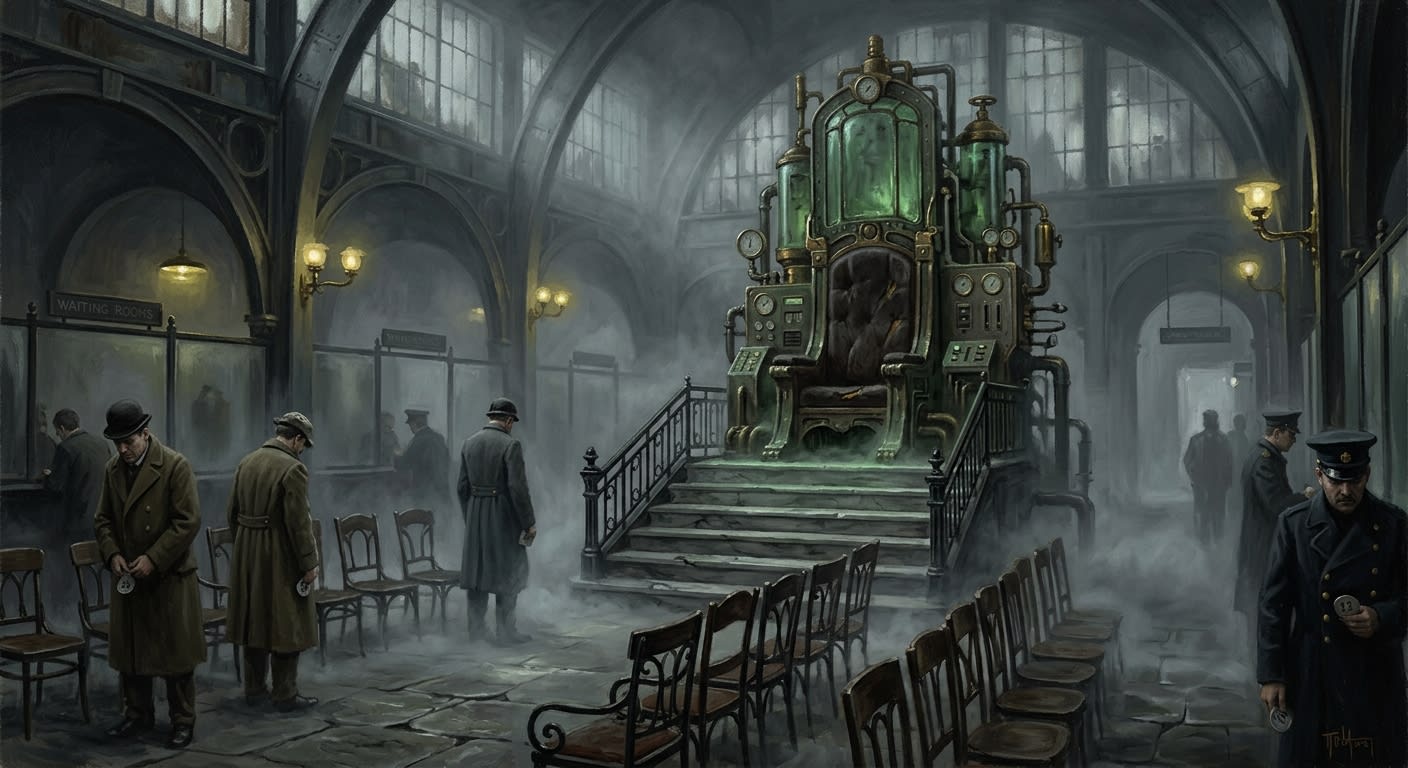
The Throne of Mists is the reputed seat of Syrion, Sin-General of Sloth, located at the ceremonial centre of the Vales of Stagnance, if centre may be applied to a country that treats measurement as a minor vice. It is a palace of clouded glass, fog, arrested sound, uncertain height, contradictory floor, and administrative insolence. The Bureau of Records has received fourteen primary descriptions, thirty-seven secondary rumours, six devotional drawings, one cracked lens-plate, and a surveyor’s hand preserved in a clenched position around empty air. No two agree. All mention waiting.
A fortress may be mapped. A shrine may be approached. A palace may be announced, entered, searched, sealed, inventoried, taxed, insulted, and repaired. The Throne of Mists accepts none of these courtesies. It appears above ridgelines that should hide it, in puddles with no sky to reflect, beyond roads which official maps terminate in quarry pits, and behind travellers who have not yet turned around. It is reached less by movement than by delay.
The Bureau of Doctrine names it Syrion’s seat. The Bureau of War names it a command locus. The Bureau of the Hourglass names it a sustained temporal sink with symbolic exteriorisation. The Bureau of Records names it a problem awaiting a better shelf. Each definition is correct enough to be useless.
#On the Fourteen Witnesses of A.S. 73
The first evidence fit for filing came after the Cartographic Expedition of A.S. 73, that magnificent exercise in institutional confidence by which three hundred men, instrument wagons, bells, priest-observers, survey chains, and enough optimism to choke a mule entered the Vales and returned in the number fourteen. Those fourteen survivors disagreed on distance, route, duration, season, prayer sequence, supply loss, weather, companion names, and whether they had marched at all. They agreed on the Throne.
Even agreement arrived wearing a false beard. One survivor described the structure as a glass palace floating above the Bulgarian highlands, crowned with Art Nouveau spires and tilted as if the sky had poor table manners. Another described a low court half-buried in fog, each wall transparent and each chamber furnished with chairs facing empty desks. A third swore the Throne was the size of a reliquary casket and that he held it in one hand until the hand forgot how to open. A fourth claimed there was no building, only the feeling of standing in a vestibule while a clerk in another room decided whether one existed.
Bureau school plates once reproduced the Throne as a tall glass palace with seven towers and a central seat.
Withdrawn. The seven towers came from one fevered corporal, the central seat from an engraver’s laziness, and the glass from testimony that also placed the same palace inside a boot-print. Children may be lied to for morale. They need not be lied to by bad draughtsmanship.
The famous face in the margins belongs here. Every returned map from A.S. 73 bore the same face drawn near its eastern edge: mild, blank, patient, neither male nor female, with eyes open in the manner of a sleeper who has heard his own name and chosen not to answer. The cartographers denied drawing it. Their hands showed graphite under the nails. The maps were burned. The face appeared on the ash tray after cooling. That tray is now sealed in Strasbourg under a label reading Unhelpful but retained.
#On Its Aspect, Which Refuses Aspect
The Throne of Mists is always described as clouded glass and fog. The rest revolts.
At times it appears vertical: spires thinning into a sky that has lost interest in height, galleries climbing without stairs, balconies full of motionless figures who may be statues, courtiers, prisoners, or postponed decisions. At times it appears horizontal: a long white house of waiting rooms, each door numbered in a script the witness recognises until asked to copy it. One Hourglass observer insisted the Throne had no walls, only interior. A Shipka deserter found asleep beside the Reed Road claimed he saw the Throne as his childhood parish hall, except that every pew faced backward and the altar held a pillow.
The glass is never clear. It clouds like old cataract, milk, breath on a winter pane, paper held over steam. Shapes move behind it too slowly to count as motion. A shadow lifts a hand after the witness has stopped looking. A chandelier swings before the ceiling appears. A chair waits beneath a window, and every account of the chair contains the same detail: it looks comfortable.
No sound issues from the Throne in proper sequence. Bells are heard before they are struck. Footsteps arrive without walkers. Questions are remembered rather than heard. Witnesses report the pressure of a summons, although no voice forms the words. The summons is always polite. The Throne is never crude. It does not command. It expects.
#On Waiting Rooms and Other Infernal Theologies
A throne suggests sovereignty. This is the first error. Mortal minds see seat, crown, dais, court, supplicant, order. Syrion is not a king issuing commands from furniture. He is the command to cease command, the court whose proceedings never begin, the appointment that devours the petitioner by postponement. The Throne of Mists is less palace than process: arrival deferred, audience pending, motion suspended under the courteous authority of a clerk who has gone to lunch for eleven years.
This is why the place wounds bureaucrats with such elegance. The Synod has trained Europe to wait: wait for bell, wait for seal, wait for ration window, wait for absolution, wait for the file to return from a desk whose occupant died in A.S. 162. Syrion takes that discipline and hollows it. The citizen who waits under Synodic law waits because Order will eventually move. The soul before the Throne waits because motion has become embarrassing.
A War Directorate digest classified the Throne as Syrion’s “field headquarters.”
Corrected. Headquarters imply dispatch, response, courier traffic, command pressure, and the unpleasant possibility that a junior officer may ask for clarification. The Throne clarifies nothing. It lets purpose congeal until no order can be lifted from the dish.
The rooms described by witnesses follow no dependable order, yet their moral logic is stable. Vestibules. Benches. Coats hanging from pegs. Ink drying in wells. Windows onto pale courtyards. Corridors with half-open doors. A distant bell. Papers laid in neat stacks, each stack awaiting a signature from someone absent by design. The visitor understands that entering farther would be improper without permission. Permission will arrive. Soon. Sit down.
The sentence is never spoken.
#On Attempts at Approach
No scout has reached the Throne. Several have returned convinced they did.
The A.S. 181 Preserved Village survey (Unregistered) photographed what the team thought was a roofline in fog north of Village #7. The plate developed in Sofia showed a glass arcade directly behind the photographer, although every surviving field note places the team facing east and every member swore nothing stood behind them except a goat shed. The goat shed did not appear in the plate. The photographer later spent four months standing in the darkroom doorway, waiting for someone to ask him in. He breathed. He ate when fed. He did not blink at useful intervals.
A.S. 194 brought the Station Two drag-gauge incident (Unregistered), during which a Shipka relay patrol followed a visible palace light for twelve minutes by officer count, six days by ration count, and forty-one years by the youngest private’s hair. The light retreated at walking pace. The patrol halted when its sergeant ordered everyone to sit while instruments recalibrated. Three men obeyed. Four remained standing because their knees had locked from stimulant abuse. Those four returned. The three seated men are listed as missing, although their voices answered roll call from inside the fog for nine nights.
SEALED FIELD ABSTRACT — REED ROAD / A.S. 194 Recovered audio cylinder contains chair scrape, soft rain, and one unidentified official voice saying: “Your appointment is acknowledged.” Patrol roster marked complete in a hand matching Sergeant █████, who was among the seated missing. Subsequent roll-call responses ceased after Ninth Night. Cylinder now emits breath in cold rooms. Handling restricted.
The Bureau of the Hourglass proposed an anchored approach in A.S. 199: rope teams, irregular bells, prime-count cards, stimulant rotation, witness knives, and a standing order forbidding all seated posture under pain of immediate extraction. The proposal died under inter-bureau review, which is one of the few forms of death Syrion appears to admire. War objected to cost. Medicine objected to stimulant dosage. Mercy objected to knives. Records objected to uncertain filing authority for men who returned before departure. Doctrine objected to the phrase “anchored approach,” on grounds that nothing in the target record suggested anchorage.
#On the Chair Within the Fog
The Throne itself — the seat from which the site takes its name — appears in fewer accounts than the palace. This has troubled literal-minded analysts, whose souls are already half in the fog. A throne need not be visible to govern a throne-room. A chair may rule by remaining available.
When described, it is plain. That is the obscenity. No jeweled monstrosity, no infernal dais, no screaming skulls, no red velvet soaked in conquered kings. A high-backed chair of pale wood. A campaign stool beside a dead fire. A desk chair with a clerk’s cushion. A mother’s nursing chair in a kitchen whose windows show snow. A hospital chair pulled beside a bed. Every witness gives the chair a different body and the same promise: sit, and the labour ends.
Syrion’s genius lies in refusing theatrical sin. Maldrake would build a throne from weapons and make the supplicant kneel on embers. Kargath would make it a mouth. Velmora would plate it in gold and charge admission. Syrion offers a chair that suits the exhausted back. He does not need splendour. Splendour wakes people.
The chair is not empty in all reports. Some witnesses saw themselves seated there: older, calmer, patient beyond fear. Some saw a parent. Some saw a commanding officer who died years earlier. One Bellwarden saw the entire Shipka garrison seated in ranks, helmets in laps, faces peaceful, while wake-bells rang without disturbing them. He bit through his own tongue to remain standing. The Bureau of Medicine praised his discipline and removed three of his teeth to prevent infection. This is what victory looks like near Syrion: blood in the mouth, and a report filed before sleep.
#On Present Doctrine
As of A.S. 201, the Throne of Mists remains unreached, unentered, and unconquered. It exerts influence beyond its supposed site through dreams, misfiled routes, softened commands, Chair Reports (Unregistered), and those small civic hesitations by which a province learns to stop pretending it will resume. Bastion-Shipka maintains standing instruction that any soldier reporting a glass palace is to be kept walking until examined by Medicine, Bells, Hourglass, and a superior officer with a personal grudge. Grudges are useful. Hatred moves.
The Maldrake-Syrion Contact Zone has produced three reflected sightings of the Throne in vitrified frost plates. This is anatomically impossible, architecturally insolent, and strategically unwelcome. Fire learned patience there. Fog acquired manners. If the Throne can appear in the boundary between Wrath and Sloth, then its place is not place. It is condition.
Public doctrine remains simple because soldiers deserve orders they can remember while afraid: do not pursue palace lights; do not wait for clerks in fog; do not sit; do not answer familiar voices; do not accept comfort without witness; do not trust rooms that appear to have been expecting you. The private Doctrine addendum is shorter and less kind: the Throne is the shape taken by surrender when surrender learns architecture.