
#On the Country and the Passage
Compiled in A.S. 201 from the registry's current assignment for the southern theatre and from this Codex's standing entries on Syrion and Velmora. No expedition was sent to produce it. The Bureau considered sending one and decided to keep the men.
"The Bulgarian highlands" is a phrase of the Bureau of War. Like most of that Bureau's phrases, it names a problem and leaves the place undefined. It covers the high, folded country of old Bulgaria beyond the Balkan range, south of the ground the Church can still see from its walls. The registry assigns it to the theatre of Syrion, Sin-General of Sloth, together with the range itself and the Aegean approaches. The registry gives no perimeter. I asked for one and was sent a pencil.
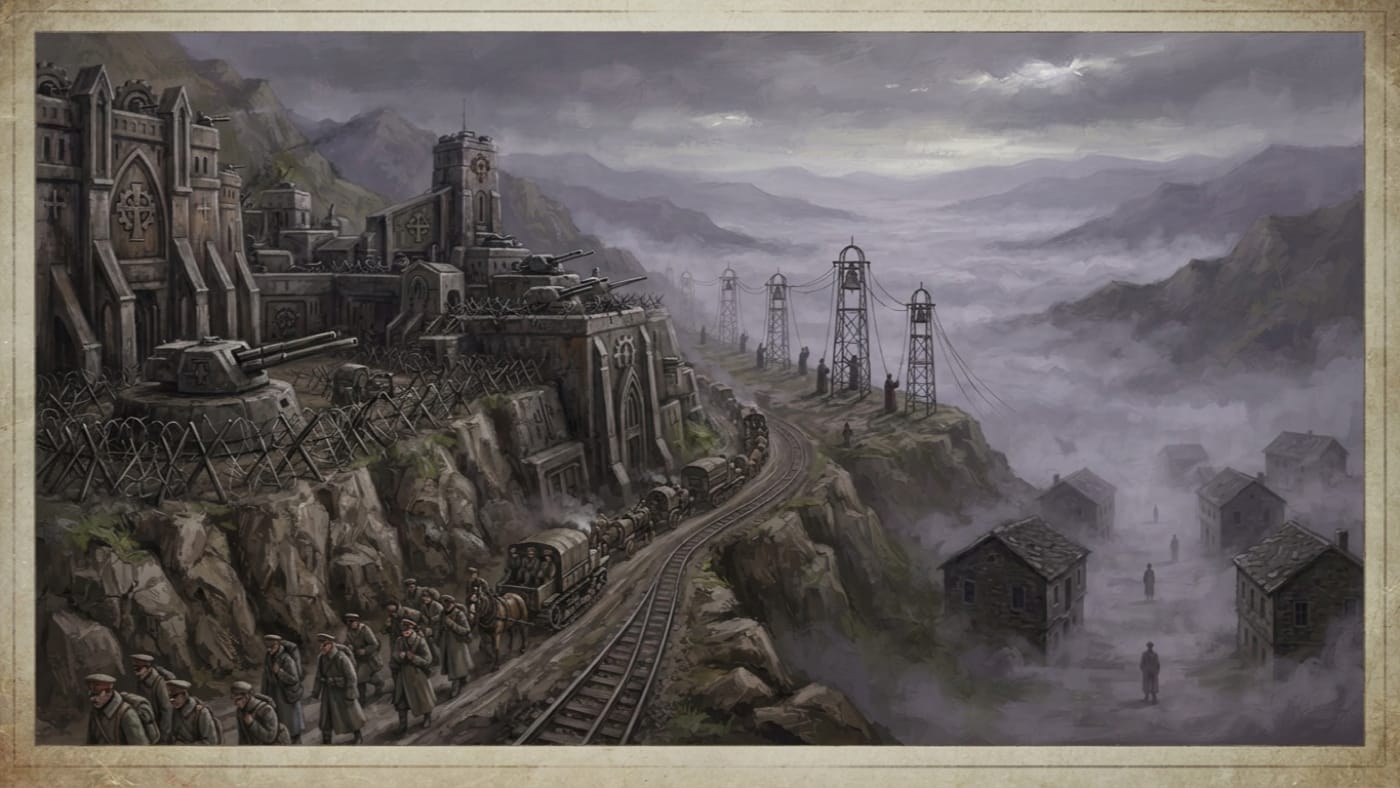
What the Church holds in this country is a door. Bastion-Shipka sits in the Shipka Pass. Counting south from Königsberg, it is the sixth bastion on the Sagittal Line and the last mountain bottleneck before the southern approach. The registry calls the pass the single viable military route from the Danube lowlands through the range toward Thrace and Constantinople. Shepherds know other crossings. A shepherd does not have to move a battery of field guns, forty wagons of shell and a hospital train in the same week, so the registry does not count his opinion.
Behind the pass lies Sofia, the southern supply centre between Irongate and Shipka. Everything bound for the highlands is weighed there, signed for and resented. South of the pass the highlands begin. The Church's certainty ends some way past that, at a point no two officers place in the same valley.
#On the Fog's Occupation
The fog came after the Sundering of A.S. 45, and it did not come all at once. The Eastern Silence of A.S. 38 was a separate omen and does not belong under this heading. I have returned three manuscripts this year for filing it here. No register dates the loss of any particular highland valley to the Sundering itself. The occupation was a slow process, and most of what records it is mail.
A highland settlement counts as in correspondence for as long as it answers. It answers tithe-letters, conscription notices and requests for the names of its dead. Then one season it answers late, with the right signatures and the wrong date. Then it answers a letter sent the year before. Then it stops. The Bureau of Records keeps such villages on its rolls long after the replies end. Removing a name requires a certificate of loss, a certificate of loss requires a witness, and the witnesses are inside.
The roads behave the same way. A highland road listed as passable in spring may be marked temporally unsafe by summer without a single stone having moved. Rivers keep their banks and lose their courses. A ridge shown as held in one return is grey in the next. The Bureau of War redraws the theatre in pencil every quarter. The Bureau of Tithes has twice asked it to justify the expense of erasers.
Survivors describe Syrion's method as patience. The fog finds exhausted men and offers them an end to effort. Doctrine names this Sloth. A soldier who has heard the Grey Heralds at the wire will tell you it has nothing to do with idleness and everything to do with stopping. The garrisons call what stands behind the fog margins the Patient Army: ranks that do not move. When the fog moves forward, the ranks are found to have moved with it.
This Codex's entry on Syrion lists the Bulgarian highlands among his domain without qualification, as though the whole region were a single fallen province.
The registry assigns the highlands to Syrion's theatre. It does not certify that every ridge in them has fallen. The held ground around Shipka, the contested approaches and the occupied depth are three separate jurisdictions. The fog frontier is something reported, and it has never been a boundary.
#On Roads and Lost Time
Three hazards govern movement in the occupied country. Every relief officer in the southern theatre must be able to name them before he is issued a map.
Stillness Fields change how much time passes, and they follow no pattern. A party may cross one in what it counts as an hour and come out to find a week gone. Another may labour through what feels like days and step out a minute after it went in. The fields also drift. A meadow certified clean one quarter has been found occupied the next.
Drag Corridors are long and narrow. With dreadful courtesy, they keep to old roads and riverbeds, which in mountain country are the only places a column can march. Columns go in. Relief is sent after them and finds only fog. Sometimes, much later by the bastion clock, men walk out certain they set off that morning. How much they have aged agrees neither with the calendar nor with each other.
Preserved Villages are the third hazard. Survey reports describe houses with tables laid and fires in the hearths. Sometimes inhabitants stand in the lanes, breathing, eyes open, beyond the reach of voice or hand. The Bureau of Doctrine has debated for generations whether they know they are being looked at. Watching them has not settled the question, and I will not settle it from a desk.
The one expedition that tried to measure Syrion's deeper country did not do it here. The Cartographic Expedition of A.S. 73 took three hundred men into the Vales of Stagnance. Fourteen came back, carrying maps that agreed on nothing. The rest are carried on the rolls as unreturned. I have seen a later summary describe them as killed. I sent it back to the clerk who wrote it and asked him to name his witness.
The highlands are one province of a wider theatre that no surveyor has seen whole. Somewhere in that wider country the reports place the Throne of Mists. They disagree about its height, its shape, and whether it is fixed anywhere at all. Nobody in the highlands claims to have seen it. I consider this the most reliable observation the region has produced.
#On the Other Hosts
Syrion is not the only power with business in the highlands. This Codex's entry on Velmora records that her host and Maldrake's aligned once in recorded history, when the terrain forced them to share a road through the Bulgarian highlands, and that the road was worse for the sharing. The record names no road, season, commander or cost, and I will not supply them. Wrath resents waiting, Greed resents spending, and the fog charged them both. One shared march does not make an alliance. The Bureau of Inter-Infernal Analysis has been asked, in writing, to stop calling it a precedent.
Velmora's own front lies elsewhere. Bastion-Sibiu stands against her, and her registered domain is Moldavia, Wallachia and the Transylvanian highlands. Her commerce reaches deep into the Balkans, but marching through these mountains did not make them hers.
Maldrake is nearer. His Thracian furnace country meets the fog in the Balkan foothills. Garrisons there report sudden changes of temperature and of duration, and rain that falls upward and burns. The Contact Zone is hostile on both sides. Officers who describe the feud as protection for the Church are invited to go and stand in it.
#On the Held Edge
Passage is kept open by labour. The labourers' names appear on duty rosters even where no hymn mentions them.
Relief columns climb to Shipka under escort. They come down carrying men who are asked to state the date aloud at every station. The Bureau of Bells staffs the pass more heavily than any other position on the Line. Its ringers keep the wake-bell sequences deliberately irregular and change them often. The ringers themselves are relieved before the sequences start to sound pleasant, and the Syrion dossier records an advisory to that effect from A.S. 198. Linemen walk the telegraph in pairs and log every delay against the bastion clock. A slow signal is the first sign that the fog has reached the wire.
East of the bastion, the marsh approaches are a different country from the highlands and must not be mistaken for them. There the Reed Road carries rail on a raised embankment between reed channels and black pools. Pump crews keep the water off the sleepers. The culverts are numbered and inspected on rounds that the engineers recite like litanies. Marker posts along the top of the embankment chime in sequence, so ladder crews can confirm their position when the reeds close in. The people of the stilt hamlets fish the channels, cut reed, keep pigs and pay their tithes. They also know where an engineer caught by fog can find a dry floor that appears on no map. The bastion's officers do not ask, and their reports are tidier for it.
Against the fog itself, the Church issues countermeasures, and each one works for a while. Soldiers recite anchor litanies while touching boots, belt, watch and tongue. They count primes. They take stimulants that the Bureau of Medicine calls preferable to the alternative. They keep moving, and when one must rest, someone near him moves instead. No one goes alone. The Synod's confidence in these measures is published. Their effect is partial, and the men who use them know this better than the men who publish them.
The Syrion dossier also records that Shipka was expanded in A.S. 190, after the fog shifted westward by a distance the Bureau of Engineering measured as eleven miles or possibly eleven years. The instruments disagreed, and the masons built anyway.
#On the Present Condition
As of A.S. 201, the Bulgarian highlands remain within Syrion's theatre. The Church holds the pass, the road, the marsh embankment, and as much of the near slopes as a sentry can see and a bell can reach. Settlements beyond that are carried on the rolls in pencil. Convoys cross under escort. Men come home and are told the date.