
#On the Collection
"That which bears a false seal bears a sentence." — Archon Casselius of Mainz, A.S. 194
The Bureau of Masks and Seals reported eight thousand nine hundred and seventeen confiscated items in its survey of A.S. 201. Read the unit with care. An item is one counterfeit seal, one forged stamp or one fraudulent impression in wax. A forger caught with six false dies adds six to the total. A cabal of forty that shares one bad stamp adds one. The Bureau counts only what it can hold in its hand.
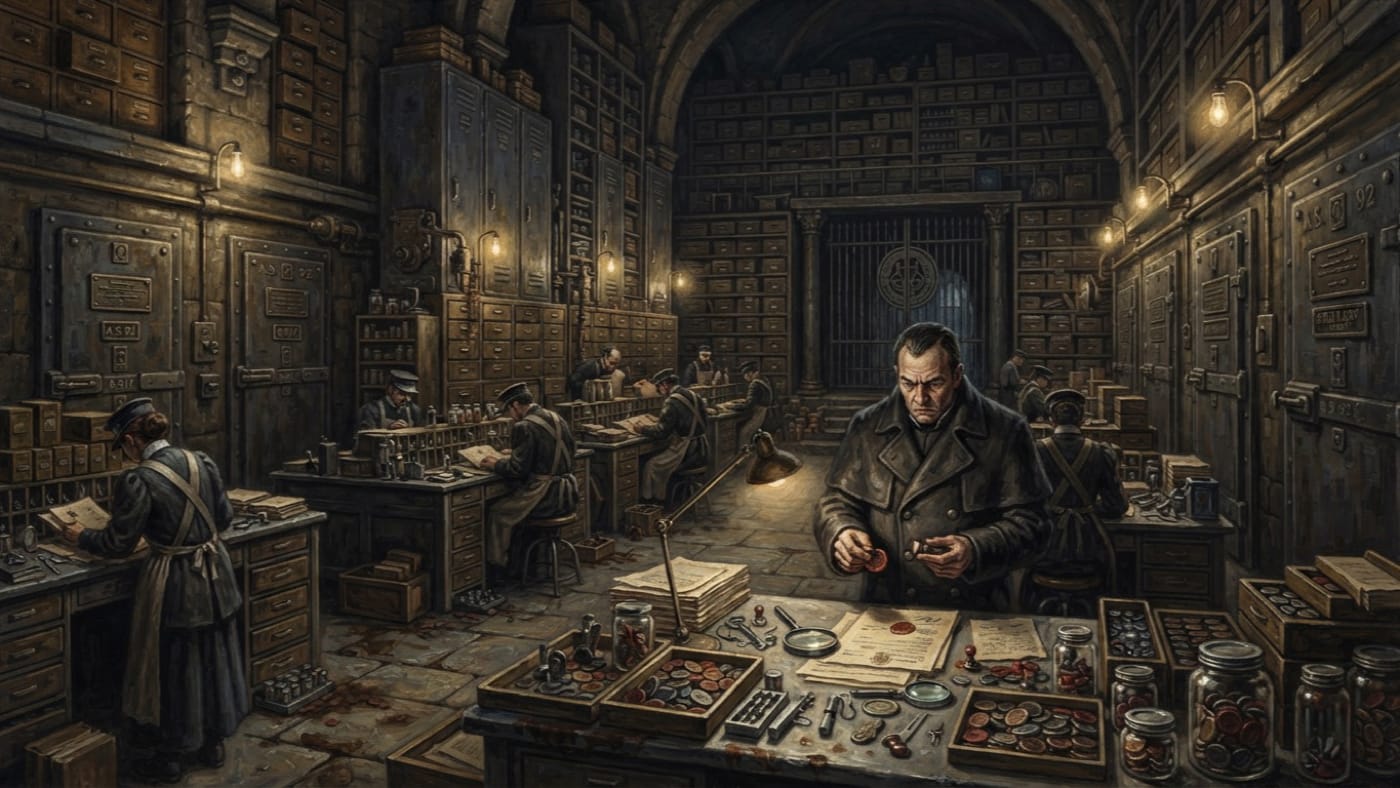
It holds them in an entire wing of the Sigillary's sub-basement. The Sigillary runs three levels down beneath the eastern cloister of Strasbourg Cathedral. Its die-cutters work there by tallow light, because oil lamps are forbidden near the wax stores. The wing is sealed. Its catalogue claims every counterfeit seal, stamp and impression confiscated since A.S. 92, the year of the Bureau's Founding Instruments. That claim belongs to the catalogue, and I let it stand. A catalogue cannot list what was never seized, and nobody counts the forgeries that were never caught.
An institution whose whole authority rests on a monopoly of the impression has kept nearly nine thousand proofs that other people can make the impression too. The die-cutters see nothing odd in this. If you melt a counterfeit, the next inspector has nothing to compare against. If you keep it, the forger has lent you his hand for good.
#On the Impression and Its Authority
To know what a forgery steals, you have to know what a seal gives.
Under the law of the Synod, no Bureau may make its own documents operative. The issuing Bureau presses its seal, and its seal makes the document a proposal. The document becomes binding only when the Bureau of Masks and Seals adds the counter-seal, a second impression. Standing Order 22-A treats any document presented without a valid counter-seal as UNSIGNED. Unsigned paper has the legal force of blank paper. Blank paper, says the same order, belongs to the Bureau of Records and should be sent back to it.
This is law and doctrine. Physics is not consulted. An unsigned requisition looks exactly like a signed one, and the grain it orders weighs the same. The difference lies in what a tribunal may do with it afterwards, and that difference has hanged men.
The Forgery Archive turns this order inside out with a precision I admire. Each confiscated counterfeit is entered as evidence. The record certifies that this wax was seized at this place, in this year, from these hands. The entry authenticates the object as a true exhibit of a false thing, and gives the false impression no authority whatever. A forged counter-seal in the archive is itself counter-sealed. The Bureau has stamped the forgery as a genuine forgery.
So the Synod's monopoly of truth includes a monopoly of certified lies. Nobody else is allowed to issue those either.
#On the Queue Road Specimen
At the cheap end of the collection lies the specimen every clerk mentions first. It is a carved potato pressed into candle-tallow, recovered at a checkpoint on the Queue Road in A.S. 140.
The record names no maker and gives no sentence. It does not say which permit, chit or licence the impression was meant to imitate, or what the bearer hoped to get past the gate with it. The catalogue gives a tuber, tallow and a checkpoint.
That is enough. The Queue Road runs on paper. A traveller there is worth exactly as much as their permissions. The road has bred a whole trade of seal-forgers to serve the line of people waiting at each gate. Most of them work in better materials than kitchen produce. Some of them do not. Somebody, somewhere along that road, looked at a vegetable and saw the authority of the Synod in it. They took a blade, cut the vegetable into a seal, and walked up to a man with a pike.
The Bureau keeps the record of that attempt beside its most dangerous forgeries. Both are impressions it did not make, so both are filed. The archive does not grade the faithless by craftsmanship.
#On the Cologne Counter-Seals
In A.S. 195 a forger in Cologne, whose name the published record omits, produced counter-seals that passed three levels of inspection.
Three levels. At each one a sworn officer held the impression up and compared it against what they knew to be true, and found it true. The forgery got through every stage built to stop it. A Seal-Walker caught it at last, one of the travelling auditors who arrive without warning and leave nobody glad they came.
The forger had cut nothing wrong. The die was right. The fault was in the wax. The Bureau's wax is made of beeswax, pine resin and a mineral pigment, mixed to a formula that is classified. The forger's pine resin was two parts per thousand away from that formula. The record does not say whether he used too much or too little. I do not know the formula, and if I did I would not print it. The Seal-Walker knew it closely enough to tell two parts in a thousand by inspection, which tells you more about the Seal-Walkers than any of their writs do.
The forger was executed. His tools were confiscated. The Bureau of Purity sealed his workshop.
That left his work. Ninety-three documents had passed through the Synod's offices bearing his counter-seals. Under Standing Order 22-A each of them was unsigned and had been all along. The grain had moved, the cargoes had sailed, and the contracts had been honoured on paper that was blank in law. The Bureau could have voided them and pulled every transaction apart back to the first false impression. It issued Retroactive Authentication Order 195-C instead. All ninety-three documents were re-stamped with genuine counter-seals and so became what they had always appeared to be.
The Bureau states that none of the ninety-three had any theological or military significance. It describes them as mainly commercial: grain futures, shipping manifests and one marriage certificate.
The marriage was retroactively authenticated. The couple were informed.
I return to that sentence more often than I should. Two people received word from Strasbourg that their marriage had not existed in law until a Bureau officer pressed wax onto it again, and that it was now valid. It had been valid, it turned out, all along. The notice does not say what they did with the information.
ERRATUM — A.S. 195 — Retroactive Authentication Order 195-C
Ninety-three documents bearing counterfeit counter-seals made in Cologne were UNSIGNED under Standing Order 22-A from the date of their false impression. Under Order 195-C each has been re-stamped with a valid counter-seal and is to be treated as authenticated. Every transaction made in reliance on these documents stands. The marriage certificate among them is valid. The couple have been informed.
#On Comparison and Correction
The Bureau has been caught short by its own instruments as well as by criminals.
In A.S. 176 the Bureau issued seventeen counter-seal instruments to its Rhine corridor offices. All seventeen had been cut from a master die that deformed during casting. They were genuine Bureau instruments with a flaw in them, and they authenticated documents for two years before a clerk noticed the fault. That was the Counter-Seal Crisis of A.S. 178. Order 178-A authorized correction after the fact. The crisis also produced the Annual Die Audit and the Seal-Walkers who carry it out. Without them, the Cologne wax would still be passing.
Those seventeen were honest failures, and an honest failure is not a forgery. Nothing published places them among the 8,917. The archive also keeps no tally of the Retirement Furnace's 12,443 melted dies, and does not share drawers with the 4,714 dies now in service. The Bureau keeps its honest mistakes in one ledger and other people's crimes in another. That is the only kindness it has ever done itself.
What the archive offers is comparison. When a doubtful impression reaches Strasbourg, the Bureau holds a century of failed forgeries to judge it against. More arrive constantly. The Black Ledger turns out ration-document counter-seals good enough to pass. The Underchords of Bastion-Irongate deal in counterfeit licence stamps. On at least two confirmed occasions the Velvet Choir has produced counter-seals so good that the Bureau suspects someone has access to classified materials. That remains a suspicion. It has proved nothing.
The Bureau passed the suspicion to the Bureau of Purity. Purity responded by placing the Bureau of Masks and Seals itself under routine observation.
#On the Present Custody
The archive belongs to the Bureau of Masks and Seals, and so to Archon Casselius of Mainz. He holds that office and the Bureau of Heraldry together in personal union. Heraldry rules on which images and meanings the Synod may display. Masks and Seals cuts the instruments that make any display, decree or licence binding. The two Bureaus remain separate on the charter. In daily practice they share one pair of hands.
So the man who decides what a symbol may mean also keeps every recorded attempt to counterfeit the proof that a symbol was lawfully used. He has the potato on file, and the Cologne counter-seals that failed by two parts per thousand. He has the Black Ledger's ration stamps, the Underchords' licences and whatever the Velvet Choir lost when its work was seized. Above all of them sits the Bureau's own stamp, certifying each one as false, under the authority of Strasbourg.
The Bureau does not publish the archive's contents. It publishes the count.