
#On the Room Where Paper Becomes Law
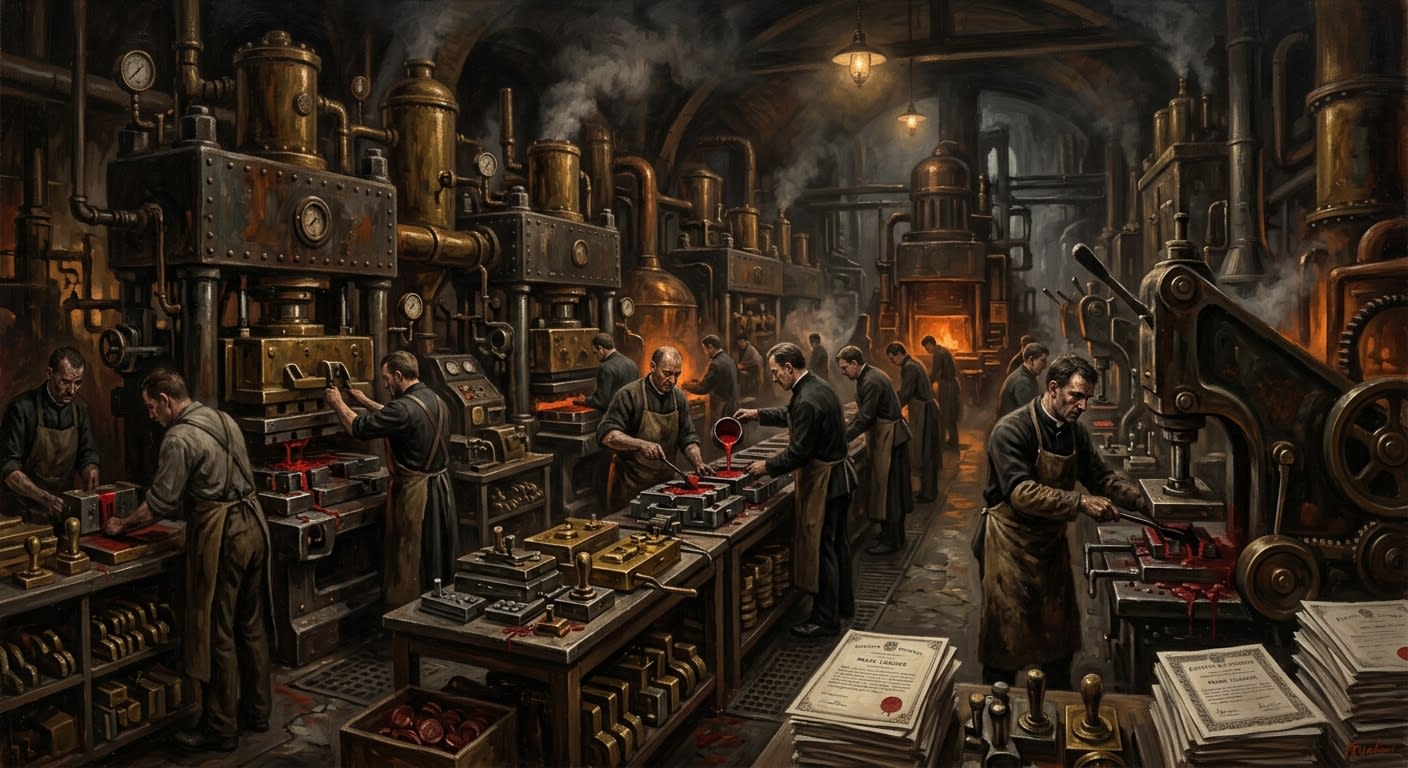
The The Sigillary occupies the eastern descent of Strasbourg Cathedral, three levels beneath the cloister stones, under a run of chapels whose parish guides describe as “quiet.” Parish guides are permitted their little narcotics. Below those devotional tiles lie the workshops, assay rooms, counter-seal vaults, wax kitchens, die benches, retirement furnace, mask-licence registry, and guarded impressions by which the Bureau of Masks and Seals performs its single appalling miracle: it makes paper bite.
A decree may be written by Doctrine, ordered by War, paid for by Tithes, filed by Records, and screamed over by every aggrieved Archon from Mainz to Marseille. Until the Sigillary has impressed its counter-seal, the document remains a dressed corpse awaiting breath. Once wax receives the mark, armies move, marriages bind, property vanishes, pardons live, death warrants open their mouths, and widows learn whether grief has been properly formatted.
The Sigillary is often called a vault. This is imprecise, and imprecision is where civic rot keeps its nursery. A vault stores. The Sigillary manufactures authority, verifies authority, withdraws authority, and melts the tools of dead authority into numbered ingots. It is factory, chapel, court, archive, furnace, and threat, all pressed together under stone until even the walls smell of hot resin and institutional certainty.
#On Its Descent Beneath the Cathedral
The Cathedral climbs so magnificently that the provincial eye is bullied upward. This was intentional. Height makes excellent theatre; depth makes government. The pilgrim sees rose glass, organ ribs, bell mouths, saints with improbable cheekbones, and candle smoke behaving itself under supervision. The initiated man follows the side passage east, passes two unmarked iron screens, descends between walls rubbed smooth by sleeve, oath-book, and nervous palm, and reaches a door whose hinges have been audited more often than some dioceses.
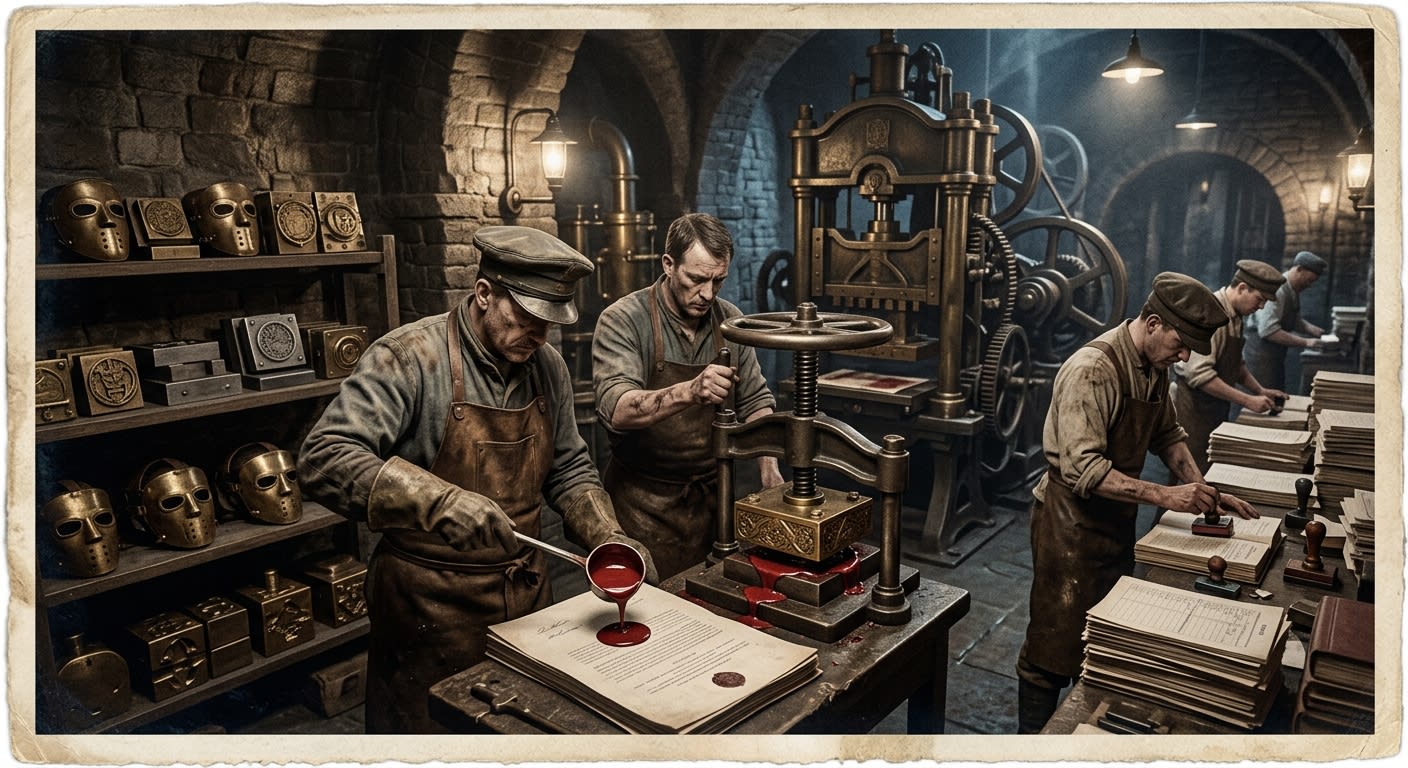
The first level receives petitioned instruments: worn parish seals, cracked tariff stamps, emergency dies from bastion courts, mask forms, reliquary sigil requests, rejected counter-seal plates, and those alarming objects that arrive wrapped in three kinds of cloth with a note reading for senior inspection only. The second level cures wax, stores master reference sheets, and houses the copying desks where impressions are compared under glass. The third level belongs to the die-cutters and the furnaces. Visitors without clearance stop above. Visitors with clearance stop when told. Visitors with curiosity are rarely visitors twice.
Engineering's A.S. 178 survey measured three directions beneath the Cathedral Close and sealed the fourth. The Sigillary abuts that sealed uncertainty without publicly admitting neighbourly relations. Its eastern wall has no doors on the authorised plan. Die-cutters working winter night shift report occasional tapping beyond it, always in sets of two, seven, two. The Bureau records these as expansion stress. Expansion stress has excellent rhythm.
ENGINEERING ADDENDUM — EASTERN SUBSTRUCTURE, A.S. 178 Measured distance from Sigillary Wall E-3 to sealed fourth direction: ███████. Audible response during hammer test: ███████. Wax trays in Room C-11 registered surface tremor without floor tremor. Recommendation: do not hammer again. Disposition: accepted.
#On the Charter and the First Thumb
The Sigillary acquired its present authority after the Concordat of Strasbourg, when the A.S. 92 Founding Instruments granted Masks and Seals custody over official stamps, seals, counter-seals, sigillary dies, reliquary authentication marks, mask licences, public emblem permits, and notarial instruments. The charter's phrasing is dry enough to preserve fish. Its effect was wetter: every Bureau suddenly had to carry its precious orders down into the Cathedral's lower throat and ask another office to make them real.
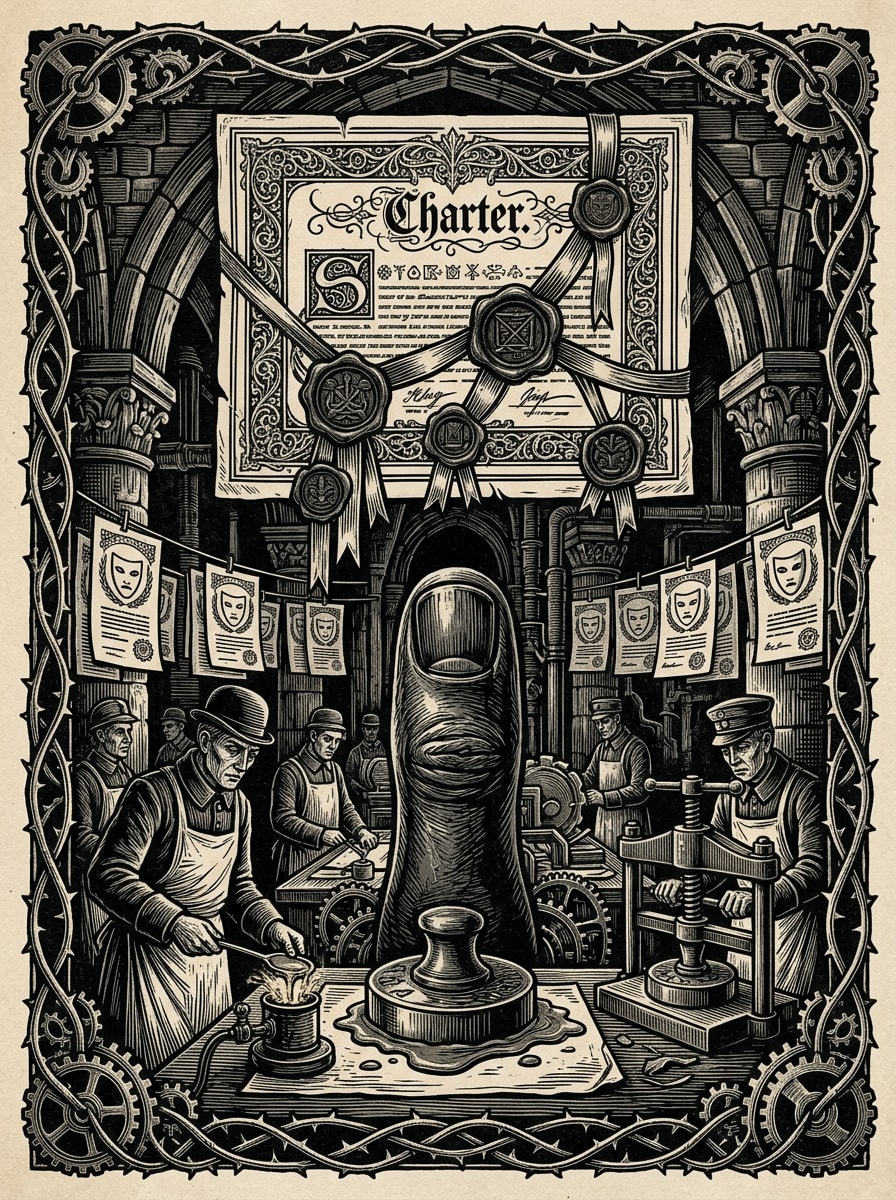
The first Archon, Sigmund of Aachen, had cut coinage dies before the war taught Europe that coins are merely soldiers waiting to become taxes. Sigmund understood the sacred fact that value lives in an impression and that an impression lives by monopoly. His protocol required every newly cut die to be tested first against its maker's thumb. Flesh before wax. Pain before law. The practice persists. The die-cutter presses the trial mark into his own skin, presents the thumb to witness, and writes his name beside the swelling. If a man will not let his own tool wound him, the Bureau will not permit it to wound the public.
Early instructional plates describe the thumb-test as symbolic humility before the Synod.
Corrected. The thumb-test detects burrs, depth errors, edge drag, and cowardice. Humility entered the explanation later, when the Bureau of Rites discovered the procedure and became jealous of anything involving blood and form.
Sigmund died in A.S. 107 from lead, fumes, and devotion measured in occupational residue. His thumb-print remains under glass in the Archive of the Counter-Seal. It authenticates his death certificate. There are jokes one need not improve.
#On the Guild of the Anvil and Stylet
The Sigillary's true inhabitants are the die-cutters of the Guild of the Anvil and Stylet, chartered under Bureau protection since A.S. 105 and exempt from ordinary craft-guild discipline because ordinary craft guilds are full of men who think a tolerable horseshoe prepares them for metaphysics. The die-cutter works in reverse, in miniature, under magnification, within tolerances that make the theologian's quibble look broad-minded. A line too soft creates doubt. A serif too proud creates litigation. A border one-sixteenth of a hair outside master impression may convert three executions into procedural mist.
Their oath begins: I serve the impression. The impression serves the Synod. I do not serve the Synod directly, for intermediaries are the Bureau's theology. Doctrine has objected to this language three times. Masks and Seals counter-sealed the objections and filed them. The objections are valid, inactive, and handsome in their boxes.
The workrooms are lit by tallow, not oil. Oil is too lively near wax stores and too fond of spreading doctrinal reform by flame. The air tastes of beeswax, pine resin, hot metal, mineral pigment, damp wool, old sweat, and the dreadful concentration of men who have spent eight hours improving a curve no citizen will ever see and every citizen may die beneath. Apprentices learn to breathe through cloth, sleep without rolling onto burned fingers, and identify counterfeit wax by shaving it thin enough to read its shame against candle-glow.
Wax-masters hold a different priesthood. They judge heat by touch, viscosity by the fall from spoon to tile, resin ratio by smell, and pigment strength by how colour gathers at the seal's rim. Three wax-masters have died since A.S. 172 in Sigillary incidents officially termed occupational. Occupational death is bureaucracy's most elegant condolence: it says the man mattered, the work continues, and no superior has misplaced his budget.
#On the Counter-Seal Vault and the Archive of False Mouths
At the Sigillary's core lies the Archive of the Counter-Seal. Master impressions sleep there beneath cloth, guard, prayer, lock, wax, and an atmosphere of such refined suspicion that even dust enters under escort. Each active die in the Synod's territories must answer annually to its master sheet. 4,714 active seal-dies by last census. 12,443 retired instruments since A.S. 92, melted and stored as numbered ingots. The retired dies are not forgotten. A dead seal may still have authenticated living obligations, and obligations are the only ghosts the Synod treats with consistent respect.
The Retired Instruments Ledger runs to forty-seven volumes. Casselius of Mainz reads them for pleasure, because Providence creates some men as arguments against leisure. Each entry names the die, office, years active, documents authenticated, retirement cause, melt witness, ingot number, and cross-reference to every instrument derived from it. A seal that served a dissolved office is not erased. It is retired. Erasure would imply the office never acted. Retirement admits the office acted and that the Bureau reserves the right to charge for proving it.
Beside the master archive sits the Forgery Archive, that museum of criminal flattery. 8,917 confiscated items lie in drawers, racks, lead boxes, paper sleeves, and one suspended cage whose contents impressed the wrong surface when shelved flat. The collection ranges from potato stamps and tavern-carved pilgrim marks to the Cologne false counter-seals of A.S. 195, precise enough to pass three inspections until a Seal-Walker found the pine-resin ratio two parts per thousand off formula. The forger died. His tools survive. The Bureau has always preferred instruments to explanations.
Public notices claim the Forgery Archive proves the triumph of Synodal authentication over criminal deceit.
Clarified. The Forgery Archive proves that criminal artisans study us carefully, improve with practice, and occasionally force reforms the Bureau then describes as ancient discipline. Triumph is a word for sermons. Drawers are more honest.
#On Reliquary Sigils, Mask Licences, and the Pig-Bone Panic
The Sigillary's most delicate bench belongs to the Reliquary Sigillators, nine specialists whose tools are consecrated by Rites before use and inspected by Relics afterward, because stamping a bone requires enough supervision to make the dead feel employed. A reliquary sigil must adhere to metal, crystal, bone casing, field casket, trench shrine, travelling chapel box, or emergency finger-tube without cracking under rain, oil, candle heat, rifle shock, or the private resentment of the relic itself.
The A.S. 117 Relic Counterfeit Scandal made this bench rich in work and poor in sleep. Pig-bone entered tariff-chapel calibration caskets, false sanctity entered the scales, and commerce discovered that a fraudulent zero is more dangerous than a fraudulent sermon. After the panic, mandatory relic assay required Sigillary counter-seals. Relics could declare a fragment holy; Masks and Seals made that declaration punishable to doubt. A saint in a casket ceased to be enough. The paper around the saint grew teeth.
Masks form the Sigillary's other great irritation. A mask is forbidden because the face is a confession. A mask is required because festivals, tribunals, interrogators, penitents, Purity, and the officially nonexistent Bureau of Shadows all insist upon hiding faces for excellent and mutually incompatible reasons. The Sigillary resolves theology by licence. Eye-hole width, nose ridge, fabric, pigment, duration, parish, procession, user class, storage method, disposal rite: all specified, stamped, and counter-stamped. Eleven thousand mask applications a year. Fourteen archivists devoted to preventing two white devotional masks in one parish from sharing identical measurements. Holiness is detail with penalties.
#On Errors, Audits, and the A.S. 178 Humiliation
In A.S. 178, seventeen counter-seals distributed to Rhine corridor offices were discovered to have been cut from a master die deformed by a hidden alloy bubble. For two years, every document struck by those instruments had been, under strict reading, unsigned: grain requisitions, tithe assessments, marriages, property seizures, three execution warrants, and a military deployment order that moved two regiments across the Rhineland. The soldiers marched. The dead remained dead. The wax, examined later, cleared its throat.
The Sigillary answered with Retroactive Authentication Order 178-A, dispatched re-stamping teams, and converted two years of legal rot into provisional continuity. This is the Bureau's genius. When reality contradicts the stamp, the Bureau does not abandon the stamp. It issues a second stamp instructing reality to have been obedient all along.
The humiliation gave birth to the Annual Die Audit and to the travelling Seal-Walkers, those beloved minor plagues who arrive without warning carrying callipers, magnification lenses, master sheets, and writs of access bearing the very counter-seal they have come to inspect. They measure parish stamps, gatehouse dies, convoy plates, tariff chapel instruments, relic assay marks, and the pockets of clerks who look too warm. Offices hate them. Hatred is not a defence.
#On Casselius and the Present Condition
As of A.S. 201, the Sigillary labours under Casselius, whose union of Heraldry and Masks and Seals places visual meaning and legal authentication in one pair of bloodless hands. Records calls this irregular but not prohibited. Doctrine calls it convenient. I call it the sort of concentration that would terrify me if I had not already spent my career inside a larger one.
Casselius has tightened retirement logs, reduced decorative licence in parish seals, expanded mask measurements, revised acoustic-mark policy after the Doorbell of Mainz, and instructed the Guild of the Anvil and Stylet that “beauty is permitted only where legibility has finished eating.” His handwriting looks as if denial has become a script. The die-cutters respect him because he notices errors too small for hatred. The wax-masters fear him because he smells overheated resin from farther away than charity allows.
The Sigillary's current condition is active, guarded, overworked, profitable, and spiritually smug. Counter-seal applications approach 340,000 per annum. Mask licences multiply. Relic sigils crack, melt, survive, or arrive pre-authenticated from places that should not know the formula. Forgers improve. Seal-Walkers travel. The Retirement Furnace eats revoked instruments and exhales numbered certainty. Above, pilgrims look up at stained glass and imagine that splendour governs them. Below, the die falls.
The stamp is good. Kneel accordingly.