
#On the Permission to Burn
The Fuel Allowance Tables are the Church's permission to burn. Every boiler on the Line draws by them. So does every locomotive in a rear marshalling yard, and so does every hospital stove with a ward of coughing men gathered round it like penitents round a reliquary. The Tables belong to the Bureau of Engines & Furnaces, so the Bureau decides, in ink, which fires the Synod intends to keep.
A bishop may bless a furnace, a choir may cense it and a pastoral letter may praise it. Without its allowance it is a consecrated iron box full of cold ash.
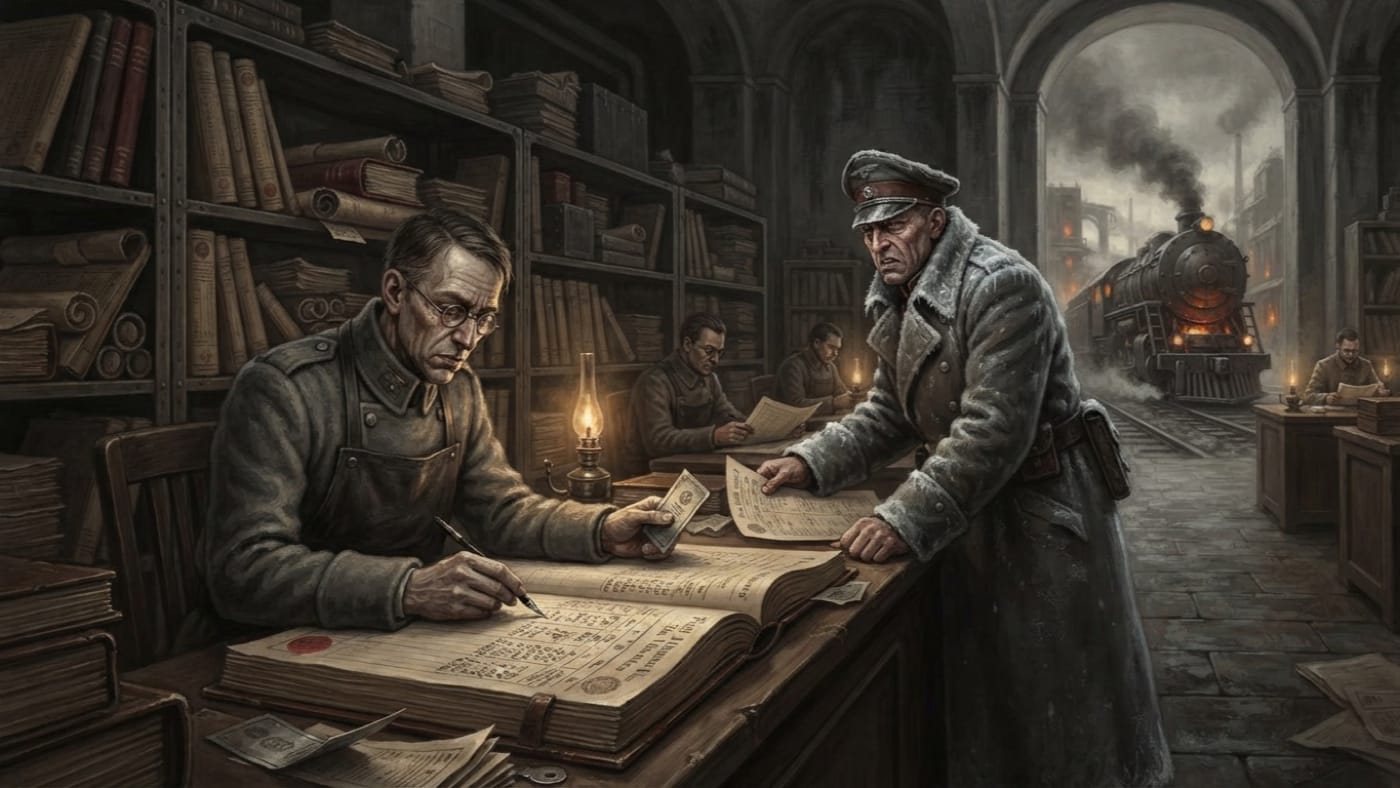
The arrangement is simple to state and miserable to live under. The Bureau of War requests fuel for guns, trains and forward depots. The Bureau of Tithes counts what extraction and purchase have brought in. Engines allocates. The allocation is what a depot clerk reads by a rationed lamp when a sergeant with frostbitten ears pounds on the counter. The clerk has never commanded so much as a latrine detail, and he tells the sergeant to wait.
#On the Portfolio and Its Supply
For decades after the Sundering, fuel went to whoever held the nearest coal shed and the stoutest door. Foundry masters, millwrights and siege artificers worked under temporary writs. Those writs said a great deal about cannon and very little about who should go cold so the cannon could be cast. From about A.S. 50 the provisional council governed by improvisation. Improvisation is a fine principle for a man with a full bunker.
By the Concordat of Strasbourg in A.S. 90 the Synod had settled the Bureau's portfolio, and fuel allowances lay inside it beside manufacture, furnace discipline and heavy apparatus. The Ledger does not tell me when the allowances took the name of Tables, or whose hand ruled their first columns. Records has offered me no first edition, and I will not forge one to tidy a paragraph.
Several provincial primers state that the Fuel Monopoly Acts of A.S. 112 created the Fuel Allowance Tables.
Incorrect. The Fuel Monopoly Acts placed wound-site extraction under licensed Synodal charter. They govern who may draw fuel from the ground. The Tables govern who may burn it. Primers that confuse the two are to be confiscated and used as kindling, subject to allowance.
The Acts matter all the same, because they laid the pipe that feeds the Tables. Tithes sells the extraction rights. Engines coordinates what the industries require and what the sites yield. Every crew carries its permit, its escort assignment and a purity declaration filed before the first drum is tapped. War holds neither the charter nor the allowance. It resents both with the steady heat of an institution convinced that courage should be exempt from paperwork.
#On Allowance and Consumption
The Tables can say that a powerhouse shall receive fuel. They cannot make the fuel arrive honest. Three quantities stand between the entry and the flame: what was allowed, what was delivered and what will actually keep a working installation alive through a night shift. The whole craft of Engines lives in the distance between them.
The Wound-Site Prospector sends up seep-fuel drums, vapour canisters and slag briquettes, each with its seal and its paper. Seals are forged. Purity marks are bought. A drum passed as strong proves weak. A yield reported at one figure stood at another before a charter-holder's clerk improved it. Bureau auditors compare declared yields against what the furnaces consumed. The furnaces cannot write, so they cannot lie, and they frequently disagree with the paperwork.
Then comes the machinery. A boiler with a fouled flue eats its allowance and asks for more. A cracked gasket bleeds pressure until the gauge sulks. The Litany-Engineer turns authorised supply into working apparatus. The Diesel Resonance Plumber lives by allotments, pressure directives and compliance sheets, and knows exactly which repair will cost a district its next week of fuel. An allowance poured through a leaking line is an allowance spent twice.
#On the Places That Receive the Heat
At the Chrismole Furnaces of Brast, kiln-cathedrals distil sanctified fuel for the Line, and the city that makes the heat is billed for it. Rent follows shift tempo and heat allotment. Wages come as coin, ration chits and warm chits, the stamped heat credits that buy a radiator for the night. A family that overdraws falls into heat debt and pays it off in overtime, informant work or confession. Heat-allotment renewals cross the same desks as rail manifests. Brast's own courts, Ordnance officers and Furnace Chapter govern these local instruments. Ask how far a given chit descends from a column in Strasbourg, and Brast's clerks will answer according to who is asking.
Essen-of-Hymnsteel imports its coal and slag fuel. It is governed under a Tri-Bureau Compact shared by Engines & Furnaces, Records, and Orison & Song. Furnace-Marshal Kord controls the slag fuel and the overtime, and in Essen that means controlling the city's pulse. Procurement officers want output. Calibrators want stable furnaces. One morning's allowance cannot satisfy both. Essen's heat credits buy duct-space rights. They are a separate currency from Brast's chits, and a clerk who treats the two as one will learn the difference in a cold room.
At Bastion-Irongate, in the Danube gorge, fuel becomes pressure and pressure becomes the bastion's voice: bell-thumpers, sermon amplifiers, ward harmonics, valves that must open on command. A shortfall there does not mean a cold bedroom. It means a silent line.
#On Discrepancy and Forbidden Supply
Wherever an allowance runs thin, a second economy grows in the gap. In Brast, between the kiln and the railhead, fuel is siphoned, seals are counterfeited and manifests are rewritten. The trades breed their own shortcuts: a filter changed late, a bypass left open past its hour, a compliance sheet signed on the strength of hope. Each of these sins against the Tables. Each also keeps running something the Tables had left to freeze.
Below the shortcuts works the Black Diesel Distiller. When Bureau allotments fail, black diesel moves through hidden pipes into barracks, kitchens and back-room boilers. Its fumes are dangerous and its trade is criminal. Where the alternative is a frozen garrison it is tolerated, by officers who would sooner sign an arrest warrant in spring than a burial list in winter.
War has its own remedy. Emergency bypass teams can shut off a hospital's heat to keep a gun battery firing. No priority schedule I am authorised to quote makes this the rule. It has happened often enough that the Sisters keep blankets folded beside the radiators.
The Furnace Catechist brings a sermon to all this. Doctrine's public text holds that combustion proceeds by divine permission through material instrumentality. A starved boiler therefore becomes a question of permission, and a question of permission becomes a matter for confession. The shortfall is preached as slackness, the shift is disciplined and the allowance stays exactly where it was. The Bureau of Doctrine calls this a theological clarification. The stokers call it weather.
The Tables have never protected anyone from bad fuel. In A.S. 152 a rupture at the Furrow of Pest killed thirty-seven workers and sent three weeks of wrong flame through the southern supply corridor. Every furnace that received that fuel held a correct allowance. The remedy came through the Gasket Hymn Reform, in clamps, pump cadence and hymn, and not through any ruling on who deserved the drums.
The Quiet Basin Incident of A.S. 178 produced the highest yield on record. Seventeen had entered Basin-7. The warm sealed drums came back. So did the tools, cleaned and ordered. I am not cleared to write whether that yield ever stood in a column of the Tables, or what became of the seventeen. The A.S. 189 amendment to the Acts is public. Its reasons are not.
#On Present Application
As of A.S. 201 the Tables govern a war that moves by rail and holds by pressure. The front asks for more. The rear makes more and is told to want less. Each winter the same desks in Strasbourg settle the old quarrel between a gun, a train and a fever ward, and each winter the losing party learns that appeals are heard in spring.
War still believes it commands the fuel because it burns most of it. Tithes believes it owns the fuel because it counted it. Engines holds the pen, and the pen has stayed in a warm hand under every confident general since the Concordat.