
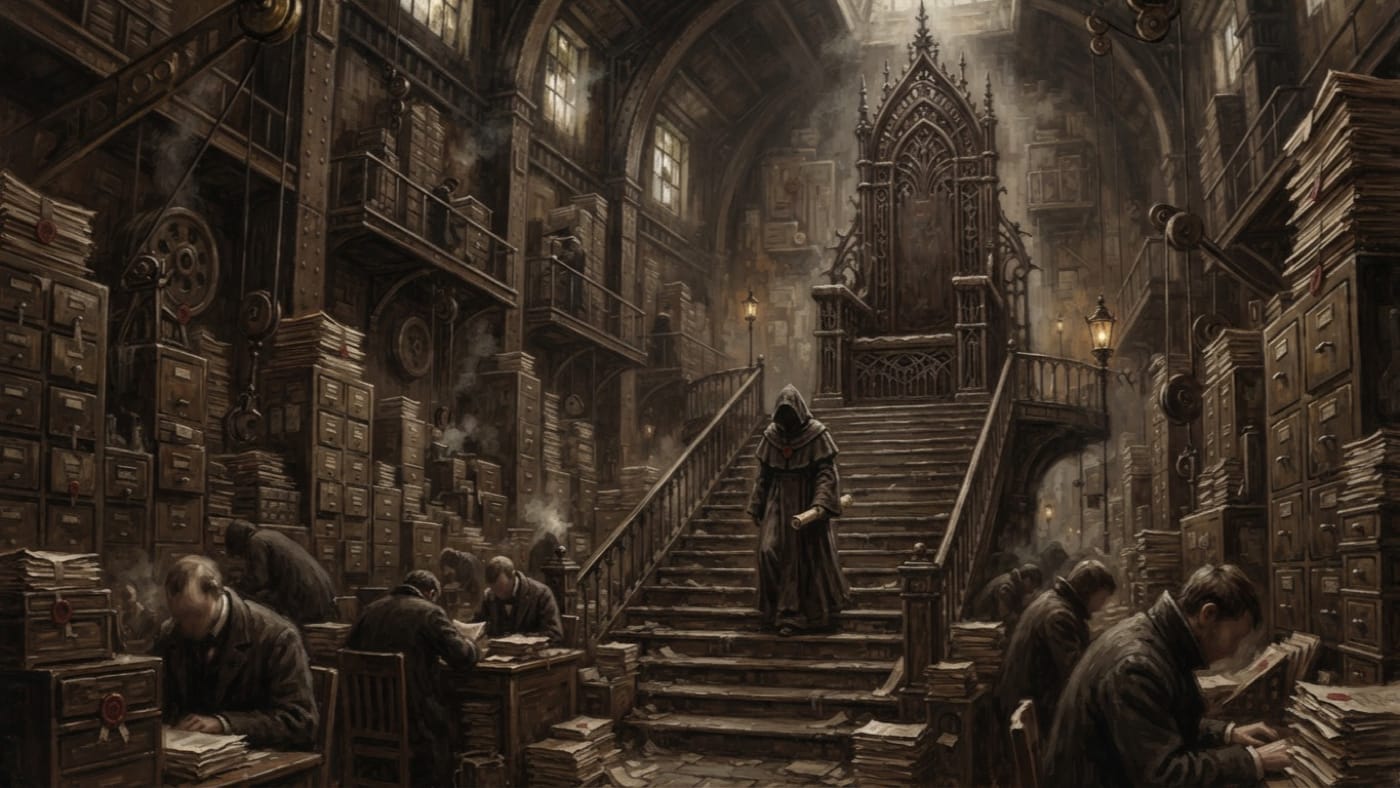
#On the Station of the High Censor
"The Inquisition answers only to the High Censor." — Bureau of Doctrine, standing formula
The title in full is High Censor of Strasbourg, and it crowns every chart of the Inquisition that a clerk has ever been permitted to copy. Below it, in the order the Inquisition professes, come the Grand Inquisitors, the Ordinaries of Severity, the Lictors of Purity and the Penitential Shadows. Each rank sits lower and nearer the ground than the one above it, until the pyramid rests on the condemned. I have drawn that pyramid myself, in red and black, to instruct novices. It is a handsome diagram. It does not show whether anyone at the top gives orders.
An office and its holder are separate articles of property. The office is a title, a precedence and a form of words that other forms of words defer to. The holder is a body that can be summoned to a chair and made to sit in it. The Church has plenty of evidence for the first: the whole apparatus of the Synod prints the title, quotes it, swears by it and appeals to it. For the second it has three incompatible rumours and a footnote. I record both. I confuse neither.
Even the oldest register of Inquisitorial ranks hedges its own peak. It calls the High Censor "the supposed supreme authority, though rarely glimpsed in public." Supposed. The word was set down by an Inquisitorial hand, and I have never known an Inquisitor to waste a qualifier.
#On the Inquisition's Obedience
The Inquisition governs by sacred exception. A Procurator may be challenged and a Warden petitioned. A Governor may be held up by writs until he dies of old age at his desk. An Inquisitor's word ends the matter. Their seals open any door, and their judgments admit no appeal. A glance can overturn a confession notarized by a parish priest, and an absolution signed in red wax can be annulled because the candle dripped crooked. All of this is done as a shield against the Great Deceiver. These powers belong to the institution and to every licensed hand that carries its seal into a village. The record does not trace any of them back to an order from the Censor.
Two formulas govern the question of obedience, and both are on file. The Bureau of Doctrine proclaims that the Inquisition answers only to the High Censor. The Bureau of Records, in a ledger it later redacted, wrote: "No, they answer to no one."
I once reconciled the two in print. I wrote that both are correct: if the Censor commands them, they obey, and if no one commands them, they still obey. It is a fine sentence. Three Ordinaries have quoted it to me as proof of my soundness. It does not say who signs the orders.
Naming a superior costs a Bureau one line of ink. Restraining an Inquisitor costs considerably more, and the archive holds no receipt showing that anyone ever paid. An older version, still repeated in the lanes behind the cathedral, says the Censor "often trembles before their silent emissaries." If that is true, the summit fears its own slope. If it is false, someone in Strasbourg still thought it worth saying.
#On the Mask and the Advisory
There are three accounts of the holder, and no press has yet printed them on one sheet.
The first makes the Censor a mortal: one person, rarely glimpsed, holding the title as a bishop holds a see. The second makes the Censor a mask, passed among Inquisitors so that no single wearer becomes indispensable. Some versions of this account hand the mask to the Council of Veils, a conclave of nameless Inquisitors described as a cloister within the cloister. The third says the mask is empty and moved by Providence, and that the voice behind it is neither male nor female, neither young nor old.
Each account has its partisans. The first suits the Bureaus, which like a name to write on a writ. The second suits the Inquisition, which distrusts any servant it cannot replace. The third suits Doctrine, because nobody can depose the Creator or summon Him to give evidence.
On the Council of Veils, the rumours say more than the files. No face is seen and no tongue heard. Its minutes are said to be kept in the smoke of secret censers. Some insist its decrees emerge already written in ash before anyone has asked the questions. In an earlier chapter I wrote that I had seen those minutes myself, written as vapour on cistern water, and that they vanished when disturbed. I stand by the sentence. I cannot produce the water.
The minutes of the Council of Veils are kept in smoke upon the cisterns beneath Strasbourg.
Bureau of Records, 4th Revision: "Replace all references to 'Council of Veils' with 'High Censor's Advisory.' Strike mention of smoke minutes. Friction is fuel." The struck line is my own. It stays visible beneath its rule, as Records requires of every correction that does not involve fire.
The correction changes only a name. "Advisory" is a homely word. Every Hierarch has clerks, and every clerk has opinions, so the new wording invites the reader to picture a table, a jug of water and men in good collars. It does not say who sits at the table, how many sit there, who appointed them, or whether they advise the Censor or speak through the mask. Doctrine, when consulted, confirms nothing. Records has supplied a better label and no further contents.
#On the Judges' Alleged Superior
"They answer to the High Censor, but only when he dares speak their language." — Bureau of Purity, off the record
This article was ordered because of the Judges. Their entry quotes Doctrine's claim that they are "the Synod's unspoken tribunal, answerable to the High Censor alone." A reader who follows that sentence upward arrives here expecting to find the tribunal's master at his desk.
The Bureaus disagree about what that reader should find. In the line just quoted, Doctrine gives the Judges to the Censor. Elsewhere, Doctrine calls them Providence in a mask, answerable only to Heaven. The Bureau of Purity, speaking where no clerk was meant to be listening, gives them to the Censor on a condition. Records, in a redacted line, says they answer to no one. It wrote the same sentence about the Inquisition. Records economises.
Set those claims beside what is reported of the Judges themselves. They carry no writ, no seal and no insignia. They walk through barred gates, and nobody remembers giving the order to open them. The Inquisition, which fears nothing it can file, fears them. The fullest account in the Judges' entry places Grand Inquisitor Malthus the Red at Vienna, ordering the arrest of a masked figure who had pronounced judgment in the garrison quarter. By that account, Malthus and his retinue were husks within the hour, and within the week his name had vanished from every Bureau's lists.
Suppose the Censor commands both the Inquisition and the Judges. Then at Vienna the Censor's servants destroyed one another, and nobody in Strasbourg thought it worth a memorandum. Whoever drew a command chart that survives such an afternoon unaltered was careful to stay indoors.
The Synod has never declared the Judges heretical. That silence fits a tribunal under the Censor and a tribunal under Heaven equally well. It also fits a power under nobody that the Church has decided not to provoke. The Judges' own entry gives the fuller treatment, and it has more corpses in it.
#On the Reported Vacancy
The Judges' entry holds the only date this office possesses. It states that the position of High Censor has been vacant since A.S. 107 (1817 CE), "when the Hierarch of the Seventh Seal ceased attending sessions and was described, in a footnote that has survived three purges of the archive, as 'presently engaged in contemplative duties.'"
As of this survey, that is ninety-four years.
Read the sentence slowly; I have read it forty times. It joins two absences with the word "when." It does not say that the High Censor and the Hierarch of the Seventh Seal are one person, or that one title was a robe for the other. Readers have taken it both ways. Either the Seventh Seal wore the Censor's mask, or two chairs emptied in the same season. The footnote fits both readings and settles neither. The Seals sit at the summit of the Synod and the Censor at the summit of the Inquisition, and I have found no instrument that sets one summit above the other. I decline to forge the missing seal myself.
Vacancy is also not death. The file contains no death notice, no requiem, no burial in the cathedral, no successor's oath and no acting appointment. It gives no day and no month. It also sits awkwardly beside the older accounts of a Censor who is glimpsed, who speaks in an ageless voice and who trembles before emissaries. A vacant chair does not tremble. Either one set of accounts is wrong, or the office shows itself without an occupant, and I am not paid to choose.
#On the Present Register
What this survey can enter in the Ledger is short. The title. Its professed place at the summit of the Inquisition. Doctrine's claim of obedience and Records' redacted denial. Three accounts of the holder. A rumoured council, and its renaming as an Advisory. A tribunal of Judges that one Bureau assigns to the office and others withhold from it. A vacancy dated to A.S. 107 by a single entry and linked to the Seventh Seal by a single word.
What it cannot enter is longer. There is no name, and no sex, age or face. There is no date for the creation of the office, whether before or after the Concordat of A.S. 90. There is no oath of appointment, and no order that can be traced seal by seal from the Censor's hand to an Inquisitor's brand. No witness, myself included, can produce the smoke or the water.
The Bureau of Shadows was asked to add to this list. It returned the request unopened, with the original seal unbroken and a second seal pressed beside it.