
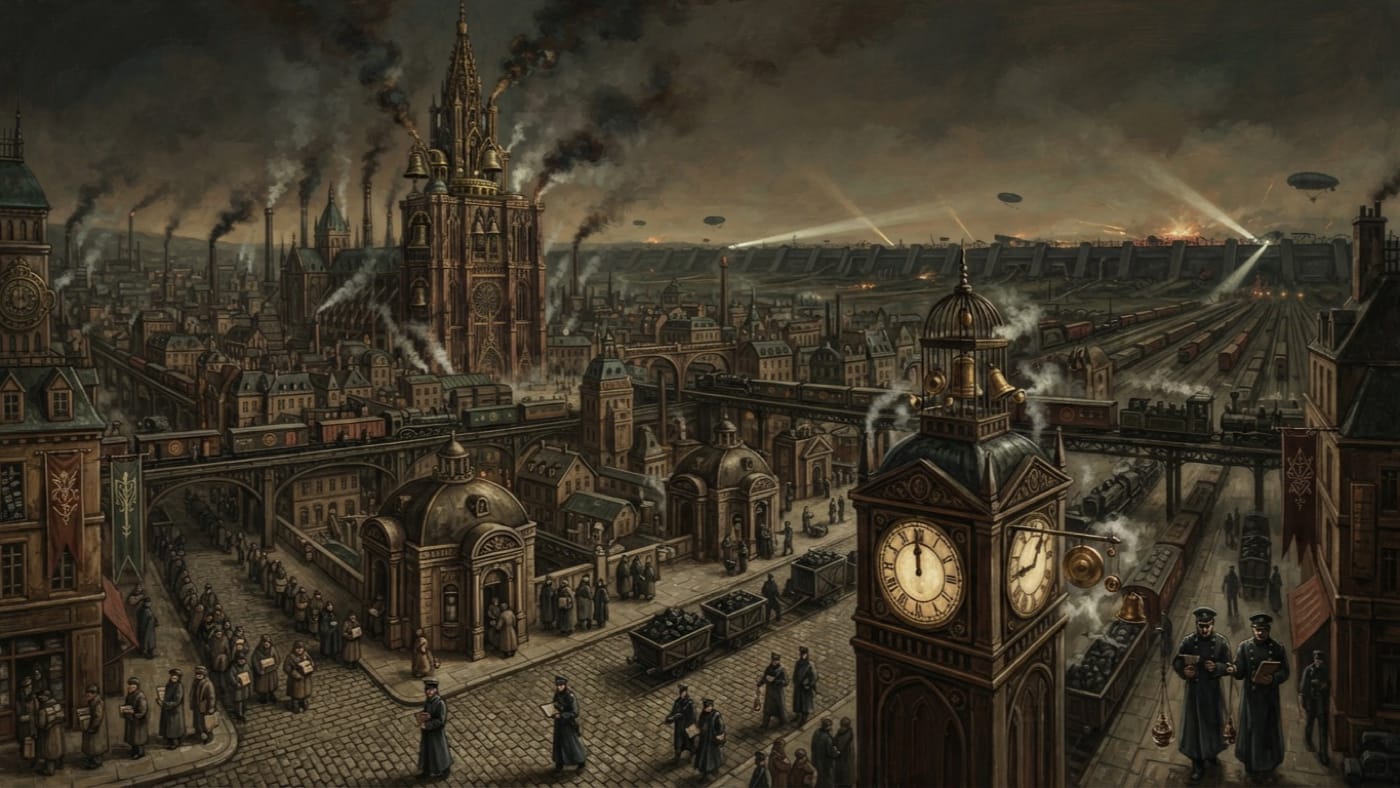
#On the Name and the Claim
The Holy Dominion is the country you are born into by being written down. Its people call it the Dominion, its clerks call it the jurisdiction, and its enemies, most of whom are now dead, called it worse. The Bureaucratic Synod is the machine that governs it. The Dominion is everything the machine is allowed to touch: every parish register, every rail siding, every queue between the Atlantic and the Sagittal Line, and every soul that has answered its name at a confession post.
The distinction matters in my profession. A Synod can sit, contradict itself and adjourn. A Dominion cannot adjourn. It must be fed by the Third Peal.
Doctrine holds that this authority covers all humanity, because all humanity was made by the Creator, and in a silent age obedience to His Church is the form His service takes. Jurisdiction is a smaller and more honest word. The Crown in London has never sent us a tithe. The merchants of Amsterdam lend us money at rates no sinner could improve on. Universal sovereignty is a doctrine. The Dominion is what is left once the doctrine has been surveyed.
#On Its Emergence
The popular catechism has the Dominion springing up whole from the ashes of the Sundering, with its bells already hung and its ledgers already ruled. The Bureau of Records knows better, and is paid to know it quietly.
Before 1 November A.S. 45 there was a hidden Church: households, correspondences, offices without doors. Then the east broke open and the hosts of the Great Deceiver came through. That Church climbed out of its cellars and found the civil order lying in pieces at its feet. It picked the pieces up unevenly. One diocese took over the granaries. One bishop took over the militia. A third town took over nothing and was gone by the following spring. By about A.S. 50 an interim council was governing out of necessity, the only mandate that has never needed a seal.
The Common Allegiance was issued in A.S. 55 under the authority of Augustinus, on work he shared with Kratz and Sabine. Three years later came the Night of the Black Decrees, and town after town discovered the advantages of subscribing. Some subscriptions were given with tears of joy, others with the other kind. The Allegiance had foreseen this and provided for coerced local subscriptions in its closing clauses.
The Council of Worms ratified the Allegiance in A.S. 87, thirty-two years after it was issued. Its register holds three hundred and fourteen names: two hundred and eighty-nine clean seals and twenty-five entries my office calls mixed. A name in a register is not a bishop in a chair. Some came in person, some sent proxies, some sent paper. The Concordat of Strasbourg constituted the formal Synod in A.S. 90 and, looking backward, adopted the calendar I date this page by. The Dominion has been at war for a hundred and fifty-six years and under its constitution for a hundred and eleven. The faithful are encouraged to round these two figures together. I am paid to keep them apart.
#On the Lands Held
Strasbourg is the capital, both administrative and sacred. It sits on the Rhine, deep in the heartlands, far enough from the front that its clerks can discuss the war in the conditional mood. France, Iberia and the Rhineland were bound together there as the Triune Hearth. The Synod sang it as a second founding; the peasants of the day called it a third famine. Other provinces reached the Hearth's keeping by other roads in other years. Records files each accession separately, because a province that remembers its own terms may someday want to discuss them.
To the east, the Dominion ends in fortification. The Sagittal Line runs north to south for some two thousand miles, from Bastion-Königsberg on the Baltic through Brest, Przemyśl, Sibiu, Irongate and Shipka to Bastion-Constantinople at the Bosphorus. It follows lake, river, mountain and gorge where the Creator's geography obliged, and concrete where it did not. Past the wire lie the Grey Miles of No-Man's-Land, and past those the Charnel Lands, where the maps give up. Southern sea-routes carry shells, pilgrims and quarantine flags to the lower Line. Calais guards the Channel. It is not a bastion of the Line, whatever its Chapter claims at dinner.
To the west and north, the Dominion ends in diplomacy, which is uglier. The British Isles and the Netherlands are independent, necessary, and a pain in the arse. The Fractured North keeps its own bells and disputes ours.
#On the Administration of Salvation
In the Dominion, sacred and civil authority are one authority stamped in different colours of wax. The Holy Bureaus sit in Strasbourg. I decline to give their number, because it depends on which Bureau you ask. Doctrine defines what may be taught. The Bureau of Purity decides who has failed to learn it. Records enters the people, their property and their sins. Tithes takes what is owed. The Bureau of War turns what Tithes takes into shells, soup and rolling stock. Bells tells everyone when.
A ruling made in the Sanctum Mile does not reach a village as a ruling. It arrives as a Procurator's red wax, a Legate nobody expected, a Vicar's ration order, an Archon's tribunal, a Confessor's booth on every third street, and finally a Warden at a gate with his hand out for your papers. Governor-Praelates hold the provinces. Every office carries the full weight of the Synod, and every office received its writ from a different hand. So a Vicar can license a pilgrimage that a Warden has orders to stop at the bridge. Both writs are valid and both seals are genuine. The pilgrim waits on the bridge while the jurisdictions are reconciled, and is fined for loitering.
Earlier editions of the constitutional commentary described the Dominion's tiers of parish confession, civic procession and continental Concordat as a hierarchy of punishments.
Corrected per the Bureau of Records: read scale of salvations. Negative framing undermines compliance. Friction is fuel.
Confession is where the machinery touches skin. The Confessor hears the sin, the clerk enters it, and the entry travels to Records. Some weeks later, a man who admitted resenting his quota finds his bread allotment adjusted for spiritual reasons. Absence from confession is recorded too. The Dominion knows its people better than they know themselves, and far better than it knows its enemy.
#On What the Faithful Supply
Every household owes. It owes coin to Tithes, grain where coin runs short, sons where grain runs short, and labour once the sons have already gone. Tithes agents stand in every market and know what you owe before you do. The people maintain that the Bureau is full of thieves. The Bureau maintains that taxation is a spiritual discipline. My office finds both positions correct, and notes that only one of them is armed.
What is taken does not disappear. That is the Dominion's scandal and also its defence. The tithe becomes coal for the central foundries, rails laid east, hospital trains rolling west with painted-over windows, tinned meat in the depots behind Brest, and shells for the Iron Gates. A widow in Lyon gives up a third of her winter flour, and through forty ledgers she feeds a gunner at Sibiu. She will never meet him and he will never thank her. The arithmetic holds anyway, which is more than most theology manages.
Her bread comes back to her stamped. Rations are drawn at the Third Peal and again at the Seventh, against entitlements pressed in wax. The clerks at the counter are trained to spot a forged seal at arm's length and a starving child at no distance at all. Travel needs a permit, and pilgrimage needs a better one. The Ninefold Peals open the shutters, form the queues, light the furnaces and, at the Ninth, close the taverns. In the Procession of Receipts, every household carries its ledgers through the street and chants its balances while auditors call the time. Outsiders take it for civic pride. It is a census with hymns.
The faithful endure the way the faithful always have, by being impossible to govern completely. They trade ration coupons for boot leather. They sing the Creed at the permitted tempo and the tavern songs just below it. In Strasbourg's River Quarter, the women keep a pot on the stove for any neighbour whose allotment has been adjusted for spiritual reasons. Purity has looked into the pot more than once and has yet to find a statute it breaks. The jokes about Tithes outnumber its agents. Several of them are mine.
#On the Present Dominion
In A.S. 201 the Holy Dominion works. The trains keep the Bells' schedule. On most nights, at most bastions, the Line holds. The bells of the Cathedral carry twenty miles in clear weather, and the clerks beneath them go on filing. The city is also exhausted, the way a city gets once it has forgotten what peace was for. Relics glow and bells answer, and someone pays for every answer in years or in self. Doctrine names the creditor. Records only enters the debt. The Church promises deliverance when faith is perfect, and faith is audited quarterly.
Reader, you belong to it. Your name is in a book beneath the Cathedral, and the book is in better repair than you are.