
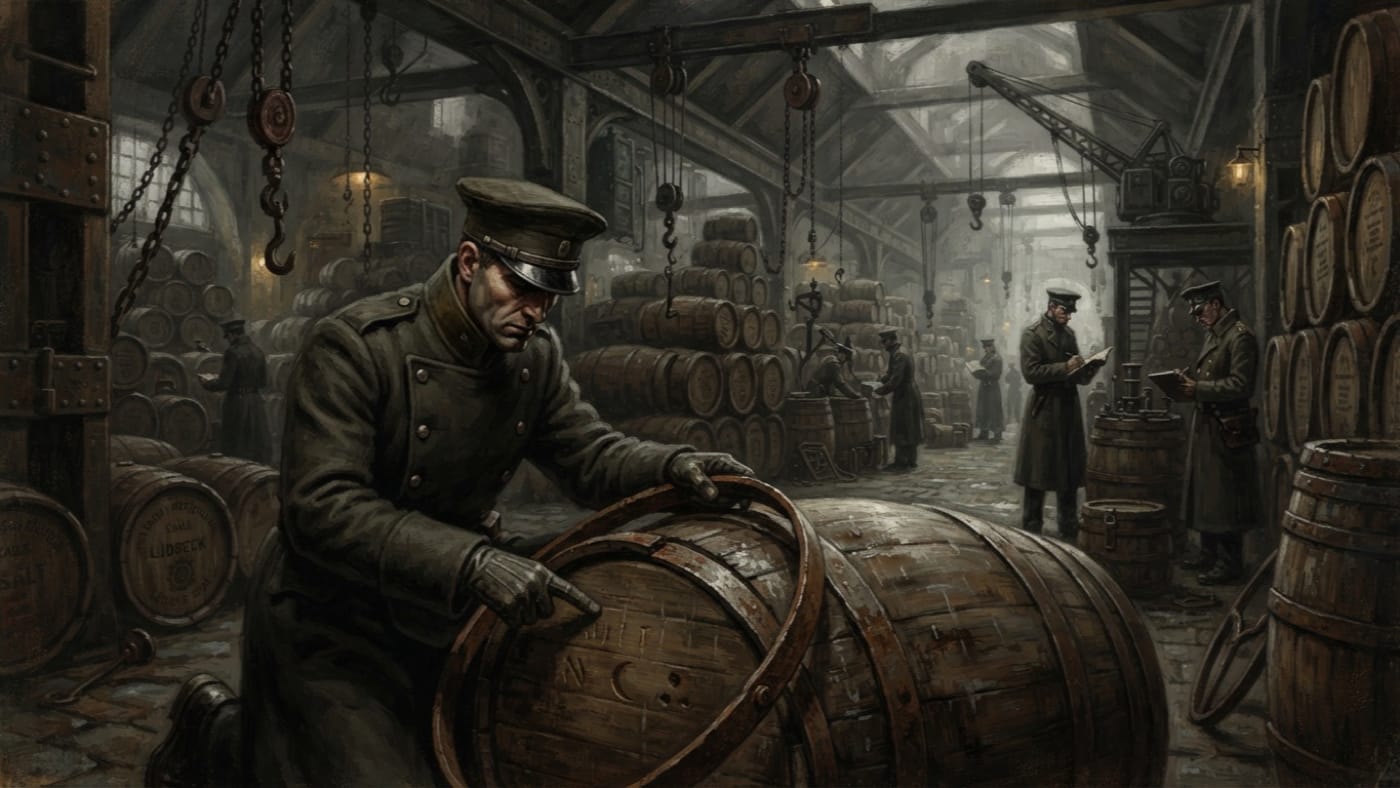
#On the Underside of the Hoop
"An inspector reads the side of the barrel that faces him. Coopers learned early which side that was." (marginal note, Drax, written against an apprentice inspector's examination paper)
Every cask that left the quay yards of Lübeck in the Brotherhood's day carried two accounts. The first was public and lawful. The capacity brand was burned into the head, the stamped table set out what the staves were sworn to hold, and the manifest was folded under a seal that some clerk somewhere would later break with a sigh. The second account rode on the inner face of the hoop, the curve that bites against the oak once a driver and mallet have forced it home. Nobody honest ever looked there.
The cuts were shallow. Salt worked into them, pitch filled them, and a season of rolling, hoisting and dropping wore their edges down until a deliberate mark looked like an ordinary dent. To read one, an inspector had to start the hoop loose on a full cask. A man who loosens hoops on a full cask of cod oil gets a bath, a complaint and a bill.
The Coopers' Brotherhood of the Blessed Barrel held lawful authority to certify volume, and it did so. Beneath that certification it kept a second ledger in iron, bound around the very containers it certified, where the Bureaus could not read it.
#On the Marks That Travelled
The Brotherhood entry preserves four marks by meaning. Three shallow notches meant chapel stock. A crescent scar meant the manifest lied by charity. Burned dots meant cargo requiring darkness. A double seam meant the barrel would be weighed twice and opened nowhere.
Four signs do not make an alphabet. The same entry records the kinds of thing a hoop mark could carry: origin, buyer, night route, cargo class, bribed gate, receiving clerk, devotional exemption, and whether the cask was to be opened with a mallet or with a prayer. No document shown to this office matches each of those questions to a particular cut. The Codex has a list of what was said and four examples of how it was said. It does not have the grammar that joined them. I will not fill the gap in my own hand and then sign a dead cooper's name under it.
The meanings that do survive are broad on purpose. Charity covers a great deal in the Church, and that is what it is for. A manifest that lies by charity might be hiding alms, an exemption, a gift to a chapel that wanted no record of the giving, or something else that found a pious name convenient. Darkness is a handling instruction. It tells a man how to treat the cask: keep it out of the lamp, keep it below, keep it until night. It says nothing about what is inside. Clerks who read "darkness" and write down "contraband" are doing their own arithmetic.
#On Volume and Route Memory
A careful reader keeps three things apart that careless clerks run together.
The first is certification: the lawful capacity brand, the table and the seal. The second is instruction, which is the hoop code and its message to whoever turns the cask over. The third is concealment, the physical work of fraud. The Brotherhood entry lists that work: staves shaved inside, hoops set false, bottoms doubled, pitch mixed thick enough to hide a seam, cavities dried shut inside swollen sidewalls. Those cavities might hold correspondence, seal plates, an unregistered person, or other goods.
A cask with a crescent scar did not need a cavity, and a cask with a doubled bottom did not need a mark. The code told a handler what to do. The carpentry gave him something to do it with. Clerks who treat the double seam as a doubled bottom have mistaken a word for a joint. The Shadow extract does not make that equation, and neither will I.
What made the codes valuable was that they moved. A Brotherhood ledger sat on a shelf by the quay, while a barrel went wherever it was sent. A cask cut in Lübeck could reach a warehouse in Hamburg, a factor in Kanzleiburg, or a corridor clerk near Bastion-Brest, a reader who had never seen the hall or heard its songs. Freight bound for the Bug River sector passes through the yards of Warsaw, and any barrel that goes through those yards carries its hoops with it. Paper is opened, read and copied at every gate. An iron hoop is opened once, at the end of the road, by the person the road was built for.
The system needed no wheel, key or table. To a Hamburg porter, a hoop turned over was scrap iron. To a factor who had been taught, the same hoop told him what to do next. The Brotherhood had no need to hide its marks from the world, only to make sure that most of the world had never been shown them. The Bureau of Shadows called this route memory, and it found the idea very appealing.
#On the Index Shadows Retained
In A.S. 180 (1890 CE), the Year of Smoke, the Bureau that does not exist came to Lübeck. Eleven unmarked Night Wagons left the harbour. Forty years of harbour records burned. Three guilds dissolved before the smell had left the quays. The Grain Merchants discovered spiritual renewal, and the Salters reported insufficient membership. The Coopers, the loudest fraternity on the Baltic, filed papers citing a desire for contemplative silence.
The Brotherhood entry reproduces a Shadow extract from the barrel yard. It is copied below exactly as given there, with no new discovery attached to it and no figure restored:
SHADOW EXTRACT — BARREL YARD, LÜBECK, A.S. 180 Hoop-code tablets recovered: ███ False-bottom casks present: ██ Cargo categories concealed: correspondence; seal plates; unregistered persons; █████████ Brotherhood songs containing route counts: █████████████ Instruction: burn chorus sheets; retain master hoop index; replace craftsmen by contract.
The extract is an instruction. It is not a receipt. It says the master hoop index was to be retained. It does not say who compiled the index, what it was written on, where it went, or who reads it now. I have asked. Records sent me a blank page filed under lock, which by the Bureau's own accounting is a complete answer.
The policy needs no gloss from me, so I will give it only one sentence. Burning the chorus sheets destroyed the memory the yard held in common, and keeping the index put that memory in a single drawer with a Bureau lock on it. A code known to a whole yard is a conspiracy. The same code known to one cabinet is an asset.
#On Approved Inspection
As of the present survey, A.S. 201 (1911 CE), twenty-one years after the seizure, the former hall houses a school for barrel inspection and devotional quiet. Children there learn circumference, capacity, authorised variance and seal placement under rafters that once held festival banners. The yard still makes barrels under private contract. The craft survived the fraternity, as the extract intended.
Approved inspection brands replaced the private marks. The Brotherhood entry reports that some old forms survived inside the new vocabulary. A thin crescent became "seasonal swelling notation." Burned dots became "pitch-depth verification." The double seam became "reinforcement for northern weather." No approved description has been filed for three shallow notches. I record the gap. I decline to fill it.
The new descriptions are lawful and sensible. Oak swells with the seasons, pitch has a depth worth checking, and northern weather does split casks. Every one of these notations can be given an honest reason in front of an examining board. That is why they make such good vestments for the old marks.
With the Brotherhood's dissolution in A.S. 180, the hoop codes of Lübeck passed out of use.
Corrected. The Brotherhood passed out of use. Its marks went into the inspection manual with new names and clean collars. Cutting a private sign on a hoop is prohibited. Cutting an approved notation in the same place, in the same shape, is required.
None of this proves an underground Brotherhood. I have no roll of members, no secret chapter and no living cooper confessing over beer. What the record does show is a yard that kept its tools, its hands and its habits, and an inspection manual that gave those habits official names. Dissolving a fraternity removes its charter, its bell and its songs. It does not take back what a man's hand learned from a mallet.
#On Reading a Barrel
Inspectors on the Lübeck quays, and on every road a Lübeck cask travels, should keep the following in mind.
A crescent scar under a hoop proves that somebody cut a crescent under a hoop. It does not prove that the manifest lies, that the cask is hollow, or that any particular cargo is inside it. The shape is now lawful, so any apprentice can cut it, and it is copied as easily as it is read. Salt wear turns honest dents into apparent notches. A Hamburg warehouseman who believes he recognises a sign has proved only his own education, and the Bureau may want to know where he got it.
Ownership is a separate question from meaning. The surviving entries name readers in Hamburg, Kanzleiburg and the corridor, but none of them names a recipient, a hierarchy or a route held in common. A mark tells you that someone expected the cask to be read. It does not tell you who that someone was. Seizing a barrel on the strength of a crescent will produce a cask of oil, an embarrassed clerk, and a complaint filed by a merchant whose cousin sits on a chapter board.
The correct procedure is dull. Check capacity against the brand. Check the seal against the manifest. Note any approved notation in the register by its approved name. If a mark has no approved name, describe it, report it, and leave the hoop where it is. Where the old forms and the new descriptions meet, the inspector's job is to write things down. Judgement belongs to whoever holds the index.