
#On the Clerk Who Removed the Impression
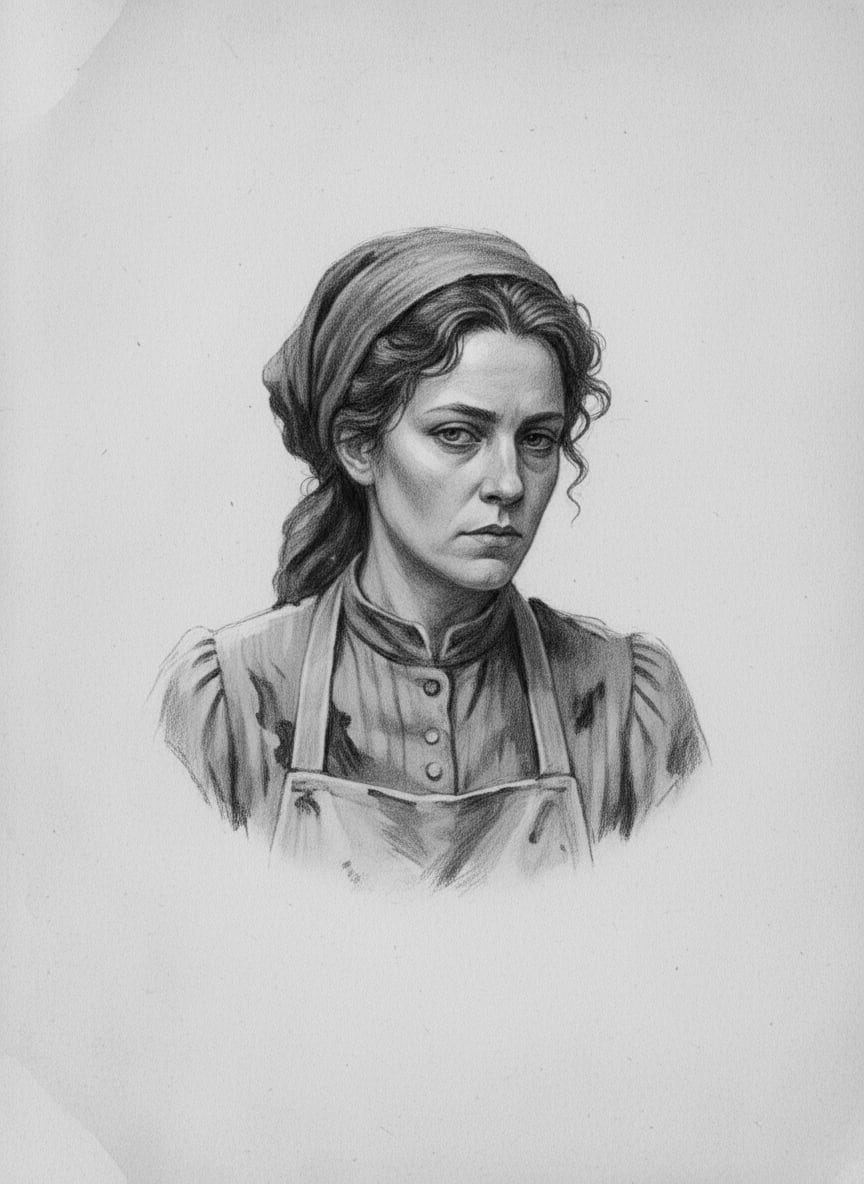
Irena Vale enters the record through an apron.
That is uncharitable, which recommends it. The official personnel file gives her birthplace as Warsaw, her schooling as Synod-standard, her appointment as ordinary, her penmanship as excellent, her catechism scores as adequate, and her posting to Bastion-Brest as a routine administrative rotation under the Crossing Bureau. A life in columns. A soul reduced to education, transfer, stipend, dormitory, and seal access. Then A.S. 197 arrives, and the apron becomes biography.
Vale worked in the stamp room, where crossing papers received the small pressed permissions by which bodies became lawful on the Brass Ribs. The room was watched, counted, ventilated, audited, and blessed. Guards inspected hands and pockets at exit. Supervisors weighed dies. Clerks signed wax ledgers in paired witness. The procedure lacked one noun: apron.
#On Her Training and Its Failure to Restrain Her
Vale was trained by the same clerical schools that furnish half the Bureau of Records with neat-handed adolescents and the other half with exhausted adults who have learned fear by ledger weight. She knew margins. She knew sequence. She knew that a crossing stamp is useless without pressure, angle, cure, and witness. She knew the difference between a worn die and a living one, between a legal impression and a merely pretty dent in wax. This is the insulting part: the woman was good.
Good clerks trouble me. Bad clerks can be corrected by shouting, reassignment, hunger, or a week in the cold stacks. A good clerk who turns has already learned the system's grammar and can conjugate treason in the Bureau's own hand.
Her duty was cleaning, aligning, and presenting the dies used in the crossing lanes: absolution tokens, temporary transit seals, manifest corrections, booth reroutes, pylon-labour exceptions, escort waivers, and the small grey mark used when a traveller's name must be held under review without stopping the convoy. She learned which marks frightened guards, which soothed them, which could be stamped crooked and still pass, which demanded red wax, which accepted black. Such knowledge is too intimate for innocence.
#On the Apron Method
The method was base, elegant, and almost insulting in its smallness. During routine cleaning, Vale pressed approved stamp dies into warm wax. The impressions cooled against the inner fold of her work apron, where flecks, smears, and tool residue already accumulated as occupational dirt. At exit, the guards examined her hands. They examined her pockets. They examined the tool roll. They did not examine the apron because no instruction told them an apron could contain jurisdiction.
Earlier annotations identified Vale as “Irena of the Warrens,” implying birth among the Pylon districts.
Corrected. Vale was born in Warsaw and posted to Brest under ordinary rotation. The Bureau apologises for granting the Pylon Warrens more credit than they had yet earned.
She carried the wax out in plain sight. That phrase enrages every official who has read the file. The impressions were not hidden inside reliquaries, stitched into hems by some theatrical conspirator, or smuggled beneath a dying man's bandage. They lay against cloth, flattened by labour, mistaken for grime. From these negatives, the Blank-Sheet Circle could cut working duplicates: imperfect, temporary, enough. A false die need not survive a century in the Sigillary. It need only survive the hour in which one nameless soul crosses eight hundred metres of brass, confession, gun-smoke, and panic.
#On the Circle's Use of Her
The Circle did not need Vale to write doctrine. The Blank-Sheet Circle has always understood that doctrine is a luxury for movements with leisure, pulpits, and a death wish. It needed her hands. It needed her memory of die pressure. It needed her knowledge of which stamp-room supervisor drank at second bell, which guard hated searching women, which replacement wax batch cracked under winter damp, which impression could pass at the East Gatehouse if the clerk were tired and the convoy loud.
The Bridge Tribunal calls her primary seal technician. Judge Elsbeth Krail uses the phrase as if it were a species of venom. I have heard her say it: primary seal technician. Four words, clipped, exact, contemptuous. Krail does not despise Vale for criminality. Criminality fills Brest like mist in the lower ribs. Krail despises her for competence outside licence.
Vale's work changed the Circle from nuisance to mechanism. Before her, blank papers were paper. After her, they became paper awaiting authority. That distinction is the whole Synod in miniature and the whole heresy in one gesture. The blank sheet offered absence. Vale taught absence how to receive a stamp.
#On Her Absence from Custody
Nineteen arrests have entered Krail's folios. Vale is not among them. This fact sits in the file like a splinter under the nail.
Some witnesses place her in the North Lane after curfew. One swears she crossed into the Pylon Warrens carrying a wooden measure and came back with her hair wet from river mist. A Confession Scribe identifies her voice behind a screen during a safe-sin processing sequence, then recants after hearing that same voice whisper from the shutter three hours later. The Confession Echo enjoys participation. It is rude that way.
BRIDGE TRIBUNAL WITNESS ANNEX — VALE THREAD Witness Seven: “She said the stamp does not make the soul real. It makes the guard lazy.” Witness Eight: “Moth called her sister.” Witness Nine: “Moth was paper. Vale was the hand.” Custody recommendation: ███████████████ Reason for delay: ██████████████████████████
Marshal Vonn would shell the pylon cellars if Krail gave him a clean writ and if the Bureau of War could be persuaded that destroying Brest's own understructure was less embarrassing than admitting a stamp-room assistant has outlived nineteen arrests. Krail will not give him that writ. She wants Vale alive. A dead technician proves a breach. A living one explains it.
#On the Present Classification
As of A.S. 201, Irena Vale remains unapprehended, uncanonised, unredeemed, and irritatingly useful to every theory that has survived first contact with evidence. She is a clerk with seal memory. She is a fugitive with wax under the nails. She is the answer to a procedural question Brest was too proud to ask: what happens when the people trained to authenticate reality decide to authenticate escape?
The Bureau of Purity wants a brand. The Bridge Tribunal wants testimony. Records wants a corrected file. The Bureau of Masks and Seals wants its embarrassment melted down and recast as policy. I want her apron.