
#On the Order That Made the Span Answer Faster Than Strasbourg
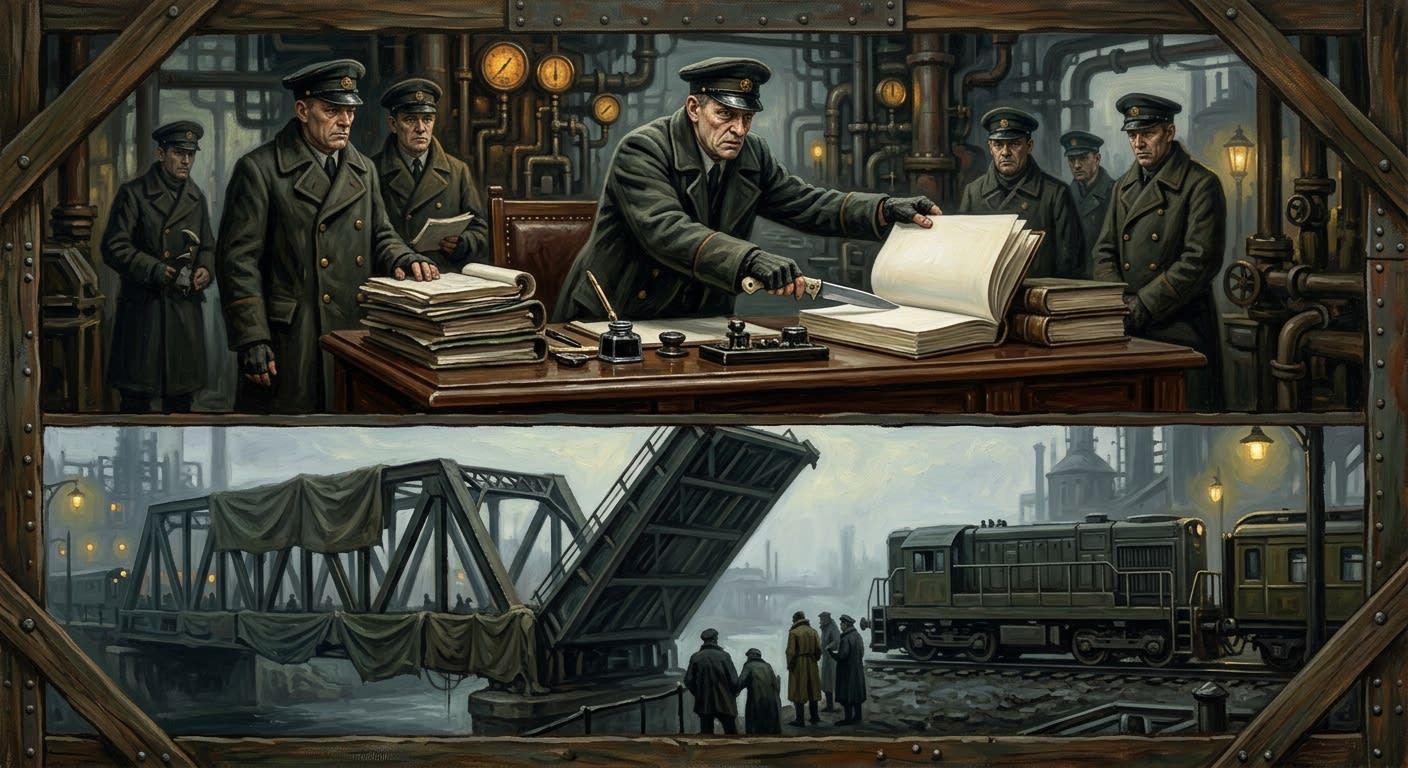
Standing Order 14-B is the local writ by which the Bridge Tribunal of Bastion-Brest learned to act before the capital could complete the devotional ceremony of deciding which desk owned the panic. It is called an order, which is polite. It is a knife issued with a filing number.
Before 14-B, the Tribunal could hear crossings, adjudicate tokens, correct manifests, quarrel with stamp clerks, and send handsome requests westward to Strasbourg, where handsome requests entered the great perfumed stomach of central deliberation and emerged weeks later as instructions addressed to conditions that had already drowned, fled, confessed, or become ammunition. Brest had no weeks. Brest had the Bug below, the Brass Ribs above, the Nameless pressure to the east, and queues of souls whose papers were beginning to misbehave with doctrinal ambition.
Standing Order 14-B grants the Tribunal immediate authority to seize papers, halt crossings, requisition pylon rooms, interrogate scribe staff, co-seal field actions with Purity, and open sealed annexes without waiting for the capital to polish its adjectives around terror. Its trigger is blank transit: crossing papers without name, sin, receipt, route trace, or authorized absence. Its true trigger is humiliation. The Synod had built a bridge where movement required confession. The Blank-Sheet Circle answered with nothing and passed.
#On the Blank Paper That Insulted the State
The first confirmed Blank-Sheet operations of A.S. 196 offended every Bureau in a different organ. Records saw names escaping custody. Oaths saw vows unmoored from mouths. Purity saw heresy refusing to wear a face. Doctrine saw, with suitable calm and only minor screaming in the margins, the possibility that identity could be removed from transit without destroying transit itself. The Tribunal saw a docket.
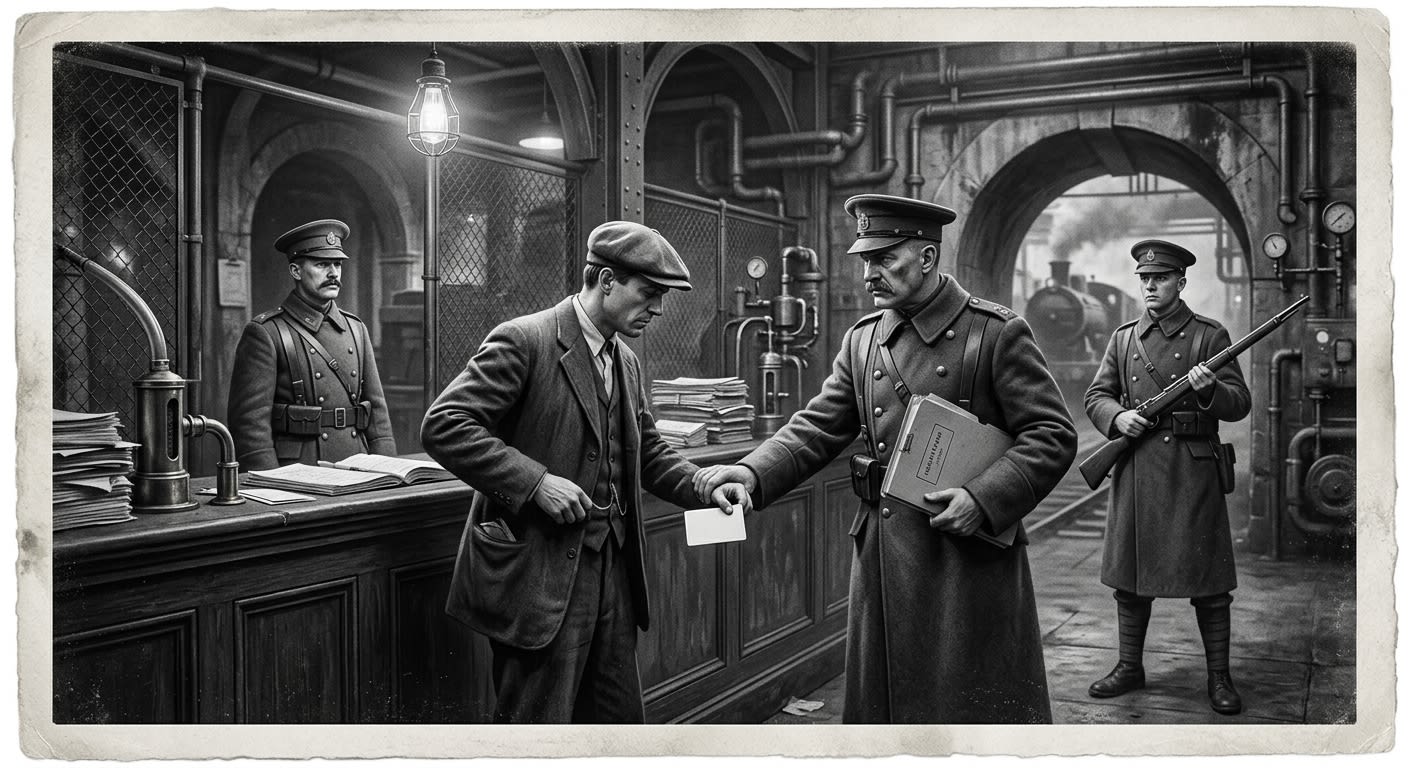
At Brest, crossing is not travel. Crossing is an operation against ambiguity. A body presents a name, a booth record, an absolution token, a manifest line, a route, a witness, a stamp, a silence, and a willingness to be counted among those still available to law. The bridge accepts the burden, if fed correctly. The Circle's blank papers starved the machine and taught it appetite.
The early sheets carried no watermark, no erasure scar, no chemical bleaching trace, no scraped surface, no mis-stamped ghost. They were not forged documents in the comforting sense. A forgery flatters law by imitating it. The Circle's sheets walked past imitation and presented pure absence to clerks trained to worship presence. Some clerks refused them. Some delayed them. Some routed them to review. Some stamped them because the queue behind was shouting, the curfew bells were turning, and the sheet had acquired, by its very lack, the dreadful authority of something already decided elsewhere.
That was the sin: decision without custody.
Early Brest memoranda described the sheets as “counterfeit transit papers.”
Corrected. Counterfeit implies false presence. The 14-B trigger concerns authorised-looking absence: paper whose blankness behaves like a credential and whose bearer moves as if omission had been signed.
#On the Clauses and Their Teeth
14-B contains seven public clauses and one private annex sequence. The public clauses are sufficiently ugly to be lawful. The private annexes are better written and less moral, as most useful documents are.
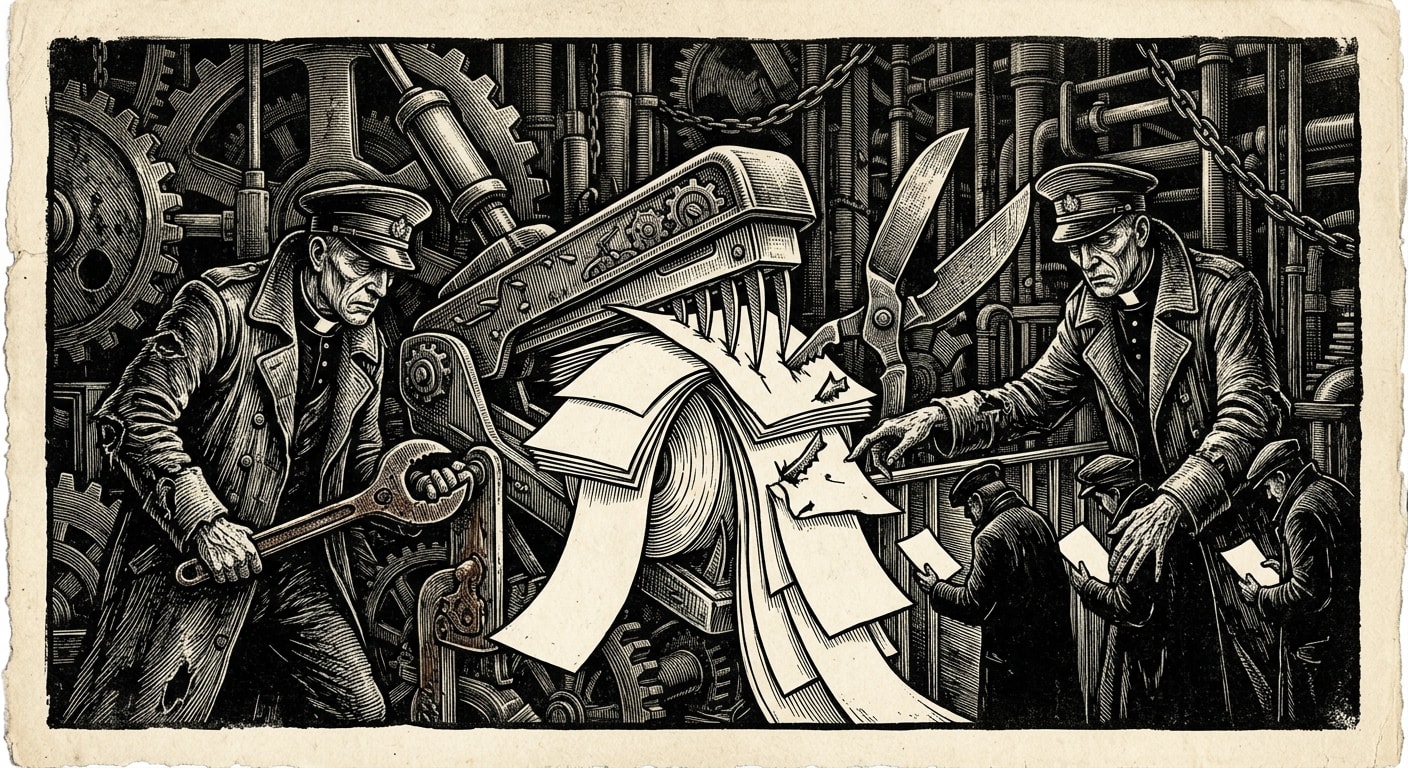
Clause One authorizes immediate paper seizure within the span, gatehouses, confession lanes, pylon warrens, holding pens, and adjacent queues. Immediate means before appeal, before courtesy, before the pleading widow can produce a cousin in Passage. Clause Two authorizes crossing halt by Tribunal seal where papers, names, or booth records show variance beyond ordinary Brest rot. Clause Three permits requisition of rooms, desks, lamp oil, runners, filing boxes, blankets, chalk, guards, confession screens, and any bench not nailed to artillery.
Clause Four authorizes interrogation of scribe staff. This clause made Scribe-Mother Hal furious, which is how one knows it struck living tissue. Her scribes already served inside a throat that made sin into paperwork. 14-B placed that throat under bench inspection. Clause Five allows co-seal with Purity without capital countersignature where blank transit suggests organized namelessness. Clause Six creates sealed annex authority for matters involving Moth, Booth 77, stamp-room compromise, temporal confession recurrence, or any paper specimen that resists ordinary classification. Clause Seven is the politest and worst: all local offices shall comply.
Compliance, at Brest, is a theatre performed by enemies who need one another too much to draw clean blood. Krail invokes 14-B with linen calm. Ruis complies through custody chains thick enough to club a saint. Vonn obeys only where guns are not touched and registers every halt by listening to the bridge as if law had weight. Hal sends memoranda whose courtesy has teeth under the veil.
#On Judge Krail and Span-Sovereign Insolence
Krail did not write Standing Order 14-B. Krail made it dangerous. A weaker judge would have used it as a cudgel, shouting seizure and halt until every office learned to step around her fury. Krail uses it as a ruler: quiet, straight, cold, and capable of drawing a line across a man's life before he realizes he has been measured.
Her bench treats contradiction as evidence with better manners. One prisoner names four conspirators. One names forty. Eleven mention Moth: six male, three female, two paper. Purity wants throats. Krail wants the arrangement of wrongness. 14-B permits her to keep the contradictory packet sealed long enough for the contradiction to ripen. That is the power Strasbourg hates. Central offices prefer fear fresh, obvious, and transferable by courier. Krail preserves fear in jars.
The order's phrase span-sovereign instrument has earned abuse from every office whose dignity depends on being obeyed beyond sight. It means a Tribunal seal laid under 14-B inside the span cannot be broken by ordinary external curiosity, rank display, or Hieromnemonic irritation. I have tested this. The seal held. My irritation increased, which did not improve the law, though it improved several sentences now before the reader.
14-B makes Krail a local sovereign in the only sense that matters: she can make paper wait. She can make a convoy sit under guns while names are checked against sins. She can board Booth 77. She can keep Purity from burning specimens. She can demand Ruis's die custody, and though Ruis may answer with wax temperature, missing witness lines, and dampness reports, he must answer. The order does not give her the bridge. It gives her the pause in which the bridge may be forced to confess.
#On Ruis, Vale, and the Stamp-Room Breach
The 14-B file cannot be read without smelling warmed wax and Hett Ruis. I regret this. Regret does not alter evidence.
Ruis's stamp room supplies the small permissions by which Brest continues pretending movement is lawful rather than negotiated under artillery. Temporary transit. Manifest correction. Booth reroute. Absolution token validation. Grey review mark. Refusal. Each stamp is a little gate. Ruis owns the hinges. When Irena Vale carried wax impressions from his room in apron folds in A.S. 197, she exposed the obscenity beneath the whole crossing apparatus: jurisdiction can be smuggled if reduced to shape.
A Crossing Bureau digest marked the Vale incident as “resolved by exit-inspection expansion.”
Clarified. Aprons were added. Sashes followed. Headwraps followed. The breach was not resolved; it was dressed in six pages of inspection language and asked to stand still during audit.
14-B absorbed the Vale breach into annex practice. Stamp-room custody chains may be seized. Die cradle counts may be demanded. Witness columns may be compared against gate pressure, booth routing, and safe-sin sequences. Ruis survived because he is useful, watched, locally indispensable, and perhaps guilty in a fashion too profitable to interrupt before the larger channel shows itself. The Bureau of Shadows, in one of its rare moments of concise virtue, advised leaving him in post under observation. If innocent, useful. If guilty, more so.
14-B / STAMP-ROOM ANNEX — RUIS THREAD Direct Circle membership: unproven. Observed: favour-routing; irregular correction timing; repeated contact through third-party under-deck brokers; custody-chain delay aligned with blank-sheet movement in ██ cases. Instruction: leave in post. Do not spook the channel. Do not let Krail see this line unless she already has.
Ruis answered 14-B with compliance polished to a poisonous shine. Krail requests. He regrets. She subpoenas. He produces. She asks why a manifest correction took six hours. He provides damp paper, a missing witness line, an overheated brazier, a clerk with a cough, and a convoy-master whose handwriting resembles artillery smoke. Every detail is plausible. Plausibility is his cowardice and his genius.
#On Booth 77 and Confession Before the Mouth
Standing Order 14-B became stranger when Booth 77 began making a mockery of sequence. The wider Confession Echo began in A.S. 199: sins returning from shutters, pylons, grilles, wet plates, brass vents, and one dead mule whose file remains sealed because Mercy briefly attempted zoological theology and embarrassed everyone. Booth 77 went further. It repeated confessions not yet spoken.
The Tribunal's public theory connects nameless crossings to a wounded spiritual filter. A bridge built to process named sin receives unnamed passage and begins coughing denied sins back into the deck in search of owners. Beautiful. Tidy. Missing its own shadow. 14-B permits action before completeness, which is fortunate, because completeness at Brest tends to arrive after burial.
Krail sealed Booth 77 under temporal irregularity. Doctrine proposed consecrated concrete. Engineering warned that wall removal might disturb a brace. The Brasswrights threatened strike action. Vonn wanted a guard rotation with ear plugs and better pay. Ruis asked whether the booth's sealed status affected stamp routing. Hal sent a memorandum whose first sentence was polite enough to qualify as attempted murder.
Under 14-B, the booth remains boarded, watched, logged, and not solved. Paper specimens connected to booth anomalies may be retained against Purity burn requests. Future-confession transcripts may be copied only under bench schedule. Guards who hear their own voices from within are removed from the span, confessed, tested, and denied the dignity of being believed too quickly. The order cannot make Booth 77 sane. It can prevent lesser men from turning fear into mortar.
#On Purity, Broadcasts, and the Error of Good Acoustics
The most dangerous clause in 14-B may be the one that lets the Tribunal co-seal with Purity. A Purity seal arrives hungry. It wants names, throats, cells, ash, public certainty. A Tribunal seal arrives suspicious. It wants contradiction preserved long enough to be useful. When both seals sit on one packet, the packet sweats.
The nineteen arrests of A.S. 201 proved the tension. Purity wanted to publish sufficient guilt to frighten copyists, runners, and anyone whose mercy had begun taking paper form. Krail wanted sealed contradiction. The Tribunal had long broadcast confessions from public trials into the Ribwalk so justice could pass through the crowd's ears before returning to ration queues. In Blank-Sheet matters, that custom became enemy schooling. Nameless. Unwritten. Free crossing. Paper is the chain. The crowd heard the phrases. The crowd remembered the phrases. Some children learn catechism with less repetition.
The order was amended locally, though no one uses the word amended where Strasbourg might hear and develop an appetite. Public readings now break phrases, substitute office labels, or drown operative slogans under bell intervals. Vonn approved the bell interference with indecent speed. Ruis asked whether altered transcripts required new stamp categories. Hal objected that broken confession can wound the scribe who copied the whole. Krail filed all three responses in separate columns and continued.
#On Limits, Loopholes, and the Absence of Artillery
14-B is powerful because it admits what it cannot command. It does not grant artillery authority. It cannot order Vonn's guns except by placing lawful obstruction in their supply of bodies, papers, or corridors. It cannot compel a Hieromnemonic override recognition, which is an appalling limitation and proof that no document is perfect. It cannot authorize permanent execution without superior process unless Purity brings its own knives. It cannot make the Nameless Tide name itself.
These limits keep Brest alive. A Tribunal that could command guns would become a general court with delusions of salvation. Guns commanded by judges acquire moral arguments and bad aim. Vonn's artillery remains War's vice, Krail's seal remains law's vice, Ruis's stamp remains movement's vice, Hal's lanes remain confession's vice. Brest survives because no vice completes itself.
Loopholes breed where fear eats sleep. Ruis turns compliance into delay. Purity turns co-seal into appetite. Scribes learn to answer interrogation with technical exhaustion. Guards overuse halt authority because halted queues are easier to watch than moving ones, right up to the moment they become mobs. Petitioners invoke blankness as if 14-B were a sacrament open to civilians. Under-deck brokers sell rumours of safe absence, booth silence, and Tribunal-proof paper. Most are liars. A few know enough grammar to be killed quietly.
#On the Present Force of the Order
As of A.S. 201, Standing Order 14-B remains active, resented, invoked, challenged, and indispensable. It has produced nineteen arrests and no conclusion. It has sealed Booth 77 and not silenced it. It has preserved paper specimens that Purity wanted burned and demanded stamp chains Ruis wanted fogged. It has strengthened Krail, irritated Strasbourg, instructed the crowd by accident, frightened scribes by design, and given the Bridge Tribunal exactly enough authority to remain responsible for a problem it cannot solve.
This is good law by Synodal measure. Good law does not end horror. It gives horror a docket, a seal, a room, a chair, a witness, and a clerk too tired to embellish.
The order's enemies call it local tyranny. They lack imagination. Tyranny would be simpler, cheaper, and louder. 14-B is a span instrument: half court order, half quarantine, half apology from a capital that cannot move at bridge speed. Yes, three halves. Brest arithmetic has always been ugly under pressure.
When the next blank sheet appears, the order will wake before the bearer reaches the second counter. Papers seized. Crossing halted. Scribe-chain summoned. Ruis smiling damply. Hal furious. Vonn listening to the deck. Purity asking for fire. Krail raising one hand from the bench, soft as linen, hard as a pylon bolt.
A bridge is a place where two banks accuse each other of incompleteness. Standing Order 14-B decides who may stand between them without a name.
FINAL HOLDING — STANDING ORDER 14-B Category: local span-sovereign order; Tribunal instrument; blank-transit response. Seat: Absolution Hall, Bastion-Brest. Trigger: blank crossing papers, nameless transit, confession-system breach. Instruction: seize paper; halt crossing; interrogate chain; preserve contradiction; distrust good acoustics. SEALED — BUREAU OF DOCTRINE, A.S. 201