
#On the Office Between Foot and Permission
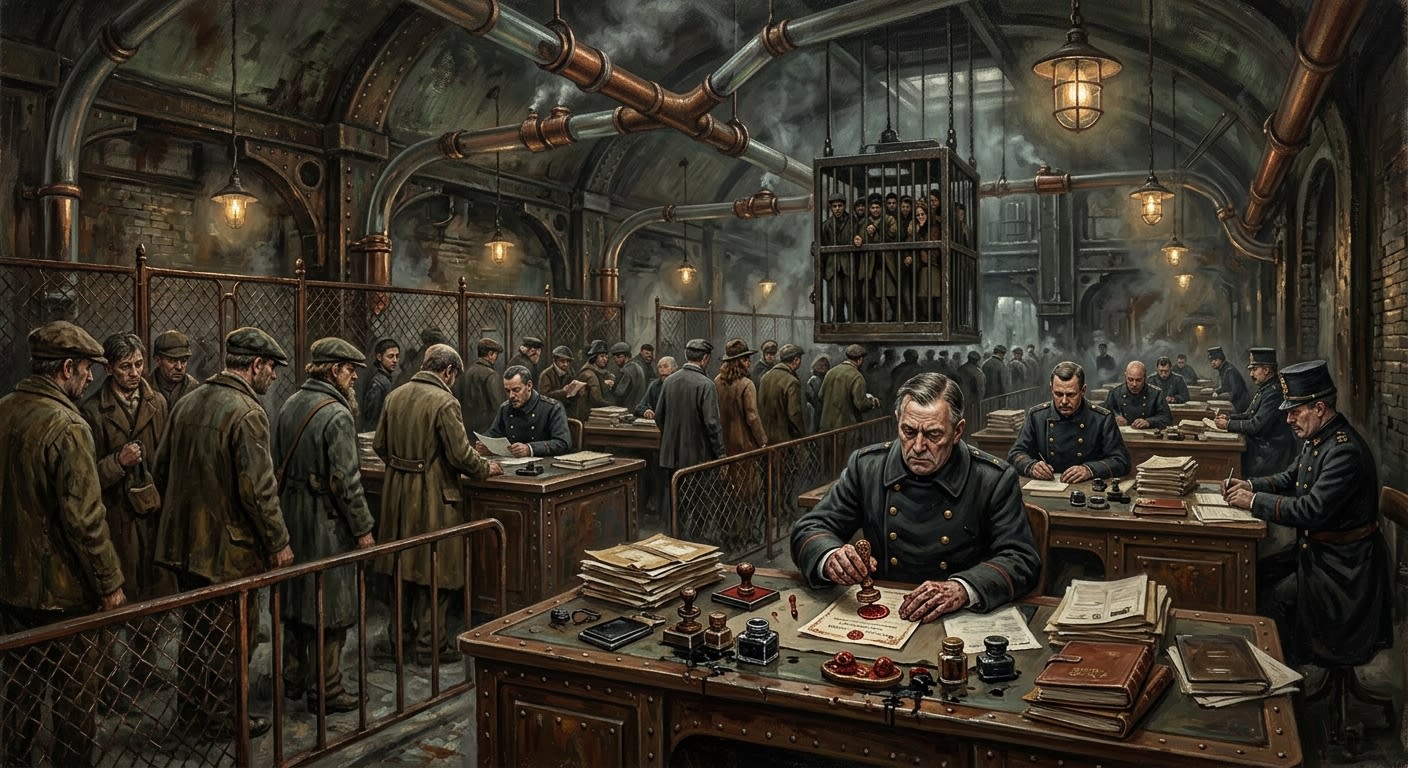
The Crossing Bureau at Bastion-Brest is the local span authority that owns the little permissions by which a body becomes lawful upon the Brass Ribs. It borrows the Bureau of Passage's instincts, stamps, and ancestral pleasure in delay without becoming the parent Bureau. Judge Elsbeth Krail would like every disputed seal to kneel before the Bridge Tribunal and confess its parentage; the Bureau lets her want. Every crossing mark depends upon the damp little receipts of the Confessional Lanes, but the Lanes hear sin and the Crossing Bureau makes feet legal. The Crossing Bureau is the hand at the counter after the soul has spoken and before the bridge consents.
A person may possess a name, a destination, a military order, a tithe record, a confession receipt, an absolution token, a queue slip, a fever clearance, a mercy exemption, three witnesses, and a letter from a grandmother with handwriting so pure it makes Records clerks weep. Without the Crossing Bureau's stamp, he is still only an intention wearing boots.
The Bureau's Brest counters stand beside the East and West Gatehouses, with their main stamp room three chambers behind brass mesh where papers arrive wet, frightened, and overconfident. Its authority covers crossing writs, transit marks, manifest corrections, temporary passage seals, booth reroutes, escort waivers, pylon-labour exceptions, grey review holds, refusal marks, and the odious little annotations that turn a family's morning into a hearing. If the Tribunal is Brest's conscience and the guns are Brest's teeth, the Crossing Bureau is the tongue that tells the teeth where to close.
Its motto is unofficial, because the official one changes whenever Strasbourg visits. The clerks say: No mark, no crossing. The bridge says the same thing without needing Latin.
#On Its Parentage and Local Mutation
The Synod's wider transit authority was born from the Great Retreat, when movement killed almost as efficiently as demons: carts brought fever, gates broke under refugee weight, deserters vanished into market roads, relics wandered under false custody, and bridge captains discovered that a rope across a road could acquire the moral authority of a cathedral if enough frightened people stood before it. By the Concordat settlement of A.S. 90, the Bureau of Passage had been formalised from gate, bridge, ferry, convoy, quarantine, and checkpoint controls. Its doctrine was simple enough for soldiers and cruel enough for clerks: No Name, No Passage.
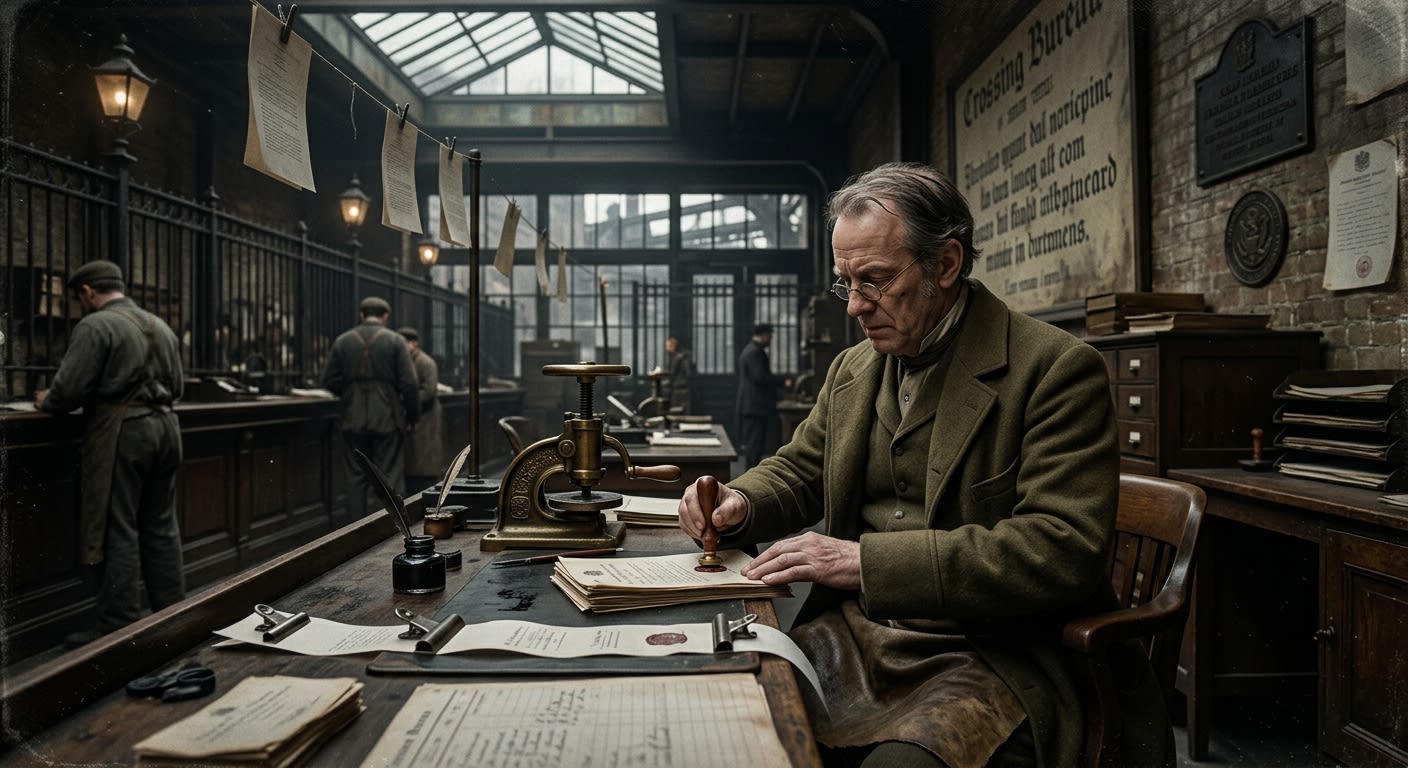
Brest required a local mutation. The Bug River crossing could not be governed like an ordinary gate. It was bridge, fortress, market, court, barracks, river lock, confession machine, artillery platform, and vertical slum condensed into eight hundred metres of brass and damp patience. The first western-bank works of A.S. 67 had toll boards and chapel queues. The Bureau of Engineering's A.S. 92 bridge-fortress plan gave Brest its modern span body. By the certified A.S. 98 full military crossing under load, artillery, confession, and tribunal supervision, transit authority had grown too tangled for distant Passage clerks to command by general rule. Brest needed counters close enough to smell the wax.
A Passage catechism once called the Crossing Bureau “a mere gatehouse subdivision.”
Corrected after the A.S. 196 Standing Order 14-B disputes. A subdivision does not trap convoys, survive Tribunal subpoenas, lose stamp impressions to a fugitive, or decide which soul becomes visible to the bridge. The approved phrase is “local span authority under contested parentage.” Bureaucracy loves adoption when inheritance is profitable.
The Crossing Bureau grew from three older offices: the toll table, the military gate clerk, and the confession receipt desk. Their marriage was arranged by appetite. The toll table wanted money. The gate clerk wanted speed. The receipt desk wanted proof that each traveller had recently declared himself morally damp. The modern Bureau inherited all three appetites and added a fourth: the pleasure of being indispensable.
As of A.S. 201, the office's authority is claimed by Passage in charter language, Records in custody language, Doctrine in moral language, the Tribunal in judicial language, and Hett Ruis in the language of the man who has the stamp in his hand. Local fact beats distant theology before breakfast.
#On the Stamp Room
The stamp room is smaller than its consequences. Twelve desks. Six die cabinets. Two wax braziers. A blackened brass chain for each die. A weighing scale blessed by the Bureau of Masks and Seals and recalibrated often enough to acquire clerical resentment. Cupboards of red wax, black wax, grey wax, travel wax, refusal wax, quarantine wax, and the bitter yellow variety used for temporary pylon-labour exceptions that no one admits is cheaper. Drying racks hang over coal heat. Ledger shelves climb the west wall. The air smells of warm wax, mildew, clove oil, damp paper, human breath, and the old panic of people waiting behind mesh.
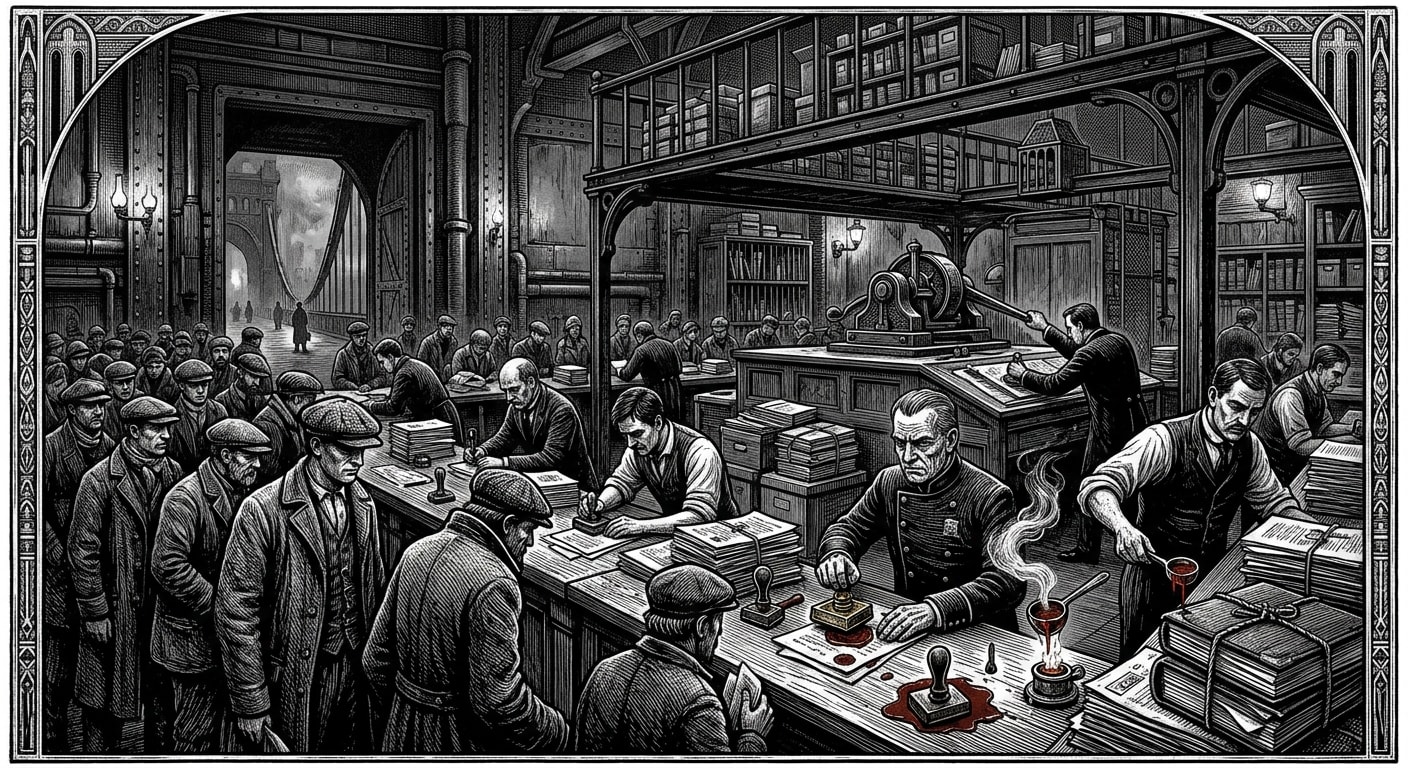
Every mark has a cradle. Every cradle has a ledger. Every ledger has witness lines. In theory, this sequence forms a clean chain of authority. In practice, theory remains the one commodity Brest imports without shortage.
The desks are arranged by consequence. Routine westbound civilian passage sits nearest the public counter, where the clerks can look harmless. Military convoy marks sit nearer the inner brazier under armed watch. Manifest corrections are kept by the north wall, because corrections breed quarrels and quarrels prefer corners. Refusal marks remain under the Seal-Registrar's direct hand. Temporary marks hang in a locked tray whose key is held by the deputy registrar, the watch clerk, and a woman named Mother Jask who cleans the floor and has more practical control over Brest's movement than three minor bishops.
A good crossing mark is pressure, angle, heat, witness, and timing. Press too lightly and the gate guard squints. Press too hard and the wax cracks in winter. Wrong angle implies drunkenness, haste, forgery, or the existence of a clerk whose wrist deserves reassignment. Too much heat smears the seal. Too little heat causes flaking. Delay makes the queue speak. Speed makes Krail suspicious. Accuracy, at Brest, is the narrow strip of floor between riot and subpoena.
#On Hett Ruis and the Doctrine of Delay
Hett Ruis is Seal-Registrar of the Crossing Bureau, which means he owns the little red refusal, the temporary transit mark, the manifest correction, the booth reroute, and the expression of sympathy that arrives three minutes before denial. He does not command Brest; no one commands Brest, though several people spend their lives rehearsing the delusion. Ruis commands the desk between legal desire and stamped fact.
His talent is delay. Crude clerks obstruct. Skilled clerks let procedure acquire the weight of a saint's reliquary. Ruis asks for a paired witness line. He requests a drier duplicate. He notices the confession category does not match the traveller's prior sin history. He regrets that the wax has cooled unevenly. He offers to submit the matter to review. Each action is lawful. Together they make a cage.
The public believes a stamp grants passage. Ruis knows the greater power belongs to stamps withheld, delayed, questioned, corrected, or returned for recertification. A granted mark spends itself at the gate. A delayed mark feeds the entire office: information, coin, apologies, favours, pleas, accusations, witness names, route gossip, convoy schedules, under-deck rumours, and those little personal humiliations from which durable files are made.
An administrative digest described the Crossing Bureau as “subordinate to the Bridge Tribunal in all contested matters.”
Clarified under Brest practice. The Tribunal may overrule a stamp after hearing. The stamp decides whether the subject reaches the hearing. Jurisdiction rewards whoever touches the paper first.
Ruis's survival after the A.S. 197 Vale breach (Unregistered) has made him both suspect and necessary. Innocent men are often dismissed to prove vigilance. Guilty men sometimes remain because they know where the spare keys are hidden. Useful men remain because removal would expose the machinery around them. Ruis remains.
#On Irena Vale and the Apron That Humbled Procedure
Irena Vale entered the Crossing Bureau file as a Warsaw-born clerk, properly trained, adequately catechised, posted to Brest under ordinary administrative rotation, and trusted near the dies because she was good with her hands. The last phrase should be carved in warning above every seal cabinet in Europe. A good clerk close to a stamp is either a blessing or a fuse.
In A.S. 197, Vale carried wax impressions out of the stamp room in her apron folds. Hands were inspected. Pockets were inspected. Tool rolls were inspected. The apron, that lowly garment of labour and invisibility, passed unexamined because no instruction told the guards that jurisdiction could cling to cloth. From those impressions the Blank-Sheet Circle gained working duplicates: imperfect, temporary, enough. A false die need not serve a century. It need only outlive a gate shift.
STAMP-ROOM BREACH REPORT — A.S. 197 Subject: Vale, Irena. Access: die cleaning and alignment. Failure point: wax-impression retention in apron folds. Initial supervisor note: “No loss of die integrity observed.” Later correction: █████████████████████. Registrar attestation: received; contested; resealed.
The Bureau's response was magnificent in the manner of men locking a stable after the horse has founded a cavalry regiment. Aprons were added to inspection. Then sashes. Then headwraps. Then prosthetic limbs after an unrelated Przemyśl embarrassment. Exit protocol expanded from one page to six. Guards received new illustrated cards. Clerks were instructed to stand with arms lifted while matrons checked garment folds. The stamp room became more invasive, slower, angrier, and only slightly wiser.
Vale herself remains unapprehended as of A.S. 201. Her absence stains every crossing mark. Krail wants testimony. Vonn wants permission to shell pylon cellars. Ruis wants the matter described as a corrected personnel anomaly. The Circle wants what the Circle has always wanted: paper able to receive authority without surrendering a soul to the Ledger.
#On the Blank-Sheet Circle's Necessary Enemy
The Crossing Bureau is the Blank-Sheet Circle's enemy, quarry, teacher, and unwilling accomplice. The Circle manufactures blank crossing papers, unsigned, unstamped, unfiled, fit for nameless transit across the bridge. Yet blank paper alone is a child's insult. The bridge requires marks. The guards expect pressure. The Confessional Lanes expect receipts. The Tribunal expects a contradiction it can hold by the neck. A blank sheet becomes dangerous only when it can imitate the moment before obedience.
The Circle needs three things from the Bureau: knowledge of marks, access to stamp rhythm, and a culture in which irregular correction looks ordinary. Vale supplied the first two. Ruis's office supplies the third by being precisely itself: overloaded, damp, negotiable, proud of its forms, addicted to small delays, full of clerks who know the difference between an error, a favour, and an error arranged as a favour.
Krail's nineteen arrests in A.S. 201 produced contradictory confessions and one useful certainty: the Circle does not depend on a single forged die, a single clerk, or a single booth. It has learned the sequence. That is worse. An infiltrator can be caught. A learned sequence must be changed, and changing sequence at Brest is like changing bone while the patient is marching.
The Crossing Bureau now audits pressure marks, wax batches, temporary seal usage, correction timing, late-shift die weights, blank stock requests, refused civilian papers, escort waivers, and every clerk whose apron looks too clean. It does not audit despair, pity, or the small civic conviction that unnamed passage may sometimes be mercy. The Circle recruits from that omission.
#On Its War with Krail and Vonn
Brest's rulers form a trinity of mutual usefulness and professional contempt. Krail owns the court. Vonn owns the guns. Ruis, through the Crossing Bureau, owns the stamp before the court and the route before the guns. None can remove the others without weakening the span. Each knows this. Each pretends the fact is temporary.
Krail's quarrel with the Bureau is legal. She wants crossing files fast, complete, and obedient to Tribunal theory. Ruis supplies files that are complete enough to resist accusation and slow enough to express sovereignty. She subpoenas delayed manifests. He produces damp-paper chains, wax-temperature notes, absent witness explanations, route-priority conflicts, and a clerk with a cough. She asks whether a seal is valid. He explains why validity requires context. No blade enters the room; several leave sharper.
Vonn's quarrel is martial and blessedly stupid. He wants lanes clear when guns turn, fuse cord delivered when ordered, fire keys respected as military instruments rather than registrable transit devices, and no stamp-room clerk delaying ammunition because a manifest edge is wet. The Crossing Bureau wants every movement through the span recorded before War converts it into smoke. Vonn once answered a thermal-stability complaint by firing a curfew salvo close enough to harden the stamp room's wax braziers. Ruis answered a week later with three corrections to artillery ration manifests. Fuse cord arrived late by half a day. Brest learned caution from both.
A local harmony memorandum described Krail, Vonn, and Ruis as “coordinate authorities working in disciplined concert.”
Revised. They are rival knives stored in one drawer because the kitchen has no other drawer. The meal still arrives. This is not harmony. This is cutlery management.
The Confession Echo (Unregistered) has worsened every rivalry. Returned sins challenge the receipts Ruis validates. Booth 77 produces future evidence Krail refuses to release from preservation. Vonn sees every anomaly as hostile reconnaissance without a target. Ruis sees every anomaly as a paperwork category not yet monetised by survival. Hal sees clerks bleeding. The bridge keeps taking traffic because catastrophe has not yet submitted a closure petition.
#On the Public Counter
The public counter of the Crossing Bureau is Brest reduced to posture: brass mesh, wet paper, tired hands, narrow slot, wax smell, a clerk behind the screen, a queue in front of it, and behind the queue the knowledge that evening will make every defect colder. People approach the counter as supplicants, liars, soldiers, widows, merchants, smugglers, pilgrims, children with adult papers, adults with child-count annexes, and the occasional officer furious that ink has delayed rank.
The clerks speak in short sentences because long explanations invite argument. Next. Name. Route. Receipt. Token. Wait. Wrong counter. Wet seal. Witness missing. Stand aside. Do not stand there. Return after second bell. The refusal vocabulary is Brest's common liturgy. Children learn it before multiplication. Traders hear it in sleep. Soldiers repeat it with obscenity added and call the result morale.
Around the counter grows the usual undergrowth: form-fillers, queue brokers, dry-paper boys, wax warmers, witness renters, apology writers, mother-tongue coaches, and little runners who know which clerk prefers bread, which prefers clean socks, which prefers news, which prefers nothing because he is either saintly or already paid. The Bureau forbids all of them. The Bureau uses most of them. A queue without parasites is a queue about to invent worse parasites.
There is humour at the counter, because misery without humour becomes prayer and prayer slows the queue. A man whose papers are perfect is called a corpse, since only the dead travel without correction. A woman who returns three times in one day is called a pilgrim, no matter her destination. A child who can recite the refusal codes is called registrar and offered no sweets, lest ambition grow.
#On Convoys, Children, and the Arithmetic of Refusal
The Crossing Bureau's most hated work is conditional permission. Refusal is clean. A red mark, a halted body, a guard's hand, a holding pen. The hated work is that grey administrative purgatory in which the traveller may cross if a missing witness appears, if a token is recut, if a confession category is amended, if a fever tag dries to the correct colour, if a convoy-master admits the third wagon contains ammunition rather than chapel candles, if a child whose name has been written twice can be made one child again before dusk.
Brest loves conditions because conditions create obedience without the theatrical expense of punishment. A man denied passage curses and may become brave. A man conditionally approved waits, bargains, fetches, apologises, signs, returns, and learns to admire the counter through which his life has been narrowed.
Convoys suffer most visibly. A Warsaw grain train arrives with forty wagons, eight escort files, three Mercy tags, two War priority marks, one sealed Relics crate, and a convoy-master whose paperwork was perfect when he left Warsaw and damp by the time Brest's clerks touched it. The Crossing Bureau splits the convoy into legal organs. Grain may proceed. Drivers wait. Escort rotates. Mercy tags require reissue. Relics crate requires separate witness because its seal sweated under river fog. One wagon's child-count annex has a blot shaped like an erased name. The convoy becomes a town by afternoon. By night it has vendors. By morning it has debts.
The Bureau has formulae for this, of course. Queue-density tables. Mark-latency projections. Perishable cargo priority charts. Military necessity exceptions. Civilian hardship exceptions. Exception-to-exception review slips. A cart of barley can cross before a mother if War has initialed the barley and Mercy has misnumbered the child. This appears monstrous only to those who expect systems to notice faces. Systems notice columns. Faces must learn to fit.
Children are the office's secret terror. Adults lie with preparation. Children answer with ruinous freshness. A father says three persons. The child says four because Grandmother is in the flour sacks. A mother presents one name. The child gives the old one. A boy rehearsed for two days forgets his safe birthplace and names a village east of the permitted line. Clerks hate children because children turn paperwork into testimony. Ruis hates them because they make delay look cruel in front of witnesses. Krail likes them only as evidence. Vonn prefers they stay out of shell lanes. Hal sends booth runners with sweetened brine when the queue begins producing sobs, which is crowd control with sugar.
The Bureau records child irregularities in blue ink. Blue is meant to soothe. It does not. A blue-marked annex can hold an entire family while the stamp room decides whether one small mouth has contradicted a file, revealed a smuggling attempt, or merely performed childhood at an inconvenient angle. The distinction matters. The line does not care.
It is here, among convoy divisions and child-count annexes, that the Circle finds its moral weather. A blank paper looks less like rebellion when a child is coughing behind the mesh. A forged reroute looks less like heresy when a grain wagon will spoil by second bell. The Crossing Bureau teaches the public that law is a series of obstacles; the Blank-Sheet Circle sells a path around them. Strasbourg condemns the sale. Strasbourg rarely studies the lesson that made customers.
#On Present Classification
As of A.S. 201, the Crossing Bureau remains active, watched, compromised, essential, and faintly damp in every drawer. Vale remains fugitive. Ruis remains at post. Krail's Tribunal continues to demand files it does not trust. Vonn continues to suspect every delay of having a pulse. The Blank-Sheet Circle continues to turn absence into passage. The Confession Echo continues to make speech unreliable after the fact, before the fact, and occasionally in the mouth of a clerk who swears he never heard the original.
The office's danger lies in its necessity. One may close a corrupt stall, arrest a broker, seal a booth, shoot a saboteur, or burn a packet of blank papers. One cannot close the Crossing Bureau without closing Brest, and one cannot close Brest without inviting the Nameless Tide to learn how quiet a bridge becomes when its papers stop moving. The Bureau survives because the bridge needs marks more than it needs purity. This is the sort of sentence Strasbourg dislikes and frontiers understand instantly.
NORTHERN THEATER REVIEW — CROSSING BUREAU CONTINUITY PLAN Scenario: removal of current registrar and senior stamp staff. Projected delay to crossing operations: ███ hours. Projected convoy accumulation: █████ persons / ███ wagons. Projected exploitation risk: █████████. Recommendation: observe, audit, preserve visible channel. Addendum: if Echo begins validating marks independently, burn file unread.
The latest monthly reconciliation lists twelve thousand civilian marks, four hundred military priority marks, ninety-three child-count variances, thirty-one Tribunal holds, and seven corrections marked administrative shame, a category I recommend for wider use. The figures are too clean. Clean figures at Brest indicate either discipline, fear, or a clerk with a knife under the desk. I found all three.
I inspected the stamp room at seventh bell. Ruis smiled. Krail's latest subpoena lay under a paperweight shaped like a bridge key. Three refusal marks cooled on the rack. A clerk with red eyes weighed a die twice and wrote the same number both times, which at Brest counts as courage. Outside the mesh, a woman held a child-count annex damp at one corner. The clerk asked for a drier copy. The woman began to cry. Ruis did not look up. His hand descended. Wax received the seal.