
#On the Name
The Last Lock is Bastion-Constantinople. The name turns up in wagon chalk on Hintermark sidings and in the drinking songs of levy boys who have never seen the strait. It also turns up in the dispatches of officers who see little else. I have found no register that records who coined it, in what year, or on whose authority. Records searched at my request. Records found the phrase already in use everywhere, as though someone had issued it.
What follows is therefore my interpretation. It makes no claim to history.
A lock is the last turn of the key before a house is shut. The Sagittal Line runs from Bastion-Königsberg on the Baltic down to the Bosphorus. At its southern end the spine of trench and wire meets the strait, and the sea closes both its flanks. The Line has no further lock below this one. Below it are the cellars of the house: the Aegean coast, the southern supply lanes, and every province that sleeps because the strait is barred.
#On the Strait and the Southern Anchor
The fortress stands at forty-one degrees north and twenty-nine east, in Zone 4, on top of a city older than every office that now governs it. Its designation dates to A.S. 68 (1778 CE). In those years the Line had become defensible but was still unfinished. The works of that season were raised under wartime Church authority, twenty-two years before the Concordat of Strasbourg gave the Synod its formal constitution. The Synod later ratified what it had inherited, with the composure of an heir reading his own name on a deed. The Belfry of the Hinge went up in timber that same year and was rebuilt in stone afterward. A designation is a signature. Walls come after it, slowly, built by men nobody invited to the signing.
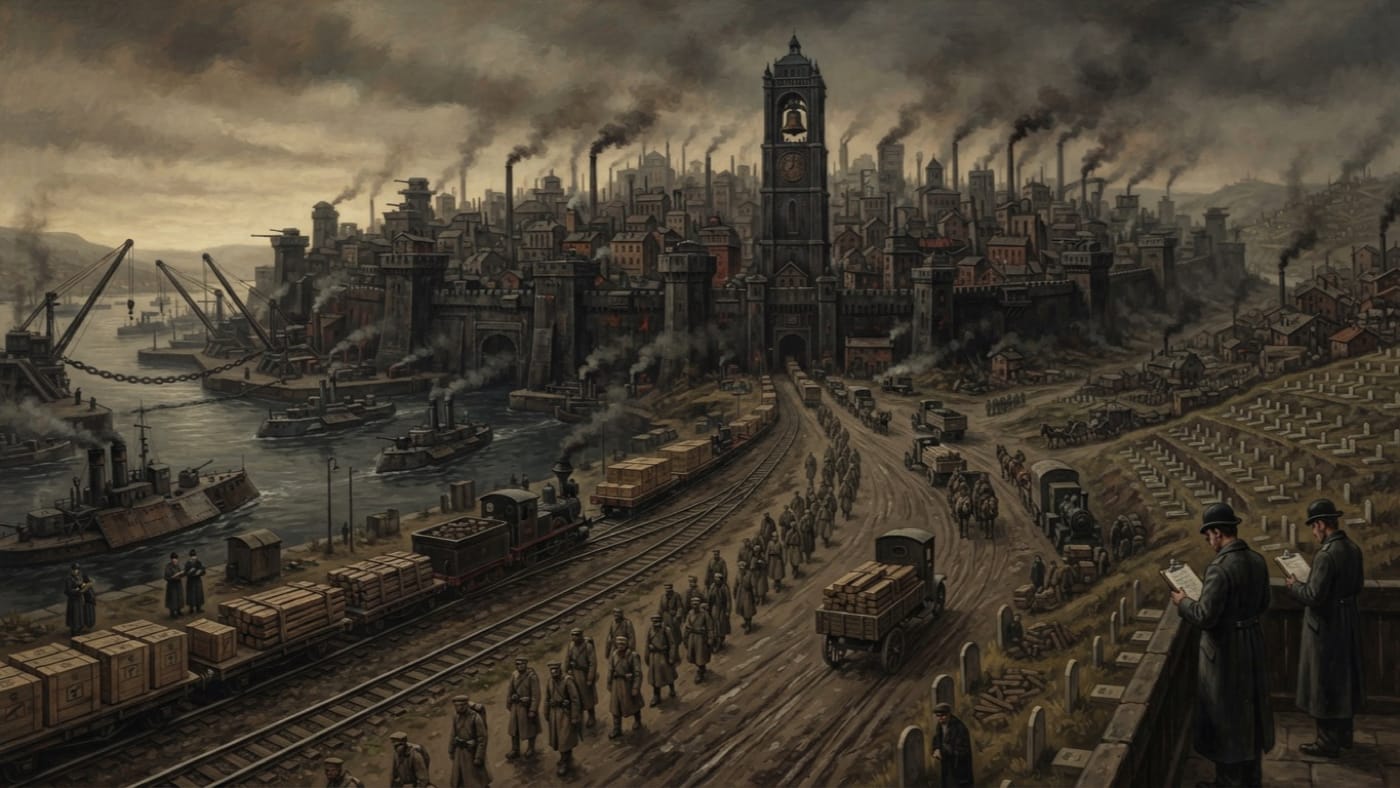
The site is a hinge. The trench-spine comes down through Thrace, meets the water, and stops. To the northeast lies the Black Sea, which has the name of a sea and serves as an attack lane. Beneath the ramparts the city remains enormous, ancient and frightened. Reliquary masonry, gun platforms, chapels, ration halls, clerks' offices and tenements all occupy the same streets, crowded together like organs in one chest.
Two Sin-Generals press on it at once. No other bastion on the Line has that distinction, and none has asked for it.
Kargath comes by the Black Sea and the Thracian marshes. He works quietly. Grain reaches the gates damp, salt pork arrives with something moving in it, and cistern water turns sour before the bucket clears the lip. His war is fought on convoys long before it reaches the walls.
Maldrake comes out of Thrace in campaigns of fire and slag, bringing siege-engines that walk and furnaces that march in step. The Bureau of War calls his intervals irregular. The garrison calls them too short.
Earlier doctrinal plates style the fortress the Western Anchor of the Line.
Corrected. Bastion-Constantinople is the southern anchor. The Line runs north to south, and the fortress stands at its foot. The error is attributed to cartographers who wanted the Church's most famous wall to point toward her most famous cities, and who drew accordingly.
#On What Reaches the Walls
Stone stands by itself. A garrison has to be fed.
The Hintermark lies west of the fortress in Zone 3, along the road-and-rail approaches that run back toward the Sofia corridor. Most of what the Last Lock spends arrives along that throat. Coal goes to the Harbor of Chains, where it keeps the lamps and windlasses working. Metal, labour and the dirtier contracts go to the Foundry Quarter. Levy replacements walk east in columns that are counted at departure and counted again on arrival. The two figures are reconciled afterward by men who were present for neither. Coffin timber rides east stacked flat and returns east assembled.
Each town in the belt does its own work. Keska smelts and reworks. Edremit casts boiler throats and lower-grade rivet stock, and it will tell any inspector who lingers that Constantinople would choke without it. The smaller villages burn charcoal, sort scrap, cut boards to the regulation length for a man of average height, and raise sons whose hands War measures before Doctrine has tested their catechism.
Arch-Artificer Lute Brann draws on three of these foundry-towns for his lower works beneath the Quarter. Keska and Edremit are named consistently. The third origin changes its designation from one filing to the next. I have read the filings and I decline to choose among them. The consignments travel by covered rail under seals other than Purity's and go down below street level on arrival. That is everything this article needs to say about them. Anything further belongs in another article, with another seal on it.
The Hintermark supplies two further goods that never appear on a manifest. The first is routing discretion: a wagon can pass through a village without the village asking what it carries. The second is burial capacity. The fortress needs graves as much as it needs coal, and graves take up ground that the Last Lock cannot spare inside its own walls.
The Administrative Redrawing of A.S. 188 (1898 CE) took in the Hintermark and the fortress's eastern terraces under the same mandate. Forty thousand civilians were displaced or reclassified. Keska dropped out of the Zone tables altogether and stayed out for eleven months. Throughout those eleven months it kept shipping metal on schedule. Yvette Langres reconciled the Keska packet in A.S. 189. The fortress itself registered no interruption.
#On Holding by the Bell
Inside the walls, bells keep the time. The Bureau of Bells maintains the bronze, the ropes and the men who pull them. The Bureau of Doctrine decides what each peal means. The Bureau of Tithes attaches an obligation to each meaning. The Bureau of Records certifies that the bell rang, that the meaning held, and that someone paid. Four offices share every hour. Not one of them can strike the hour on its own, and each of them keeps the others' receipts.
Ration issues follow the peals. Miss the noonday bell and the kitchens close their shutters, and the shutters stay closed until the next lawful hour, whatever the hunger in the queue. Gun crews on the ravelins eat to the same bell as the widows in the lower terraces. Each group finds this a scandal in its own way.
Hunger in the Last Lock is punctual. So is the order of priority. When shells and bread compete for one wagon, the shells ride and the bread waits at the siding with Kargath for company. When foundry contracts compete with roof slate, the roof waits. A stamped manifest settles each of these disputes, and the city has learned not to argue with a stamp.
The dead are counted by bell as well. Doctrine holds that within earshot of the fortress's towers each soldier's end is written into the Book without any human hand. An unsealed Records note replies that their ink never runs dry at the southern anchor, and that this is a different thing from autography. I set both opinions down and endorse neither. Whoever writes the name, the board under the body came west to east on a Hintermark flatcar.
Not every danger comes by sea or out of the Thracian smoke. Cold coin turns up in the counting-houses now and then. It is the currency of Velmora, whose own bastion is far to the north at Sibiu. Her money travels further than she does and is accepted more readily than it should be. The Last Lock fights famine in its warehouses and fire at its gates, and it fights clerks in its own ledgers whenever a debt has been signed by the wrong hand.
#On Present Condition
As of A.S. 201 (1911 CE), Bastion-Constantinople stands as it has stood since its designation. Every map now carries its proper name. Pilgrims call it the shield of the Church, the Hintermark calls it the Last Lock, and the Bureau of War calls it a demand schedule.
The roads behind it are among the best kept in the southern corridor, because an army eats by road. The houses along those roads are among the worst kept, because a house fires no artillery. Grave-fields climb the Hintermark slopes in orderly terraces, and the orchards beside them have grown used to smoke. Kargath still spoils what he can reach. Maldrake still returns when his furnaces are full. The coal still goes to the harbor and the metal to the Quarter. The levies still walk east, and the boards still ride east behind them.
At dawn the trains leave the western sidings. At noon the bell opens the ration hatch. At dusk the road lamps burn eastward, toward the walls, and every wagon on the throat travels in the same direction, away from the villages that loaded it.