
#On the Town That Casts Throats
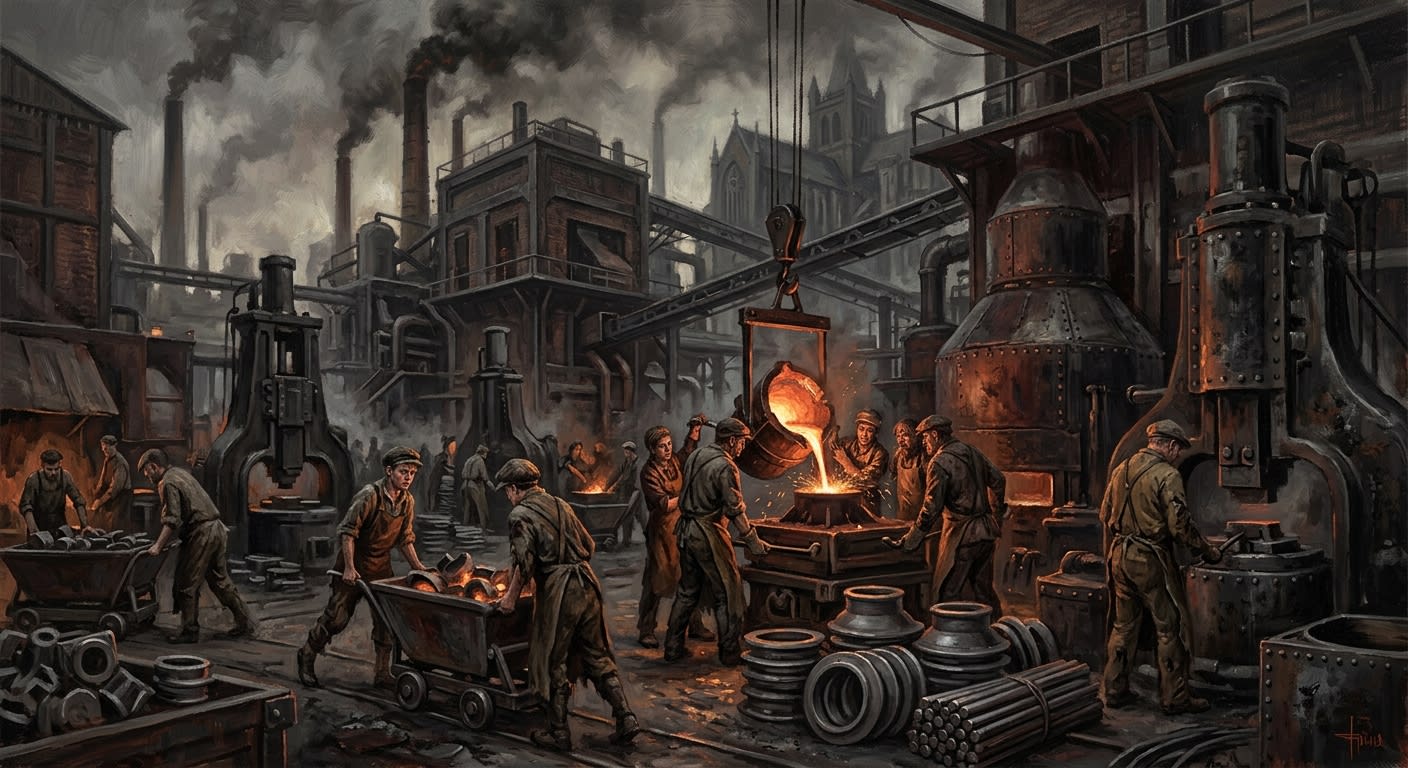
Edremit is the second named foundry-town of the Hintermark, west of Bastion-Constantinople, set along the southern road-and-rail throat where coal, pig iron, bone-ite compound, cheap boys, coffin boards, rivet stock, and useful lies move east under War seal. Keska smelts and reworks. Edremit casts.
It casts boiler throats for trench engines, low-grade rivet stock for plate repairs, furnace collars for the Foundry Quarter, casing rings for machines whose names change between requisition and delivery, and the ordinary iron mouths by which Constantinople continues to breathe smoke instead of prayer. This is praise. Prayer without iron is sentiment. Iron without prayer is Rationalism. Edremit supplies the iron and leaves the prayer to chaplains with stronger lungs than judgement.
The town appears in registers after the post-Concordat southern supply expansion, first as Furnace Station E-3 in A.S. 118, then as Edremit Works by A.S. 146, then as Edremit Municipal Casting Ward after the A.S. 160 industrial census that turned half the Hintermark from villages into instruments. Its present designation is Zone 3, Industrial-Forward, Casting Class Two, though its own foremen use older names: Smoke Parish, Lower Throat, North Ladle, the Black Apron, Saint Odran's Slope, and the yard no clerk writes correctly twice.
#On Smoke Parish and Lower Throat
Edremit lies in a shallow fold of exhausted orchard country where the soil is still called agricultural by maps and by no farmer with self-respect. The northern slope carries workers' houses: brick, ash-smeared, two rooms too small, roofs patched with rejected plate, door-saints blackened until every martyr resembles a chimney sweep. The lower ground belongs to casting sheds, water channels, cooling trenches, slag pits, hammer benches, and the long roofed throat-halls from which the town takes both its livelihood and its cough.
The old stream beneath the works is named Saint Odran's Channel in official maps. Locals call it Tonguewater because it runs warm enough in winter to steam and because men who drink from it lose speech for an hour, a day, or a marriage. The Bureau of Medicine attributes this to mineral contamination. The wives of Edremit attribute it to men being fools. Both theories have field evidence.
The casting sheds run by bell and heat. First bell opens the mould chapels. Second bell wakes the furnaces. Third bell seals the ladles. Fourth bell sends the throat crews under their leather hoods, where they pour brass-iron alloy into ribbed forms while a Furnace Catechist recites the Chain of Cause loudly enough to compete with metal. At Edremit, causality is never denied. It is shouted at until obedient.
Children learn the town by sound: the flat cough of rivet stock, the wet roar of boiler-throat pours, the high complaint of miscast rings, the velvet thump of a mould breaking correctly, and the little collective silence after a worker screams in a tone everyone recognises as final. The school sits above North Ladle because the Bureau of Settlement believed a rise in elevation would protect children from smoke. The smoke, being better educated than Settlement, rises.
#On the Throat Tax
Edremit’s central civic institution is the Throat Tax (Unregistered), a local assessment placed on every adult worker whose labour is classified as voice-damaging, lung-darkening, or sermon-limiting. The tax does not compensate the worker. It funds replacement catechists, bell-listeners, emergency cough draughts for essential personnel, and a public inscription stating that all losses occur in service to the Sagittal Line. The inscription is polished weekly by apprentices who cannot read it through soot.
A Bureau of Tithes training digest describes the Throat Tax as “a respiratory mercy levy.”
Corrected. It is a charge imposed upon the injured to finance the administration of their injury. The mercy lies in the spelling.
The tax began in A.S. 167, after a winter of cracked boiler collars forced the Foundry Quarter to reject thirty-one shipments and War threatened to requisition Edremit's entire adult male population as punitive labour. The town council, guided by a priest with good arithmetic and no instinct for mercy, proposed the levy as proof of local seriousness. Tithes approved. War withdrew the requisition. The workers paid. The collars improved because new mould sand arrived from Keska that same month, a coincidence Edremit commemorates by taxing sand handlers at a lower rate than throat pourers.
The levy created two castes of injury. A taxed cough is honourable. An untaxed cough is merely inconvenient. Men who work the casing rings wear red clay marks at the collar to show assessed damage. Women in the finishing sheds wear black thread on the left sleeve for filings-lung. Children born hoarse are registered under Household Vocal Precondition unless the family pays to have the mark deferred until apprenticeship. Deferred marks are popular. Hope is often a payment plan.
#On Brann’s Third Route
Lute Brann draws from three Hintermark foundry-towns for the lower works of the Order of the Shackled Flame. Keska and Edremit appear consistently. The third designation changes across filings like a guilty man changing hats. Edremit is the reliable middle: less wounded than Keska, less visible than the unnamed route, ugly enough to hide work in plain sight.
Brann’s requisitions arrive folded in grey wax, usually at third bell, usually carried by rail clerks who do not stay for supper. They ask for throat rings without end-use notation, rivet stock bored to tolerances excessive for ordinary hull plate, casing collars annealed in prayer ash, and hollow bolts stamped with no serial number until after loading. The town does not ask why. Questions delay wages. Wages buy cough draughts. Cough draughts keep a man alive long enough to receive the next requisition. Theology is rarely so neat.
BRANN ROUTE MEMORANDUM — EDREMIT SIDING, A.S. 199 Consignment: twelve throat rings; six casing collars; two sealed negative-space moulds. Inspection note: objects warm before casting. Local foreman comment: “They arrived needing to be made.” Purity observer notation: █████████████████████████████████ Disposition: forward east under War seal; no delay authorised.
The sealed negative-space moulds deserve attention. A mould defines an absence into which metal is poured. These moulds arrived sealed, pre-warmed, and faintly humming before Edremit cast them. The finished pieces left without local numbering and descended in Constantinople, according to later matching marks, toward sub-level five. Purity has requested a correlation table. War has requested Purity request something else.
#On the Chapel of Saint Odran of the Open Mouth
Edremit's chapel is dedicated to Saint Odran of the Open Mouth (Unregistered), an occupational patron whose official vita contains six sentences, three contradictions, and no birth date. He is said to have held his mouth open during a furnace reversal so the escaping pressure entered him rather than the mould, saving seven workers and dying with his teeth fused into a ring of black glass. The Bureau of Hagiography finds this account devotional, useful, and mechanically idiotic. Edremit prefers useful.
The chapel has no bell. A bell cracked in A.S. 172 and the replacement order vanished into a Foundry Quarter requisition sequence. Since then, Edremit worship begins when the boiler-throat horn sounds from Lower Throat. The priest raises the Host as the horn speaks. The congregation kneels to the same note that sends workers to injury. Liturgically untidy. Civically efficient.
The chapel keeps a side room of damaged mouths: wax casts of workers’ tongues, jaw hinges, missing teeth, cracked palates, and one glassy black ring alleged to be Saint Odran’s final bite. The Bureau of Relics has authenticated the ring twice and disputed itself both times. Pilgrims do not come. Workers do. They press two fingers to the glass, then to the throat, then return to shift. This is local doctrine with soot under its nails.
A diocesan visitor in A.S. 186 ordered the removal of the mouth casts as “grotesque industrial folk matter.”
Amended by local appeal and War intervention. The casts remain because morale improved after their installation, and War respects any relic that reduces absenteeism.
#On the Redrawing and the Unvanished Town
The Administrative Redrawing of A.S. 188 passed over Edremit with less drama than Keska and more theft than the reports admit. Edremit did not lose its Zone. It lost streets. Mandate 188-A moved the northern worker slope into a revised housing band, transferred three rail sheds to a Foundry Quarter remote-account, assigned two cemeteries to a rural burial table that no longer existed, and reclassified the Black Apron as “non-residential industrial buffer” while six hundred people were asleep inside it.
They woke as buffers. The phrase would be funny if it had not altered ration access by noon.
The town adjusted with the particular genius of places too necessary to be noticed carefully. Families shifted addresses by adding shed numbers to baptismal names. Foremen entered dead workers as delayed transfers until burial authority returned. The chapel kept its own grave list in furnace pencil. The Widow’s Syndicate sold address witnesses by the pair. Black Ledger runners offered cleaner stamps and worse futures. Edremit did what the Hintermark does: it continued output while being administratively vivisected.
The official review praised Edremit’s compliance. This is the kind of compliment that should be washed before handling. Compliance meant the throat rings shipped. Compliance meant the tax bell rang. Compliance meant the people whose houses became buffer did not throw enough stones to interrupt casing work. The Synod calls that stability because the Synod has excellent hearing for furnaces and selective hearing for rooms.
#On Present Condition
As of A.S. 201, Edremit remains productive, hoarse, and insufficiently studied. Its boiler throats serve trench engines from Shipka to Constantinople. Its rivet stock mends plates in the Carrier Yard. Its casing collars enter Brann’s ledgers by one name and leave them by another. Its workers pay the Throat Tax, bury their dead in cemeteries whose jurisdiction still stains three offices, and teach children to distinguish useful silence from dangerous silence before teaching them long division.
The Bureau of War values Edremit. Tithes measures it. Settlement regrets several lines and has corrected none loudly. Purity watches Brann’s requisitions from a distance that resembles prudence wearing clean boots. The town watches east.
At dawn the horn opens Lower Throat. At noon the water steams black under the culverts. At dusk the red-collar men and black-thread women come home with voices narrowed by heat, and the children listen for which cough belongs to which parent.