
#On the Approved Life
A clean note wards a dirty mouth.
The approved Life of Orla is the most consulted text in the Iron Choir and the one that says least about its subject. It gives her no birthplace, no parents, no age, no childhood vision and no face. It begins with a posting. A psalmist of the Bureau of Orison and Song is lent to Purity's iron chapels, does her work, does it again, and dies doing it. The compiler is unnamed. The Life records no date of composition, approval or revision, and no count of surviving copies. I have asked the Archive for all of these. It returned a polite blank in four colours of wax.
The woman is filed under Saint Orla of the Steady Note. This entry concerns the thing that was made from her: the account an Iron Choir Brand-Singer hears read at induction, cites at examination and mutters in a cold corridor before the condemned are brought down. The Bureau of Rites recognises the cult that the Life sustains. The Bureau of Doctrine examined the miracle testimony underneath it. The Bureau of Purity uses it. In this profession, use is the only authorship anyone has ever asked for.
#On the Borrowed Voice
From A.S. 94 to A.S. 104, Purity had irons, Lictors, scribes and a growing supply of the condemned, but it had no singers of its own. It borrowed trenchline psalmists from Orison and called the arrangement provisional. Purity's problem was a bodily one. A brand is a sentence. Burned into a struggling forearm, that sentence comes out as a smear that no tribunal can read and no Records clerk can file.
The Life places Orla in the first Strasbourg iron chapels during the late Market Drift years, when street recitation of the Creed was failing and Purity's dockets were filling faster than its procedures could empty them. It gives no year for her posting. In fact it gives no year for anything until the end.
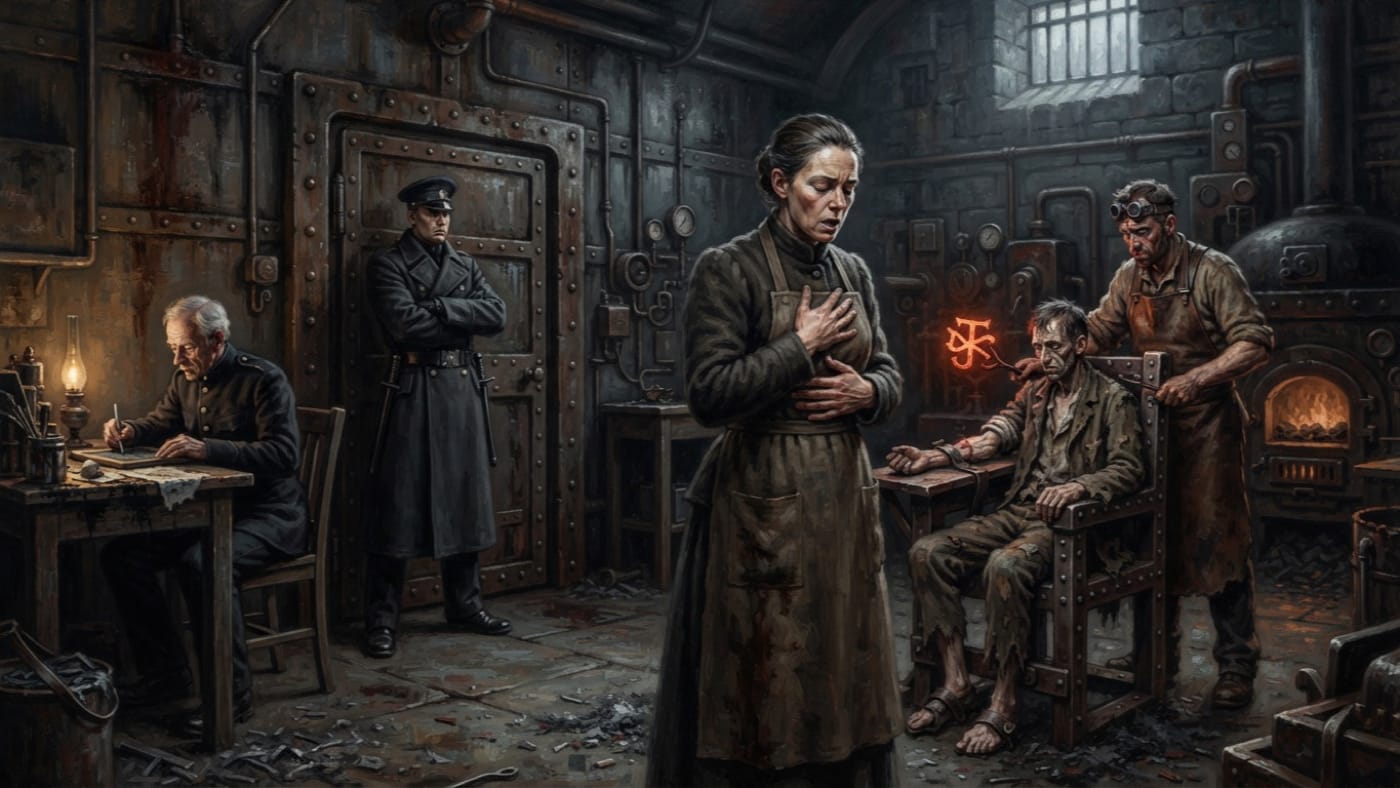
The first approved miracle takes place at a forearm branding. A condemned lecturer from Cologne thrashed hard enough that two brands slipped. A scribe fainted. A Lictor lost a tooth to the chain. Orla was standing at the threshold. Nobody had ordered or summoned her, and she began a low drone. The man went still, the iron came down true, and the inscription held.
The devotional copies leave the lecturer unnamed. The saint's dossier records that a sealed appendix identifies him as Father Arnolt Deiss. I note the appendix and decline to add to it. The Life needs no biography of the man. It needs only his forearm.
Popular chapbooks have Saint Orla's psalm cool the iron in the Brand-Smith's grip, heal the condemned lecturer and turn back a mob at the chapel door.
Corrected. The approved outcome is a legible confession on a living arm. The iron kept its heat. The lecturer kept his burn. No mob is recorded. Chapbook printers are reminded that the miracle of record is accuracy, and that accuracy sells poorly to washerwomen.
A profession was founded on this miracle, which consists of a sentence burned straight.
#On the Closing Tone
Early rites ended badly. According to the Life, the chapel would not settle after the subject had been carried out. Scribes reported false echoes. Brand-Smiths heard words in the cooling water. One chorister confessed to a sin that belonged to the man he had just sung over. That last report created the kind of filing problem that keeps Records up at night. Whose sin was it now? Which ledger held it? Did the chorister owe the penance, or did the condemned receive the credit?
By the Life's account, Orla prescribed an ending: three descending notes, then fourteen heartbeats of silence. The count is in heartbeats, taken in the singer's own chest with a hand flat against the ribs. It is no unit a clockmaker could sell. The Life does not say when she first used it. It says that she used it and the chapel settled.
The prescription was practice first and law afterwards. Standing Order 22-S codified it in the same institutional season that produced Writ 14-C, and a saint's habit became a clause. Later singers named the unsettled chapel echo weather and attached a professional fear to it. The Life uses neither the name nor the fear. It describes the thing plainly and then describes how to end it.
#On the Last Chamber
The Life closes in winter. Doctrine's approved reckoning files that winter in A.S. 104, before Writ 14-C formally constituted the Brand-Singer corps. The Orison calendar, the Purity roster and a notation scratched on the back of the earliest icon do not agree, and some of them say A.S. 103. I file under 104 because Doctrine sealed the file there. The dispute remains open. I will not close it with a forgery.
Three prisoners came down from a cellar academy. The charge was teaching the Doctrine of the Inaudible Voice backward. The Life names neither the prisoners nor the academy, and it records no other charge. The chamber's north wall had been repaired that morning, and its mortar was still dark with damp. Orla tested the stone, found the baseline unstable and asked for another room.
A tribunal prefect refused her. The Life does not name the prefect. It records only the authority behind the refusal, which was quota. Quota authority is an excellent instrument for many purposes. Stone is not one of them.
The first brand went in, then the second. At the third, the Life reports, the chamber answered, and it answered early. The response sounded half a breath before Orla's own note arrived, as though the room had read ahead in the hymnal. The three prisoners began to breathe together. The Brand-Smith dropped the iron, and it hissed in the ash on the floor. The scribe wrote one word eleven times on his slate and then tried to eat the slate. The Life does not say what the word was.
Orla lowered her drone. She held it beneath the room's note, pressed down interval by interval, and kept it there until the Closing Tone was finished, three descending notes with the silence still to come. Before the silence, she gave the only command the Life puts in her mouth.
Do not answer it.
She died after fourteen heartbeats of silence.
#On the Corrections to Devotion
The Life has been corrected, though its frame has never been touched. Three corrections matter.
The first concerns the lecturer. Devotional copies keep him nameless, and the sealed appendix keeps his name. Each document does its own job. An unnamed man makes a better homily. A named priest from Cologne prompts letters from Cologne.
The second concerns the throat. The devotional account says Orla's throat stayed warm for three days after she died. The infirmary account says her vocal cords were torn in three places and her lungs were full of ash. One document is read aloud at feasts. The other sits where the Bureau keeps documents that are not read aloud at feasts. Doctrine has certified neither a bodily miracle nor a mechanism, and this archive will not certify one either. Both accounts sit in the file under the same violet seal, and they do not quarrel.
The third concerns her heart. Devotional manuals once urged singers to imitate Orla's compassion. Purity Circular 14-C/9 struck the word and substituted steadiness and control. I can find no date on the circular. Its effect, however, is easy to date: every novice inducted since it took hold has been taught to read the Life for its breathing. Read that way, the drone at the Cologne lecturer's threshold becomes a demonstration of pitch, and the lowered note in the last chamber becomes a lesson in technique. Nothing in the text has changed. The readers have been retuned.
#On the Life in Service
The Life is used for examination. A candidate sustains Orla's Line, a low drone held while an auditor reads false charges, family names, bribe offers and fragments of forbidden melody aloud. The candidate who drifts fails. The candidate who weeps and holds pitch passes. The weeping is not marked. A Cantor-Marshal who wants to make the point taps the slate where the Life says the inscription held and waits for the novice's breathing to steady.
The Life is also used in argument, and the schools read it as rival lawyers read a will. Mercy Tone reads the preserved breath: the lecturer kept alive long enough to be written on legibly, and the last three prisoners kept alive until the Closing Tone was done. Judgment Tone reads the accurate inscription and points out, correctly, that the Life ratified a clean brand and said nothing about a comfortable one. The Silentists read the final command and the half-breath before it. They conclude that every licensed note is an invitation, and that the holiest singer is the one who was ready to stop.
Orla belonged to none of these schools. All three received their charters after her death, and the Life records no opinion of hers on any of the questions they fight over. That silence has made her the most useful saint in the profession. Each school can claim her, and the Bureau can let all three do so. A corps arguing over a dead woman's breathing has no breath left to argue about its wages.
Her account is fixed. Two brands slipped, then a third held. A wall was repaired that morning and a prefect refused a transfer. A room sounded half a breath early. Fourteen heartbeats of silence followed, counted against the ribs. Everything else in the Life was written by other people and later corrected by others still.