
#On the Catechism Performed in Iron
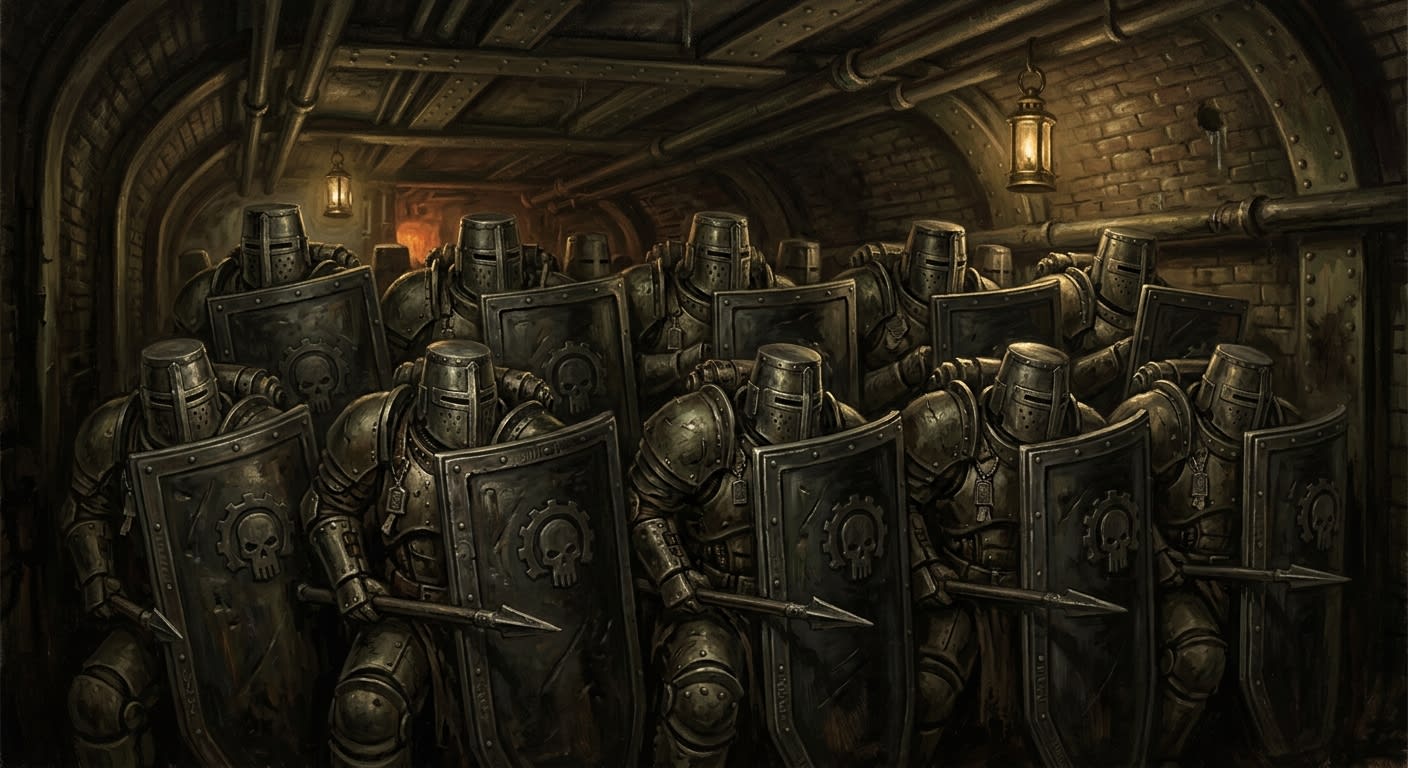
The Lock Formation is the Wall's smallest republic: three ranks of Shield Paladins, one shared breath, and an agreement that terror may enter the body but may not pass through it. War describes it as a breach-reception drill. Doctrine calls it embodied refusal. The Paladins themselves, who have little patience for phrases composed by men sitting down, call it the Lock.
A citizen imagines a row of tower shields. The citizen is wrong with his usual economy. The Lock is a verdict arranged by hinges, knees, hooks, jawbone chant, mud-depth, and the thick theological fact that a frightened man may be made into architecture if given enough iron and insufficient permission to flee.
The formation belongs to the Doctrine of Layered Death as the first barrier, the visible barrier, the barrier simple enough for children to draw and difficult enough for grown men to die performing. Behind it, Litany-Engineers prepare charges. Above it, Ash Chaplains turn lungs into mortar. Around it, Radiant Fusiliers wait for banner-light and permission. Beneath it, the ground is expected to behave. The ground frequently disappoints.
#On the First Rank
First rank drops. This is the sentence in the manual, clean as a nun's knife. In practice, the first rank descends into mud, brick-shard, blood-water, coal dust, hot shell fragments, dead insects, boot nails, teeth, and whatever else the breach has prepared as welcome. The left knee enters first. The shield edge bites forward. The shoulder rolls behind the upper brace. The right foot remains planted if the earth permits; if the earth refuses, the Paladin plants faith, which is less stable but easier to praise afterward.
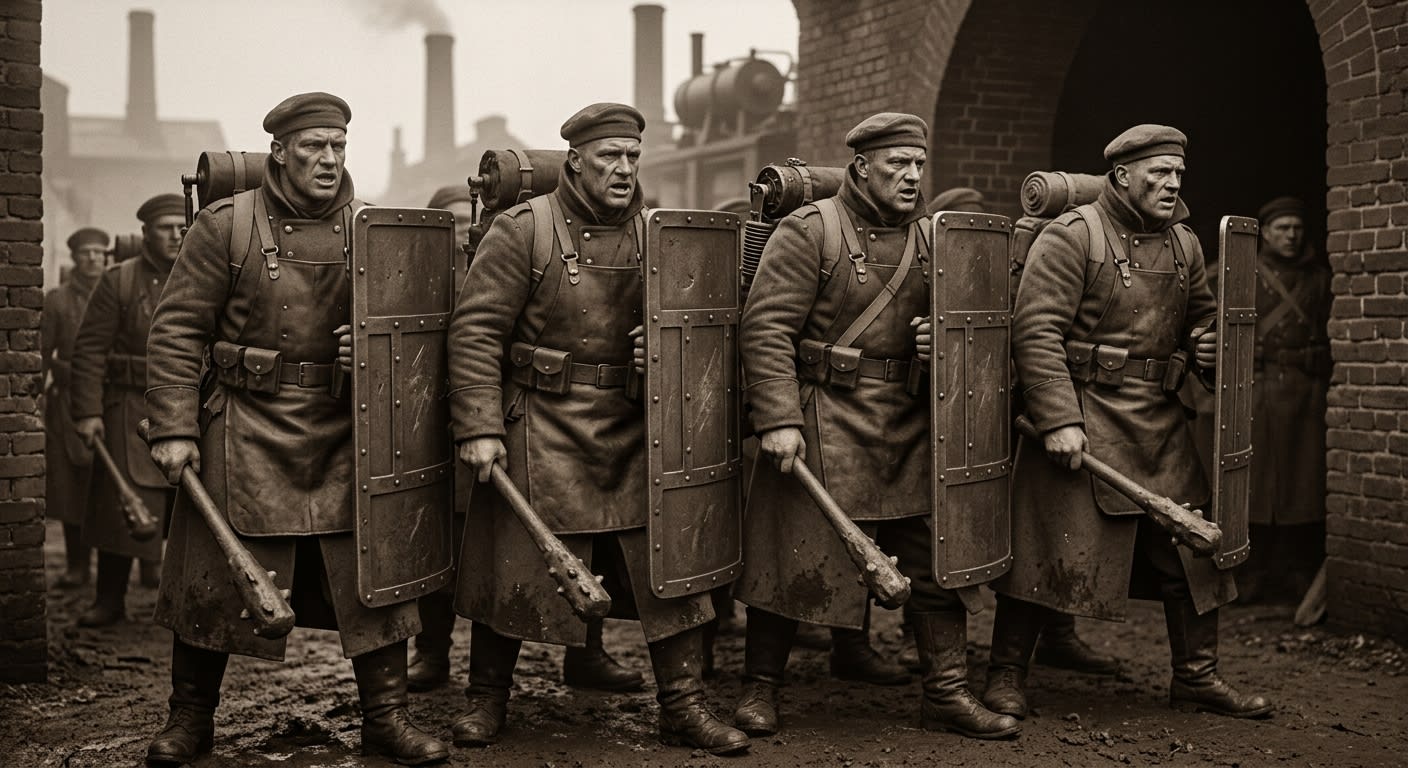
The first shield does not meet the enemy. It meets the next shield. That is the secret children are not taught at parades. A hero faces outward. A Paladin first faces sideways, judging angle, pressure, rim-bite, hinge-height, the little seam through which an Ash-Fodder spear or a Wormhost coil might write its own rebuttal. The enemy kills men. Gaps kill formations.
The shield is wider than mercy and less flexible. Its chant-rim carries grooves cut so a blinded Paladin may read alignment by touch. Its lower lip is notched for trench boards. Its inner straps hold forearm, elbow, and sometimes the last reasonable thought the bearer will ever have. A properly placed first rank appears still. Stillness is effort sealed under iron. A cathedral looks serene because the stones have no choice.
#On the Second and Third Ranks
Second rank overlaps. Their shields ride half a breadth above and behind the first, closing the upper seam and taking the blows that would otherwise turn kneeling men into opened cupboards. Second rank also chants the breath-count: Credo Lapidem on each exhale, low enough to travel through jaw and collar when artillery swallows the air. Shouting is forbidden. Shouting opens the throat, lifts the ribs, breaks the brace, and informs the Enemy that the Paladin has opinions. Opinions are for officers before contact and widows afterward.
Third rank braces the backs of the kneeling men with shield-hooks and shoulder poles. In narrow works the third rank becomes reserve, dragging fallen shields into place. In wide breaches it becomes a second wall. In catastrophe it becomes corpse removal with theology. The distinction is decided by time, and time at a breach is a clerk with burning sleeves.
Early drill cards stated that fourth-rank deployment was optional support.
Corrected. Fourth rank exists when there are enough living bodies to afford optimism. Its duties include reserve pressure, casualty extraction, shield recovery, and receiving shouted orders from officers who have confused volume with command.
The third rank learns the hardest cruelty: to recover the shield before the man. A dropped shield is a psalm unsung; a dropped Paladin is a sorrow, an invoice, a mother, a Mass, and a replacement request. The shield keeps the line legible. War's preferences are rarely tender, but they are generally arranged in the order that preserves breathing for the greatest number of inconvenient souls.
#On the Saint Ardent Variant
The Saint Ardent (Unregistered) variant is the form used when smoke erases sight, bells misalign, or the breach has become too intimate for trumpet command. It adds chant markers cut into shield rims, pressure signals along the left edge, and a threefold emergency seal repeated by touch: press, hold, release; press, hold, release; press, hold until answered. Speech fails first. Hands remain doctrinally useful for several seconds afterward.
Call: Stone. Answer: Creed. Command: Brace. Countersign: None shall pass. A recruit learns these before his field name, before his coffin dimensions, before his instructor bothers remembering his original parish. The words are short because long words perish in smoke. I say this as a man of long words and am not wounded by the fact. Even magnificence must sometimes kneel before utility.
The variant was named for Saint Ardent of the Lower Works (Unregistered), whose historical existence is disputed by Hagiography, War, and a widow in Essen who claims the saint was her grandfather with better press. The debate is harmless. The drill works. Function is the sternest canonisation.
#On Failure
The Lock fails by gap, tilt, swallowed knee, broken chant, backward corpse, inward turn, command confusion, hostile song, liquefaction, parasite rupture, panic disguised as initiative, and officers attempting inspiration at the wrong decibel. These are War's failure ledger entries, each with names beneath it, many of them spelled correctly.
Gap is the common killer. A half-inch opens. A blade enters. A hook catches. An Ash-Fodder shoulder wedges where doctrine should have been. Tilt follows fatigue: the shield leans back, the upper rim exposes the throat, the second rank overcorrects, and the line develops a mouth. Swallowed knee belongs to Flesh-Mud sectors such as Knife Mile, where the earth pulls the first rank downward and converts holy immovability into burial.
Broken chant is subtler. Pale Chanters do not need to kill a Paladin if they can interrupt the syllable by which he measures breath. One missing exhale becomes one missed brace. One missed brace becomes a seam. A seam becomes a file of dead men and a posthumous committee.
TRAINING ADDENDUM — SECOND-RANK HOOK SEVERANCE If a Wormhost ruptures within second rank, adjacent Paladin will apply hook severance through host spine and shield strap. If parasite repeats countersign in the host's voice, do not answer. If formation pivots inward without command, rear officer will fire into the pivot. Survivor names from ████████ Sector sealed by Mercy request and War refusal.
Backward corpse is the shame category. Death is permitted. Falling forward is acceptable. Falling down can be built upon. Falling backward opens space, and space is the Enemy's favourite chapel. Paladins train to die into the Lock. A body that falls correctly remains useful. There is comfort in this, if one has been educated beyond softness.
#On the Mud Lock
The Knife Mile taught War that the Lock could be horizontal. During the Catastrophe of A.S. 137, the trench became a mouth, the parapets melted to stakes, and the enemy entered behind Ash-Fodder waves. Paladins drove shields into the mire flatwise, edgewise, crosswise, making a causeway from iron and trapped bodies so the Radiant Fusiliers could cross and fire the breach shut.
Manuals now call this the Mud Lock. The diagram is handsome: blue arrows, black shield marks, tidy bodies represented by rectangles with no faces. It is taught as adaptive anchor doctrine. It should be taught beside a basin of mud and a man whispering from underneath, but training committees dislike instruction when it stains the floor.
Public teaching sheets describe the Mud Lock as a planned tactical adaptation of the Lock Formation.
Corrected for officer copies. The Mud Lock was an improvisation performed by men too trapped to retreat and too well trained to die uselessly. War later discovered intention in the wreckage, stamped it, and sold it back to the living as doctrine.
From that day, the Lock added plank, dam, plug, brace, gate, coffin-lid, and road to its duties as wall. The Paladins did not enjoy this enlargement of duty. War rarely consults tools before discovering new uses for them.
#On Enemies That Study the Seam
The Shadow Court has read the Lock by beating itself against it. That is one of Hell's few respectable habits: it learns. Ash-Fodder spend arms and breath until Paladin shoulders tremble. Rotbelchers (Unregistered) liquefy the ground beneath the first rank. Maldrake's forge-beasts time impact between brace calls, striking the pause where flesh remembers it is flesh. Velkara's agents perfume straps so fingers loosen at the hinge. Syrion sends sleep-fog where waking is the only mortar.
Wormhosts remain the Lock's particular insult. The formation assumes danger presses from outside. A Wormhost waits within the human file, then opens. No wall likes discovering a door in its own ribs. Second-rank hook severance exists for that hour: sever, burn, hold. The verbs are short because pity must not be given room to sit down.
#On the Present Discipline
As of A.S. 201, the Lock Formation is drilled at all seven bastion sectors of the Sagittal Line, altered by geography but never excused by it. Brest teaches lowland mass reception against crowds that arrive like arithmetic made hungry. Przemyśl teaches ridge locks, angled into wire and frozen clay. Sibiu teaches gatehouse locks where twelve men can become a mountain's refusal. Irongate teaches damp locks under pressure-door thunder. Shipka teaches waking locks against Sloth, with pain pins and bell rotations. Constantinople teaches everything because the southern anchor receives every ugliness with a queue number.
The recruit learns that the shield is returned when possible and the body when convenient. He learns that air between shields is sin with room to grow. He learns that the man beside him matters less than the rim beside him, then learns, after the first assault, that this is how the man beside him survives. War's mercy arrives disguised as geometry. Naturally, people complain.
The Lock remains a scandal to softness and a comfort to those of us paid to prefer the living Line over the individual pulse. A breach opens. Men panic. Bells stammer. Smoke erases command. The Paladins drop, overlap, brace, murmur into iron. The wall answers.