
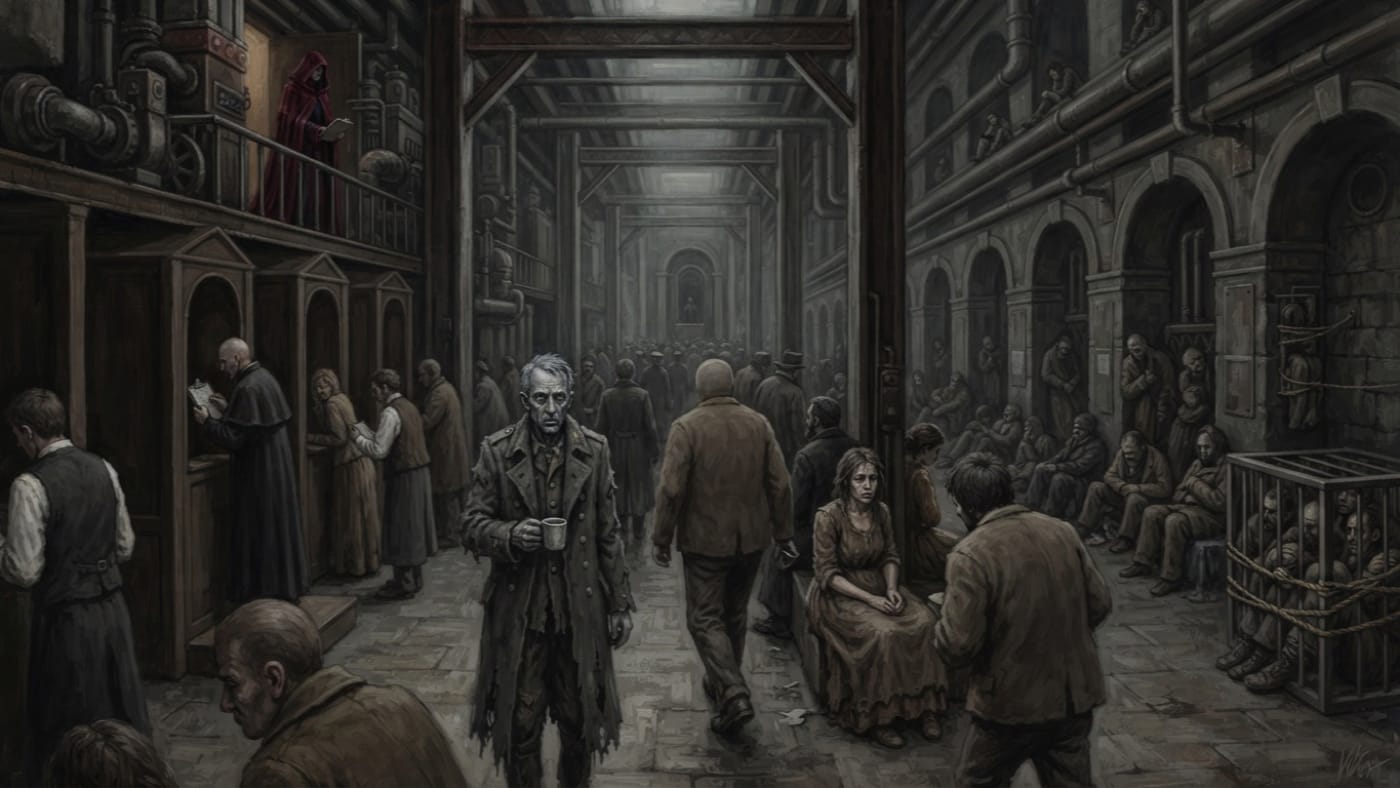
#On the Appetite
The Bureau of Doctrine defines Lust in a single clause, and I have spent a good part of my career defending it against men who wanted it shorter: the use of a person as material for sensation, and the setting-aside of that person once the sensation is spent. The clause makes no mention of beds. Clerks who open this survey hoping for beds may leave by the side door. The Bureau of Purity keeps a register there for the disappointed.
Desire is no sin. The Creator made the appetite along with the tongue that tastes and the hand that reaches, and the Church has never condemned a wife for wanting her husband home, or a widower for missing the warmth of a shared blanket, whatever certain parish preachers have told their congregations. Affection is permitted. Pleasure is permitted, in its ration. Doctrine condemns the moment a face stops being a face and becomes a vintage, to be tasted, compared, and put back on the shelf with the cork pushed in.
The vice has a general. Velkara, the Crimson Temptress of the older chronicles, is the Sin-General of Lust. The Synodal catalogue adds a train of further titles, among them Lady of the Fading Sensation and She Who Hungers for the Next. When the field reports speak of "Lust's hosts," they mean hers. Her person and her catalogue of horrors are filed under her own name. This tract concerns the appetite she commands, which a man may practise for thirty years without ever having heard of her.
#On Pursuit and Its Accounting
It begins with boredom, which no confessor in my experience has ever thought worth confessing. A comfortable life that registers as nothing. A marriage gone to routine. A posting where every day repeats the last. Doctrine's account holds that the influence-demons of Lust seek out this dissatisfaction rather than loneliness, and that their whispers sound so much like the subject's own boredom that he cannot tell the two apart. You could do better. When did you last feel anything?
Then the gift arrives, and the Bureau insists, against every preacher who calls it illusion, that the gift is real. Colour comes back into the world. The pursuit succeeds. The subject finds himself looked at twice in rooms where he was once looked through. Doctrine is careful on this point: the gift makes a man wanted. It does not make anyone want him against their will, and no perfume or whisper yet catalogued has removed another person's power to refuse. Those who report otherwise usually wish they had not refused.
What follows is a ledger. In the first season the subject remembers names, the colour of a coat, the street where a door was opened to him. By the third season the names have become initials. By the fifth they are strokes, four upright and one across, and the officer in the mess can tell you the total but not one entry. The artist who wore out three muses goes looking for a fourth. The rifleman who volunteers for the forward sap every week has learned that a quiet billet no longer registers, and that a shell landing near him does. None of these is a documented case. Each is a type, and every garrison chaplain on the Line will recognise at least one.
The threshold rises. What thrilled him last month bores him this month, and the remedy is always more: more danger, more strangers, more of what he once would have refused. Service follows dependency. The subject begins to do things for the whisper, because the whisper is the only thing that still feels like something.
Then he is spent. Doctrine says plainly that the influence does not abandon him as a punishment for disobedience. It leaves when he is no longer useful, the way a tallow-chandler leaves a pot that has given up its fat. The sensation fades past ordinary into a flat, colourless indifference that the catechists call greying. Food tastes of nothing. Music becomes noise. The people around him are objects that happen to talk.
Those he used and set aside are, in the Bureau's wording, injured parties. The phrase is mine. I fought for it in committee. The sin is the user's, and the used carry none of it.
#On the Courts and Their Servants
The Shattered Courts at Belgrade are Velkara's nominal seat. The word nominal is doing a great deal of work there, since the Bureau of War has never once found her at home. Reports from the Courts describe Mirror and Perfume Arts: corridors of glass where a reflection opens like a gate and a man comes back through it with his face slightly altered, and scented fogs that unsettle memory, so that a returning scout recalls his last confession as an assignation. Doctrine's account is that the perfume edits recollection. It does not move the hand. That distinction has been argued before three tribunals, and it has never once comforted a defendant.
Further in, the reports describe trophy halls, rooms lined with tokens and keepsakes and painted likenesses, each one labelled, none remembered. Glass salvaged from those mirrored corridors still reaches the bastion markets as Demon Glass. Purity confiscates it, and some of it is later found hanging in officers' quarters.
The Courts are a seat, and her real domain is the interior of the front itself. She holds no bastion because she needs none. Her influence turns up in ports and infirmaries, pilgrim quarters, bathhouses, officers' messes and the confessional booth. The Velvet Choir operates inside every bastion on the Line. The Crimson Concord works within Constantinople, a city that remains in the Church's hands, whatever its pleasure gardens may suggest to visiting inspectors. The Bureau of Purity concedes that it cannot reliably detect either. Nor has any tribunal established that these cells take orders from Velkara herself. A cult may serve a Sin-General faithfully without ever receiving a single instruction from her, and most of them do.
#On the Uses of a Captive
The vice has a military form, and the clearest specimen is the Brașov Flood of A.S. 110.
Kargath consumed Brașov proper. That was his operation, and it was conducted in his manner. The Flood came afterwards and belonged to someone else. From the captives taken in the surrounding lowlands, Velkara's overseers drove fifty thousand of the Ash-Fodder into the Danube with whips, and their dead became the crossing over which her hosts marched. The Flood bears the city's name, but Brașov does not stand on the river. The name records the campaign and where the captives came from, and nothing about the place of the crossing. Report details from the Synod's sappers survive under attribution: a causeway some three hundred yards across, a passage of four hours, nine days before the current broke it apart.
The fifty thousand were not practitioners of Lust. They were its material. A host that treats a person as an occasion for sensation will, under the conditions of war, treat fifty thousand persons as an occasion for a river crossing. The method is the same one the officer uses in the mess, carried out at a larger scale and with more rope.
The Shadow Court's apologists claim that Velkara has no need of chains. The bindings cut at the riverbank say otherwise. Doctrine holds that no demon can take a man's will, but nothing in Doctrine prevents a demon's servants from tying his wrists.
Earlier Codex entries attributed the Brașov crossing to Kargath's forces.
Corrected: Kargath's forces consumed the city proper. The Flood was a follow-on exploitation under Velkara's command, using captives from the surrounding lowlands. The Bureau considers the distinction material. The fifty thousand were not consulted.
#On the Prescribed Remedies
The Synod has six remedies. Each succeeds in part, and each has a published failure the Bureau would rather I had not written down.
The Discipline of Routine. Every day has the same bell, the same bread and the same duty. The theory is that sameness gives novelty nothing to work on. In practice, sameness produces exactly the boredom on which Lust feeds, and chaplains in the bastions report that the most regulated companies produce the most enthusiastic deserters to the bathhouse.
Pleasure Restrictions. Entertainment, drink and intimacy are rationed by ordinance. Escalation slows. Meanwhile the black market behind every barracks grows prosperous, because a forbidden pleasure fetches three times its price.
The Doctrine of Sufficiency. Contentment is holy, and wanting more is the beginning of sin. The teaching works on the already content. On everyone else it works as shame, and a man ashamed of his dissatisfaction hides it from his confessor until the hiding is no longer necessary.
Confession of Desire. Improper wants are spoken aloud at regular intervals, before a priest who records them. Accountability does slow some penitents. The confessor, however, now knows who is hunting, and whom.
Mandatory Presence. Prayer, meditation and compulsory attention to the hour at hand are meant to cure the habit of always looking ahead to the next thing. Penitents report that enforced presence feels like punishment, and many of them escape it in the only direction available.
Execution of the Grey. The visibly greyed are put to death as beyond redemption. Synodal policy holds that sensation, once lost, cannot be restored. That is a claim about irredeemability, and the Bureau has not demonstrated it. Chaplains can name penitents who left the pursuit and lived on in a muffled world, years later still unable to taste their bread properly, and who would not go back. Their recovery was slow and partial. Some carry injuries that no penance will mend. Whether the policy is true or merely convenient, the Bureau has never commissioned a study to find out.
The remedies keep order. The Synod is full of men and women who perform satisfaction with great discipline while privately waiting for something, anything, that feels like something.
#On the Remaining Entry
Each quarter the Bureau of Purity sends me a return from the bastions: the number of the greyed found, the number examined, the number executed. The figure arrives on a half-sheet. I initial it. The half-sheet has no column for names, and I have never asked for one.
I could tell you this year's total without consulting the file. I keep it the way the officer in the mess keeps his, four upright and one across, a neat column in the back of my diary. I could not tell you a single name from it, though I have read every one of the returns.
The officer, I am told, has also stopped noticing that he cannot.