
#On the Requirement
"No bone uncounted." — attributed to Saint Morin of the Sealed Mouth, carved above intake arches in the mortuary towns
Mandatory Burial Clearance is the rule that makes a dead body the Church's business before it becomes the soil's. No remains may be interred, transported, processed, displayed, rendered, sold, housed, exchanged or piously retained without stamped clearance from a licensed tariff-chapel clerk. Read the list twice. It covers the grave, the cart, the kiln, the mantelpiece, the reliquary shelf and the widow's back room. Clearance is no fee for a hole. It is the warrant that tells the dead where they may go and who may touch them on the way.
The requirement was adopted in A.S. 78 (1788 CE), during the First Ossuary Panic, when overcrowded and badly sealed pits along the Rhine corridor began sounding after dark. Its instrument was the Joint Classification Mandate — Remains Processing Protocol. It was issued by the Church's wartime offices for registry, rite and assessment. Later constitutional usage calls them the Bureau of Records, the Bureau of Rites and the Bureau of Tithes. The formal Synod that settled those titles would not sit until A.S. 90. From here on I use the familiar names, as everyone does, the offices included.
Records described the night noise as post-interment atmospheric settling. The diggers described screaming. The Mandate never ruled on the noise. It ruled on custody. Identity, contamination, unlicensed movement, broken rites, theft, relic confusion and untaxed bone became one obligation, and that obligation went to one desk. The Dead-Goods Tariffer still sits behind it.
#On Presenting the Dead
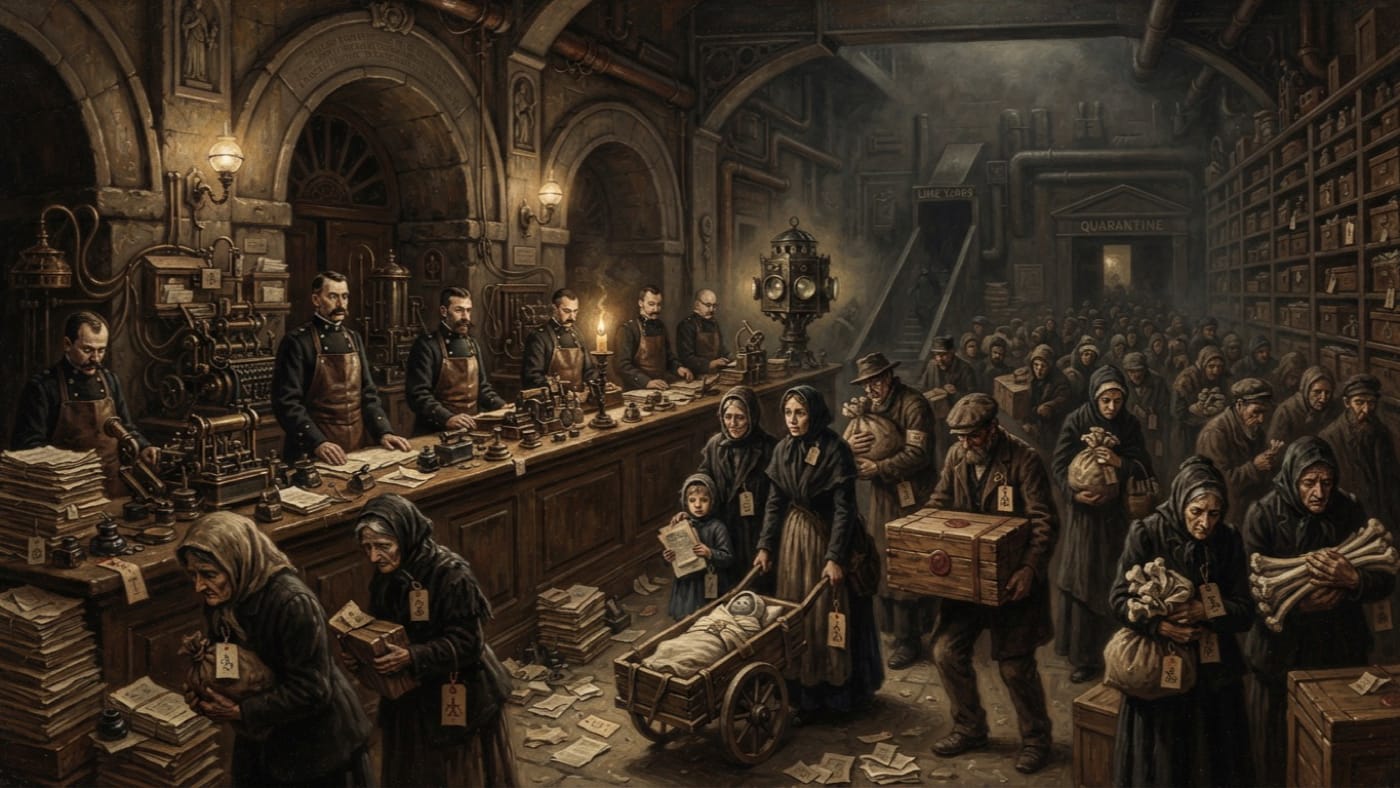
The dead reach the counter in the order the queue allows, which is seldom the order in which they died. A family brings a shrouded bundle on a handcart. A porter brings three crates and a convoy manifest. A chapel sends a letter whose seal is already cracking. The clerk wants paper before flesh: the death tag, the kin claim, the chapel letter. Anything that came by road needs its manifest, and anything of contested sanctity needs its provenance.
A Tag Runner matches the tag to the manifest. If the numbers agree, the remains get a provisional classification and pass to the purity lamp. One burns at the end of every counter at Marrowgate, in a hall that smells of lime grit, damp shroud and old wax, with the incense losing its long argument with rot. The lamp is read against the Rites rubric. The Tariffer then assesses which rites the remains still require and what tariff they owe. Then the seal press comes down on one of two papers: a clearance certificate with sealed tags, or a hold order. Routing follows, to the graveyard, the ossuary, the transport yard, the Lime Yards or quarantine. At day's end the ledger is reconciled, skull count against coffin count against ash sacks, and the chain is declared pure until the next audit says otherwise.
Families soon learn that each paper does a different job. A confession receipt says a priest attended the dying. A kin claim says who wants the body. A transport tag says where a crate believes it is going. A porter's health papers let him walk through a cordon. They say nothing about the corpse on his back, and Sanitation, which governs cordons and contagion, has no seal that classifies remains. Only the stamped mortuary clearance lets the dead move. Kinship confers no exemption. Neither does devotion, however loudly a parish insists that its martyr is too holy for the queue.
The fee is assessed, collected and receipted. Paying it does not buy release for remains the lamp has refused.
#On the Five Classifications
Five words govern every intake.
Burial permits ordinary interment. It requires verified kin, a confession receipt from the last attending priest and a satisfied purity lamp. Families want it most and wait longest for it.
Transport permits movement to a named destination, such as a family ossuary, a distant parish or a chapel vault. It requires sealed tags, a manifest entry and the transit assessment that Tithes applies. The destination is part of the clearance. A crate cleared for Strasbourg and found in a cellar at Mainz is uncleared remains with a forged itinerary.
Salvage sends suitable remains to sanctioned reuse, above all bone-lime, the mortar in the Church's walls. The unclaimed and the unattested go this way most often, because nobody stands at the counter to argue for them.
Ornamental governs decorative use, under tax. It was one of the original five in A.S. 78. The skull tariff Tithes introduced in A.S. 124 only refined what the category already charged for.
Contaminated stops release. The bay is sealed, the Bureau of Purity is summoned, and the remains go into restricted custody and specialist examination.
Cleared and held are release states, and either can apply to any of the five. Clerks talk of cargo, industrial lots and relic-grade bone. That is counter slang and adds no sixth classification. Where a fragment may be sacred, the custody question goes to the Bureau of Relics. Authentication, marking, counting and resealing in their own work belong to the Ritual Bone-Stampers. The kilnman follows the routing slip. He does not reread it.
#On the Held
The common chapel formula for a hold order is "No interment until verified." The family takes the order home, and often the body goes home with it.
Any Marrowgate parish priest will tell you that families wait weeks for burial permission and keep their dead in the house meanwhile. The back room is cooled with whatever ice the season allows, and the children are sent to an aunt. By the second week the shroud must be changed. By the third the neighbours have opinions. The tag has to match when the family returns, so it is kept in the family Bible and guarded more carefully than the Bible.
Holds have reasons. A tag disagrees with its manifest. The kin claim names a widow, and a second widow appears. The last attending priest died of the same fever and left no receipt. The lamp gutters. Every hold protects someone from a real danger, since contaminated bone in clean ground was the very disaster of A.S. 78. Every hold also rots.
This is where the profession divides. The Pure Chain clerks will not release anything until every check has closed, and they call the queue morally irrelevant. The Mercy Stamp clerks point to the bodies in back rooms and the fever that follows them, and they clear faster. Both are describing the same hall.
Between the two factions the trade grows. Split tags give a skull one official tag and one hidden one, so it can leave by the back door. Kin proxies are paid mourners who file claims on remains they never knew. Lime masking pours enough lime on a bundle to hide whatever the lamp might have caught. Patron reclassification turns Salvage into Ornamental for a friend. Then there is deliberate delay, the purest instrument of the lot: the clerk holds the dead until the family learns what it costs to lift the hold.
The First Ossuary Panic is undated in the Bureau of Records, which is itself a datum. — Dead-Goods Tariffer, prior text
CORRECTED. The Panic belongs to A.S. 78 (1788 CE), the year of the Great Plague and the Lull of Names, and the Mandate it produced bears the same year. The date carved over the intake arch at Saint Morin's tariff-chapel remains disputed. That dispute concerns only the arch.
#On Emergency Clearance and Revision
In the Plague Winter of A.S. 157 (1867 CE), the queues at Marrowgate and along the corridor became a sanitary threat of their own. The answer was Gray Clearance, an expedited procedure that sorted every intake into cleared or held. Cleared remains went toward the Lime Yards without the usual lamp, caliper and kin checks. It emptied the halls. It also taught every family within a day's ride that a stamp could be hurried along.
Gray Clearance was revoked in A.S. 158, but the lesson stayed. The mercy stamp is unofficial, off-ledger and bought, and it descends directly from that winter. It has no lawful standing at all. Every Tariffer denies issuing it, and every queue knows which window to approach.
The Mandate has been revised four times, each time after an embarrassment. A.S. 104 (1814 CE) brought confession-chain language into tariff-chapel practice. A.S. 134 (1844 CE) tightened the witnessing of mouth seals. A.S. 187 (1897 CE) dealt with forged ornamental permits. A.S. 199 (1909 CE) revised the procedure for remains that speak. Records calls that last revision preventative.
#On Present Application
At Marrowgate in A.S. 201, the chain is the A.S. 78 chain with four revisions folded in: tag, claim, receipt, lamp, assessment, seal. The queue forms before dawn. Each morning the overnight holds are unsealed, and by noon most of them are sealed again.
This morning's counter holds a clearance slip stamped Burial, its ink still soft. Beside it lies a held tag for a child whose confession receipt names the wrong parish. The mother has brought a second letter from a second priest, correcting the first. Two priests now attest to the same deathbed.
Disposition: held pending verification. Family advised to keep the remains cool.