
#On the Southern Office
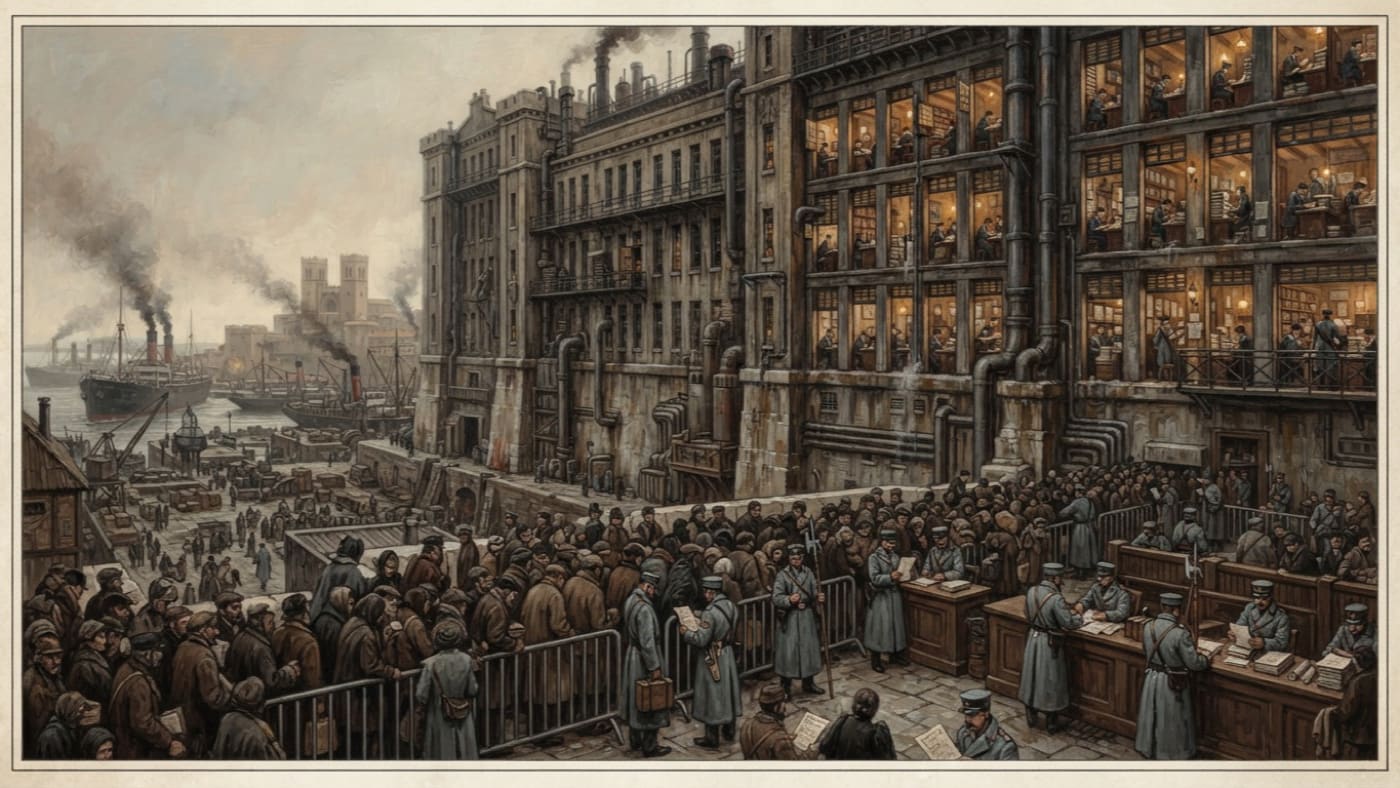
The Bureau of Pilgrimage governs from Strasbourg. The route tables are drafted there and the chief seals are kept there. It collects from Marseille. The southern headquarters is a limestone house of permits near the pilgrim basin. It stands within hearing of the bells of Saint-Victor and so close to the water that salt has entered its lower rooms and ignored every notice to vacate. The clerks upstairs stamp. In the foundations below them are three guild-masters who refused a document in A.S. 123. Between the two levels of this arrangement there is a sound.
By the account current in A.S. 201, the house issues approximately four hundred thousand embarkation permits a year. The figure counts permits only. A careless widow can lose and replace her paper twice before the tide, so it is no count of pilgrims, and it is certainly no count of arrivals at Thessaloniki, which belong to the sea and to the eastern clearance office. The building is a counter with a harbour attached. The work goes on all day: wax on paper, ink in the ledger, a name entered and a name refused. Somewhere beneath the permit hall, at hours that suit itself, the masonry makes its remark.
#On the Construction Authority
The full history belongs to the Harmonized Routes Edict, and I will not copy it out for readers too idle to follow a link. The essentials are these. In A.S. 120 the Belgrade miracle set the Church walking. In A.S. 121 the Riots of Santiago showed what private guilds did with walkers: three processions on one feast day, three sets of tolls, forty-one dead and a damaged shrine. In A.S. 123 eight guild-masters were summoned to Concordat Hall in Strasbourg and offered a future in writing.
Three signed and were made route inspectors in places so remote that exile came with a desk. The master of the Golden Sole was among the signatories and went to the Carpathian snow-line. Three refused, and they were walled into the foundations of the new southern headquarters. Two fled to England, which received them with its usual hospitality toward our administrative problems.
The same instrument authorised the house. The Mediterranean needed a southern office for Iberian route supervision, for pilgrim embarkation toward Thessaloniki, for the relic traffic of the coast and for harbour revenue that had gone too long without a Bureau to belong to.
That last blank line is accurate. The Edict authorised the building, and the authorisation has a year. The opening has no year in any file I am permitted to cite. I decline to invent one. Inventing years is how A.S. 238 happened.
The Harmonized Routes, and with them the southern headquarters, were established in A.S. 238. Alternatively, A.S. 38.
Both withdrawn. The legal basis of the Harmonized Routes is the Edict of A.S. 123. A.S. 238 lies thirty-seven years beyond the present and is therefore unavailable even to the Bureau of Pilgrimage. A.S. 38 comes before the Bureau existed. The first edition of the route tables is undated and will stay undated until someone produces it rather than a guess.
#On the Permit Halls
The process runs in one direction, from the street to the sea, and every stage keeps a copy.
A pilgrim reaches the house already holding route permission under the Harmonized Routes. Without it the visit ends at the door. The pilgrim presents a token, which may be pinned to a hat, sewn into a coat or hung on a rosary, and at the counter it is compared with the bearer's identity entries, which the Bureau of Records keeps and Pilgrimage consults with the warmth of a lodger borrowing a landlord's ladder. If paper, token and person agree, the clerk issues the embarkation permit and writes the name onto a passenger manifest. From then on the pilgrim exists twice, once in damp linen and once in ink, and the ink has the stronger legal standing.
Saint-Victor's bells call the muster. The pilgrims go down to the embarkation docks, where the Peregrine Wardens take over. They wear coats of road-grey wool and pilgrim-blue sashes and carry token-hooks, seals and halberds or pike-staves. A Warden checks the token against the permit, the permit against the manifest, and the face against both. A defect earns a seal. The mildest seal sends the pilgrim back up the hill. The worst turns a pilgrim into a pedestrian.
Clearance continues past the gangway. Each vessel carries a Bureau inspector and a chaplain, and they go on examining souls and papers until the anchor is weighed and for some time afterward. At Thessaloniki the eastern office repeats the exercise for travellers bound onward to the Aegean Shrine-Circuit. The southern headquarters claims none of that later diligence as its own. It claims only the permit, and the permit is where the money is.
A pilgrim who is refused at the counter does not sail. They stay on the quay, rent a pallet, find a confessor and wait for another bell. Marseille lives well on people who are waiting. The house does not count them, and it has never needed to.
#On the Foundations
The Bureau's official account says the three immurements were penal, lawful, witnessed and complete. I accept all four words, and the Bureau of Doctrine has accepted them before me.
Other accounts exist. The builders reported that the central foundation settled particularly well after the third walling. The clerks reported groaning before the roof was finished. Neither statement is doctrine, and both are on file.
Pilgrimage has sealed the three names. The guilds of the three men are not entered here either, because the records I hold do not assign them, and I do not assign the dead by elimination. Tavern singers do, and the singers are wrong in at least one verse.
The sound is reported in three places. It rises through the stairwells in humid weather. It comes from beneath the permit hall at compline. In the parent account it was heard in the records cellar while a clerk stamped a route denial for an Iberian widow. By that account it has continued for seventy-eight years. Pilgrimage classifies it as structural settlement and non-doctrinal. Twice the Bureau of Engineering has offered to inspect the foundations. Twice it has been refused, on the ground that the internal masonry forms part of an active disciplinary sentence, and a sentence still being served may not be opened for surveying. Doctrine accepts this reasoning. It is lawful. It is also very convenient.
Since no inspection has taken place, there are no findings. The cause is unknown. Settlement has not been disproved, and nothing else has been proved. The building is a working office whose lowest storey is legally a cell, and the cell has never been audited.
#On the Other Bureaus
The headquarters controls passenger manifests. It does not control the harbour. On the quays, Pilgrimage takes the passengers, the Bureau of Tithes assesses cargo, the Bureau of War decides what military freight sails first, and the Bureau of Relics authenticates every sacred object that lands at the Quai Saint-Lazare. A pilgrim who comes home with a saint's knucklebone in a pocket answers to two Bureaus, each of which thinks the other a thief.
Tithes is the old enemy. Its Salt Dues date from A.S. 92 and are older than this house, which means Pilgrimage arrived in Marseille to find the sea already taxed. Tithes runs its own limestone Revenue Office nearby. Pilgrimage complains that the dues raise the cost of putting a soul on a ship. Tithes replies that revenue is sacred. The quarrel became so personal that an inter-Bureau memorandum of A.S. 167 now forbids the clerks of either Bureau to borrow, lend or give each other ink. The ban extends to chalk, wax and the margins of shared documents. In a port that lives on paperwork, both sides apply it with great care.
War keeps a schedule of its own. When War needs a berth, the pilgrims wait, the manifests are held and the permit hall goes on stamping for ships that are not leaving yet.
The Bureau of Bells sets the hours. Saint-Victor rings muster, departure and compline, and the house runs its counters to that timetable. Compline is also the hour at which the masonry is said to object. The Bureau of Bells has not been asked about this and has not offered an opinion.
#On the Present Condition
In A.S. 201 the southern headquarters is in full operation. The account still gives approximately four hundred thousand permits a year. Ships continue to sail from the eastern basin. Salt continues to rise in the lower rooms and is scraped off in the spring like any other arrears. The maintenance review of the foundations is still marked pending, a status that requires nothing of anyone.
The clerks keep regular hours, and so do the bells. The three men in the foundation keep whatever hours are left to them, and their file is still open.