
#On the Tables
Each season the Bureau of Pilgrimage enters the Brittany Coastal Route in the Harmonized Routes tables. The entry names a destination: the Chapel of the Tide, on the marsh road beyond Saint-Malo. It names a token, Grey-Clement-43. It authorises a road on which the faithful may walk toward Saint Clement of Brittany without being taken for vagrants, Rationalists or Flemish toll-keepers. Then the folio is closed, sanded and shelved, and the entry waits to be made again next season.
The tables are nothing more than this. People who have never seen them imagine a great painted map with saints at every crossroads. What exists is ruled paper in a clerk's hand. Its power is that three things can be found on the same page: a place the Church recognises as holy, permission to travel toward it, and a means of checking that permission at a gate.
The clerks are careful to leave out a fourth thing, which is arrival. A shrine may be recognised for a century and receive nobody. A pilgrim may hold a perfect paper and lose his footing on the tidal flats. The tables record the destination and the right to go. Whether anyone gets there is a matter for the pilgrim, the weather and the Creator. The Bureau claims jurisdiction over none of these three, though it has drafted several memoranda about the weather.
#On the Monopoly
The tables exist because a pilgrim once had too many masters. At the Riots of Santiago in A.S. 121, three guild processions reached the shrine-city on the same feast. Each claimed toll authority, lodging priority and command of the road. The faithful paid one guild, then a second, and were being asked for a third fee when the marshals drew staves. Forty-one died, and every one of them had been obeying somebody.
The settlement came in A.S. 123 at Concordat Hall in Strasbourg, where the Harmonized Routes Edict was ratified. Eight competing pilgrimage guilds lost their independent authority, and their roads, lodging rights and escorts were absorbed or dissolved. The Bureau of Pilgrimage was formally constituted to hold what the guilds had held, and the Peregrine Wardens were constituted to enforce it. What became of the individual guild-masters belongs to the Edict's own folio, which records it at length and with relish.
The Edict decreed; the tables carry the decree out. A decree speaks once. A table is consulted every morning by a man with cold hands at a gate, and it must agree with the copy held by another man at the next gate. That is harmonisation in the Bureau's sense: a single claim on the road where there had been eight, written down in a form two strangers fifty miles apart can both check.
The Harmonized Routes date from A.S. 238, as an older survey of the Bureaus states. Certain route memoranda give A.S. 38.
Both dates withdrawn. A.S. 238 lies thirty-seven years in the future, and the Bureau of Pilgrimage, whatever its appetites, has not yet licensed travel in that direction. A.S. 38 is earlier than the Bureau, the Riots and the guild settlement. The documented legal basis of the system is the Edict of A.S. 123. This correction does not date the first edition of the tables. Readers who wish to invent such a date may apply to Records and wait.
#On the Licensed Chain
A licensed pilgrimage begins at a desk. The issuing clerk checks the pilgrim's identity and whether the route he names is open to someone of his description. If it is, a token is stamped with crest and serial, the serial is bound to a ledger entry, and the pilgrim receives route papers bearing a wax impression that will smear the first time it rains. Common speech calls both the craftsmen who cut the dies and the clerks who sit at the gates Route-Stampers. They are different men with different burns on their hands. The clerk at a Breton gate has never tuned a bell-hour core in his life.
After that, the token must agree with everything the pilgrim meets on the road. A lodging house near a certified shrine may not rent a pallet to a pilgrim whose paper lacks the proper line. An escort may not carry staff or blade without Bureau licence. At ration-stones and toll gates the pilgrim shows token and paper, recites the Creed, and is either passed or held. The pilgrim roads keep their own station slates and passage ledgers, which a Warden may compare with whatever the pilgrim is carrying.
The Wardens do the chain's physical work. They inspect papers, escort convoys, put down banditry, suspend permissions and void licences on the spot. Pilgrims curse them in the queue and thank them in the woods. A convoy that reaches its shrine with everyone alive usually had a Warden walking at the back. I will not hear sneering about that from anyone who has never met a bandit.
Each Bureau takes its own piece. Pilgrimage licenses the movement and sets the schedule. The Bureau of Records keeps the permits, the visitor rolls, and the reconciliations proving that the tokens issued in a day match that day's ledger. The Bureau of Doctrine decides what the walk means. The Bureau of Tithes disputes Pilgrimage's revenue in every quarter, and Pilgrimage disputes Tithes' right to look at it.
Indulgence tokens with bell-hour mechanisms ring along certain routes, and token classes vary with distance and access. No file I have consulted gives Clement's grey token either a mechanism or a class, and I decline to give it either.
#On Grey-Clement-43
The Breton route runs to a small whitewashed shrine on the coast of Brittany that smells of salt, tallow and old wool. Its pilgrims follow the memory of the procession that left Dinan in A.S. 10 and was halted at the Porte Saint-Vincent, where the Massacre at Saint-Malo began. In A.S. 14 Clement's observance was yoked to the Saint-Malo office as its secondary rite. This was an early ecclesiastical arrangement, made long before the present Bureaus existed. Later offices administered and ratified it, and in A.S. 92 Doctrine gave Clement the eve of the memorial. When Pilgrimage entered the road in its tables, it was registering a devotion far older than its own seal. It has behaved ever since as though it laid the paving.
The permit token is grey and stamped with a crozier, a wave and the number forty-three. Visitors confuse it with the older tin wave-disc, stamped with a crozier and a fishbone, which Breton pilgrims bought for pennies before anyone in Strasbourg could find the chapel on a map. The disc is a devotion. The token is a permit. Sensible pilgrims carry both, the disc pinned inside the coat and the token kept dry in a waxed pouch, which is rarely dry.
The number counts everyone who set out from Dinan. The register divides them into thirty-one certified dead, seven wounded witnesses and five consumed absences. A clerk who stamps thirty-one on a Clement token has confused the gate's toll with the chapel's count, and his error is corrected before it reaches the die.
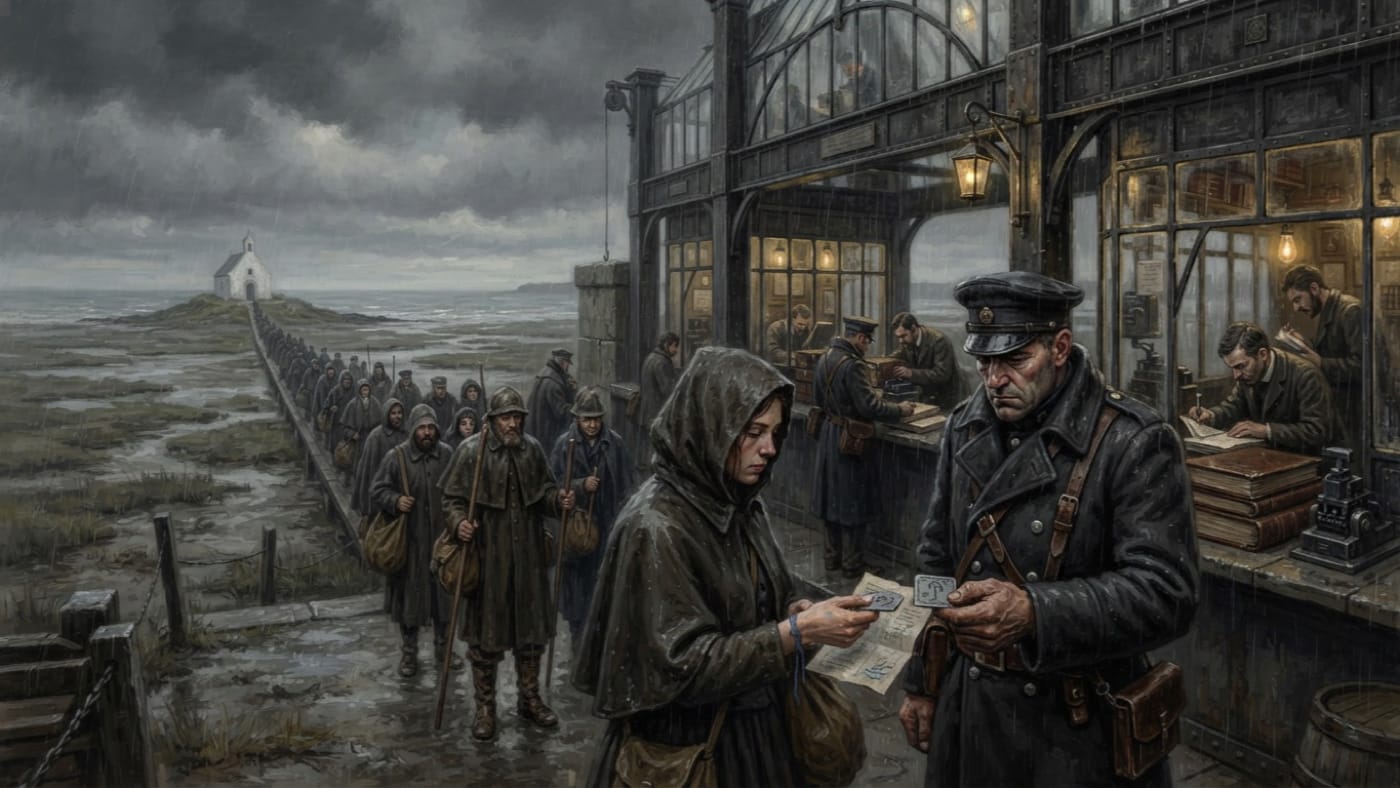
On a wet morning at the marsh road I watched a Warden turn one of these grey tokens over in his palm. It had come out of a woman's pocket still dripping. The rain had already softened the wax on her paper to a pink blur. He was entitled to void it. He read the number, looked at the blue thread knotted around her wrist, and waved her on. Records may have his name if it can get it from the weather.
The old devotion carries on alongside the licence. Mothers still tie blue thread on children before any road, and fishermen still leave chipped shells on the altar. On the eve of the memorial, kept on the fourteenth of Corvus, children from Dinan's registered families hang forty-three tokens on forty-three brass hooks behind the altar. They are told not to cry, and they cry anyway. The tables record that the route was open that season. They do not record which child needed three tries to reach the top row.
#On Delay and Present Force
Clement is patron of interrupted journeys, failed arrivals, and petitions delayed by weather, war or Pilgrimage procedure. The third cause is printed in the Bureau's own route tables. Each season the compilers enter the patronage beside the route, so the Bureau's own folio lists the Bureau among the hazards of the road. It is the most honest line on the page. No one in the compilers' office has noticed it, and I have not told them.
In A.S. 201 the tables are in full force. Pilgrims crowd the approach path to the chapel, where stalls sell hook charms, thread and shells to people who have already bought all three at home. Route marshals set the processions to schedule. Gates close for storms. Papers are refused for a smeared serial, a missing lodging line, or a Creed recited with too much Breton in it. A pilgrim turned back at the gate goes home holding a valid grey token and is free to pray to the saint of refused arrivals, who receives him without charge.
A valid entry in the tables is permission to try, not passage. The Bureau has never claimed otherwise, and it has never put that sentence on a token either.