
#On a Name Preserved in Wet Ink
The Marsh Cartography Division survives in the record through one sentence and the mud that sentence explains. When Bastion-Shipka was raised during the early consolidation of the Sagittal Line, its first architects came from two bodies: the Order of Litany-Engineers and the Marsh Cartography Division. The account names men and women. It names their work. It does not name their master, their seal, their headquarters or the clerk who paid them, and I decline to supply these from imagination. I leave that habit to novelists and quartermasters.
What the sentence does establish is enough. Someone had to decide where a fortress could stand in a country that had never settled whether it was land or water. Someone had to say which ruined tower would carry a gun, and which would carry the gun briefly to the bottom. That judgement belonged to the Division and the Litany-Engineers together, and the record divides it between them no further. I shall not divide it for them. Credit handed out without evidence is flattery holding a ruler.
#On the Ground Beneath the Works
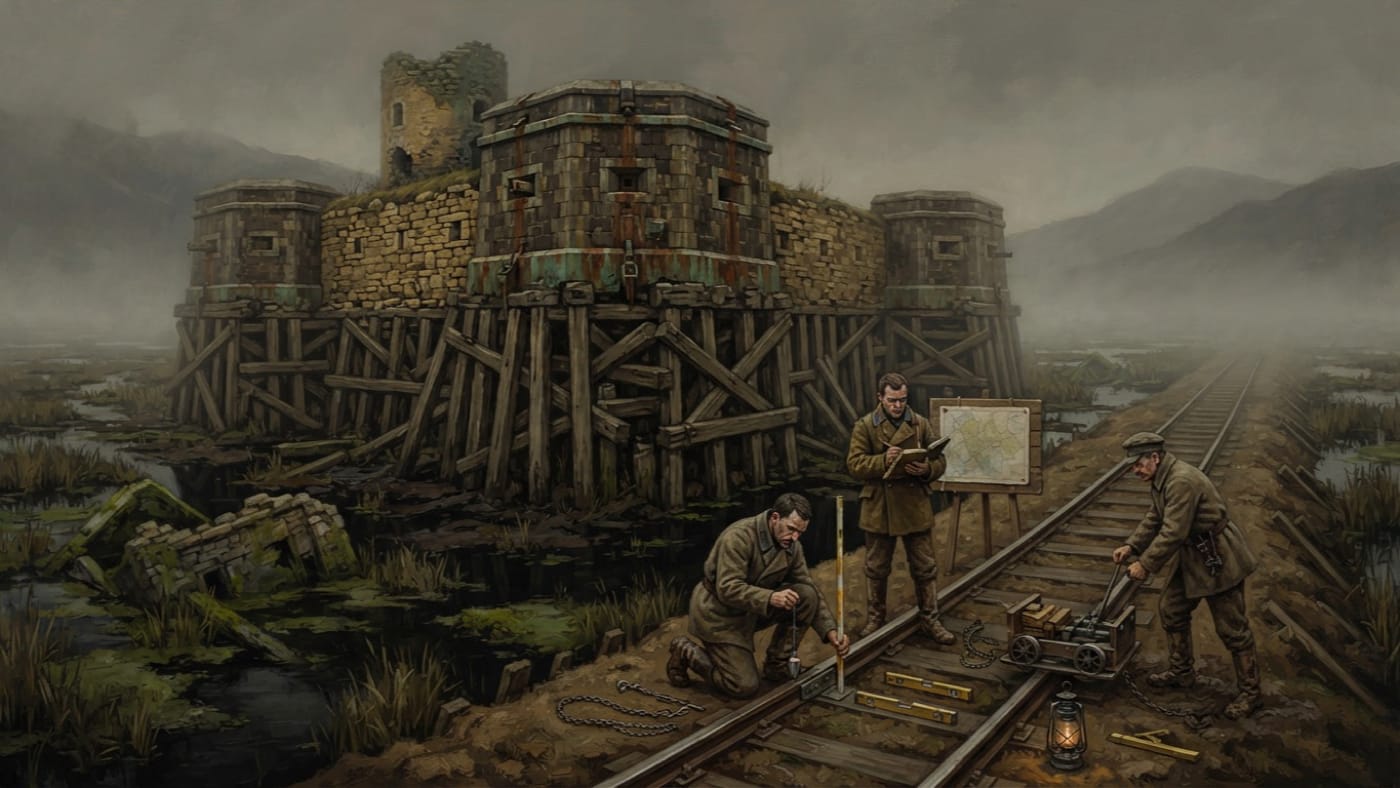
Shipka is the sixth of the seven principal bastions of the Line. It holds Shipka Pass through the Balkan Mountains of Bulgaria. That is the mountain fact. The marsh fact lies beside it to the east: the Phocis Marsh Corridor, which the garrison calls Shipka Marsh. It is a broad trough of black water and reed channels running toward Syrion's Vales of Stagnance. The heights stay where they were put. The corridor does not.
Its surface is a mat of roots and half-rotted turf. Stamp on it and it may answer with honest firmness. It may also open into a hidden sink that takes a man to the waist and a wagon to the axle. Under the reeds lie the drowned works of older Phocis: towers gone to ivy, and curtain walls standing knee-deep in their own reflection. Some of that stone was sound. Some of it was a promise made by a dead king's masons and broken by two generations of water.
Then comes the second difficulty, which belongs in a different ledger. The Bureau of the Hourglass classifies the corridor as a persistent low-grade stillness field. Sound falls short of its proper distance. Time loses its manners. Sleep passes between bodies like damp between bricks, and will itself wears away. A surveyor in such country has two enemies. One is the ground shifting under his rod. The other is the fog, which may persuade him he has already taken the reading.
The first is a matter of drainage. The second is a matter for Doctrine, and for anyone who wishes to come home.
#On the Founding Works
The architects began by refusing to waste a ruin. They salvaged the Phocian fortlets that stood before Syrion's coming: towers, broken courses of stone, half-drowned curtain walls. Whatever could still bear weight they knit into a new plan. The result was low and thick, built to squat rather than soar. The walls were faced with old kingdom stone and mortared with ossuary dust, following the Spine's practice that the dead should hold the line still. Kings quarried the facing. Paupers, presumably, supplied the mortar. Shipka has been even-handed about its masonry from the first course.
The walls were the visible half. Beneath them the founders sank a lattice of piles and floodgates. It was a second fortress turned upside down into the mud, with timber for battlements and water held at bay for a garrison. A curtain wall in that ground is only as honest as the piles under it. A pile is only as honest as the reckoning that placed it. Between chart, rod and hammer, men and women chose each footing knowing that a bad choice would stay quiet for years and then fail all at once.
The earliest pump rooms were consecrated as chapels of pressure. Valves were engraved with psalms, and gauges were ringed in catechism. Visiting confessors have since found this quaint. The founders found it accurate. When the pumps failed, men drowned. When they held, the bastion stood. A chapel is where one attends daily to the thing that keeps one alive. By that definition the pump room has the stronger claim.
The bastion was designated about A.S. 68 / c. 1778 CE and ratified in A.S. 72 / 1782 CE. These are the bastion's dates. Anyone who calls them the Division's founding or its charter is selling you a seal he engraved himself.
#On Measuring What Will Not Hold Still
Every cartographer on the Line fights the same heresy: the belief that a map, once drawn, stays true. Elsewhere the error creeps in slowly. At Shipka the marsh revises the survey while the ink is wet, and Syrion revises the surveyor.
The record does not describe the Division's methods, and I shall not invent a sacred theodolite for it. Any man who has pegged out a footing knows the ordinary tools: chain, rod, level, stake, a lantern and a notebook gone soft at the corners. Whatever the Division carried, the marsh will have treated it as a dog treats a slipper.
Later practice at Shipka shows how hard a problem those first architects walked into. Today the Hourglass compares the bastion's clocks with those of neighbouring bastions to learn whether the stillness has crept west. Bells are timed across the reeds. Telegraph beats are checked against horn codes, and Station Two keeps its own instruments farther out. All of this apparatus came later, and the Division invented none of it. It records the same truth, belatedly and in brass: in this corridor, any single measurement is a rumour until a second one agrees with it.
The founders built without that brass. They had the marsh, their own judgement, and the ruins of men who had misjudged before them. The walls they placed still stand.
#On the Works After the Workers
Founders depart. Footings remain, and someone must keep them honest.
At Shipka that someone is the rail gangs, the pump crews and the telegraph hands. They are Shipka's own people, and the record does not trace their relation to the founding architects. I shall not invent one. They walk the Reed Road, the raised rail embankment and inspection causeway that carries the marsh spur east through the corridor. They clear culverts of reeds, roots and things that were once alive. They open and close floodgates. They go down into pump rooms where the founders cut the psalms and the founders' grandchildren now grease the bearings. When water rises, they decide which section to flood so the rest may stand.
The Bureau of Engineering raised the Reed Road three times before it held. The third lift held because the engineers stopped trusting the surface and drove piles into the drowned peat. The founding architects would have recognised the lesson. The road's crews learned it again at their own expense, in mud up to the thigh.
Early completion notices described the Reed Road as "stable ground secured by Synodal industry."
Corrected in field copies, as the Reed Road account records. The road is maintained stability, not achieved stability. In a marsh, secured describes a condition that lasts until the next inspection.
This labour produced Shipka's engineering ethic, as stern as any rule an Order ever wrote. Inspect accurately. Report the crack. Close the road if the culvert is bad, and endure the officer's displeasure. The man who softens a stress reading to please command keeps company with the Great Deceiver, and the next train pays his fee. This is the culture of Shipka's crews. The archive does not say whether it descends from a Division oath, or whether the Division ever swore one.
When the works fail, the consequences travel. Grain, powder, coal and wounded men move along the spur, and a sunken embankment starves a front as surely as a lost battle. Strasbourg reads such failures as logistics. The crews read them as names.
#On What the Record Withholds
The archive is silent on when the Division was constituted and who commanded it. It is silent on what became of it, and on whether any member still draws a ration. It is silent, too, on whether the Division served Shipka alone or came on loan from wider duties. I will not paint over the gap.
What can be weighed is this. The walls are low and thick and faced with the stone of a dead kingdom. Beneath them the piles stand in the mud, and the floodgates answer to the wheel. In the chapels of pressure the pumps still breathe. Tired men and women keep them breathing through shifts the Synod would sooner praise than staff. The fortress that cartographers and Litany-Engineers built stands because their successors refuse to lie about the ground.
Ink fades. Piles hold, as long as someone checks them.