

#On the Phrase and the Letter
A referral to a Medicine House begins with a sentence meant to comfort the family. The patient has been recommended a period of restorative retreat. The air is good. The supervision is competent. Correspondence will follow. It does follow, on thick paper with correct seals, and it says the patient is resting. It says very little else. The family learns to read the little else the way a parish reads a bishop's face for weather.
This survey concerns that sentence and the houses behind it. I compiled it in A.S. 201, and that is the year of my looking, nothing more. The registers I was allowed to see give no founding year for any Medicine House or for the arrangement as a whole. I decline to manufacture one for readers who believe every institution must have a birthday. Some institutions are simply allowed to grow.
"Medicine Houses" is itself an informal name. Clerks use it at the counter and deny it in writing. The Bureau of Medicine writes "sanitariums" in its own register. The Bureau of Records writes nothing at all, since it lists none of them in any public directory, and in Records a preference for nothing has the force of a wall.
#On the Houses as Registered
The Bureau of Medicine's register names an Adriatic house, a house at Bratislava, a facility in the Swiss cantons, and three unnamed sites along the rear echelon of the Sagittal Line. That makes six, if one counts as the register counts. I do not certify that six is complete. I certify that six is what the register admits, and in this administration those are separate quantities.
Two of the six have files thick enough to describe.
The oldest is on the Adriatic coast. It is a converted monastery of no architectural distinction, whitewashed, with a herb garden kept by sisters. They have been told they serve the Bureau of Mercy, and they have been wise enough to ask nothing further. No record I have seen gives its exact site. Its lack of distinction is, I suspect, the most carefully maintained feature of the building.
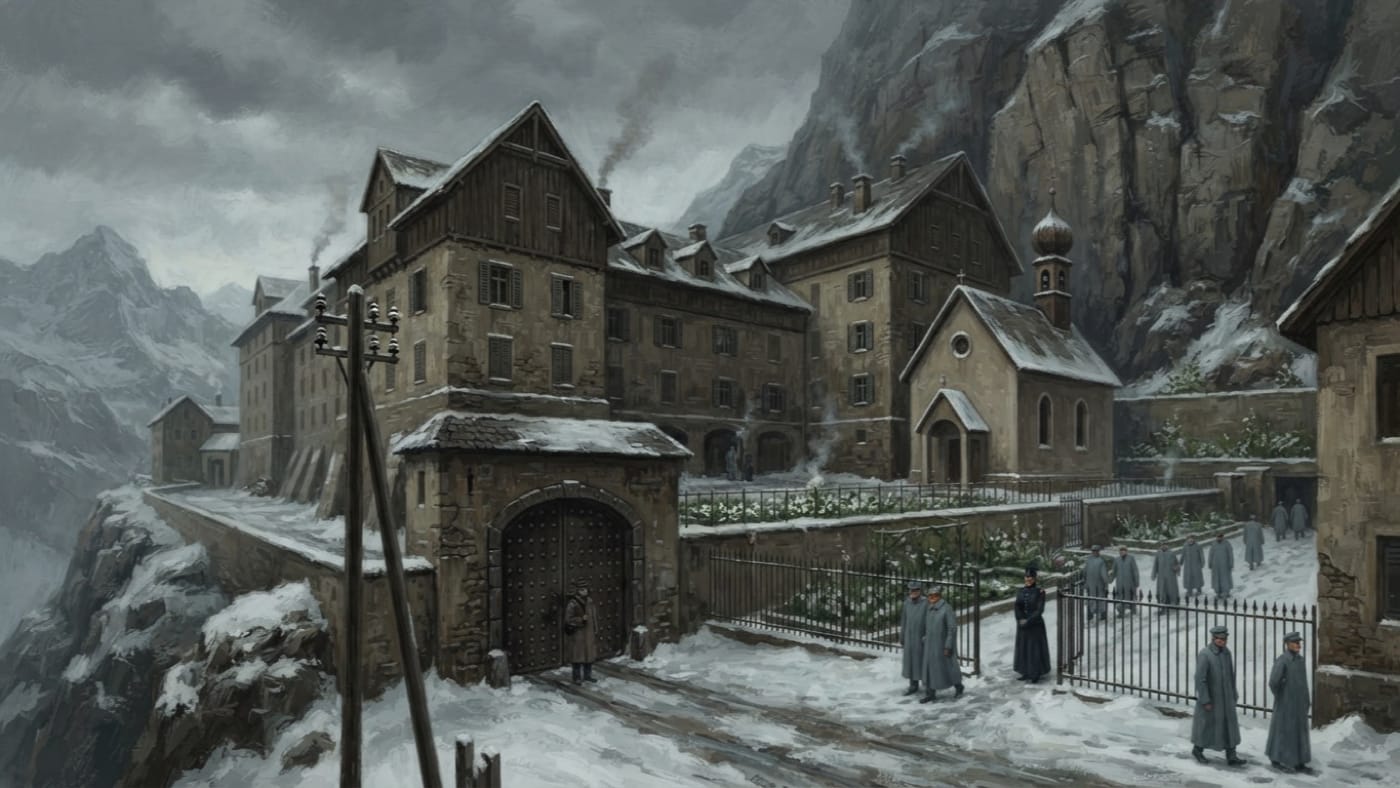
The Swiss facility is an old hospice above a pass whose name is given differently in three registries. Its chapel faces east and its medical wing faces a rock wall. Its upper windows are shuttered from the outside. Its garden grows fennel, wormwood, alpine mint, and a white flower whose official name changes whenever a patient repeats it too often. I have reported the flower before and I report it again. I offer no explanation for it. Medicine offers none either, and for once we agree.
The two houses differ more in how they keep people than in how they treat them. A coastal sanitarium sits among harbours, ships, sea-bells and gossip, and every harbour talks. By the account I gave in my survey of the cantons, the Swiss house rose in importance once the Bureau found that some patients do better where the air is thin and every road down can be closed. Snowfall closes it, or a toll, a militia drill, an avalanche alarm, or an order in calm blue ink. The register does not say whether "do better" refers to the patient's mind or the Bureau's comfort. I have my opinion. The register has its silence. Both are on file.
#On the Referral and Its Vocabulary
For the Swiss house, at least, the public phrase is restorative retreat. Inside the Bureaus the phrase depends on the clerk, the physician, the severity and the nerve. I have seen convalescent hospice, mountain quiet house, Alpine semantic ward and protected contemplation site. Once I saw the place we send witnesses, in a note by a junior surgeon who was later promoted for honesty and punished for timing. All of these labels come from papers about one house. They are not a classification, and any eager provincial physician who prints them as one will hear from me.
The register does name what the sanitariums treat: damage to the faculty of understanding itself. The patient can still see but cannot say what he saw. Medicine calls this semantic ablation. Mercy calls it the silence of the blessed. War calls it non-deployable. That is three Bureaus and one ward, and no agreement on what the ward is for. The term describes symptoms. It discloses no procedure, and I have found no document that does.
Each Bureau also claims the Swiss house in its own grammar. Medicine calls it clinical and Mercy calls it pastoral. War uses it when a soldier cannot be released and should not be shot. Doctrine uses it for people who have heard sentences that cannot be unheard. Purity uses it rarely and badly. Shadows uses it and never admits to knowing the road.
From what I have been shown, a patient there receives care of a familiar kind. There are white blankets, brass beds, mountain broth, supervised walks to a fenced overlook, chapel offices sung softly, and physicians with warm hands. There are also small locks. Patients are addressed by courtesy titles until a name becomes a symptom, and then a number is used instead. Letters leave on Tuesdays after review by Medicine and Mercy, and by Doctrine as well when a case has begun to smell of theology. Families receive correspondence that is approved and says nothing specific. Visitors are restricted, and in winter the mountains enforce the restriction for free.
None of this is cruel in itself. A broth is a broth and a lock is a lock. The trouble is that the same corridor can serve rest and seclusion at once. The paperwork that could tell the two apart is the paperwork that leaves on Tuesdays.
#On the Referrals of A.S. 199
The best-documented referrals followed the Broadcast of the 3rd of Argent, A.S. 199. On that day the Vigil Ark Saint Barachiel carried an unauthorised transmission through its Sermon-horns above the Bosphorus. The transcript is sealed and the source is unresolved. I shall supply neither. Readers who write to ask for the words will receive a pamphlet on patience.
Four civilians tried to repeat what they had heard in public: two harbour clerks and two fishermen. They were offered theological rest in the Swiss cantons at Bureau expense, and they accepted. The Swiss intake abstract records their condition.
BUREAU OF MEDICINE — SWISS FACILITY INTAKE ABSTRACT, A.S. 199 Source: Constantinople theatre. Patients: four civilians, two harbour clerks, two fishermen. Presenting condition: urgent speech pressure, liturgical distress, name fixation, auditory return under silence. Disposition: contemplative. Quarterly note: ███████████████████████████████. Family correspondence: approved, non-specific.
I have written elsewhere that they accepted after the kind of conversation in which refusal is already buried. That is my reading of the circumstances. The files I hold contain no transcript of that conversation, and I will not invent one to flatter my reading.
When the rotation of the third crew was terminated, its eleven personnel received a similar offer: honourable discharge, a pension, and removal to the Swiss cantons under contemplative classification. Eight accepted and three declined.
Sergeant Kael was one of the three. She asked for observation duty at Kestrel-7 on the Blightmarsh perimeter, and War mistook her perversity for morale and granted it. When asked why she refused the mountains, she said: Too quiet. That is testimony about her own choice. It tells us what she feared in the offer. It tells us nothing about what happens behind the shutters. I have been tempted to make it say more, and I have been corrected. I corrected myself, which is the only correction I accept without a hearing.
#On the Adriatic Precedent
The Adriatic house holds the longest documented residence I can find. Colonel-Inquisitor Aras Venn went there after leading the first Shadow Court expedition in A.S. 72. He was found dead there in A.S. 94. He had written a single phrase on every available surface of his quarters, the margins of his breviary included. The phrase is classified. The Bureau of Medicine recorded natural causes, with complications.
Venn's file covers twenty-two years, one man and one phrase. It shows that a patient could enter an Adriatic ward and stay there for the rest of his life. It does not show why, or at whose wish, or whether any other patient shared his course.
Venn's file and the Swiss abstracts lie at opposite ends of the evidence, a century and a mountain range apart. I put them side by side only because the Bureau's register already does. On this evidence, comparing the two houses means comparing two keyholes.
#On the Cantonal Bargain
By the account in my survey of the cantons, the councils around the Swiss house receive hard currency, salt rights, pass exemptions and grain priority. In return they enter no patient names in their civil rolls, and their minutes record no unusual business. That is a bargain. It does not prove that every innkeeper in the valley knows what the bargain buys. Most of them know the price of salt.
"The letters are signed. The seals are correct. The patients do not return." (Swiss Cantons, survey of A.S. 201)
Corrected. The letters are signed and the seals are correct. Some patients have not returned. The eight from the third crew go unnamed in public summaries, and the four civilians from the Broadcast remain classified as contemplative. About everyone else, the registers say nothing either way. A claim about every patient needs a register of every patient. The Bureau has not given me one, and the Ledger does not lend its authority to my adjectives.
The houses exist, and six are registered. Two are described. Patients go in under a gentle phrase and receive care a physician would recognise. They are written about in letters that say little, and in the documented cases they are kept a very long time. The paper does not decide whether the houses heal, hide, study or simply hold, and I will not decide it for the paper.