
#On the Counting-Houses
The Merchant Quarter of Hamburg stands on the south bank of the Elbe. It is the only district in the Synod's northern harbour where an official of the Church has to knock. The Dock Quarter obeys whistles and the Synod Quarter across the river obeys seals. The Fishmarket obeys its cats. The Merchant Quarter obeys contracts, and a contract, unlike a subordinate, carries two signatures at the bottom.
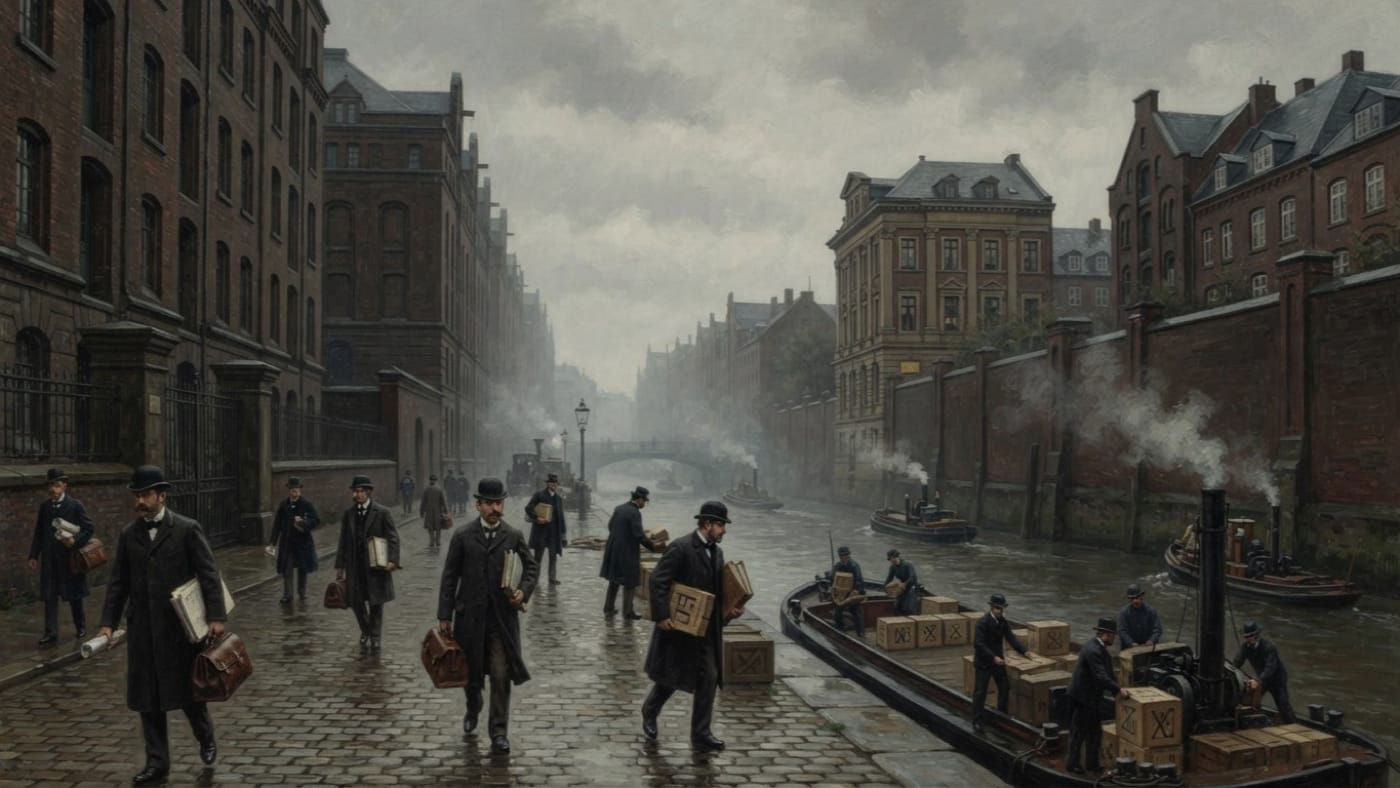
The quarter is built of counting-houses in brick, shipping-company offices with brass plates polished by boys who will never own the brass, and the residences of the Dutch and British factors behind walls tall enough to discourage both the curious and the devout. Inside are desks, letter-presses, copying books, wet umbrellas, cabinets with good locks, and men who read a bill of lading the way a confessor reads a face. The traffic in the streets is mostly clerks. Some run, some copy, some carry lien papers across to the customs directorate, and the rest carry them back amended.
The rest of Hamburg receives orders, while this quarter receives offers. The Bureau of War may requisition a warehouse, a crane, a barge or a man. It cannot requisition a British cargo still at sea or a Dutch line of credit still in Amsterdam. Those have to be obtained, and obtaining is a slower sacrament than commanding.
#On the Foreign Factors
The Netherlands keeps a permanent trade delegation here of fourteen clerks, six factors and a consul. The Codex does not record the consul's name, but his office overlooks the Elbe. From that window a man can count every hull at anchor and price its delay before the harbour office has written the delay down. The confidential assessment of the Bureau of Purity describes the delegation's filing cabinets as containing "material of potential theological concern." Purity has not opened them. In the Bureau's vocabulary the phrase means locked, and to an office that holds no key, every locked cabinet in the Church is of potential theological concern.
The British Crown keeps a factor's office in the same quarter. The Bureau has not published its staff, and the factor's identity is not a matter of record. Its significance is measured elsewhere. British grain ships carry one quarter of all inbound tonnage at Hamburg harbour. That is a figure for the whole river and not the turnover of one office, but the grain is sold on paper in this quarter before it is lifted onto stone in the other. A British captain arrives with clean invoices, an irreverent crew and a contract written in a legal English that slides around Synodal assumptions like an eel through choir stalls. His ship is unloaded all the same.
The Dutch sell money. Dutch banking houses finance the Synod's military contracts through Hamburg intermediaries. The loans are denominated in guilders and repaid in Synod marks, and the space between the two currencies is where the Dutch live. Interest compounds and conversion bites. The Bureau of Tithes tolerates the arrangement because it cannot fund the northern front without it, and it says so only in memoranda it seals before Doctrine can read them.
None of this makes the quarter foreign soil. No charter the Codex has seen cedes a street, a wall or an exemption to London or Amsterdam. The Netherlands and the Crown are independent powers. Their factors are guests who conduct business under Hamburg's harbour law. They need no paving stone of their own. A man who holds your payroll has no need to hold your street.
#On the Admiral-Prefect's Business
Admiral-Prefect Gerta Halske has headed the Northern Maritime Chapterhouse since A.S. 194, seven years before this survey. The Chapterhouse stands in the Synod Quarter, and her desk, her boards and her blue pencil stay there. Her influence crosses the water. On paper she answers to the Archon of Kanzleiburg for civil administration and to the Bureau of War for military logistics. In this quarter she answers to whoever holds the cargo, and she makes sure it is generally her.
She does not flatter the factors, which alarms them more than hostility would. Officials who come in robes make grand remarks about Faith and leave holding worse contracts than they brought. Halske comes with spoilage tables. She knows how many days British wheat survives in a damp hold and which Dutch liens are clear. She knows which cargo can wait a tide and which will rot through its sacking if it waits two. The factors respect a counterpart who can price their delay as precisely as they do.
Her tools are the ordinary instruments of a harbour office: berth assignment, discharge order, rail slot, escort and the lien register. A British grain ship with clear papers gets the berth ahead of a crate of saints. A Dutch courier packet tied to a War payroll gets an escort, because a payroll that arrives late leaves a contractor unpaid, and an unpaid contractor's timber stays piled at the mill. The arithmetic behind every allocation is plain. In A.S. 200 the harbour handled 4.2 million metric tons. The northern front needs about fourteen hundred tons of grain a day and normally gets about twelve hundred. When a grain hull sits in the roads over a disputed lien, it loses its berth, then its rail slot, then its place in the Northern Corridor. A fortnight later the shortfall reaches the ration tables at Bastion-Königsberg and Bastion-Brest.
#On Respectability and Inspection
The walls are the quarter's first argument. They do not stop an inspector, but they make him announce himself, and an inspector who has to announce himself has already lost half his inspection.
The Bureau of Purity keeps eleven officers in Hamburg for a city of about nine hundred thousand souls. Those eleven cover every quarter, not this one alone. Their complaints, preserved in the Halske file, list too little access to ships, warehouses, foreign residences and taverns, and inspections postponed until the cargo has moved. Halske grants access once a hold is empty. Purity regards this as obstruction, and War regards it as the correct order of operations. Both are right, and only one of them is fed by the arrangement.
In its A.S. 200 quarterly audit, Purity's Hamburg sub-office recorded church attendance in the Merchant Quarter at 34.7 per cent. That is three times the Dock Quarter's figure and little more than half the Synod Quarter's. The number counts pews. It says nothing about what the absent do on a feast-day morning, and Purity, to its credit, has not pretended it does.
The published account in North Sea states that British naval maps vanish into the Merchant Quarter and come back as rumours in taverns where Purity officers pretend to drink. I accept that sentence as written. It names no buyer and proves no ring, and nothing in it implicates any particular factor. It does establish that charts and gossip circulate here in roughly equal measure and that the Bureau's officers have learned to nurse a single glass.
An earlier edition of the Hamburg entry attributed the city's foreign trade to "the generosity of the Unregistered Kingdoms."
Corrected, and the correction stands for this quarter. No counting-house on the Elbe has ever been generous. The British sell grain because grain pays. The Dutch sell credit because credit pays better. The word "generosity" belongs to sermons, and the Merchant Quarter keeps no sermons in its copying books.
The quarter's respectability is measured by the people it keeps out. A senior holdman of the Stevedores' Compact wears a bent hatch nail on a cord. With one refusal he can stop a hold, delay a grain ship and irritate a consul. He is still refused entry to three respectable taverns in the Merchant Quarter. The landlords' names are not recorded, though their standards evidently are. The man who can starve a regiment by folding his arms may not drink beside the man who financed the regiment's boots.
#On the Present Condition
In A.S. 201 the Merchant Quarter does exactly what it did the year before: it sells the Synod what the Synod cannot make, on terms the Synod cannot dictate. The Dutch cabinets stay locked. The British office stays discreet. The consul's window still overlooks the river.
The Dock Fire of A.S. 189 burned four blocks of the Dock Quarter and killed three hundred and twelve people. It preceded Halske's appointment by five years. The counting-houses did not burn. They waited out the eleven-day stoppage like the rest of Hamburg and went back to their columns once the seven-per-cent hazard supplement had bought the ships back to work. This quarter learned from the fire what it learns from everything, which is the price of the cargo's absence.
Doctrine classifies the quarter's foreign dependence as Providentially Arranged. Tithes classifies it as foreign pressure, in private. War does not classify it. War sends Halske across the river with her tables and waits for the trains.
The quarter stays open, contracted, walled and necessary. Its factors keep their copying books, and its clerks keep running. Purity keeps a single glass in hand. The Synod keeps knocking.