
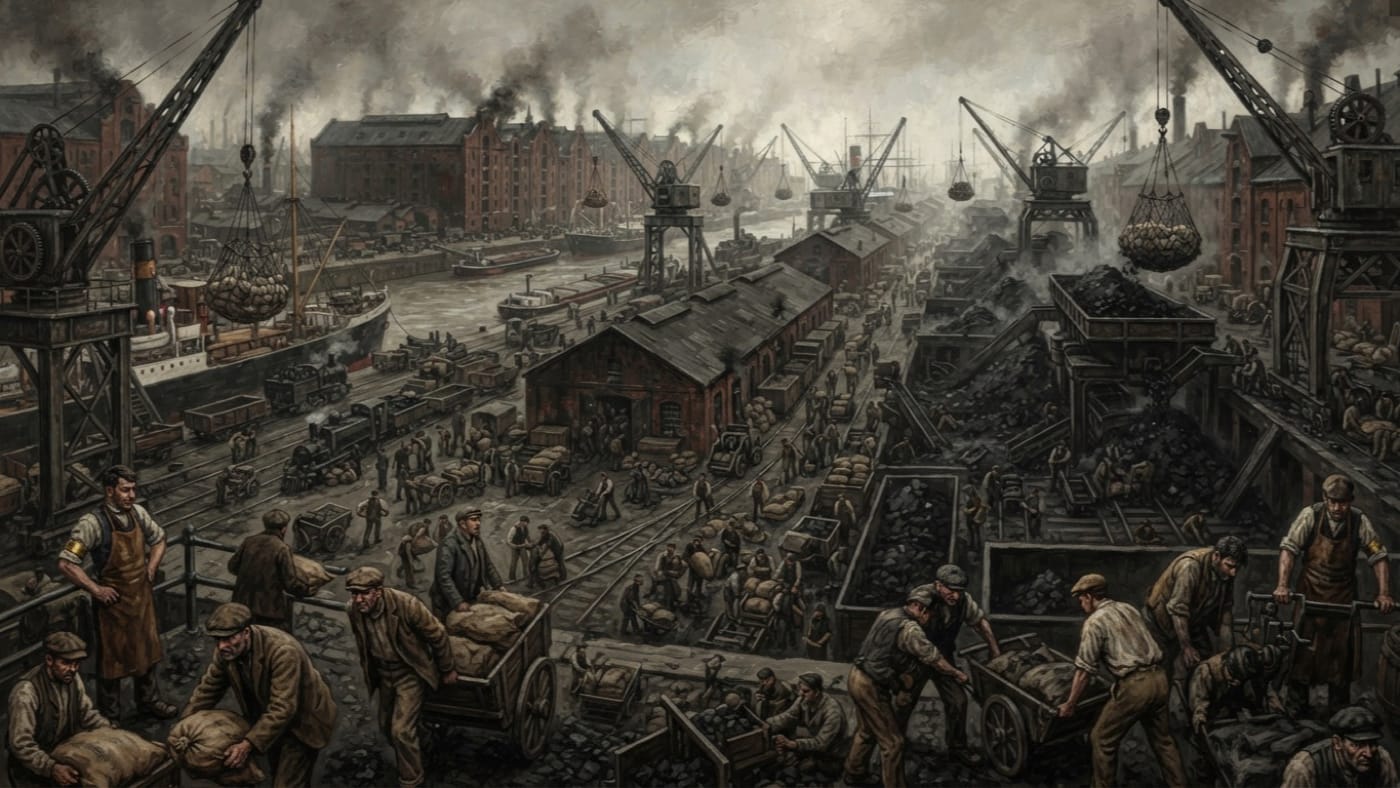
#On the Quays and Their Hinterland
The Dock Quarter of Hamburg is the stretch of Elbe waterfront where the Church's northern war stops being an argument in Kanzleiburg and turns into a wet sack on a man's neck. It takes up the western and central quays: deep-draught grain berths, crane gantries, sling platforms, customs sheds, warehouses whose brick has gone the colour of old gun-oil, and staging ground where everything the North Sea delivers waits to be told where it is going. The streets behind the quays supply the labour. Three streets back from the grain hoists stands the low, soot-dark hall of the Longshoremen's Brotherhood.
The black yards lie to the east. The heaps, chutes and tender sidings of the Coal-Heavers' Union adjoin the Quarter and trade with it every hour. The Union hall is built against the eastern coal wall, and its windows film over again by noon however often they are washed. Whether the yards belong to the Dock Quarter is a question for surveyors. No cadastral roll in my possession settles it, and the coal men have never asked.
The Quarter has no founding legend worth the vellum. It has a smell instead: wet grain, tarred rope, river mud, and coal haze drifting west when the wind turns. It also has the shift whistle. A visitor who takes the whistle for ornament will be knocked into the Elbe by a swinging net, and the Brotherhood will enter him under spoilage.
#On the Hands That Govern Cargo
Three jurisdictions meet at every unloading, and none of them owns the port. The Stevedores' Compact governs the hold, meaning stowage, hatches, and the order in which cargo may leave a ship without rolling it onto its side. The Brotherhood governs the quay: loading schedules, grain call-books, crane hiring, sling gangs, and the chalk marks that decide which crate reaches rail custody before dusk. The Coal-Heavers govern the heap, the chute, tender loading, barge transfer and the night bunker crews. A grain ship passes through two of these hands and a collier through all three. The line between hatch and hook is a border, and the foremen who police it have louder voices than any customs officer.
Hamburg keeps twelve dock labour bodies. The Bureau of Records holds no complete roster of them, and I file that sentence with my teeth set. Beyond the three already named, the port is known to have chandlers dealing in rope and lamp oil, along with smaller fraternities attached to hides, livestock and quarantine freight. Their names, halls and masters are absent from my folios. I will not invent them to make a tidy table.
Forty thousand men work Hamburg's docks, and that figure covers the whole city. The Records do not say how many of them sleep inside the Quarter, how many berths it holds or how many acres it covers.
Authority here is practical, and it is posted on walls. The hiring board decides who eats this week. The call-book decides which ship discharges first. The chalk mark decides which crate is handled softly. The widow tin decides what a dead man was worth, and the hall's injury shelves keep the price more exactly than the Bureau of Mercy has ever managed. Hall bread feeds the injured, and guild debts keep the healthy in line. Coal-dust lung kills the heavers by instalments, and Mercy's brass lung-bells hang at the throats of men who can no longer shout for help.
The halls keep their saints the way they keep their debts: locally, stubbornly and without central confirmation. Saint Varric of the Bent Hook keeps the Brotherhood's chapel niche. Saint Barro of the Sooted Palm hangs above the Union stove. Doctrine has confirmed neither of them and removed neither, and I am not volunteering for the second task.
#On the Northern Passage
Everything that enters the Quarter is already late for somewhere else. Hamburg is the North Sea intake of the Northern Corridor, and the Dock Quarter is the waterfront that does its lifting. British grain comes up the Elbe in deep holds. Welsh coal follows in colliers that leave black water at the berth. Scandinavian timber arrives lashed on deck, and military freight arrives under labels painted over so often that the crates are mostly paint. Dutch credit arrives as paper and pays for the lot. Britain and the Netherlands remain independent powers, and their captains set their prices accordingly.
Grain moves by handoff. Holdmen bring it to the hatch, sling gangs land it on the quay, and crane crews swing it to staging, where it gets its chalk. Tithes weighs it. The Brotherhood then sends it to rail wagons or Elbe barges. From there it goes to Kanzleiburg, on to Warsaw, and out along the forward spurs to Bastion-Königsberg and Bastion-Brest. Coal takes the eastern way round, into the black yards, through bins and chutes and into tenders, and then up the same iron road. When a bastion eats in March, the food passed under a Hamburg sling boss some weeks before.
Each handoff is a checkpoint, and a guild holds every one. The Bureau of War wants speed and has to ask the call-book for it. Tithes wants assessment and gets it at the pace of the crane. The Bureau of Purity wants inspection and is told, very courteously, to wait until spoilage risk has cleared. Eleven Purity officers serve a city of nine hundred thousand souls. I have yet to meet one who can read a Brotherhood chalk mark without asking a docker what it means, and the docker charges for the answer.
#On the Fire and the Settlement
The Quarter's scar dates from A.S. 189, twelve years before this survey. In Warehouse 17-E, chrismole had been stacked six-high against brick that was already condemned, and warnings about that storage had been raised for six years. The Dock Fire began in the chrismole. The Coal-Heavers insist on this point and the record agrees with them: the coal did not start it. Four blocks burned, and three hundred and twelve people died.
What came after belongs to the Quarter more than the fire does. The Brotherhood closed the western quays. The Compact followed at the deep-draught berths. The Coal-Heavers refused night unloading and then day unloading. Twelve labour bodies held the port shut, and for eleven days no ship in Hamburg was unloaded. Grain stayed in the holds and coal stayed in the colliers, and the northern bastions began counting their stores.
War notices issued during the stoppage described the refusal as "sympathetic labour contamination."
Corrected. The stoppage was coordinated action by Hamburg's twelve dock labour bodies. It began at the western quays and was joined, in sequence, at the berths and the yards. Contamination spreads without anyone's consent. These men voted.
On the twelfth day, War offered a hazard supplement of seven per cent above the base dock wage, and Tithes agreed that the supplement would not be taxed. Work resumed. The clause hangs today from the Brotherhood's hall beam. Tithes has spent the twelve years since trying either to tax the supplement or to define the qualifying work so narrowly that nobody qualifies. The halls fight both efforts with copies, with precedent, and on one occasion with a jar that the assessor declined to open.
#On the Present District
As of A.S. 201, Admiral-Prefect Gerta Halske governs the harbour. She does not govern the Quarter, and she understands that difference better than the Bureaus that report to her. Her job is to keep cargo moving. War presses her for tonnage. Tithes presses her for assessments and for a reading of the supplement that favours the treasury. Purity wants entry to halls, yards and bonded sheds, and Mercy brings her its injury rolls. The guilds push back with the one argument the Quarter has ever needed, which is that they can stop working.
Purity's inspections are put off as a matter of routine: until a discharge ends, until spoilage risk clears, until wages are counted, until a Union guide can be found who has not lately been lost.
The halls keep their own records. The Coal-Heavers keep a black book of captains, clerks, debts and injuries. The Brotherhood keeps a black-edged ledger and denies it exists, badly. Neither book is the Black Ledger, and I would thank assessors to stop mistaking stationery for conspiracy. The Black Ledger does keep one confirmed cell in Hamburg's bonded warehouses. My sources do not say which warehouse, or whether any guild man serves the cell. Elsewhere the Ledger works by turning a gift into a debt and the debt into obedience. A sack missing from a Quarter tally may be theft, charity, smuggling, or the first payment on somebody's loyalty, and the tally cannot tell you which.
Black Marta Pell holds the Union whistle. The Brotherhood's First Hook goes unnamed in official correspondence, and this survey follows the correspondence.
The Bureau of Doctrine classes the Dock Quarter as a district under harbour authority. The Quarter classes the Bureau of Doctrine as a party that does not lift. Both classifications are on file.