
#On the Theater That Refuses a Name
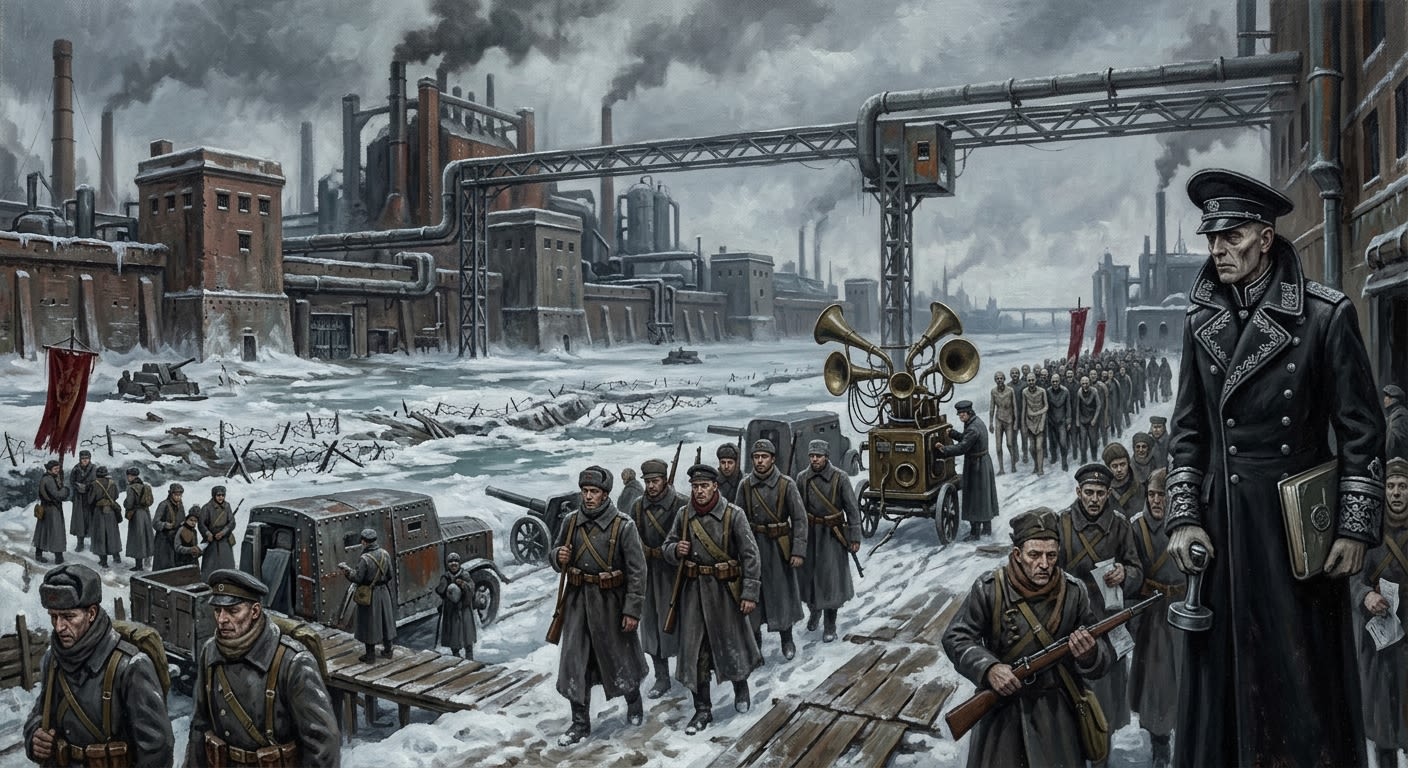
The Northern Theater is the Synod's coldest confession: a stretch of Baltic water, Masurian marsh, Polish flatness, bridge-law, rail hunger, fog testimony, and suppressed paper in which the enemy has committed the administrative indecency of remaining uncatalogued. Other theaters enjoy devils with banners. The north receives pressure, faces, returned hymns, nameless crossings, and fathers who bar their returned sons from the door with gutting knives.
A theater, properly understood, is not a map. A map is ink flattered into obedience. A theater is the argument between terrain and fear after men have been ordered to stand there. The Northern Theater runs from Bastion-Königsberg on the Baltic anchor through the Masurian approaches and Polish lowlands to Bastion-Brest on the Bug, with Warsaw behind it as staging city, Kanzleiburg behind Warsaw as administrative brain, and Hamburg behind Kanzleiburg as damp mouth. The line of support is long. The line of dread is shorter. Dread travels without waybill.
The Bureau of War calls the region a strategic sector. Doctrine calls it a classification difficulty. Bells calls it a resonance exception. Purity calls it a screening problem. Records calls it several things at once and files them under separate tabs so no single clerk must faint from comprehension. The garrisons call it north.
North is where the Seven-Sin catechism thins. Przemyśl has Pride. Sibiu has Greed. Irongate has Envy. Shipka has Sloth. Constantinople has Gluttony and Wrath gnawing at one another across the same gate. Lust, being subtle and better travelled than most bishops, occupies every interior. Königsberg and Brest face something else. Two somethings, if the Bureau wants two files. One thing wearing two behaviours, if the Bureau ever develops courage. The Bureau has made an art of not deciding.
Confidence is the Bureau's word for a sealed drawer.
#On the Geography of Exposure
The Northern Theater has two doors and neither opens politely. Königsberg holds the Baltic hinge, where the Sagittal Line meets sea, marsh, lake, ice, and the old Prussian habit of enduring what Strasbourg has not understood. Brest holds the Bug River crossing, the flat sector, the brass-ribbed bridge where souls are counted under gun barrels before the eastern road receives them. Between them lies a north that resists heroic composition: lake maze, river line, rail yard, frozen harbour, low road, reed-bank, trench-flat, and the sky too wide above men who would prefer a wall.
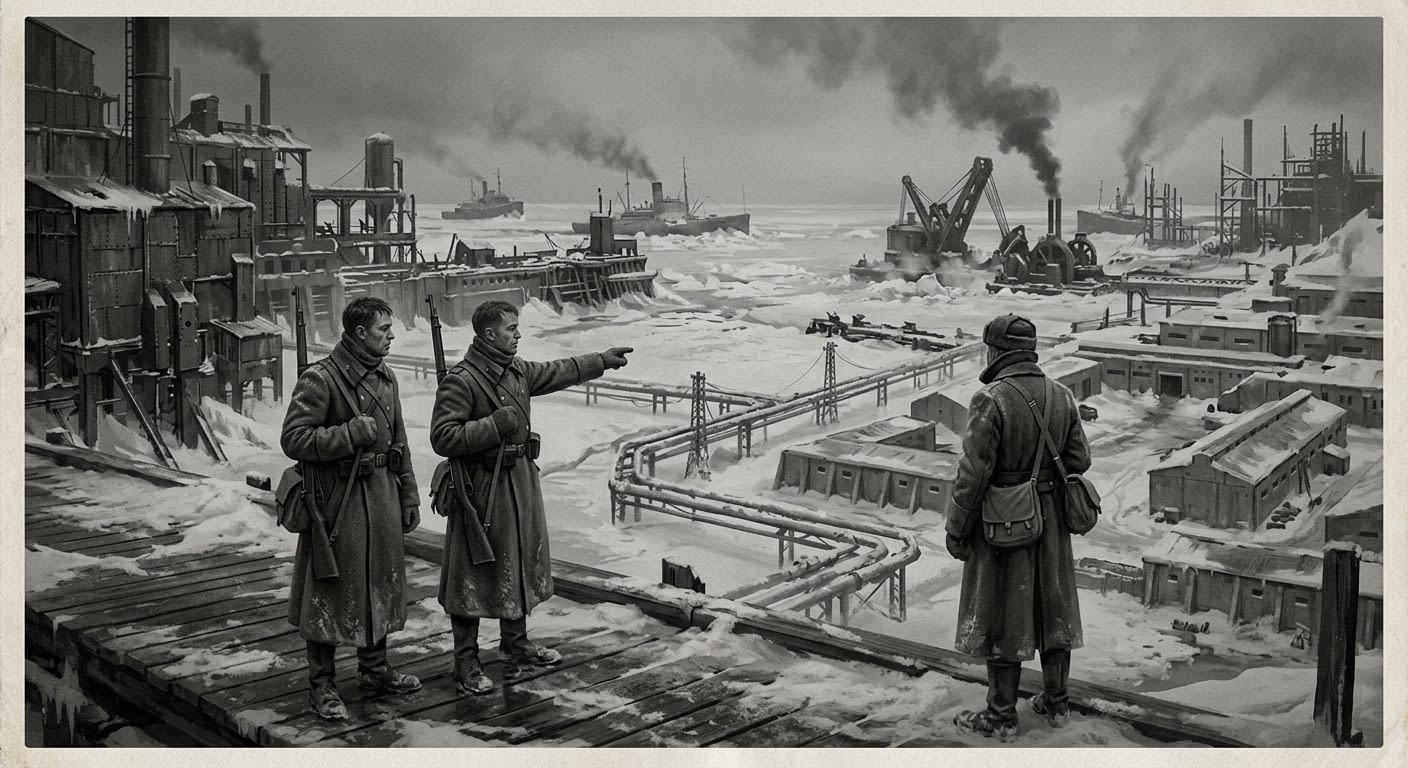
Königsberg's defences look backward and outward at once. The old Ordensburg carries garrison command and the Northern Theater office of Doctrine. The Cathedral Close rings forty-one bells in Northern Standard Resonance, a tuning Bells insists remains canonical despite the evidence of every ear cursed enough to hear it. The Sea Wall faces the Baltic, where fog arrives with no respect for wind. The Frost Yards hold stores, bodies, and reports that make words like refrigeration sound like cowardice.
Brest is less a city than an argument hammered into a bridge. Thirty-two brass ribs span the Bug; each rib holds guns outward and confession inward. Two hundred and fourteen booths process the traffic of sin. Fourteen pylons drop into water that receives bodies, tokens, silt, and rumours with equal appetite. The bridge is chokepoint, tribunal, market, fortification, pylon-warren, gun platform, and sacramental trap. Its genius is also its deformity: nothing crosses without being named. The thing outside has no name.
The Polish lowlands do the enemy the courtesy of being flat. Sound travels too far. Light travels too far. Panic travels farther. The glow from Brest can be seen where settlement officers would prefer citizens to admire curtains. Warsaw hears the front on clear nights and calls the low percussion the Breathing when Doctrine is not listening. Children sleep through it. They wake when it stops.
The Masurian Lakes offer a different fraud. Water and reeds make a maze, and the Bureau of Engineering, intoxicated by terrain, has spent a century congratulating itself upon a defensive gift. The Grey did not apply for permission to use the expected approach. It comes from the Baltic, from northeast, from fog, from memory, from wherever a face can be almost recognized.
Older War primers described the Northern Theater as “favourable defensive terrain with limited hostile mobility.”
Corrected. Terrain is favourable when the enemy consents to terrain. The Grey does not. The Tide accumulates where it was not seen moving. Mobility, in the north, is a comfort word for officers who still believe arrival requires approach.
#On Königsberg and the Grey
Königsberg is the northern anchor and the Bureau's most elaborate unfinished sentence. Its garrison has faced the Grey since at least A.S. 190, when the first Northern Theater assessment placed contact reports under Unknown Forces, Extradoctrinal Classification Pending. Pending remains the official word. Eleven years of pending have passed through rosters, coffins, relief drafts, chaplain rotations, and frost-yard tags. The file waits with the patience of a spider no one has agreed to notice.
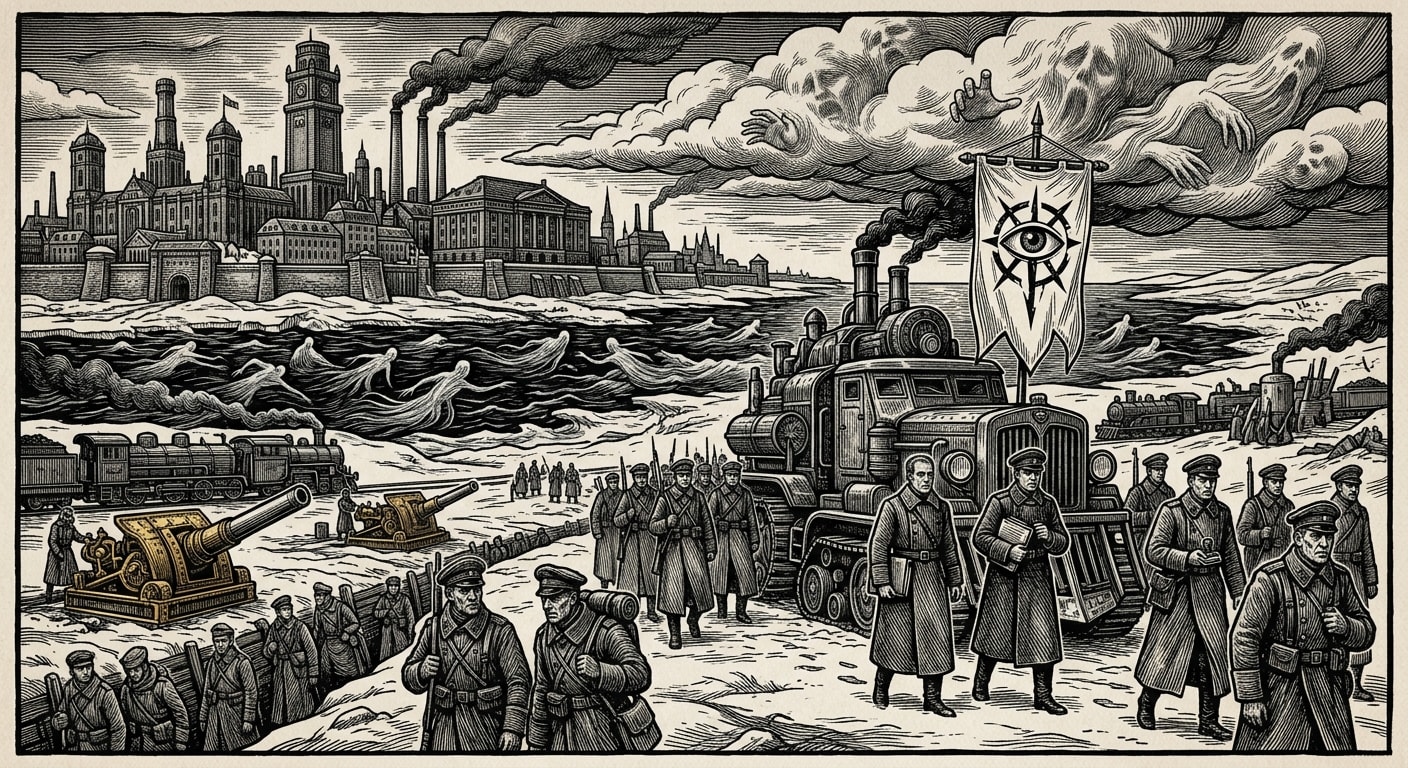
The Grey is fog if one wishes to insult fog. It crosses open water without reference to wind. It carries faces. It returns hymns perfectly, sometimes before the choir has sung the relevant bars, which is a theological discourtesy of the highest order. Hymns fail. Relics fail. Bells ring. The Grey continues.
The faces do the work. Some are known. Some are strangers. The worst are almost known, faces positioned in the mind's vestibule where recognition reaches and finds no handle. Men salute them. Men weep after seeing them. Men refuse sleep because dreams are now a second theatre and no one has issued orders for it.
Dreher's harbour testimony remains the north in miniature. His son vanished during a northeast fog tide in A.S. 198 and returned after three days. The boy's body passed inspection. Pulse, pupils, teeth, scars, holy-water response: all proper. Dreher refused him entry. He said the boy's habits were wrong — rope reached from the wrong side, fish gutted without old disgust, sleep turned northeast, a song anticipated before the father's memory found it.
Purity called this grief-induced perceptual deviation. Dreher punched the clerk. I record the clerk's nose as an unofficial correction to the file.
The Grey's offense is not slaughter alone. Slaughter can be counted; the Synod is excellent at counting. The Grey damages continuity. It raises the possibility that a thing may return with every external sign intact and the essential stamp missing. Records cannot handle this. Doctrine cannot preach around it. Purity can splash cold water on a boy and declare him consistent. Fathers are not required to agree.
The Frost Yards sharpen the same blade. Bodies in vaults turn northeast after placement. Burial cloth tightens. Bread takes frost marks like fingers. Sergeant Halder files reports with the dull bravery of a man who has not yet learned to lie for institutional peace. One sentence passed through Northern Theater offices with the stealth of a knife: subject appears to have listened.
#On Brest and the Nameless Tide
Brest faces pressure. Not attack in the decent, soldierly sense. Not charge, not formation, not banner. Pressure. The Nameless Tide gathers at the eastern wire, bends stakes, shifts mud, leaves tokens facing the wrong way, and teaches old soldiers to write their names on their cuffs before watch. The Tide does not arrive. One notices it has arrived. Marshal Vonn's sentence remains the cleanest field doctrine in the sector, which explains why War rendered it into a useless digest and why soldiers quote the original.
The Tide shares the Grey's scandal: hymns fail, relics fail, bells fail, cursing helps morale and nothing else. It differs in behaviour. Königsberg's enemy wears faces and sings. Brest's enemy presses and returns sins. The Bureau insists upon separate classification reviews. The Bureau has an almost erotic attachment to separate folders.
Brest's bridge was built to defeat ambiguity. A crosser gives name, sin, receipt, token, route. The system forces every body into category before the bridge consents to bear weight. The Blank-Sheet Circle offended this machine by manufacturing transit without name, without sin, without confession receipt, without the pleasing clerical stink of identity. Since A.S. 199, the bridge has answered.
The Confession Echo began as returned speech: a sin whispered in a booth, stamped, absolved, crossing permitted, then hours later the same voice emerging from brass, rope, shutter, deck plate, mist. At first exact. Then corrected. Booth 77 improved the horror by repeating confessions before they were spoken, because chronology, too, has apparently failed to respect Bridge Tribunal jurisdiction.
Judge Elsbeth Krail blames the Circle enough to arrest bodies and doubts the blame enough to arrange contradictions in private. She sits in Absolution Hall with the serenity of a knife laid beside statute. Vonn distrusts explanations that polish too easily. Hett Ruis smiles over stamps that no longer quite balance. The booths open each morning because closing the bridge would serve the Tide better than any demon could.
NORTHERN THEATER MEMORANDUM — BREST / KÖNIGSBERG PARALLEL, A.S. 200 If Grey hymn anticipation and Booth 77 temporal confession share vector: █████████████. If named sacramental architecture attracts unnamed pressure: suspend ███████████ across bridge-bastions. If suspension impossible without front starvation: continue processing; deny correlation; request Vermillion. Vermillion status: nonexistent / denied / active.
Brest is the place where sacrament becomes aperture. The north is teaching us that the machines built to name, bless, confess, and file may also feed whatever stands beyond naming. I have submitted that sentence twice. Doctrine returned it once with no comment and once with a tea stain. The second was closer to engagement.
#On Doctrine's Failure and the Bureau's Blank Page
The Northern Theater humiliates taxonomy. That is why its files are sealed so heavily one expects the cabinets to sweat wax. The Synod's war rests upon a radiant administrative comfort: evil can be named; sin can be assigned; named sin can be countered; countered sin can be reported as managed. The north does not cooperate. Its hostile forces may predate the Sundering, may belong to the Great Deceiver's host by a path no present theology admits, may be two behaviours of one absence, may be a category so old that our bells are newcomers shrieking in a language the water finds comic.
Doctrine hates old problems. Doctrine prefers ancient answers and recent problems. The Grey and the Tide invert the pleasure. Scandinavian accounts of det grå vattnet speak of grey water older than Concordat, Synod, Sundering. The Bureau calls this pre-Concordat folk tradition, unverified and naive. The Bureau has also requested old Scandinavian bell tunings three times and stopped asking after the third refusal at sea. These two facts dislike standing near each other. I have placed them together anyway.
The Northern Theater office of Doctrine has learned the cowardly elegance of phrases such as Outside Current Doctrinal Scope, Extradoctrinal Classification Pending, and Absolute Suppression. These are useful seals. They keep panic from becoming doctrine before doctrine has selected a defensible lie. They also keep truth in the dark long enough for truth to grow teeth.
Absolute Suppression is not silence. It is curated leakage. The right officer hears enough to obey. The right chaplain hears enough to soften a report. The right Hieromnemon hears too much and becomes annoying. The wrong soldier hears the truth from fog and spends the rest of his tour writing his name inside his cuff.
#On Purity, Velvet, and the Interior Front
No theater is purely external, because men carry interiors with them like contraband. The Northern Theater's visible scandals are the Grey and the Tide, yet the same files draw in the Velvet Choir, the unnamed Purity Briefing Officer, and the peculiar terror of an enemy that uses human wants with more discipline than our officers use field tables.
The Briefing Officer's A.S. 197 seminar on Choir recruitment ended a room. She taught that the Choir does not make people do things they would otherwise refuse; it makes them do what they have always wanted to do and always known they should not. This was not a warning about perfume and beds alone. It was a warning about agency, shame, and the Bureau's habit of converting human need into forbidden inventory.
Six weeks later she was reassigned to the Northern Theater. The personnel ledger called it special consultation. Records produced no promotion writ. Purity clarified nothing. The north received her the way it receives all inconvenient clarity: by making it hard to confirm whether she lives, serves, vanishes, or has become another useful blank.
The Choir matters to the north because the northern problem is not only the unnamed outside. It is also the unsteady inside: the sentry who sees a familiar face in fog, the father asked to accept a returned son because records approve, the clerk who hears confession return in a voice he was paid to seal, the officer who knows desire can be used because he has watched longing pass checkpoints better than orders. Velkara has no fixed bastion because walls flatter her. The north proves the rule by other means. A wall against fog is mostly a place to stand while being studied.
Purity's instruments struggle at both edges. Against the Choir, awareness does not confer immunity. Against the Grey, inspection does not establish identity. Against the Tide, confession does not end speech. The Bureau of Purity survives by declaring that enough water, questions, and pain can separate true from false. The Northern Theater replies: sometimes the false has no seam; sometimes the true returns wrong; sometimes the question itself is the aperture.
#On Command, Personnel, and the Cold Arithmetic
The Northern Theater is governed by people whose titles sound firmer than their sleep. Castellan-Warden Ingrid Halvorsen holds Königsberg with Scandinavian blood, Prussian habits, and a personnel file describing her as theologically adequate, which is War's way of complimenting a commander who has stopped asking questions in ink. Rector-Chaplain Wendelin Grau keeps the Northern Carillon and discusses bell schedules whenever the Grey is mentioned, a habit either evasive, saintly, or sane. Sergeant Halder files corpse reports from the Frost Yards as if orderly prose might keep the dead from listening.
At Brest, Krail owns the argument, Vonn owns the guns, Ruis owns the stamps, Scribe-Mother Hal owns the damaged clerks, and the bridge owns them all. Krail's nineteen arrests have not stopped the Echo. Vonn's shells have not named the Tide. Ruis's stamps continue because a bridge without stamps becomes a riot, then a breach, then a lesson preached by corpses.
Behind both bastions stands the Northern Corridor: Hamburg feeding, Kanzleiburg routing, Warsaw dispatching, rail confessors counting seconds, widows paying pennies, section men tapping rails under frost. The Northern Theater cannot be separated from its throat. Königsberg's frozen harbour throws supply onto Polish routes for months each winter. Brest's bridge backs convoys into Warsaw when confession lanes jam. A single rail failure becomes a ration cut, a ration cut becomes a disturbance, a disturbance becomes a sealed memorandum, and the sealed memorandum becomes, in time, my problem.
Endurance is the theatre's true currency. Men endure fog that studies them. Clerks endure voices that borrow their categories. Judges endure theories that fail before dawn. Fathers endure returned sons. The Bureau endures uncertainty by stamping it pending. Of these, the fathers suffer with the least ornament and the most dignity.
#On the Civilians Who Keep the North Human
The Northern Theater has civilians in it, which every strategic report treats as an unfortunate infestation around military truth. This is false. Civilians are the reason military truth has kitchens, laundry, dock rope, lamp oil, burial cloth, fish, bread, illicit tobacco, replacement socks, petty lies, and witnesses not yet trained to admire euphemism.
At Königsberg, fishermen still launch narrow boats under weather that has acquired a reputation for returning what it borrows. Their wives mend nets beside supply crates marked for War. Children run messages between the Harbour Quarter and Cathedral Close because small feet pass checkpoints before adult explanations gather weight. Old merchants sell herring to soldiers who pretend not to be afraid of fog and buy twice as much salt as they need because salt, unlike doctrine, has visible use.
At Brest, civilian life clings to the Ribwalk and the Pylon Warrens with the sour tenacity of mould under a chapel floor. Market women sell brine fish beside casemate vents. Children learn safe sins before multiplication. Under-Deck Moorers ferry mechanics through fog routes whose legality changes by hour, bribe, and tribunal mood. Dredge wives can identify a corpse by boot leather after the river has taken the face; Records calls this informal practice unreliable, then asks them quietly when the tags are gone.
The north's civilians know more than doctrine because doctrine has edited itself for dignity. Civilians cannot afford dignity. They know which fog smells wrong, which returned man eats too slowly, which booth guard hums too much, which clerk has begun writing before people speak, which soldier has stopped checking his cuff name because he no longer cares whether it remains his. They keep this knowledge in gossip, price changes, lullabies, door bolts, and the angle of chairs placed toward exits.
The Bureau calls these superstitions. The Bureau is not entirely wrong. Superstition is often field observation without permission to become policy. A fisherman who bars his door against the returned son may be wrong, mad, cruel, grief-cut, or correct. The Bureau wants one answer. The north usually supplies several and charges interest.
A Purity circulation sheet ordered “immediate discouragement of civilian grey-water customs in Königsberg and Brest.”
Withdrawn after local commanders noted that discouragement required patrol time, patrol time reduced watch strength, reduced watch strength increased exposure, and exposure produced more customs. The civilians kept their bowls, cuffs, and mutters. Purity kept the withdrawal quiet.
#On the Present Theater
As of A.S. 201, the Northern Theater holds. This is not comfort. A man may hold a hot coal if he is too frightened to drop it near powder. Königsberg rings. Brest processes. Warsaw feeds the line. The Grey approaches, withdraws, sings, waits, or performs whatever verb our language has failed to earn. The Nameless Tide presses, bends, recedes, accumulates, and leaves the eastern wire needing straightening again. The Choir remains an interior lesson no office has mastered. The Briefing Officer remains unresolved. Dreher listens. Krail opens court.
The Bureau wishes to present the Northern Theater as a contained anomaly inside the greater architecture of holy war. This is tidy and false. The north is a question placed against the entire edifice: what if naming is not mastery? What if bells are local grammar? What if confession creates an opening as readily as it seals one? What if the enemy does not hate the Ledger but has learned to read it?
A draft strategic reassurance described the Northern Theater as “stable pending theological resolution.”
Corrected. The Northern Theater is stable because soldiers, clerks, fishermen, judges, bell-ringers, widows, rail crews, and frightened fathers continue doing their appointed work while theology hides under review. Resolution has contributed nothing but stationery.
The next report will say confidence. It will say watch rotations maintained, bridge processing maintained, bell schedule maintained, morale watched, classifications pending, local terms discouraged, no public doctrinal risk. It will not mention Dreher's knife. It will not mention the Sea Wall sentry whose salute began before the face appeared. It will not mention Booth 77's guard humming tunelessly because melody attracts attention. It will not mention the Briefing Officer's erased pencil mark. It will not mention the old Scandinavian bells whose tuning Strasbourg no longer asks to hear.
NORTHERN THEATER CLOSING ADDENDUM — DISTRIBUTION LIMITED If Grey / Tide / Echo phenomena are proven related: █████████████████████████████████. If pre-Sundering origin confirmed: revise catechism section █████; suppress until replacement doctrine drafted. If replacement doctrine impossible before next surge: maintain current bells; discourage witness language; increase ink allocation. Final public phrase: the north remains faithful.
At fourth watch, the Baltic fog presses toward Königsberg and the Bug mist climbs Brest's brass. A bell rings in the north and something returns the note too cleanly. A penitent whispers into a booth and a bridge remembers him with improvements. A fisherman stands with his hands in his coat and refuses to sing. A judge asks whose name is missing. The file remains open.