
#On the Quarter and Its Trades
The Oltrarno is the workshop quarter of Florence. Florence is a Zone 2 city of the Italian heartlands, set on the Arno and far enough from the Sagittal Line that its worst visitors have generally arrived with schedules instead of horns. The Ledger holds no charter for the quarter, no founding year, no surveyed boundary and no census. It holds benches. A clerk who wants more may go and count them himself. Several have tried, and none has produced the same total twice.
The trades sit shoulder to shoulder: ivory-workers, joiners, turners, gold-beaters, lace-tool makers and cabinet carvers. Apprentices sweep between them. Households live above the shops, behind them and, to judge by the inspection reports, partly inside them. A turner's wife knows which drawer sticks. A joiner's son knows which panel lifts. The quarter keeps its knowledge where a working family keeps its bread, close to the hand and away from strangers.
The benches are narrow. The drawers are deep, deeper than any law of joinery requires, and for generations the Oltrarno has insisted that this is a matter of storage. Florentine storage is the most theologically ambitious carpentry in the Italian heartlands.
#On the Objects Kept in Drawers
The quarter's art was smallness. Its carvers made crosses from old tusk, bone, boxwood and horn, plain and unoccupied, short enough to close inside a fist. Poorer shops boiled chalk in glue, shaped it and polished it until a grieving widow could not tell it from bone at three paces, which was all any widow asked of it. Some of these crosses were sold and many were given. A few were sealed into furniture built for secular magistrates. Men who signed Rationalist circulars therefore rested their elbows on the Creator's sign every working day and complained of draughts.
This was how Florence kept the hidden Church, before the Sundering and long before any Bureau existed to admire it. When faith could not be kept in a nave, it went into a drawer, a clothes-chest, a flour bin, a hem, a cradle, or the hollow beneath a bench where a cross waited beside spare awls. A cathedral can be watched. A drawer has to be opened, and opening a thousand drawers takes men, hours and a willingness to look ridiculous.
The old account gives the quarter some three decades of this concealment before A.S. 44. Records insists that I state the arithmetic. The habit was older than the Edict of Rational Allocation, which followed the Treaty of Regensburg in A.S. 30. It was also older than the formal Rationalist Republic that the treaty established. Rationalist administration had been sneering at Florentine devotion for years before it had a constitution. The Edict gave the sneer a filing system.
#On the Night the Workshops Barred Their Doors
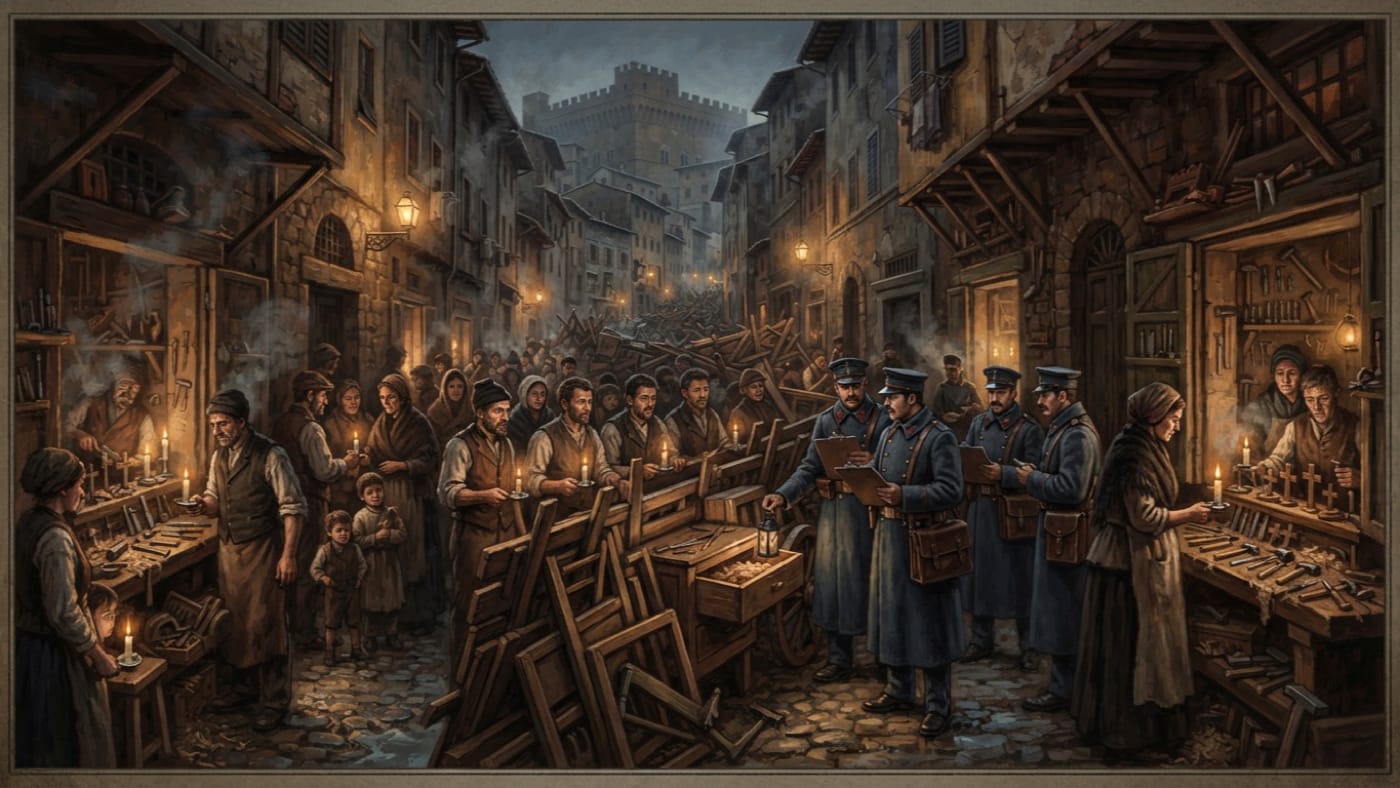
In A.S. 44 the Rationalist Prefecture of Civic Clarification brought its writ to the workshop lanes. The full account belongs to the Ivory Revolt. Here I record what the quarter did with the writ. It required workshop devotional objects to be surrendered for cataloguing, de-ritualisation and educational display. The party came at dusk with printed schedules sorted by craft and household, boxes lined in grey cloth, and a cart fitted with locked drawers. Thirty-six Republican Guards escorted it, along with two anatomy lecturers from Pisa and one municipal notary. The schedules were thorough and listed the quarter's trades exactly as I have listed them above. The Prefecture knew who worked in the Oltrarno. It had not troubled to learn what they could do.
At the bench of Matteo Bellandi, ivory carver, a guard reached for a small cross and lost two fingers to a gouge. That single inherited sentence is all we have. No words survive from either man, and the guard has no name. Whatever the pilgrims believe, the site of the shop is unrecorded.
What followed belonged to everyone. Apprentices barred doors with timber clamps and shutters. Gold-beaters struck their plates in warning, and the sound ran down the lanes faster than any bell the Republic had left hanging. Lamp oil went up to the windows. Lace-tool makers threw needles, and glue pots came down on Guard boots. In Via dei Serragli the turners dragged lathe frames across the street and built a barricade of unfinished chair legs and workshop lumber. The Prefecture's own cart went into it, its locked drawers broken open, emptied and refilled with stones.
Every weapon in that street had a maker and a price. None had been made for killing.
The Guards answered with gunfire, bayonets and fire. The quarter held through the night. By dawn the barricade was quiet. The surviving devotional objects of the Oltrarno were gathered in a square for destruction while the lecturers from Pisa explained material density to people who had stopped listening. The old chronicles say every artisan lay dead by morning. That is the voice of lament, and no casualty roll survives to confirm or correct it. The Republic filed the night as urban disorder. Two words was roughly what the Republic thought the quarter was worth.
#On the Tools Taken into Custody
The quarter's tools outlasted it. The Concordat of Strasbourg was settled in A.S. 90, and Tuscany was pacified afterwards. At some point after that, the Bureau of Relics recovered forty-three implements associated with the revolt: twenty-one chisels, nine awls, six gouges, four burnishers, two ivory knives and one hammer. No accession year is recorded. I decline to imagine one.
The tools were classified as Instruments of Spontaneous Witness, Category Two. This designation is separate from the Bureau's First, Second and Third Class relic taxonomy, and archivists who confuse the two are reassigned to count candles. Forty-three is a count of objects. Anyone who reads it as a count of the dead, or of owners, has mistaken a tool rack for a burial register.
The Bureau holds one gouge, narrow and slightly curved, as Bellandi's by attribution. It holds the attribution firmly, but it has no unbroken chain of custody from his bench to the glass. The hammer's handle is worn by long gripping, and nothing establishes that it was his. Pilgrims who weep over it as his are weeping for an unknown man. That is no worse a use of tears.
Examiners report that the group gives off a faint luminescence under devout handling and stays dull in skeptical hands. The report states no mechanism, and neither do I.
An early Bureau of Records catalogue listed the Florence tool group as forty-seven implements.
Corrected to forty-three. Four pieces were later identified as ordinary workshop debris and withdrawn. Any apprentice in the Oltrarno could have sorted the debris from the witnesses in an afternoon. No apprentice was asked.
The tools now rest behind glass in the Uffizi reliquary rooms under Relics custody. The quarter made them, used them and bled beside them. The Bureau owns them. We call this preservation, and I have signed the word myself more times than I can number.
#On the Quarter Under Inspection
As of A.S. 201 the Oltrarno keeps its benches narrow and its drawers deep. Its cabinet carvers still cut concealed devotional compartments into furniture and enter them on the rosters as joinery tradition. The entry is accurate and tells Purity nothing. Florence's workshops supply the heartlands with sanctioned reliquary casings, devotional seals, catechism plates, processional fittings and the small parts of portable shrines. The Oltrarno takes its share of that work with the composure of a quarter that once made such objects against the law and now makes them under licence, at a better price.
The Bureaus watch these lanes, and each watches something different. Doctrine watches what the quarter remembers. Relics watches what the quarter might yet produce. Records watches its families. Purity watches its drawers, and the current Florence finding advises quarterly drawer inspections, a recommendation the drawers have received with characteristic depth. Tithes watches the price of everything, which in the Oltrarno is high and hard to itemise.
The annual Ivory Vigil begins at dusk in the workshop lanes, the hour the Prefecture's party arrived. The candles are regulated and the litanies approved. Only ceremonial implements registered with Relics may be carried. Doctrine reviews the wording every year, and Tithes reviews the candle concession every year with keener interest. No record fixes the Vigil's calendar day or the year it was first kept, and the quarter has never volunteered either.
I admire these people, and I say so in the register I reserve for martyrs and good vintages. They kept the Church in their drawers when the Church could not keep itself. They held a street against a Republic with chair legs. Since then they have accepted the supervision of every office that arrived after the danger, with the courtesy of master craftsmen being shown how to hold a chisel. I also sign their inspection orders.
During the Vigil, every bench in the Oltrarno keeps something sharp within reach. The wardens pretend not to see it. Purity sees it and counts.