
Writing complete. Here is the article body.
#On the Guarded Sidings
At the eastern edge of the Palatine Switchyard of Lorn, short of the Needle, the yard keeps a set of sidings where nobody loiters. The registry calls them the Payroll Spur Vaults. The older city survey calls them the Payroll Vault Spur. Guards call them the Spur, and switchmen call them nothing at all within earshot of guards. That is three names for one complex, and the Bureau has not yet found a fourth to file it under.
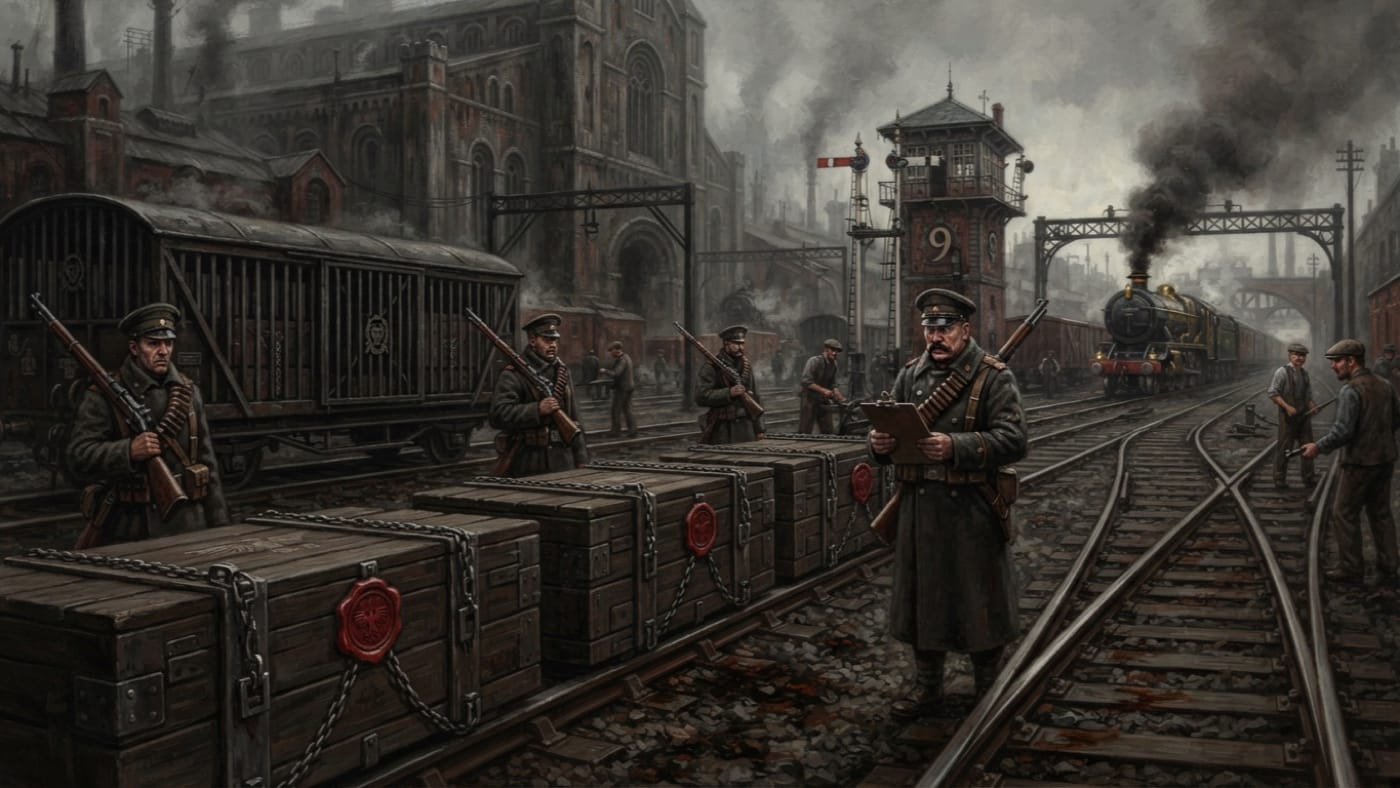
A visitor meets the smell first: wax and gun oil, which in Lorn means money and the men paid to shoot over it. Secured cars stand on the siding with their doors chained and their hasps sealed. Timber crates wait under cover in rows, each closed with wax pressed beneath a seal of authentication. The guards stand near the crates. The coal haze stands over everyone.
Lorn keeps few red lines, and it guards them jealously. Falsifying a master-manifest is one. Silencing a bell mid-dispatch is another. Touching the Payroll Spur without writ is the third. The local word for what follows is annihilation. I took it for civic exaggeration until I watched a brakeman walk forty yards around a crate rather than lean on it.
#On Payment and Permission
The Synod pays its soldiers partly in Crowns of Grace and partly in relics. An authenticated relic is savings a man can carry, holiness he can trade, and an inheritance for the family he will not see again. Gold rusts, the markets say, and relics endure. Relic-payroll is the army's share of that economy: sealed and catalogued sanctity sent east in crates, so that men at the Line are paid in the one coin they trust to outlast them. When a crate arrives short, a garrison has been underpaid in exactly that coin.
Moving the cargo takes four separate permissions and at least one tired body. The Manifest Basilica under Prefect Halden Wry issues the manifests and validates any priority window. Yard Palatine Odrin Kessel controls track priority and the enforcement of the gate. A cantor certified under Bell Marshal Sister-Calder must sing the release. Nothing has moved in Lorn unsung since the Silent Derailment of A.S. 112 killed forty-one men and made the procedure compulsory. A switchman then throws the points with his own arm.
Around all of this stands the Payroll Spur Guard Compact, the local militia publicly charged with protecting relic-payroll. Its resources are guns, writs and sealed sidings. I was not given its strength, its commander or its founding year, and I will not supply them out of my own generosity. The city inventory describes the typical guard as armed, bored and bribable until frightened. Since A.S. 199 the guards have been frightened, and the price of their boredom has risen accordingly.
#On the Three Crates
In A.S. 199, which is 1909 by the old reckoning, three sealed crates of relic-payroll consigned to Bastion-Przemyśl left the Spur and were recorded through the Needle. At Przemyśl they were opened and found empty. The seals were intact. The stamps were genuine. The cantor measure had been correct. These three crates are the case's defining exhibit. Losses on the Spur continued after them, and the series runs through A.S. 201.
Each office has answered with its own document, and each document proves something different.
The Bureau of War's loading manifest records contents, in detail. The colonel who signed it has since been posted to Bastion-Brest. I mention the transfer only because nobody else will.
Kessel produced a seventeen-page audit asserting that the crates never held cargo at all. If he is right, the Bureau of War sealed three empty boxes and sent them to a fortress on the Line with a ceremony fit for saints' bones. If the manifest is right, the audit is seventeen pages of something else.
Wry produced corrected transit documentation. It establishes that the crates passed the gate on the correct paper. The Basilica's transit entry reads Needle clear, which certifies that the Needle let them through. It says nothing about anyone at the Needle looking inside.
Sister-Calder produced tonal records showing that every release was sung in compliance. A tonal record proves that a voice was in tune at a given moment. Nobody has ever asked one to prove what was in a box, and it would be cruel to start now.
Earlier notices of this office described Payroll Spur cargo as examined twice, once at loading and once at the Needle.
Corrected. Cars without a validated priority window are opened at the Needle. Cars with one pass without full inspection, lawfully. No record shown to me says which window, if any, carried the three crates, or where between loading bay and bastion their contents went.
Set the exhibits side by side and they never quite meet. Seal, stamp and measure each certify one step. Nobody certified delivery. Somewhere a soldier was paid in wax.
#On the Routes Beneath
A second city runs under the yard. The Hush Tunnels officially do not exist, and the Hush Tunnel Runners who work them move freight, persons and paper outside the official schedule. They can alter lesser forms and move a seal from one crate to another. They cannot manufacture a true master-manifest. The city's own inventory says genuine Payroll Spur seals cannot be had in the under-yard without someone inside.
My earlier account, and the under-yard testimony behind it, holds that Runners carried payroll from the Spur under routing codes older than their cartel, cut into sealed service walls beneath Switch-Tower Nine. I stand by having reported it. It shows that Runners handled cargo. It does not show who wrote the codes, who paid for the carrying or where the cargo finished. Several Runners who handled the first crates retired quickly afterward, which suggests they were paid well and frightened soon after.
Tower Nine routes the Needle's eastern pinch and the Spur sidings, and it answers late. A caller can hold the siding at amber long enough to freeze attention without declaring an obstruction, and a lamp-reader under a grate can read the amber. Beneath the tower lies a clock sealed since before the Synod. Certain sealed analyses propose it as the source of the Hymn-Phase Slip. Their word is propose, and it is mine.
An under-yard report describes a child returning alone from beneath the tower with payroll wax in both hands. I cannot say whose wax it was, or from which crate. I can say there was nothing inside it.
#On Those Who Answer for It
Lorn's authority is split three ways, and since A.S. 199 each third has been preparing against the other two. Kessel holds his office, signs his windows and keeps his gloves on. I once wrote that he "reroutes," and I have since struck the verb myself. No court has certified his criminal responsibility. None has certified his innocence either. Wry is preparing documentary revisions. Sister-Calder is preparing a purge. At the time of this survey all three are still preparations, and none has been carried out.
The people who bear the Spur's consequences are rarely the people who sign for it. Guards are questioned over crates they never opened. Clerks whose initials appear on corrected pages find those pages corrected again. Switchmen threw the points on a sung release exactly as the hymn instructed. They are the first fined when a window runs late and the first suspected when a car runs light. The Switchmen's Union is preparing a slowdown. Its grievances are older than the payroll losses, and the losses have not made them smaller.
At the far end are the men who were owed. A relic paid to a soldier at Przemyśl is the one wage he can send home that the Ledger promises will not spoil. Three crates short is a garrison's worth of such promises, and Lorn has filed it as a discrepancy.
#On the Commission Still in Strasbourg
As of A.S. 201, which is 1911, the Spur operates. Crates are sealed, sung and thrown east, and losses have been recorded across three years. The Yard Tribunal retains the local case, with the Bureau of Shadows sitting in an advisory role.
Inquisitor-Regent Veyl Hark holds a commission granting her investigatory and interim governing authority over the Payroll Spur, Tower Nine and the Hymn-Phase matter. She remains in Strasbourg at the Joint Investigatory Cloister, reading the Spur's ledgers in cold rooms. Her field procedure has been written but not performed. She has yet to separate anyone in Lorn from his alibi, though several have begun practising.