

#On the Narrowest Permission
Compiled at Bastion-Przemyśl in A.S. 201 / 1911 CE from Orchard filings current at the time of compilation. The year dates this survey. The Screen keeps its own age, and has not disclosed it.
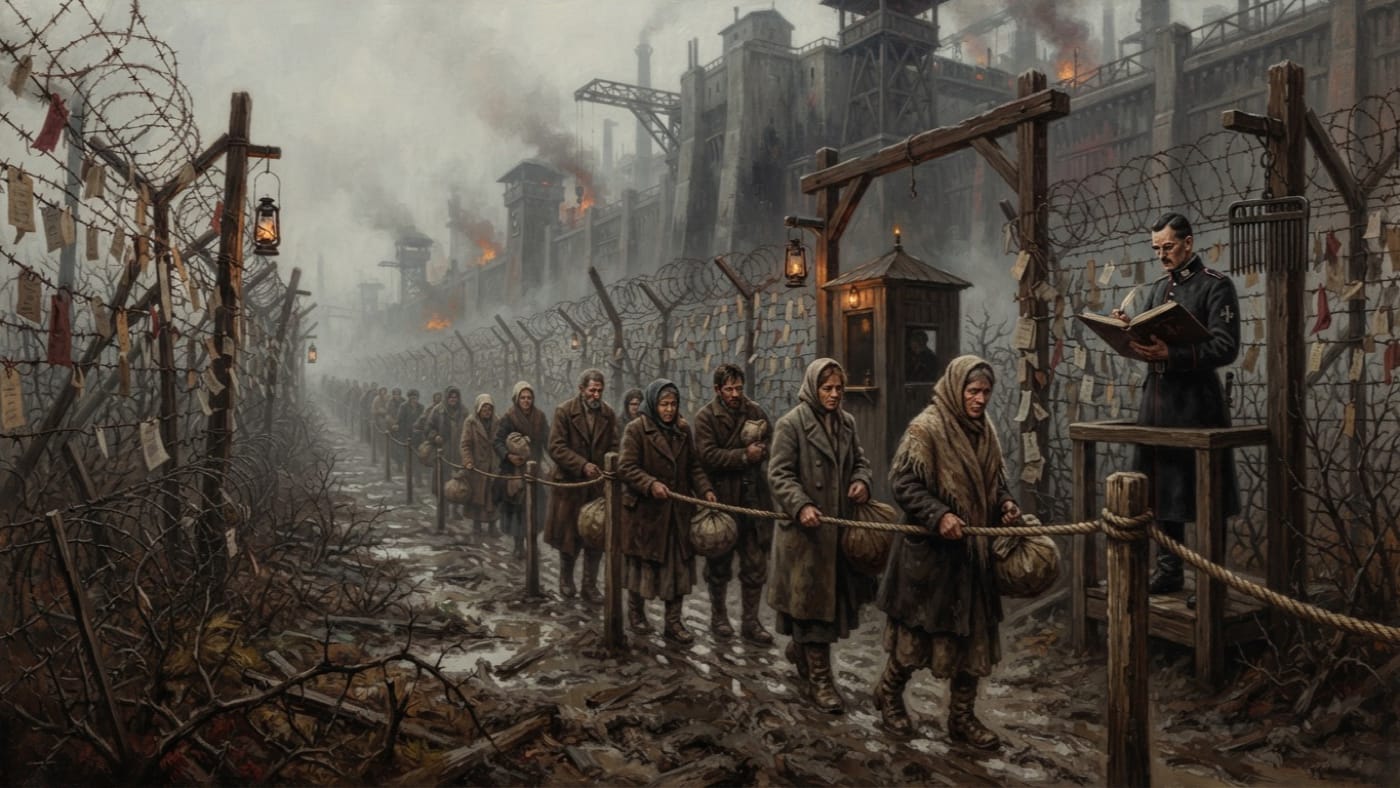
The Pilgrim-Screen is the third and least of the principal lanes through the Wire Orchard of Bastion-Przemyśl. It is a rope-guided foot passage between tag posts, and the people the Orchard has agreed to consider are counted on it by hand. The survey that names it doubts it deserves the word lane. I share the doubt and keep the word. The Bureau of Engineering filed it under that heading, and nothing at Przemyśl is ever demoted once it has a folder.
It is rope, and there are posts. Between the posts the rope runs at a height a tired person can hold. On either side stands the rest of the Orchard: barb, current, bell wire, dead fruit trees bound in rust, and paper hanging from every strand like washing put out on an execution day. The rope offers no protection from any of it. It marks where the wire has been instructed to leave a gap, and the instruction can be revised.
The Orchard lies in the Zone 4 outer works of the bastion, on the western Carpathian approaches, where Przemyśl guards the passes. The Screen is one strand of that apparatus. It is not a road to a shrine, a town of its own, or a mercy. Its designer, its dimensions and the year its first rope was strung appear in no filing before me, and this entry will not supply them on the bastion's behalf. The Orchard's own milestones are recorded: two miles of extension by A.S. 75, three miles and a permanent Logistics-Penance ward by A.S. 92. Those dates belong to the grid. The rope has never been given one.
#On the Three Lanes and the Least of Them
Three principal lanes cross the Orchard, running generally west to east. The Rail Lane runs beneath steel gantries between the Rail-Throat Yards and the forward spur, and carries sealed manifests along with the cargo they claim to describe. The Wagon Lane slants south through flood-ditch gates and mud checks. It is wide enough for artillery carts and slow enough that one dead mule becomes a question of doctrine. Both lanes were built for things that can be weighed, inventoried and refused a whole train at a time.
The Screen was built for feet. Freight travels with a manifest. A body travels with itself and whatever paper it has kept dry. The bastion's access rules divide the traffic plainly: sealed manifests on the rail spur, a permit gate on the wagon causeway, and a screened line for pilgrims. Screening is its own trade. It is slower and closer than the others, and the clerk does it within reach of the traveller's breath.
The Orchard survey reports tag teeth in each lane: iron combs at shoulder and waist height, which a correct permit passes flat against the body. It reports that a missing tag catches the comb and rings a bell, and that in the older sections a hook-line followed. The survey does not explain how a tag that is absent catches anything, and I will not explain it either. Engineering declines to describe the mechanism and the Wardens decline to stand near it. Most of what is known lies between those two refusals.
#On Those Counted by Hand
The survey lists the Screen's traffic as refugees, shrine petitioners, wounded men, reclassified civilians and goats. The list has the honesty of an exhausted clerk. It ranks nobody, and the rope ranks nobody either.
Each category reaches the posts by its own misfortune. The refugee comes because the place he left has stopped being a place, or because a household assignment was revised at a desk he will never see. The shrine petitioner carries a request that paper cannot hold, and paper must still go ahead of it. Whatever road tokens the Bureau of Pilgrimage issued along the way, this compilation has not established what they are worth at the posts. The wounded man comes because a body that can no longer march must still be accounted for, and an infirmary bed is a permission like any other. The reclassified civilian comes because a stamp changed his class while he slept, and the Orchard has to be told who he now is. The goat comes because someone owns it. Ownership is also a document.
At the posts they are counted by hand. The survey gives that phrase and nothing more, and the phrase carries a good deal. A rail consignment is counted by tonnage, a wagon by axle and seal. On the Screen a person is counted as a person, one at a time. The survey does not say whose hand does the counting, at which post, or onto what board the number goes. Of the count itself only this much can be said: it is the oldest act of the Ledger and the least trusted, because a number spoken aloud carries no wax.
Paper governs everything else. The Provost checks tags and Ledger clerks verify seals. The bastion's general controls do not suspend themselves because a traveller is limping or holy. At the Screen, as everywhere else in the Orchard, a valid tag is an administrative condition. It states that the bearer may pass through iron without being turned into evidence. It makes no promise about the iron.
"If your tag survives Ardenne, your soul might." Pilgrims' saying, as entered in the bastion's older working file.
Corrected. The bastion is Bastion-Przemyśl, and Ardenne is a superseded name. The saying is still repeated under the old noun, and Records has amended only the noun. No office has been authorised to amend the souls.
#On Paper and Flesh
The bastion's faith in paper broke in A.S. 112. During the Paper Plague, two hundred refugees entered the western perimeter under falsified identities. Eighty-seven died, and the perimeter spent three days in lockdown. The passes were plausible, and that plausibility was the injury.
No record before me establishes which lane, gate or road those two hundred used. Doctrine would like it to have been the Screen, because refugees and rope sit well together in a sermon. Records will not confirm it. I side with Records, which happens rarely enough to merit a stamp of its own.
The Compulsory Marking Decree of A.S. 113 answered the breach at every forward checkpoint at once. It required a bodily tri-mark for each class: civilian, military, clerical, ward, penitent, pilgrim and condemned. It did not retire the document. Paper stayed necessary. The mark went alongside it and checked it. When the two quarrelled, the mark outranked the paper: the document went to appeal and the body went into custody. The pilgrim class received a triangle glossed route-bound passage. In the Decree's language, that means a pilgrim may walk only where the Decree has walked first.
So the traveller reaches the rope carrying two ledgers, one folded in a sleeve and one burned into the wrist. The rope bears both without comment. When they agree, the count goes on. When they disagree, the general rules of the forward zone apply, and those rules were not written with the Screen's slow pace in mind. The Orchard survey records that the older hook-lines were reduced after A.S. 113 because they took too many shoulders from people later found to have merely misfiled their extensions. It does not say which lanes kept theirs.
Licensed marks are applied by the Geometry Brand-Smiths. Unlicensed ones are sold in the culvert stalls of the Underwire, along with smudged pilgrim triangles, dead men's tags and vinegar for lifting old wax. The Gleaners work the same tunnels, and their mercy does not appear in any approved column. A good forgery limps, they say down there. A rope cannot tell a limp from a forgery.
#On the Present Condition
As of this compilation, A.S. 201 / 1911 CE, the Orchard around the Screen is active, responsive, politically indispensable and mistrusted in operation. The Orchard Wardens maintain the grid and go out before full light with hooked poles, shears and receipt satchels for the dawn harvest. The tagged dead go to the Chapel of Counting. The untagged dead are logged as Uncounted Contact. The surveys do not say whether the harvest walks the Screen, and I will not walk it there for them.
The paper is issued, and later dies, at Taghouse Row. A missing stamp die there has turned every honest seal into a question and has forced emergency revalidation drives that produced more expired persons than the earlier count allowed. The Erased, those without a current tag, are a category the rope has no place for. The Underwire does.
The grid's history is short on comfort. In A.S. 164 the Split-Ring Disaster cut the western pylon feed, and the wire hung slack in sectors three through seven for eleven hours. No filing says whether the rope ran through any of them. Patrols report that tags in dry wind seem to say names, some of them absent from the day's rolls. The Bureau of Bells has filed this as Wire-Hymn Resonance, and Records has filed it under Pending. Nobody has asked the rope what it hears, and the cause remains unestablished.
Opposite the Orchard, in the eastern Carpathian highlands, Atheron's dominion keeps its heights. The Orchard was deliberately made dirty against Pride's optics, and its paper-fruit breaks the sightlines of enemies who prefer a polished surface. None of that is a guarantee to a woman holding a rope between two tag posts. Pride has no need to aim at her. The grid around her has already been aimed.