

Compiled at Bastion-Przemyśl in A.S. 201 / 1911 CE from Orchard, Row and Mercy filings current at the time of compilation. The year dates this survey. It does not date the first tag, the first counter or any tag still hanging in the wire.
#On the Instrument as Surveyed
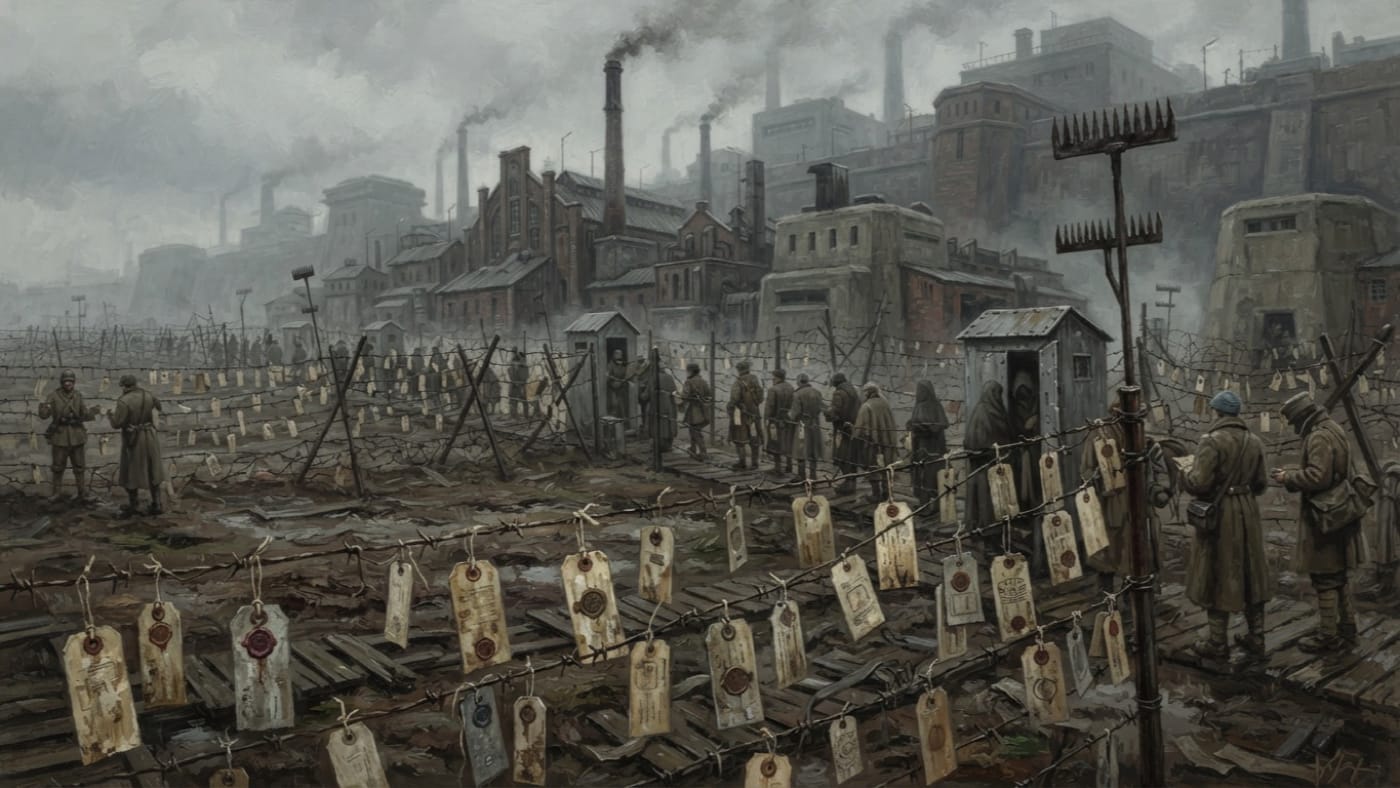
The ration tag is the working paper of Bastion-Przemyśl. It is issued and checked at Taghouse Row and inspected at the gates. It hangs by the hundred from the strands of the Wire Orchard, among transit chits, confession receipts, quarantine slips and the other paper the soldiers call fruit. Nobody calls it holy. Everybody at Przemyśl treats it as holy.
What the tag grants is entitlement. A valid one entitles its bearer to food at a class, labour at a class, a roof and a lane. The tag says nothing about whether its bearer is alive. A dead man's tag can stay in date for weeks, and a living woman can stand in the rain with no tag at all. The bastion's own rhetoric hides this, and I have caught the Codex repeating that rhetoric.
"The Candleworks... cut the dies that stamp the seals that authorize the tags that permit the men to live." — Prior Codex survey of Bastion-Przemyśl, A.S. 201.
Corrected as to the final verb. The tags permit men to draw bread, pass a lane and be entered in a ledger. The living without tags are recorded in the same filings: deserters, the misfiled and children born between census windows. The sentence stays in the plate as administrative rhetoric and is withdrawn here as fact.
The local saying runs No tag, no dawn. It describes the stakes. It is not a law of physics, though at Przemyśl the two are easy to confuse before breakfast.
#On What the Tag Says
The Wire Orchard account lists the tag's contents: name, number, date of issue, date of expiry, permitted lane, food class, labour class, confession status and a wax seal. I give the list as that account gives it, for Przemyśl. Whether every tag in every season has carried every field, and whether tags issued elsewhere on the Line look anything like it, no filing in my keeping says.
The seal is where the sources quarrel. The Orchard account has the seal's colour deciding a household's fortune before breakfast. The bastion's dedicated lore says the wax is colourless and that rank is shown by cut shape. The Taghouse Row survey declines to settle it. So do I. Anyone selling a key to Przemyśl seal colours is selling the key and nothing else.
The counter deals in three objects, and they must not be confused. The tag carries the permission. The seal-blank is the wax, poured in the Candleworks Quarter, and it changes hands as money among people who have no use for coin. The die presses a recognised authority's impression into that wax, and every impression it makes is as valid as the first. A blank buys one sealing and a die can make thousands. How the three come together is guild business, and Joryn Malk does not publish guild business.
So the counter can establish a narrow set of things. It can tell whether the paper before it is dry and in date, whether the seal reads as one the counter would itself have pressed, and whether the lane and classes match the request. It cannot tell from the tag whether the hand holding it belongs to the name written on it. That question goes elsewhere, and it is usually settled with iron.
No source describes a complete renewal from first desk to last. I have found no fee table, no fixed sequence and no processing time. What I can report is a queue and a press. The press comes down or it does not.
#On the Orphanarium Comparison
The Mercy houses keep a cleaner grammar. The Orphanage Registrar account describes the ordinary orphanarium Three-Tag System: a name disk, a ration disk and a labour disk, ceramic, punched at intake. Under that system the provisional name and the ration class are separate objects. A child can be renamed without being re-fed, and re-fed without being renamed. A missing disk triggers lockdown and a mismatched disk triggers audit.
I record the comparison because it shows what Przemyśl's single tag combines. In the orphanarium a child's name hangs on one disk and his bread on another. The Orchard's tag, as listed, puts both on one object and adds lane, labour and confession for good measure. When it goes, everything on it goes together.
The comparison ends there. No filing shows that Przemyśl tags are ceramic, that they are punched, or that a child leaving an orphanarium carries a disk into the Orchard. Nor does any filing name a child who did. The Registrar's punch is evidence about the Registrar.
#On Lanes and Teeth
A ration tag on its own is not a pass. The Orchard's three principal lanes ask different questions. The Rail Lane carries manifest-bearing freight from the Rail-Throat Yards to the forward spur. The Wagon Lane has its own permit gate. The Pilgrim-Screen is a rope-guided foot passage between tag posts, where refugees, shrine petitioners, wounded men, reclassified civilians and goats are counted by hand. Provosts check tags. Clerks verify seals. A food class does not open a lane the tag has not named, and a named lane does not feed anyone.
Since the Compulsory Marking Decree of A.S. 113 the body has kept a ledger of its own. The Orchard account reports that at forward checkpoints paper and bodily mark must agree. The decree followed the Paper Plague of A.S. 112, in which, by the same account, two hundred refugees entered the western perimeter under falsified identities and eighty-seven people died in the lockdown that followed. No record before me says which lane they used. After that year the tag was still required, and it was no longer trusted alone.
The surveys do not say how entitlement, identification and lane permission fit together at a given post: which is checked first, which prevails when they disagree, or whether a valid tag ever outranks a doubtful wrist. I will not supply a checkpoint sequence the Bureau has not filed.
Then there are the teeth. The Orchard account describes iron combs at shoulder and waist height. A correct permit passes flat, and a missing tag catches the comb and rings a bell. The account does not explain how something absent can catch anything, and the Pilgrim-Screen survey says so. Engineering declines to explain it and the Wardens decline to stand near it. The question stays open.
A valid tag protects nobody from the wire. It tells the lane that the bearer is expected, and that is all it does. Current, hooks, a falling post and an officer in a bad mood all ignore it.
#On Rotfruit and the Erased
Expired tags are supposed to be surrendered at the Row. The Orchard account and the Row survey both record what people do instead. They keep the tags in boots, sleeves, hair knots, bread sacks, mattress seams and the stitched pockets of funeral veils. They trade them and they alter them. Households hang strings of dead tags in the place where another house would hang its saint. The street calls an expired tag rotfruit. Taking up another person's tag string is grafting.
Here entitlement and the body come apart. A tag still in date after its bearer has died can feed a widow, a brother or a mother, a half-bowl at a time, until the audit finds the ghost in the soup. A living person whose tag has expired, been confiscated or never been issued joins the Erased. They still breathe. What stops is their bread, their bunk and their lane. The street calls this paper-grave. In practice the Erased man is alive and listed nowhere.
Below the counters, in the Underwire, forged tags, dead men's tags and vinegar for lifting old wax are sold from culvert stalls. The Gleaners shelter the uncounted and swap tags between the living and the recently dead. The Church calls this sacrilege against the Great Ledger of Souls. The people it feeds see it otherwise. I name no forger and no household, because no filing names one to me.
At dawn the Orchard Wardens go out with hooked poles and receipt satchels and bring both kinds of fruit in. The tagged dead go to the Chapel of Counting, where the tag is read aloud before the corpse is assigned. The untagged dead are logged as Uncounted Contact. The tag often comes back cleaner than the body. The tagged and untagged dead are filed under separate headings, and each is entered in a ledger built for its kind.
#On Supply and Revalidation
The tags do not come from nowhere, though the Row would like them to seem eternal. The Carpathian Corridor survey describes northern packets for Przemyśl carrying ration tags, confession slips and wax blanks for Taghouse Row up by rail, road and mule. It does not say where the tags are printed or by whom, and a packet listed is not a press located.
The present pressure is the die. In A.S. 200 / 1910 CE a stamp die was reported missing. That year dates the report. It does not date a theft, if there was one, or a forged impression, if one has been pressed. A preliminary Records report places the die's serial number in the registers of two bastions. That proves one number written in two places. It does not prove two dies, and it names no holder.
According to the Orchard survey, the loss has forced three emergency revalidation drives, and each found more expired persons than the previous count had allowed for. A tag that passed last season may be refused this one. Each drive lengthens the queue on the Steps. Each refusal sends a living person toward rotfruit, grafting or the culverts. The Bureau of War has modelled tag inflation and ration collapse. The model is conditional, and none of it has happened.
The die has not been recovered. Its holder has not been named. The tags on the wire are still damp, and the queue at the Row is still waiting to learn whether it is still entitled to eat.