

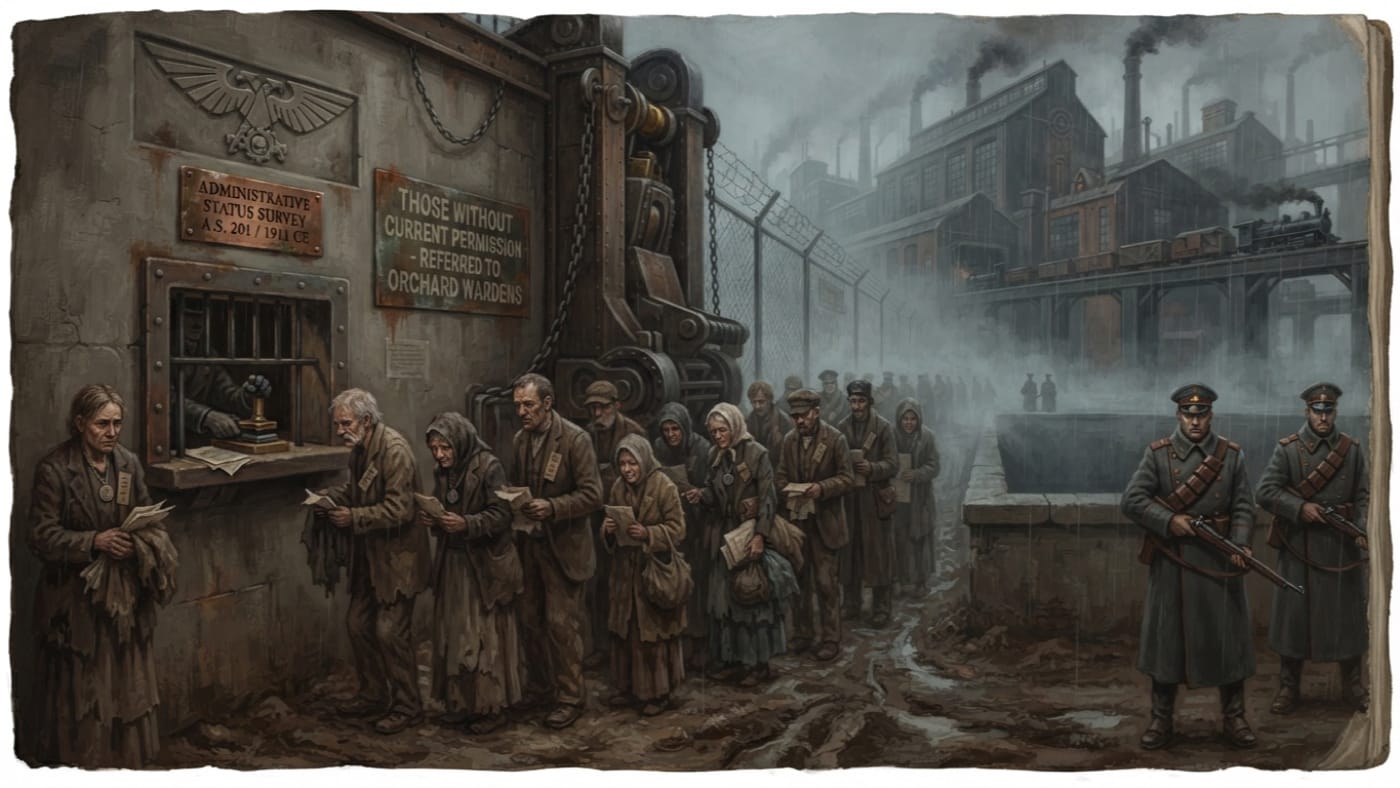
#On the Present Compilation
This survey was compiled in A.S. 201, 1911 by the old calendar, for the present files of the Bureau of Doctrine. The date belongs to the compilation. The Erased have no founding year, and I decline to invent one. A condition that cannot be dated cannot be blamed on any one reign, which will disappoint readers who like their culprits supplied with birthdays.
The word comes from the Wire Orchard at Bastion-Przemyśl, where it means persons without current tags. By commission I have widened it to include those whose recognition has failed or been withdrawn. So it describes exposure. It names no faction, and it keeps no roll. It has no doctrine, no leader and no single cause. A deserter and a widow may stand in the same mud at the same comb while the same bell rings over them. The bell does not ask which of them sinned. The Synod eventually should.
Older accounts let three outcomes run together like wet ink. A person may die. A person may disappear. A person may be erased in law and still be inconveniently alive, hungry, and standing at the gate. The third is my subject. It ends in the same ditch as the first two often enough to confuse clerks.
#On Those Without Current Permission
The Orchard's own list is the best census of misfortune the Synod has produced, and men holding shears wrote it. It names deserters, misfiled refugees and escaped labourers. It names prisoners whose transport columns lost a page, widows travelling under their dead husbands' permissions, and children born between census windows. It names hospital patients released without their recognition reissued. Last comes the large, unremarkable company whose papers were valid yesterday.
Read the list twice. Crime stands beside clerical error, and bereavement beside institutional delay. The deserter chose his road. The prisoner did not choose to lose a page. A clerk at a rail siding did that for him, possibly while eating. The child did nothing except arrive before the census window opened, which the Bureau treats as a failure of punctuality. These people cannot be exchanged for one another, morally or legally. An officer who files them as one kind has confessed only to his own fatigue.
What joins them is the consequence. No current tag means no lane. No lane means no bread at licensed distribution, and at Przemyśl it can also mean the wire. The widow carries her dead husband's name on her own face, and the comb takes no interest in her grief. The released patient leaves the infirmary healed and unrecognised: the Bureau of Mercy has achieved the recovery, and the Bureau of Records has not yet confirmed it.
#At the Comb and the Gate
A Przemyśl ration tag carries a name, a number, an issue date, an expiry date, a permitted lane, a food class, a labour class, a confession status and a wax seal. Every field is a condition. The expiry date is the cruellest, because it turns a lawful person into a questionable one without any act on his part beyond waking up. At the Orchard, permission is lent by the day. Nobody owns it.
This is local practice. Przemyśl's tag economy and its traffic in dead men's tags belong to Przemyśl. I do not offer them as the arrangement of every bastion on the Sagittal Line, whatever the Logistics-Penance pamphlets imply.
Paper lost its monopoly in A.S. 112. In the Paper Plague of that year, two hundred refugees entered the western perimeter under falsified identities. Eighty-seven deaths were recorded, and the lockdown lasted three days. The Compulsory Marking Decree of A.S. 113 answered by writing on flesh at the forward checkpoints, and since then document and body must agree. The Orchard's protocol holds paper necessary and never sufficient. It holds the mark necessary and never to be trusted alone. It prefers a witness and bills for one.
The poor man now carries two instruments that can fail separately. A true tag over a drifting brand is a discrepancy. A true brand under a dead sister's tag is a discrepancy of another flavour. The protocol lists the possible outcomes as hold, brand, return, erase or wire-referral, at the officer's discretion. I find no consistent appeal route in the sources, and I will not invent one to comfort the reader. Two identical discrepancies may meet two different officers before breakfast.
#On Recognition Withdrawn or Lost
An expired tag is a lapse. A strike is an act. The Erasure Notary performs it. He first checks the identity anchors, which are the mother's name, the baptism mark and the oath witnesses. Then he seals every dependent ledger and sends notices downstream. A completed strike can void rations and passage and freeze property. It can collapse marriage and inheritance, invalidate testimony, and deny burial in consecrated ground. Wrong-name strikes are attested. So are downstream offices that never quite receive the notice, which leaves people struck in one register and still drawing rations in another. According to the published account, reinstatement needs counter-signatures from seven offices.
Do not lend that whole catalogue of loss to every man with a stale tag. A transit paper that lapsed on Tuesday has revoked his passage, and possibly his breakfast. To prove it dissolved his marriage, you need a strike.
Administrative Dissolution is narrower still. It is a Form 77-D, a grid of Mortuary Black drawn across the entry in the Great Ledger of Souls, and the null-mark Ø in the margin. The name stays visible beneath its cage while its legal force is revoked. The dissolved remain bodily present. They differ from the never-registered, who have no line to strike, and from excommunicates, whose names stay legible under the red sigil of severance. My estimate of some nine thousand dissolved names counts gridded entries. It is no head-count of the Erased, and I forbid its use as one.
Nemea supplies a third road, through contradiction. Solene of Lyon was appointed first Abbot-Registrar in A.S. 96. When records conflicted, she selected one witnessed, sealed copy, and all legal consequence flowed from it. Original by ratification fed widows and paid arrears. After the west-wing fire of A.S. 103, entire families were missing from the rebuilt books, because no clerk could swear whether memory was a witness or a counterfeit. They were missing from the books. The sources say nothing of their bodies, and I will not supply a massacre to improve the chapter. Ratification settled claims and authorised omissions under the same seal. It does not cure erasure.
Later Records manuals state that original-by-ratification was formalised only after the A.S. 103 west-wing fire.
Amended. Solene practised it in the founding years. The fire expanded the doctrine. With it grew the number of households whose existence depended on what reconstructed paper could be ratified to say.
#On Living Beyond the Rolls
Some of the Erased survive in the Underwire beneath the Orchard, a world of culverts, drain galleries and smuggler cuts that is officially sanitation access. They trade routes, names, scraps and antibiotics. The most expensive goods below are plausible inconsistencies: flaws that a tired inspector will read as human.
The Gleaners shelter the uncounted, exchange tags, and guide deserters under the dead lanes. When a family can pay, they cut bodies down before the official harvest. Help, commerce and criminal risk come from the same hand, sometimes within the same hour. They are a local network at Przemyśl and govern nobody. The Erased have no government, an administrative distinction they share only with the saints.
Death does not close the file. At dawn the Orchard Wardens sort the harvest. Tagged bodies go to the Chapel of Counting. Untagged bodies ordinarily go to the ditch-pits unless Purity wants them. Further categories cover partial, hostile, uncertain and administratively troublesome remains. These are categories for corpses. They count the dead who hung on the wire and say nothing reliable about the living Erased, most of whom are elsewhere, keeping their tags dry.
Lübeck offers a colder comparison. After the Year of Smoke of A.S. 180, the Salters' Compact was denied legal continuity, and its trade passed to the approved preservation factors. Four former members took contracts. Four others survive in the minute-book only as scraped places. A scraped name in a guild register is suppressed corporate memory. It does not prove that the man behind it was dissolved, killed or forgotten. A clerk who files those four under 77-D has merged two procedures that the Bureau, for once, kept apart.
#On the Present Condition and the Limits of Remedy
Remedy is uneven. A lapsed tag can sometimes be reissued at Taghouse Row, when the queue, the die and the clerk's mood agree. A wrong-name strike can be reversed through seven offices. If the struck household starved first, it can be answered with a posthumous erratum. The Bureau of Records says Form 77-D contains no provision for reinstatement. Rumour and residual memory dispute this. The sources do not settle how these remedies relate to one another, and I will not settle it for them.
Forgetting is reported, and the report needs its borders marked. The dissolution account describes neighbours losing a dissolved person by stages. Doctrine calls this social coincidence, and Purity suspects contamination. The Lore Book speaks of true names lost after long exposure to sorcery. A shared vocabulary does not prove a shared mechanism. Nobody has shown that losing a ration tag makes a mother forget her son. She may forget his lane number. Mothers have other priorities.