
#On the Order
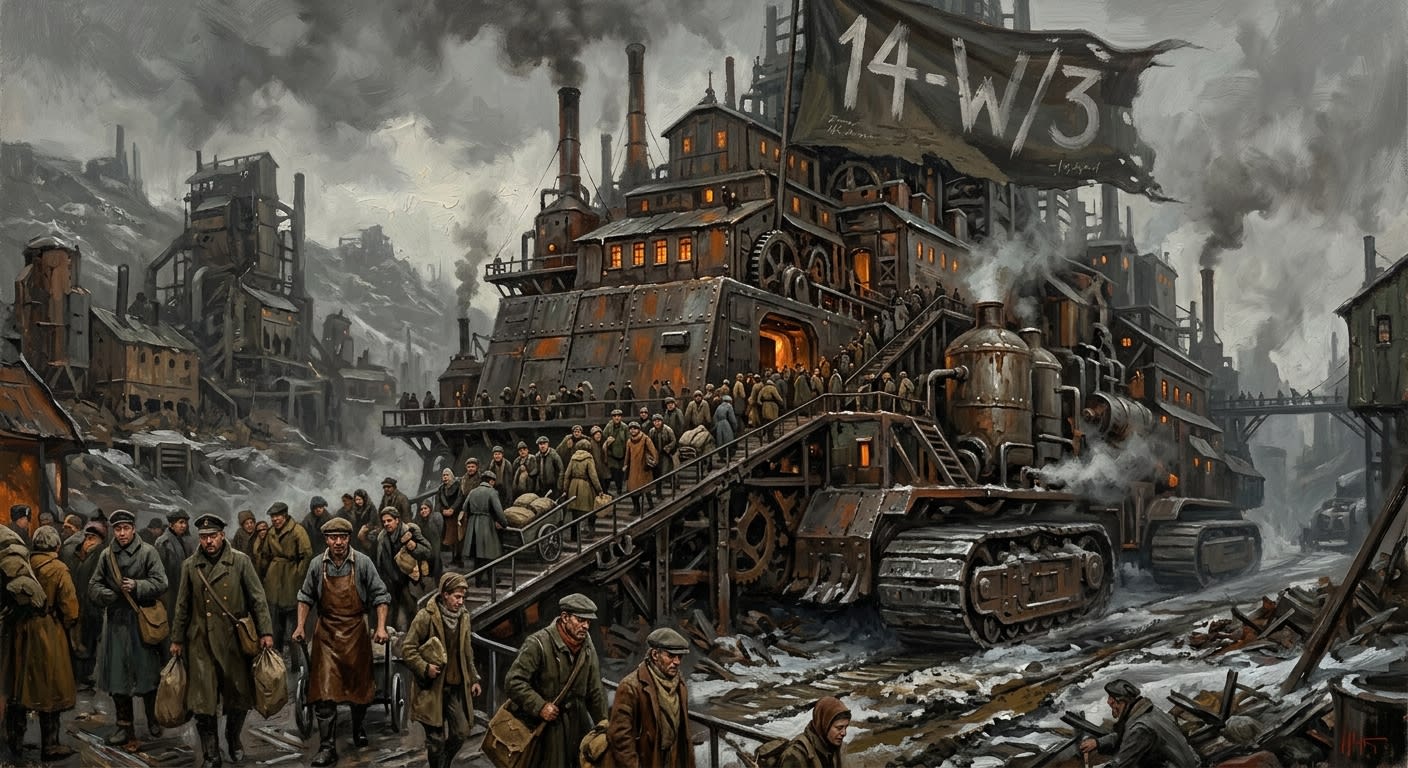
Standing Order 14-W/3 is the Bureau of Settlement's evacuation directive for the Polish forward zone, issued in A.S. 95 when Warsaw was designated a forward staging city and still possessed the courtesy to contain roughly three hundred thousand souls. The Order instructed controlled movement westward: households registered, dependents tallied, trades classified, rail allocations requested, parish lists corrected, departure zones established, and the entire civil body reduced to columns so that the Bureau might save it from proximity to the Sagittal Line.
The Order was revised in A.S. 130. It was revised again in A.S. 160. It has been suspended pending review since A.S. 160. Forty-one years of review have produced no evacuation, no cancellation, no usable readiness rating, and a city of seven hundred and fifty thousand people continuing to exist in open clerical defiance of the forms instructing it to diminish.
A lesser bureaucracy would admit failure. Settlement, being a holy bureaucracy, prefers duration. The Order remains active enough to justify offices, inactive enough to avoid action, and venerable enough that clerks now defend its phrasing with the zeal usually reserved for relic bones and bad marriages.
#On the A.S. 95 Assumption
The Order's first sin was mathematical innocence. Warsaw in A.S. 95 looked movable to men reading maps from a safe table. Three hundred thousand souls, a forward staging designation, rail lines newly disciplined by northern command, the same year Kanzleiburg acquired its Synod name and the northern machinery learned to speak in corridors. The Bureau assumed the city could be thinned without injuring its function. The Bureau assumes many things before breakfast. Few survive contact with bakeries.
An introductory memorandum called the Polish forward evacuation “administratively clean.”
Corrected. No evacuation containing children, livestock, widows, furnace ash, unpaid rents, and three bridges over the Vistula is clean. It is merely dirty in categories.
The A.S. 95 tables divided the population into classes: essential rail labour, transferable trades, dependent households, clergy, garrison auxiliaries, infirm, undocumented arrivals, and “miscellaneous.” Miscellaneous is where the Bureau places people before learning how many of them there are. Warsaw taught the lesson early. The miscellaneous opened shops, worked sidings, married porters, buried dead, borrowed rooms, fed cousins, vanished from one column, appeared in another, and made the Order's clean arithmetic smell of soup.
#On Revision and Suspension
The A.S. 130 revision admitted the city had grown. It did so indirectly, with language so dry it could have been used as kindling: “population persistence exceeds projected evacuation compliance.” This phrase deserved a medal for cowardice. By then Warsaw's rail yards had become indispensable to the northern corridor, sending grain, ammunition, personnel, and classified freight eastward toward Bastion-Brest and Bastion-Königsberg. Evacuating the city meant evacuating the hands that moved the freight, the mouths that fed the hands, the wards that repaired them, and the black markets that kept half of them alive when official ration systems discovered another holy shortage.
The A.S. 160 revision suspended the Order pending review. Population at suspension stood near six hundred thousand. This was not a pause. It was an embalming.
Since A.S. 160, the file has acquired annexes, supplements, interpretive memoranda, contradictory maps, emergency tables, annual objections, and an odor of old wax that I associate with documents too useful to destroy and too dangerous to obey.
#On Warsaw's Refusal
Warsaw cannot be evacuated because Warsaw is the evacuation. It has absorbed Poles from Bug River settlements, farming families from the flatlands, displaced garrison dependents, discharged soldiers who cannot face the heartlands, and refugees from hamlets that now exist only as Records corrections. The city receives the people the Order was supposed to move away. It sorts them badly, feeds them irregularly, houses them in ugliness, and puts them to work because the yards do not care whether a man arrived with a proper writ if he can lift a sack before the departure bell.
The Bureau of Mercy keeps four wards full. The Mothers of Plenty distribute rations to registered dependents and stare at unregistered hunger with the tired mercy of women who know forms do not boil. The Rail-Confessor Corps blesses crews who might have slept in refugee bunks before dawn. The Warsaw Standing Brigade guards the line between queue and disturbance, a line as thin as a ration chit and twice as flammable.
SETTLEMENT REVIEW PACKET — 14-W/3, ANNEX K If full evacuation ordered under current population estimate: rail labour loss █████. Bastion grain interruption: ███ days. Mercy displacement mortality: █████. Praga civil-order risk: unacceptable; word struck by War reviewer and replaced with █████████. Recommended public language: phased reassessment.
#On Herta Stoltz's Custody
Herta Stoltz, Resident-Director of Settlement in Warsaw, has held the Order like a candle in a draught for nineteen years. She has received evacuation tables, rejected false readiness ratings, corrected registered totals with unregistered estimates, and attached mortality projections to proposals that would otherwise have been called efficient by men incapable of finding Praga without an escort.
Her famous bakery answer belongs in this file. Asked why the population had not complied, she replied that the Order assumes people told to leave will leave; it does not account for those people opening a bakery. In a better civilization this sentence would have ended the review. In ours, it became an annotation.
A Settlement digest of A.S. 184 described Standing Order 14-W/3 as “substantially effective in directing population westward.”
Corrected. The Order directed paper westward. People showed less obedience than paper, a defect still under study.
Stoltz's genius lies in refusing with numbers. She does not denounce the Order. She measures it. She counts the workers who would be removed, the beds that do not exist, the children without crossing writs, the rail families in coal sheds, the bakeries that feed yard crews before the Bureau kitchens open, the old who cannot walk, the young who will not, the dead whose names still hold lodging claims because correcting the names would cost rations to the living.
#On Present Status
As of A.S. 201, Standing Order 14-W/3 remains suspended pending review. Warsaw remains inhabited. The yards send 1.8 million metric tons toward the northern front. Praga remains elevated in administrative concern. The garrison remains twelve thousand. The registered population remains smaller than the actual population, because paper has always been thinner than a city.
No Bureau has killed the Order because doing so would confess that Settlement once mistook a living city for a movable diagram. No Bureau has enforced the Order because doing so would murder the northern corridor by procedure. The file survives in the blessed middle state: authoritative, unusable, annual, expensive.