
#On the Appointment
The Prefect of Reason was the officer who brought the Council of Nine down to street level. A council cannot inspect every bell, read every household sheet or stand on every cathedral step while the reliquaries are carried out. It can appoint someone to do so. Under the Treaty of Regensburg and the Concordats of Governance of A.S. 30 (1740 CE), each of the thirty-seven Philosophical Prefectures received one such officer. He sat at its centre, held the Council's cipher-seal for local use and spoke with the authority of the Rationalist Republic.
Thirty-seven is the number of chairs. The Bureau will not tell you how many men sat in them over fifteen years, because the Ledger does not hold a complete roster and the Bureau does not invent arithmetic to please a reader. The furniture is better documented than the men who sat on it.
Regensburg did not invent prefectural government. Rationalist administrators were seizing endowments and dispersing processions decades before the settlement. The Massacre at Saint-Malo in A.S. 10 and the Night of Knives at Kraków on 17 Martius A.S. 18 were carried out by offices already well practised. The Treaty gave that machinery a constitution, a number and a single title. Rationalists called this maturity. The Bureau calls it the day the knife received a scabbard with a crest on it.
The office drew its character from the Academies. The Bureau has found no mandatory degree and no fixed career ladder. It has found that the office breathed lecture-hall air and spoke the grammar of the examination room. The Academy System had long run the chain the Prefects inherited. A lecture became a circular, the circular became a committee finding, and the finding became procedure. The Prefect was the point where a footnote turned into an order.
#On the Prefect's Authority
The Prefect's powers were these: governor of the prefecture, maker of its judges, master of its taxes, patron of its schools, supervisor of its confiscations and the only officer who could declare an emergency in it. Any one of these would have made a respectable tyrant. Combined in a single office, they made a respectable tyrant who believed himself a civil servant.
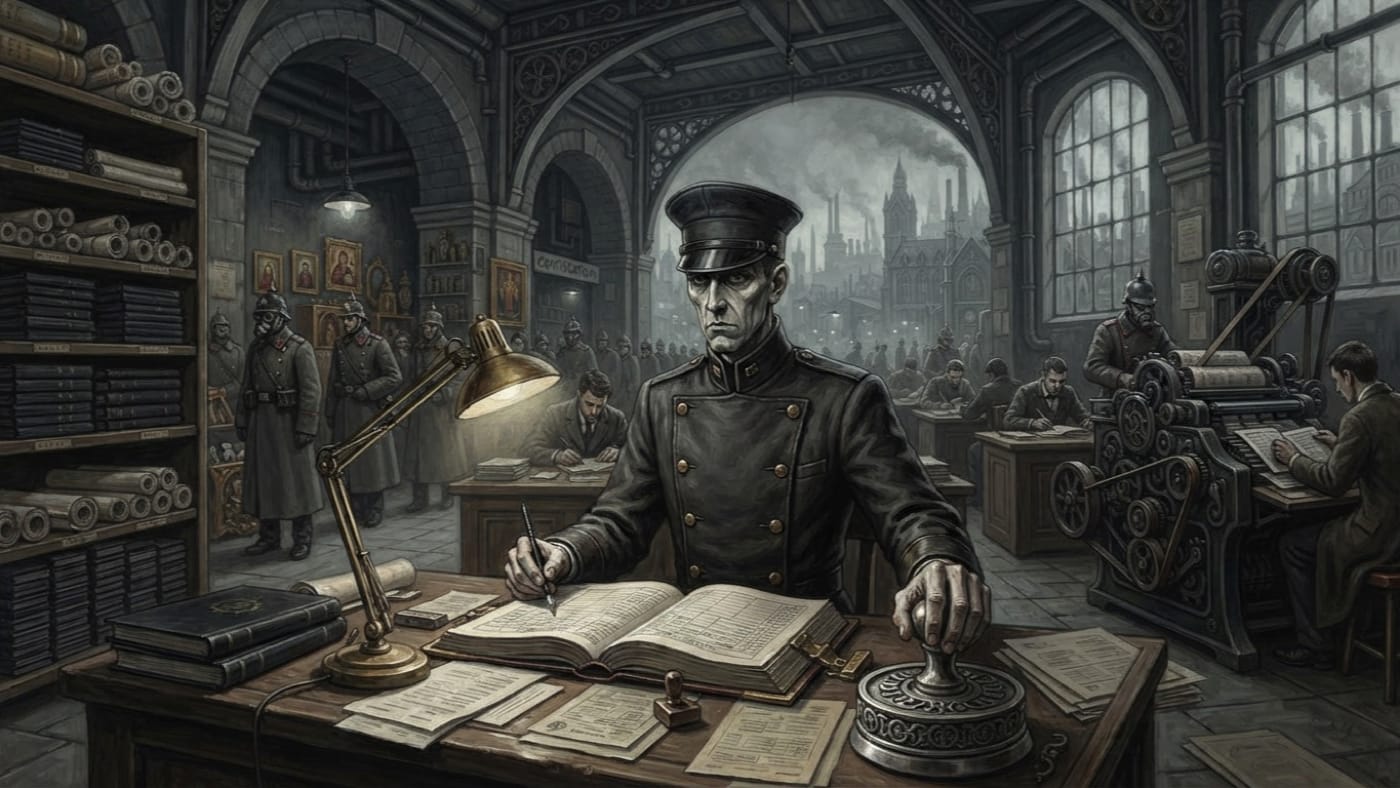
He rarely touched anyone. Four offices did the touching for him. The Civic Security Marshal commanded the Republican Guards, the municipal secular forces, the informant chains and the escort columns. The Director of Instruction governed schools, teacher appointments, approved texts and the transfer of children. The Census Chancellor kept the household registers, the eligibility categories and the correction rosters. The Tribunal of Clarity heard cases and passed sentence. The Prefect coordinated them all. He set the schedules, countersigned the returns and answered to the Council when the numbers fell short.
The Bureau will not merge institutions for the convenience of lazy pamphleteers. The Philosophical Police were a separate creature of the Academies, and the Guards were soldiers. A Marshal was no Prefect, and a Tribunal assessor was no Prefect either. Every arrest in a prefecture happened under the Prefect's authority. The fact that very few happened by his hand was exactly how the office was designed to work.
Central law came down from Paris and Vienna in large, abstract terms. Each Prefect turned it into local timetables: which parish first, which bells this quarter, which schoolmasters to dismiss before the harvest. The craft of the office was translation, from the Council's general hatred into the particular Tuesday on which a village would feel it.
#On Orders Entering the Household
The best way to understand a Prefect is to follow one of his papers out of his house.
Take a confiscation inventory under the Edict of Rational Allocation. The Edict declared sacred property a state resource. The Prefect set the schedule, and his clerks drew up columns for the bells, the plate, the reliquary casings and the monastic orchards. The schedule went to the Marshal, the Marshal sent Guards, and the Guards went to the parish and then to the houses around it, because devotion does not stay inside churches. A candlestick that had stood on one family's table through three generations became an item with a weight, a valuation and a line in the column. The silver was melted and minted into Lumens. The household kept the shape of the empty space on the table.
The Secular Gatherings Act was older than the prefectures, and Saint-Malo had already shown what it could do. The Prefects inherited it as standing equipment. Under them it stopped being an occasional massacre and became a matter of routine: a procession refused, a cellar raided, a feast dispersed and the names written down.
Then came the household sheet. The First Black Census, the great registration programme that followed Regensburg, required every household to declare itself. The Census Chancellor's office compiled the declarations, and the Prefect's authority made them binding. A declaration determined civic eligibility. Eligibility triggered a review of the household's property. The review could mark a child for transfer into Rational Instruction, and the Director of Instruction carried out the transfer. Four offices and one sheet of paper, and a family could lose its silver, its standing and its son without anyone ever raising his voice.
The Edict of Ironmouth is the sharpest specimen. It was issued from Paris in A.S. 30 and carried through every prefectural mouth. It made spoken prayer vocal treason. Ironmouth had a full set of paperwork: a warrant authorised the cut, a witness confirmed it and a return recorded it. The returns climbed through the prefectural chain to the Republic, which added them up and recorded eleven thousand mutilations in the first year. That is the Republic's own figure, summed across the whole Republic. No single Prefect owns it, and every Prefect contributed his share and initialled it.
#On the Failure of Command
The omens arrived as items for the bulletins. The Year Without Dawn in A.S. 32, the Red Flood in A.S. 34 and the Eastern Silence in A.S. 38 were each explained, printed and filed. The returns kept coming in. Tongues were counted in the same quarter that the Danube boiled. The Bureau has seldom seen such dedication to the wrong column.
On 1 November A.S. 45 (1755 CE), the Sundering broke central command. Doctrine teaches that this was judgement on Reason's arrogance. The Bureau records the administrative result. Orders kept moving after the authority behind them had collapsed. Prefects demanded reports from eastern districts whose replies came back in the wrong handwriting. Marshals sent Guard columns against things no schedule had a name for. In the west, prefectural services survived unevenly. Some offices went on collecting, registering and dispatching for a time before they were absorbed or pushed aside.
Prefects died, fled, burned their archives, reopened churches, released prisoners and denied everything. Some later served under changed names. Some were hanged after useful interviews. No complete account of their fates survives, and the Bureau will not compose one out of satisfaction.
During those years the Church came up out of hiding. It had existed in cellars before A.S. 45. It took public authority unevenly afterwards, governed through an interim council from around A.S. 50, and was formally constituted as the Synod only at Strasbourg in A.S. 90 (1800 CE). The Prefects did not hand their keys to a waiting Synod. Many of the keys were found in ditches.
Earlier doctrinal holdings listed the prefectural order as "dissolved by Sundering."
Corrected. The Sundering broke the Council's command in A.S. 45. Local prefectural offices, officers and western services survived unevenly before they were absorbed or displaced. "Dissolved" is a word for salt in water. The prefectures came apart more slowly than salt, and left more behind.
#On Annulment and Useful Inheritance
In A.S. 92 (1802 CE), the Bureau of Doctrine annulled the Treaty, the Concordats and the whole prefectural constitution, retroactive to the moment of signing. In law, no Prefect of Reason ever held valid office. Every countersignature was void, every emergency declaration was void and every child-transfer order was void on the day it was sealed. The Bureau upholds this judgement completely. The annulment does not reopen a melted chalice or return a tongue to a mouth. Doctrine voided the authority. The Ledger keeps the damage.
The Church inherited what was useful: prefectural roads, dispatch methods, storage depots, ledgers, register habits, buildings and people who knew how to run all of them. No single decree turned Prefects into Synodal officials. The inheritance came piece by piece, under corrected authority, as each frontier office worked out what it could not do without. Strasbourg kept the muscle and cut away the heresy. If a modern district office reminds you of a Prefectural House, remember who now owns the building.
As of A.S. 201, the office is taught to advanced students of Doctrine and Records once they have read Regensburg, the Census and Ironmouth. They are told to admire nothing. The intelligent ones admire the routing anyway and are corrected. Afterwards they keep better ledgers.