
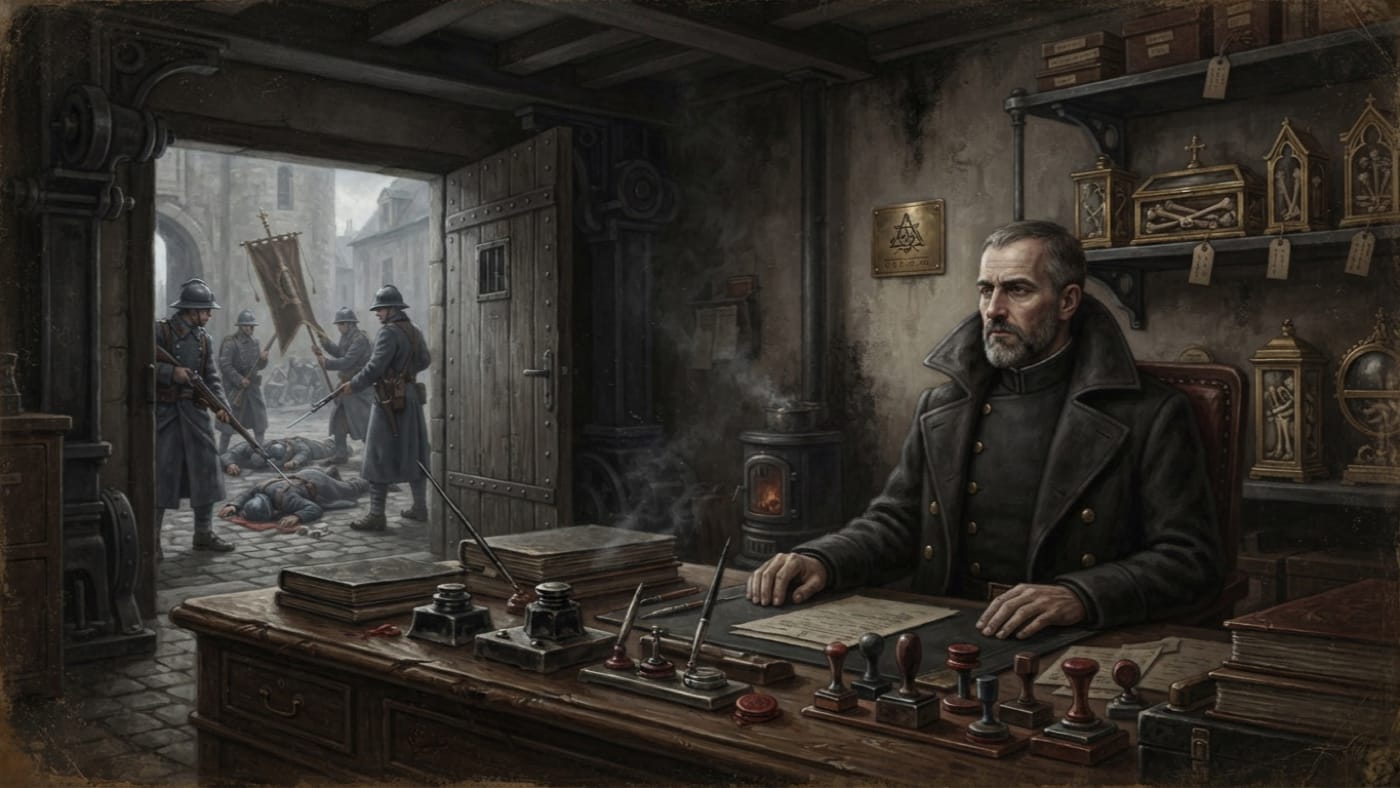
#On the Magistrate's Station
The Rational Magistrate was a local officer of the Rationalists. The office sat in a town before any Republic existed to seat it, and its business was narrow, tedious and murderous: it said yes or no to the public. Every surviving instrument names these officers in the plural. Wherever Reason had a bench, a ledger and a door that locked from the inside, it had a magistrate. The Church remembers one of them because of a gate in Brittany. It has forgotten the rest, and they would have counted that a professional success.
Nobody knows when the office began. No surviving paper says who appointed its holders, what they were paid, how long they sat or what seal they pressed. The archive is silent on all of it, and I will not fill that silence with furniture.
Three things must be kept apart, because Rationalist apologists have spent two centuries smearing them together. The statute said what might be refused. The magistrate decided what would be refused. The Republican Guards carried out the refusal with their arms. That makes three hands and one wound, and the middle hand is the subject of this entry.
#On Registration and Refusal
Under the Secular Gatherings Act, a religious procession of more than seven persons became a "public devotional assembly," and every such assembly had to register in advance with the local Rational Magistrate. The eighth pilgrim turned a devotion into a docket. The Act was no kinder to the seventh. It simply had no form for them.
The Act then listed the grounds on which a magistrate might refuse registration: safety, civic order, traffic obstruction, suspected relic fraud, acoustic disturbance, sectarian agitation, atmospheric irregularity, and "general public reason." Read the list as a pilgrim would. Traffic obstruction needs only a road. Acoustic disturbance needs only a voice. Suspected relic fraud needs only a relic and a man who believes no relic can be genuine. Atmospheric irregularity needs only weather, and on the Breton coast the weather is permanent. General public reason needs nothing at all except the magistrate.
What followed refusal was automatic. A refused procession that walked anyway was unregistered, and the Guard was authorized to disperse an unregistered gathering. A relic carried without civic inventory marks was to be confiscated. Refusing to hand over relic property counted as "resistance to lawful order." The magistrate never had to stand in the street. One stroke at the desk turned a pilgrimage into a category, and the category did the rest.
I cannot tell you what an application looked like. The Forbidden Stacks hold no blank form, no fee table and no register of petitioners granted or refused. I mention this because three lecturers of the Bureau of Doctrine have described the form to their students in loving detail. They were describing ours.
#On the Magistrate and the Guard
The Guards were older than any ministry. They began as public order companies attached to Rationalist magistracies in the first decade after De Vera Luce. Until A.S. 30, the Guards' district columns answered to their local Rational Magistrates. The office that signed a writ also commanded the men who carried it, so permission and muscle lived in the same customs room and took their meals at the same table.
The Act did not command massacre, and neither did any writ issued under it that the Bureau has examined. A writ authorized dispersal and seizure. It never said kill. No surviving record puts a magistrate at a gate on the day of blood or gives one the order to fire. Rationalist pamphleteers have built a small cathedral on this absence and worship in it on alternate Sundays.
The Bureau does not attend. Consider a magistrate who refuses a procession on grounds no pilgrim can contest, then sends armed men under that same office's command to take a sacred box from people who will plainly kneel before they give it up. That magistrate has ordered no death. That magistrate has made death the cheapest outcome on the street and gone home to supper.
#On the Saint-Malo Writ
The best documented holder of the office sat at Saint-Malo, in a former customs room beside the inner quay. The town's account records that magistracy's ordinary work: permits, fines, a chapel bell limited to three tolls, and a reliquary weighed in public "for civic inventory." This was one town's practice. Nothing in it proves the office worked the same way elsewhere, though I would be astonished to hear that it differed much.
In A.S. 10 / 1720 CE a procession came up the road from Dinan. It carried the Reliquary of Saint Matthias and the banner of Saint Hermas toward the Porte Saint-Vincent. The Guard sergeant at the gate carried a writ issued under the local magistrate's authority. He demanded dispersal, and the pilgrims knelt. He demanded the reliquary, and Father Gaël of Dinan refused: "It is not yours."
The Massacre at Saint-Malo has its own entry, and I will not retell it here. The Bureau has ratified forty-three pilgrims. Of these, thirty-one are certified dead and seven survived their wounds to testify. Five remain unaccounted for, under a classification the Bureau invented for the occasion: "consumed by the event." Their deaths have not been confirmed. Nothing has been explained.
Earlier editions of this Codex described the Saint-Malo writ as forged by agents of the Council of Nine Rationalists.
Struck. The Bureau of Records has determined that the writ was genuine and lawfully issued under the Rational Magistrate of Saint-Malo's own authority. Orchestration by the Council of Nine remains unproved. The correction takes the Republic's favourite alibi away from it. Forgers can be hanged and forgotten. A genuine writ hangs the office itself.
The magistracy kept what it seized. The reliquary went into the basement of the Rational Magistrate's office as "Item 7: bone container, provenance unverified." It stayed there for nine years among the magistracy's other confiscations until the faithful of Saint-Malo broke in and took it back during the Retribution of the Tides. Today it rests in the Basilica of the Ledgered Saints in Strasbourg. Its Bureau of Relics custody stamp was applied after the recovery, in a year nobody has verified.
#On the Transfer of Command
The Treaty of Regensburg in A.S. 30 / 1740 CE gave Rationalist administration a constitution, a formal Republic and thirty-seven Philosophical Prefectures. The same settlement took the Guards' district columns away from the local Rational Magistrates and placed them under the Council's Ministry of Civic Security.
That one sentence is everything the record holds. It does not say whether a magistrate could still requisition a cohort after Regensburg, countermand a captain, or direct a particular raid on a particular cellar. It does not say whether magistrates kept the custody basements. Lesser historians have supplied all of these answers out of a dislike for blank pages, and I file their answers with the rest of the fiction.
Some confusions still need correcting. A Rational Magistrate was not one of the Prefects of Reason, whose powers and appointment belong to the later prefectural order. Nor was a magistrate a Civic Security Marshal, a Tribunal assessor, or a forerunner of any Synodal official. The Code of Rational Jurisprudence governed the post-Regensburg courts, and reading it backward onto a customs room in A.S. 10 is the kind of error that gets a junior archivist reassigned to the Bureau of Tithes.
What the transfer did is plain enough. Command left the town and went to an office no petitioner could find. A magistrate had neighbours who knew which window to throw a stone through. A ministry had only correspondents.
#On the Retained Example
The office has no recorded end. The Sundering of 1 November A.S. 45 / 1755 CE broke the Republic's central authority, and its western services died unevenly over the following years. Some magistracies may have kept issuing permits to towns that no longer asked for them. No last working day has been found, and I decline to invent a funeral.
The office's method outlived it. The faithful condemned the Act in A.S. 12, and the Synod annulled it in A.S. 90 and again in A.S. 104. Magistrates of the Bureau of Purity still study the Act before they receive their public-order seals. They inherit no office and no personnel from the Rationalists, only a lesson. The lesson is that registration, refusal and custody can empty a street more completely than a decree can, because nobody ever has to announce that the street is being emptied.
I condemn the Rational Magistrate without reservation. The office used procedure to strip pilgrims of their protection, pressed the stripping into a writ, and stored the spoils in a damp basement under a dishonest label. Every one of those charges is true. I would be more comfortable making them if I had not countersigned four refusals this quarter.