
#On the Name and the Territory
"Germany is the name of a place. It has never been the name of a government, and every government that tried to use it found it a poor fit." — Drax, notation to the Bureau of Records, A.S. 197
In the registers of the Synod, Germany is a geographic word. It sits in the Second Zone of the Zone Map (Unregistered), the Central Heartlands, with Switzerland, northern Italy and Austria. That zone is safe and heavily industrialised, and it lies west of the Sagittal Line (Unregistered), whose seven bastions run from Bastion-Königsberg on the Baltic down to Bastion-Constantinople on the Bosphorus. Germany keeps the frontier supplied. The trenches themselves lie further east.
The name covers three things that careless clerks run together. The old German states were many separate jurisdictions. Germania is a procuratorial region governed from Strasbourg. The Rhineland is a river province. All three overlap with Germany, and no surveyor has shown that any of them matches it exactly. I will not pretend otherwise for the sake of a tidier entry.
The Treaty of Regensburg says that the old borders were erased, and Germany is on its list. The Bureau asks what was erased and what remained under the erasure.
#On the Earlier Jurisdictions
There was never one Germany to erase. Before the Treaty, the territory was a patchwork of overlapping authorities: free cities with their own councils, a Diet that met in the Reichssaal at Regensburg, barons on the Rhine, Bavarian magistrates, prince-bishops and cathedral chapters. A man might pay his tithe to a chapter, his toll to a city, and his military service to a baron whose banner he could not have described. Each jurisdiction kept its own ledger. The ledgers seldom agreed, and the clerks of each blamed the others.
The Rationalists grew inside this patchwork, as rot works into the joints of a pew. Their own histories count as antecedents the original Concordats of Ulm (A.S. −55, 1655 CE) and the Year of Letters (A.S. −32, 1678 CE). The Bureau files both under preliminary symptoms. By the time the Atheist Wars were going badly for the Church, Rationalist administration already ran in many German towns, with clerks seated at desks that had once belonged to chapters.
The military collapse came at Aachen in A.S. 25 (1735 CE), where the betrayal broke a Rhineland baron's forces and opened the river country. Two years later the hidden Church sent its men to Cologne. They met for nine days in September A.S. 27 (1737 CE), in a city that officially had no use for them, and agreed a narrow procedure for keeping contact between clergy who no longer had dioceses. It was a modest result. It was also more than the Rationalists had expected from men who were supposed to be extinct.
The Council of Cologne, A.S. 70.
The geographic register carried this date for Cologne's council, and the Bureau of Records has corrected it. The first Council of Cologne sat in September A.S. 27 (1737 CE). The later Council and Edict of Cologne belong to A.S. 100 (1810 CE). No council of Cologne sat in A.S. 70. The clerk who entered that year has been reassigned to the counting of rivets, which do not have anniversaries.
#On the Forty-Seven Articles
At Regensburg in A.S. 30 (1740 CE), the Treaty made Rationalist supremacy continental and ended the Atheist Wars. Its forty-seven articles dissolved the ecclesiastical institutions. Dioceses became Philosophical Prefectures, and Church property passed to the prefectural treasuries. The continent was redrawn into thirty-seven prefectures, numbered as one might number cattle pens.
The thirty-seven were the continental total. Germany did not receive thirty-seven prefectures of its own, and the Bureau has heard that error repeated in seminary examinations often enough to feel obliged to correct it here. The Treaty's well-known Bavarian, who went to bed a Bavarian and woke a citizen of Prefecture Twelve, is an illustration. He is not a map. No surviving instrument in the Forbidden Stacks fixes the German prefectural lines with enough confidence for me to draw them, and I will not draw them from confidence I lack.
The territory's effects were real. Diocesan boundaries that had lasted for centuries vanished from official correspondence. Chapter lands were surveyed, sealed and sold, and monastery granaries were stocked under a new register. The tithe gave way to the prefectural levy, which collected more and justified less. Civic councils that had argued with bishops now argued with Prefects of Reason, and they found that a Prefect could not be excommunicated.
Local identity outlived the articles. A Prefecture can be decreed in an afternoon, but a dialect takes three generations to wear away. Brewers in Bavaria kept their guild saints under other names. Rhine ferrymen kept charging the old tolls and logging them under the new heading. Cologne went on remembering itself as Cologne, and its archive-keepers knew the location of every confiscated reliquary.
The Bureau of Doctrine has ruled that the Treaty was never valid. The Bureau of Records has ruled that it happened anyway. Both rulings stand. A document can be void and still have moved every boundary stone between the Rhine and the Danube, and a Prefecture never valid in law can still have collected taxes for fifteen years.
#On the Return of Public Authority
The Rationalist Republic held continental supremacy from A.S. 30 until the Sundering of 1 November A.S. 45 (1755 CE), when its central command broke. Its western offices did not all close that winter. In German towns the prefectural clerks went on clerking, partly from habit and partly because nobody had told them to stop. Some offices were absorbed, some were displaced, and a few were simply renamed while the same clerk stayed at the same desk.
The Church came out of hiding and took authority town by town. Some places welcomed it. Some were bought, and others were persuaded by methods the Bureau of Purity calls pastoral. A provisional council governed from about A.S. 50 (1760 CE). The Common Allegiance of A.S. 55 (1765 CE) was circulated for subscription, and some German towns signed it more willingly than others. The Night of Black Decrees in A.S. 58 (1768 CE) extended accessions across the growing authority's reach. It did not produce unanimity overnight, and only a bad historian would claim it had.
The Council of Worms gave ratification in A.S. 87 (1797 CE). The Concordat of Strasbourg made the Synod formal in A.S. 90 (1800 CE), and its seat remained at Strasbourg, outside the German towns it governed. Germany received no capital of its own. It received Procurators appointed from the Concordat Hall, among them the officers of Germania, whose seals combine law and doctrine.
Constitutional settlement and local incorporation were different processes, and Berlin shows the gap. Ten years after the Concordat had declared the Synod's authority complete, the Prussian state was absorbed and Berlin was renamed Kanzleiburg (A.S. 95, 1805 CE). The Concordat had settled the matter on paper in A.S. 90. Prussia joined the paper five years later.
#On the Rivers and the Supply Cities
The Rhine is Germany's oldest administrator. Every authority that has governed the territory has had to tax the river, and the river has outlasted every one of them.
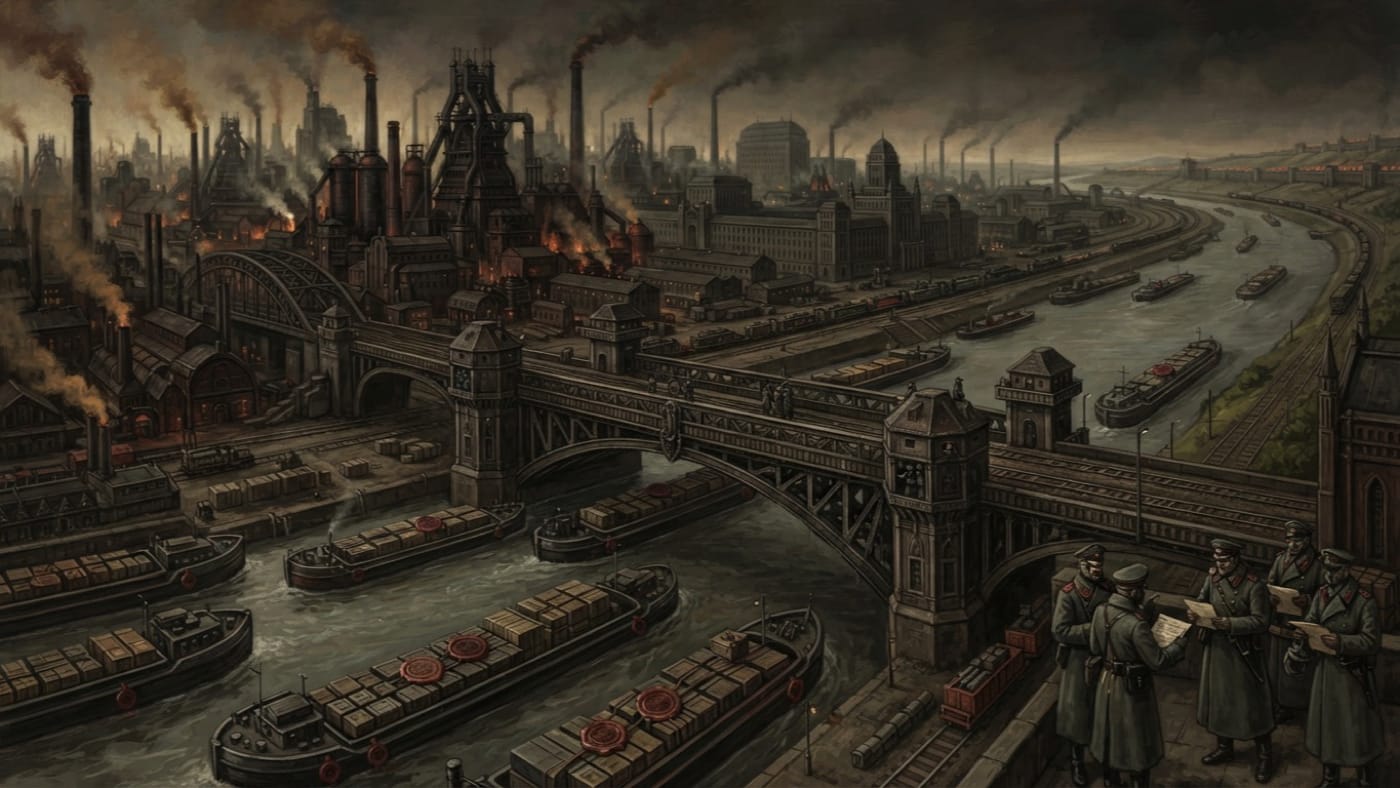
Mainz keeps the bridge and toll system, and it keeps its wax. Every barge that passes beneath the bridge courts leaves a cargo seal in red or brown according to its classification, and wax recovered from broken seals is melted and reissued at a modest profit to the Bureau of Tithes. Downriver, Cologne holds the archive-banks. There vault finance sits beside the memory of two councils, and the clerks keep both in the same kind of iron box.
Rheinscarp climbs the cliff above the river in nine terraced Steps. Each crossing between terraces counts as a registration: coin, recited verse and stamp. Grain arrives at the docks below and goes up through the ration mills to emerge as chits, and a household's place on the Steps decides whether its flour is white or grey. A mill-hand who misses the verse at the Fourth Step can be recorded absent. That is a paper death. Confession can repair it, and so can a bribe of wax.
Essen-of-Hymnsteel lies north of the Rhine and is the territory's principal sacred forge. Three Bureaus hold it under compact: Engines and Furnaces, Records, and Orison and Song. The city makes bell-cannon throats, hymn-drive housings, reliquary fasteners, and rail and lock hardware. Its freight leaves through the Seven Locks or in sealed wagons on the spur that runs east to Bastion-Constantinople. Nothing ships without a certification seal.
The calibration choirs sing the steel. Calibration is classed as a sacrament, so singing in Essen is a work permit. The choristers sleep in barracks that smell of boiled herbs, and of blood after a long pour. The hall veterans speak too loudly and watch your lips while you answer. Silence is licensed in Essen and taxed, and patrols check for it. Earplugs are stamped and serialised. Men who can afford it buy quiet rooms by the square foot from the hushwrights, and the men who cannot afford it go deaf in the Foundry Core and are entered in the injury ledger with full ceremony.
Hamburg takes in the North Sea: British grain, Scandinavian fish and Atlantic cargo for the northern front. Its loads go by rail to Kanzleiburg, the northern theatre's administrative centre and the largest Synod city north of Strasbourg. From there they move toward the Polish corridor and the northern bastions. In the south, Munich collects the lines from Strasbourg, Cologne and Kanzleiburg into the Bureau of War's largest standing warehouses. Quartermasters count blankets, boots, candle-stock and tinned meat there before sending them on to the forward zones. Soldiers call Munich the last comfortable city before the front, and the quartermasters bill them for the comfort.
#On the Present Condition
In A.S. 201, Germany is protected and in harness. No demon besieges Essen. The furnaces themselves are dangerous, along with the ration audits, the Records cages, the confessor-booths and the river locks. A Rhineland vintner's son is in no danger of being eaten on his own doorstep. He is in some danger of a Tithes clerk deciding that his vines were miscounted.
The Procurators of Germania inspect the territory, and the Bureau of War draws on it for supplies. The rest of the continent eats Rheinscarp's flour, fires Essen's steel and receives Hamburg's grain by rail. None of these offices answers to Germany as such, because Germany has never been a body that could receive an answer.