

#On Rank and Worth
"Quis corriget correctorem?" — Gloss in the present author's hand
Pride shows itself most plainly at the moment someone below you is right.
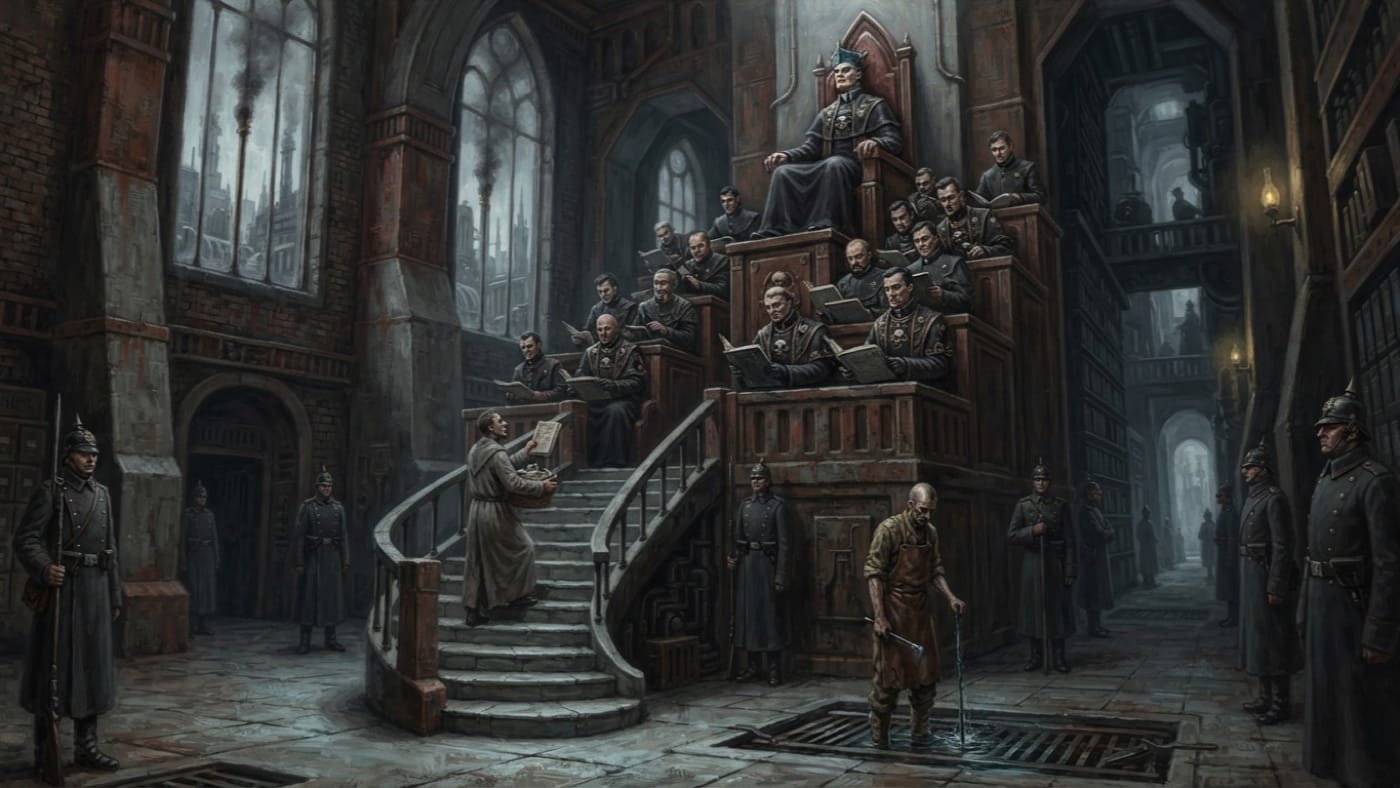
A copyist finds a misdated folio and carries it up the stairs. A sapper reports water in the gallery. Each has brought a correction, and each correction asks the person receiving it to admit that someone of lower station saw what he missed. The sound official checks the folio. The proud one checks the copyist's rank and finds it insufficient.
That is the sin as this survey uses the word. Pride makes hierarchy the only relationship a person can perceive. Every other soul becomes an inferior to be ruled or a threat to be put down. Its equal worth before the Creator drops out of view, and so does its capacity to tell the proud man anything he does not already know. His sense of himself now depends on remaining above. A self built that way cannot afford to be wrong, and so it cannot afford to learn.
The definition needs a fence on each side. Confidence, competence and success lie outside it. So does the gunner's knowledge that she lays a battery better than her major, since she may simply be right. Leadership lies outside it too, and so does the complaint of someone mistreated. The Doctrine of Equality Before the Divine leaves skills unequal and duties different. A colonel may order a sergeant into a gallery. The Doctrine denies only that the order weighs the sergeant's soul, and it asks no wronged person to call the wrong deserved. A Church that demanded humiliation of the injured would deliver its enemy recruits by the cartload.
The rot begins in contempt. Its proof is refused correction.
#On Elevation
Atheron, the Exalted, embodies Pride among the Seven Sin-Generals. He emerged at the Sundering of A.S. 45. He holds the eastern Carpathian heights opposite Bastion-Przemyśl on the Sagittal Line, and he crowns each ridge with a spire taller than the last, built to be looked up at.
His influence-demons seldom trouble the vain, who are content already. They go where dignity has been injured. They find the quartermaster whose flawless ledgers never reach the commendation list, the deacon who writes the bishop's sermons, the engineer overruled by a committee that could not read his drawings. These people have usually been wronged, and the wrong is on file.
The demon agrees with them. You deserved better. True. They did not see your worth. Often true. You are above them. There the poison enters.
The gifts that follow are real, which is why they work. Recognition arrives, and promotion with it. Doubt gives up its chair to certainty. Criticism stops landing, because it comes from below, and everyone is below. Then the account falls due. The convert has staked his entire self on position. He has nobody left to speak with across a table, and he has lost the faculty of being taught. The record attaches no name to this pattern, and I attach none.
Demons tempt, flatter, reward and threaten. They cannot possess a man or take away his choice, and every pedestal on the Line was climbed by the man standing on it. The Bureau has found no chain of command running from a Pride cell to its Sin-General.
Envy is a near neighbour. Morwen's servants want to become someone else. Atheron's want to stand above whoever is there.
Ordinary Pride needs no demon at all. A clerk, a parent, an officer or an abbess can manage it unaided. The Inquisitor who sees Atheron behind every stiff official will burn a great many clerks and very few cultists.
#On the Pedestal
Once the proud stop accepting correction, the people around them stop offering it. The sapper falls silent. The copyist lets the old errors stand. The top of the stair grows cold as a landing in Corvus, and nobody climbs up to say so.
Beyond the wire, the Mirror Courts perfect this condition in glass. Their surfaces show each viewer what he already believes himself to be. The mirrors rank nobody. They simply never contradict, and a servant raised among them forgets that across is a direction.
Among Atheron's long-term servants the body follows the habit. The dedicated record lists a spine that stiffens past its natural curve, a neck that holds the head above others, and a downward gaze that settles and stays. Crown-growths of metal or bone push out at the brow. The servant loses the ability to kneel or bow, and at the last his feet fuse to whatever raises him: a dais, a step, a pulpit. These are supernatural manifestations among the corrupted, and they do not await every vain man. A back made rigid by four winters on a firing step convicts nobody, and neither does a body that never bent easily.
"Pride cannot be cured at all, because the proud man cannot hear the cure." — this Codex, Atheron, On His Nature.
Withdrawn. The general rules on demonic influence hold that corruption never removes human choice. The proud may hear the cure late and badly, and may still take it. Bodily damage can outlast repentance. A crown-growth does not recede because its wearer has wept. The withdrawn sentence was the undersigned's own.
#On Varna
The Ledgers of Varna close on Pride's golden masks in civic halls. The masks belong to the Golden Masquerade of Varna, the one cult of Atheron the Bureau names aloud. Its documented methods are few. Converts are flattered into assigned roles, and cells stage pageants, mock trials and executions. A man overlooked for twenty years is handed the part of Magistrate, and the other players defer to him. The deference is real. In time the role begins to require its actor.
The record gives no founder, no founding year, no programme and no suppression. An earlier Codex claim that the cult had been contained has been withdrawn. Gold masks are its public image and make a good woodcut. Most Pride cells wear ordinary collars.
Varna also shows the sin's habits at work without any mask. In A.S. 129 a grain fleet arrived sound. Bureaus and Litigant houses disputed its tariff category for nineteen days while the wheat heated and rotted under canvas in sight of a hungry city. A mothers' petition was denied pending jurisdictional clarity. When the crowd surged, the Bureau of Purity fired. Records entered the deprivation as a holy fast.
No miracle was required, and none is alleged. I do not charge Atheron with Varna. The Ledgers charge offices, and men staffed those offices. I note only the shape. Every bench in the port court could smell the grain. None would accept correction from the smell, or from a mother, since correction from below would concede that the docket existed to serve the city. Standing came first. Bread came never.
#On Correction
The Church answers Pride with one doctrine and four disciplines. Each fails in a documented direction.
The Doctrine teaches that every soul stands at the same distance from the Creator and that rank is earthly and temporary. Przemyśl recites it over the ration queue, where Synod clergy and the Provost eat and sleep warm, the drafted freeze and the Erased receive nothing. Equality is proclaimed over the queue. The queue hears the order of service.
Humility Practices send officers above the rank of captain to the basin, the ladle and the latrine each quarter. In some, compelled service breeds resentment. In others it breeds a quiet certainty that they are better than the lesser men who would have refused. The Practices are distinct from the Humility Assessments that Purity and the Bureau of Doctrine impose on Przemyśl's garrison commanders. The two share a season and little else.
Rotation of Command moves officers on before they set into their chairs, and their knowledge leaves with them. Confession of Pride collects honest admissions from men who can still see their contempt, and clean returns from those who cannot. At Przemyśl the slips go down to vaults beneath the Chapel of Counting, where they serve reassignment and blackmail as readily as absolution. Penitents learn which sins are safe to name. Peer Accountability holds wherever the proud acknowledge peers, which excludes the very patients it was designed for.
Past the disciplines stands the scaffold. Those showing advanced signs are executed, and the Synod calls it mercy, on the ground that death is better than eternal frozen elevation. I record that reasoning as the Synod's. It settles how long the Synod will wait. It settles nothing about whether the condemned could have turned.
The Bureau holds the Church's order to be distinct from anything the Great Deceiver has built, and I have no contrary finding to stamp. Still, a structure that hands out warmth by rank and hears correction from below as insolence has left Atheron very little to build.
#The Ratification
The test for Pride is short. Correct the man and watch his face. This year I have applied it to a provost, two archivists and a curate, and I have entered the results in the margins of their files.
It cannot be applied to a Hieromnemon. Nobody beneath the office is competent to correct it, and nobody above has found the time. I have certified the omission.