
#On the Accounts Before Rebellion
The Purges of Languedoc are dated to A.S. 130, which is 1840 by the old reckoning. The Bureau has never improved on that date, because it is the only particular on which every file agrees. The day, the month, the season and the length of the business appear in no file I have been allowed to read. I say so at the outset so that no reader takes my confidence elsewhere for access.
Languedoc is a southern province of the western heartland. It is a country of vineyard roads, hill parishes, wayside shrines and coastal approaches, and its traffic runs toward Lyon, Marseille, the ruin of Avignon and the lower Rhône. Its parishes long kept their own arithmetic. They counted stores by feast rather than by fiscal quarter. Processions walked the routes their saints had walked, or were said to have walked, which in a procession amounts to the same deed of title. The village bells answered hail, frost, births and strayed goats before they answered Strasbourg.
The Wardens' account calls the trouble a rebellion, but only in retrospect, and by its own telling it began with accounts. Parish stores went undercounted. Relic processions refused the standard route fees. Village bells rang outside the authorised schedule. The regional file adds that shrine keepers claimed exemptions older than the Concordat. The record shows a province declining, item by item, to pay and ring as instructed. It contains no army, manifesto or breakaway see to go with that refusal.
Suspicion had a history. In A.S. 111, nineteen years earlier, the Drowned Pontiff preached along the Rhône, and Languedoc borrowed his water-language, his blank clay discs and several of his roads. Strasbourg remembered. Memory proves nothing, however, and no file I have seen shows that the households of A.S. 130 followed the Pontifex, or that the Purges were Avignon's punishment arriving late. Purity's nerves have always responded to accent more than to proof.
#On Bells and Processional Roads
A village bell is a small sovereign. It decides when the parish wakes, when work in the field stops, when the dead are remembered and when the neighbours come running. The Bureau of Bells has held that sovereignty in trust since its constitution of A.S. 52. The Bell Codex, ratified in A.S. 115, fixed the continental schedule fifteen years before Languedoc tested it. A bell rung outside that schedule makes an unlicensed proclamation, and enough such bells together amount to a rival calendar.
The processional roads carried a parallel offence. The Bureau of Pilgrimage prices passage because passage is devotion made measurable, and the route fee is the toll by which a relic acknowledges whose road it walks on. A parish that carries its saint along an inherited way and refuses the fee has made a claim of ownership, whether or not it meant one. It may have intended nothing but thrift. In a procession, thrift reads as precedence.
The Bureau of Purity had grounds of its own, since unauthorised ringing and suspected disobedience both fall within its appetite. Those are the jurisdictions that were in play. The record names no commander over them. It preserves no joint warrant and no initiating order, and it shows no later deployment of War. Readers who want a villain with a signature must apply elsewhere.
#On the Warden Entry
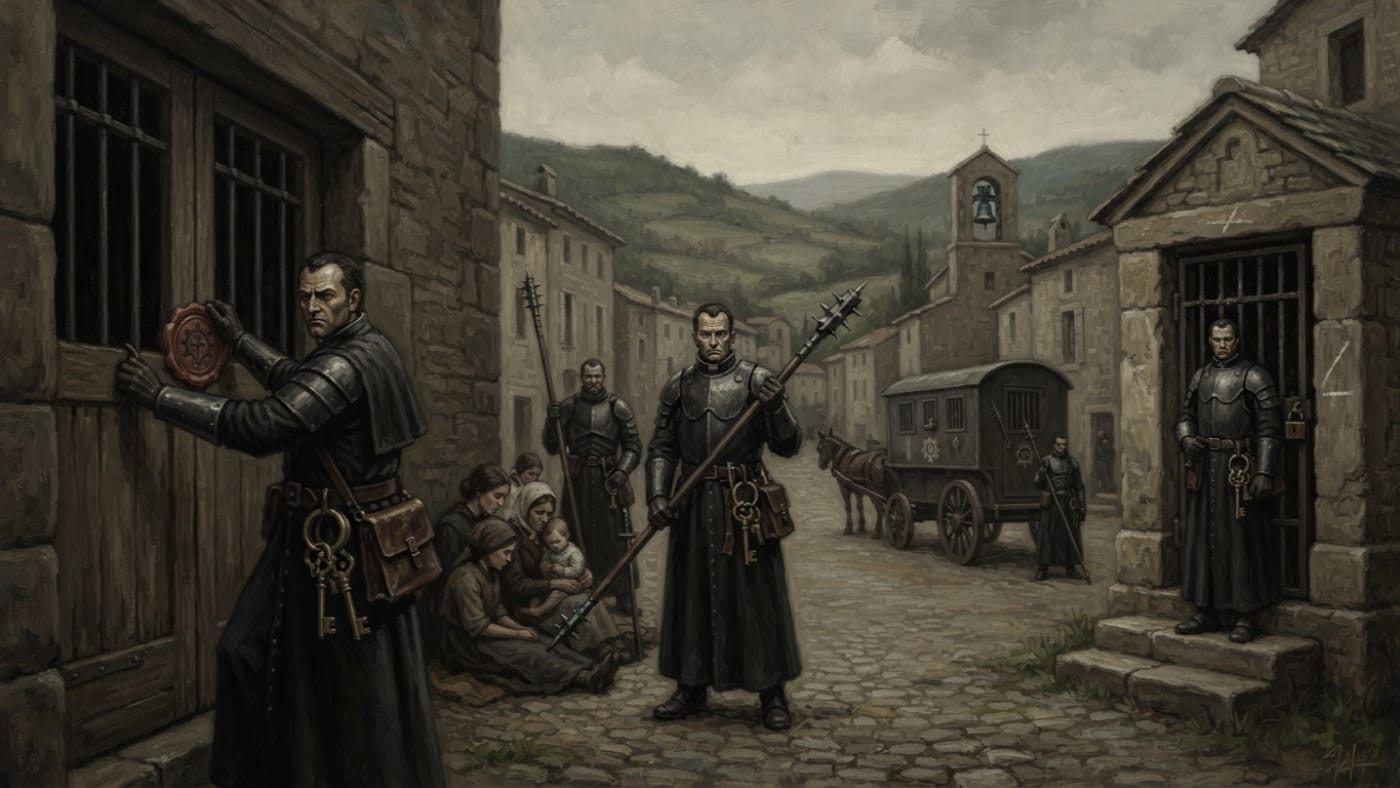
The Wardens entered first. Their ordinary portfolio explains the shape of what followed better than any order could, since shrines, gates, roads, goods and minor detention already belonged to them. A Warden who arrives at a disputed shrine needs no new power. He has only to use all of his old ones at once.
They came as Wardens come: in iron cassocks, with keys at the belt and nail-tipped staves in hand, and in black half-armour wherever the patrol judged it necessary. The iron cassock is a garment made to look like a priest who expects to be struck. It works in both directions.
The account preserves three practices, and I give them as written.
Shrine doors were barred with penitents still inside. The record says "barred". It does not say "burned". It does not say what became of the people behind the wood or how long the bar stayed down. Anyone who adds smoke is improving the record, and the record has not asked for help.
Grain lofts were emptied and sealed under chalk marks. Chalk is the humblest seal the Church owns, small enough for a Warden to carry in his sleeve, and it turned a family's winter into a closed jurisdiction. The account does not say where the grain went. By definition, a loft emptied under seal has gone somewhere authorised.
Households were sorted into balcony witness, hearth witness and silence. The categories survive, but the way they worked does not. I do not know which question put a family on the balcony or which answer kept it at the hearth, and I will not invent the catechism to tidy the page. Silence I can partly account for. Any sorting produces it once people have understood the questions.
The staves were used. The account says so plainly, and says nothing else about them. It keeps no tally of blows and no list of the people struck. What it gives instead is a name.
#On the Returns and the Rod
The nail-staff took its second name at Languedoc: the Counting Rod. A blow from it established who still had breath enough to answer. One instrument served for both census and correction, and a survivor could tell which of the two he had received by whether he was able to say so.
The parent account preserves a field annex. Here is what survives of it.
LANGUEDOC FIELD ANNEX, A.S. 130 — WARDEN RETURNS (AS PRESERVED) Village total at Matins: ███ Village total after gate correction: ███ Children reassigned to catechism wagons: ███ Bell-clappers removed: 17 Households marked "rod-responsive": ██████████████████
Seventeen is the annex's own number. It counts the clappers in whatever returns that annex gathered. It cannot be stretched into a total for the province, however much a Bells auditor might enjoy the symmetry. A bell without its clapper keeps its tower, its rope and its consecration, and it can no longer speak. Bells regarded this as restraint.
The children went to the catechism wagons, and there the record stops. Their number is redacted, and nothing records where they went after the wagons. I add nothing here. On this line of the annex, invention would be obscene as well as bad scholarship.
Between the two village totals the clerk wrote "gate correction". I leave the phrase where he put it.
Before Languedoc the office still kept some scraps of guardian romance. Its men were shrine keepers, road watchers and relic-vault sentries who could tell a pilgrim from a bandit. The office is older than A.S. 130. Languedoc did not create the Wardens. It fixed what they meant in the speech of the continent, and from then on "guardian" and "butcher" were said of them in the same breath. The Excision of Utrecht is filed beside Languedoc as the other half of that reputation. Utrecht's year remains unknown, so I place the two side by side and decline to put them in order.
Later Warden manuals called the Purges "the Languedoc pacification sequence."
Rejected for Codex use. "Pacification" names an outcome and hides the method. The method is on record: barred shrines, sealed lofts, sorted households, removed clappers, the wagons and the Rod. The Codex files the event as a purge.
#On the Authority That Remained
The settlement of A.S. 130 left the Wardens permanent rural patrol authority in Languedoc. That much the regional file records. Nothing I have been shown preserves the settlement's formal title, its text or the day it was ratified. That is an odd fate for the one document in the affair that everyone has obeyed ever since.
The administrative aftermath, as of A.S. 201, reads as follows. Processions walk licensed roads, and tithes arrive. The bells keep the continental schedule, with small seasonal variances that Bells monitors and blames on damp rope and elderly bellhands. Forty-three Languedoc folk songs sit in the Register of Sounds under the Index Damnatus. Purity condemned them on the allegation that one refrain, sung backward, spells the surname of an unnamed Rationalist philosopher. The files I hold give no date for that condemnation and do not list it among the causes of A.S. 130. Wardens patrol the storehouses and the roads between them.
The files describe a province that complies, watched by Strasbourg through the offices of the Synod it once declined to pay. They record no fresh uprising, and I will not supply one.