
#On the Sentence Available
The name is the handle by which mercy drags the sinner toward correction. — Purity Directorate Instruction 17, issued A.S. 173, withdrawn from public catechism A.S. 174
Purity Directorate Instruction 17 is the instructional text of the Bureau of Purity whose sentence, quoted above, stands at the head of the Codex record of the Great Inquest of Names. It was issued in A.S. 173 (1883 CE), the year of the Inquest itself. In A.S. 174 (1884 CE) it was withdrawn from public catechism. Those are the facts the record will bear. I state them first because everything after them is interpretation, and interpretation is where lesser clerks go to embezzle.
The sentence is the quotation available to this entry. I make no claim that it is the whole Instruction, that the rest perished, or that some drawer in Strasbourg keeps the remainder under a cord. I do not know the author. I do not know the month. I do not know how many pages followed, or whether any did, or who received copies. The designation "Purity Directorate" is retained as given. I decline to manufacture a director, a charter or a signature so that the heading looks well fed.
One sentence, then. It is enough. Some sentences carry the whole roof.
#On the Name as Instrument
In the Synod's lands a name is never a private possession. It is a key cut to several locks at once. It opens the ration window. It permits passage at a checkpoint. It secures a marriage, an inheritance, a burial plot, a witness's oath, and the right to be mourned under one's own letters. The Bureau of Records holds the locks. The citizen only carries the key and imagines it is his.
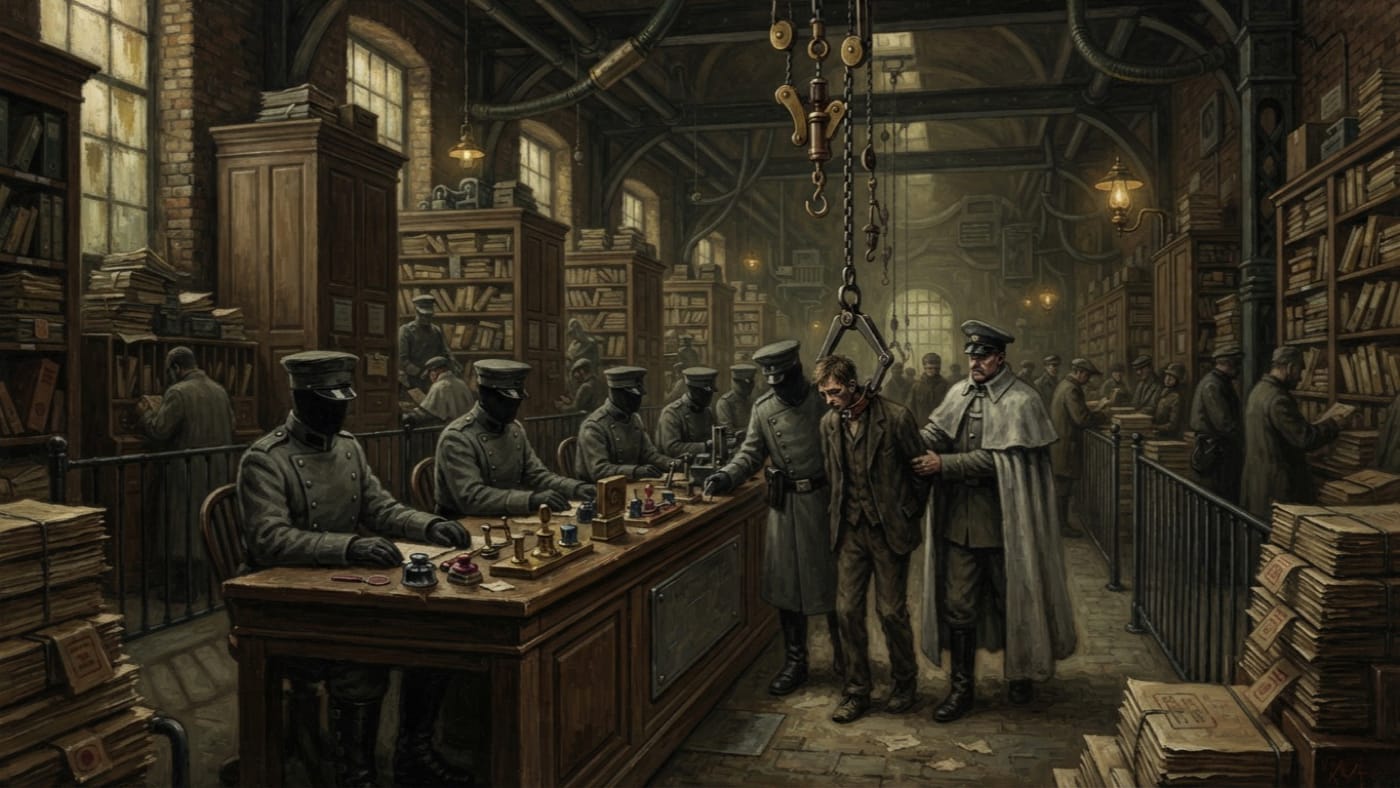
That is what makes the Instruction's grammar dangerous. It does not call the name a mark of identity or a gift of baptism. It calls it a handle, the part of an object made to be grasped by someone else.
The idea that a name could be seized was older than A.S. 173. When Arno Kett, whose first verifiable corridor cells date to A.S. 125–135, came to prosecution, Doctrine found that a creed of absence offered no articles to condemn. Doctrinal Nullification was drafted for that prosecution, and Kett was executed in A.S. 138. That instrument was later used during the Inquest, and it is a separate instrument. Nullification settled how to convict a man who professes nothing. Instruction 17, so far as its one sentence shows, settled something else: how to take hold of him before conviction, and by which part.
#On Mercy and Correction
The verbs repay study. Mercy drags. The sinner is moved toward correction, which means he has not yet arrived and has no say in the route. The sentence gives all the motion to mercy and none to the sinner. He is luggage with a soul.
The Bureau of Doctrine teaches that godlessness is the Great Deceiver's quietest liturgy, and that a soul so captured cannot walk itself home to the Creator. If one grants that doctrine, dragging becomes charity. I grant it. I have signed my name beneath it for decades. I observe only that the doctrine is very convenient for whoever holds the handle.
What did correction mean in A.S. 173? The Instruction's sentence does not say, and I will not pretend it does. The Inquest's recorded dispositions say a great deal. Organisers were erased, immured or forced to confess. An Erasure Notary struck the civic name, and with it went ration, passage, property and kinship claims. Once the handle had done its work, it was snapped off and filed. An Immurement Mason closed the body inside masonry, which spares the state a scaffold and a crowd. Forced confession produced further names, and every further name was another handle.
I cannot say whether those practices were clauses of Instruction 17. They are what the Inquest did while the Instruction was being taught as mercy. The reader may hold the sentence in one hand and the dispositions in the other and weigh them. I recommend gloves.
#On Application During the Inquest
The Inquest ran through the Rhine corridor in A.S. 173: Strasbourg, Mainz, Cologne, Mannheim, and the lesser towns that feed them paper. Its method was comparison. Purity laid tithe returns from the Bureau of Tithes beside attendance and absence rolls, ration records beside school copybooks, and burial notices beside employment books. A name that appeared in one register and vanished from another left a seam. Aliases, handwriting habits, paper sources and the company a person kept were all treated as that name's shadow, and a shadow is easier to catch than a man.
The White-Mantled Inquisitors worked the confessional screen and the parish informant. They traced paper to its mill, set mercy stings, and sent compromised recruits back to see who would greet them. The Bureau of Masks and Seals examined wax, fibre and erased hands. The Bureau of Orison and Song logged unauthorised silence where hymns were required. Records indexed everything. The Bureau of Silence sealed three annexes, and I will not decorate them.
The result is recorded once, and I give it once. Approximately forty per cent of Rhine corridor Silent Godless cells were broken, and an estimated three hundred and twelve organisers were erased, immured or forced to confess. That figure counts neither three hundred and twelve executions nor the total of arrests, and the forty per cent describes the corridor, not the whole movement. The nets also took people who were not organisers. Purity knew it.
The deeper injury was to recognition. After the Inquest, a familiar hand on a ration slip could belong to a comrade or to a clerk. Once names are handles, every friend who knows yours is holding a piece of you that someone else may demand.
#On the Withdrawal from Public Catechism
In A.S. 174 the sentence was removed from public catechism. That is what changed. The faithful who had been taught it were no longer to be taught it. Beyond that the record is silent, and I am obliged, with some pain, to be silent with it.
No rescission order is before me. No reason is stated and no replacement formula is given. Nothing establishes that every copy was recalled, that the Instruction lost legal or operational force, or that the Directorate wished it unsaid. A text can leave the catechism and stay in the clerk's drawer. It can leave both. It may never have been in the drawer at all. The evidence does not say which.
What can be observed is a gap. In A.S. 173 the sentence was public and the methods were busy. In A.S. 174 the sentence was withdrawn, and nothing in the record says the methods were withdrawn with it. The A.S. 175 assessment, to which I come shortly, describes those methods at length and without embarrassment. The catechism lost a sentence. The assessment shows no sign that the Bureau lost the method.
An earlier draft of this entry stated that Instruction 17 was "repealed in A.S. 174, the Directorate having repented of its language."
Corrected. The record establishes withdrawal from public catechism in A.S. 174. It establishes no repeal and no repentance, and it records no embarrassment. The earlier wording supplied a motive the documents do not contain. Supplying motives is the Bureau's privilege, not the Codex's.
#On the Consequences and Disposition
Within eighteen months the surviving cells had reconstituted, with revised structures, stricter identity hygiene and new knotting systems. Names were burned after use. Recognition was rationed. The Bureau's A.S. 175 assessment ran to four hundred pages, and on page three hundred and ninety-seven it conceded that the network was adapting faster than Purity's response cycle. The methods it described later became the enemy's training material.
I cannot establish whether Instruction 17 itself passed into those lessons, and I will not claim it. The Godless did not need the sentence. They had studied what it did to them.
As of this writing, the record holds no ruling on the Instruction's present force. I make none.