
#On the Fourth Ravelin and Its Unrewarded Virtue
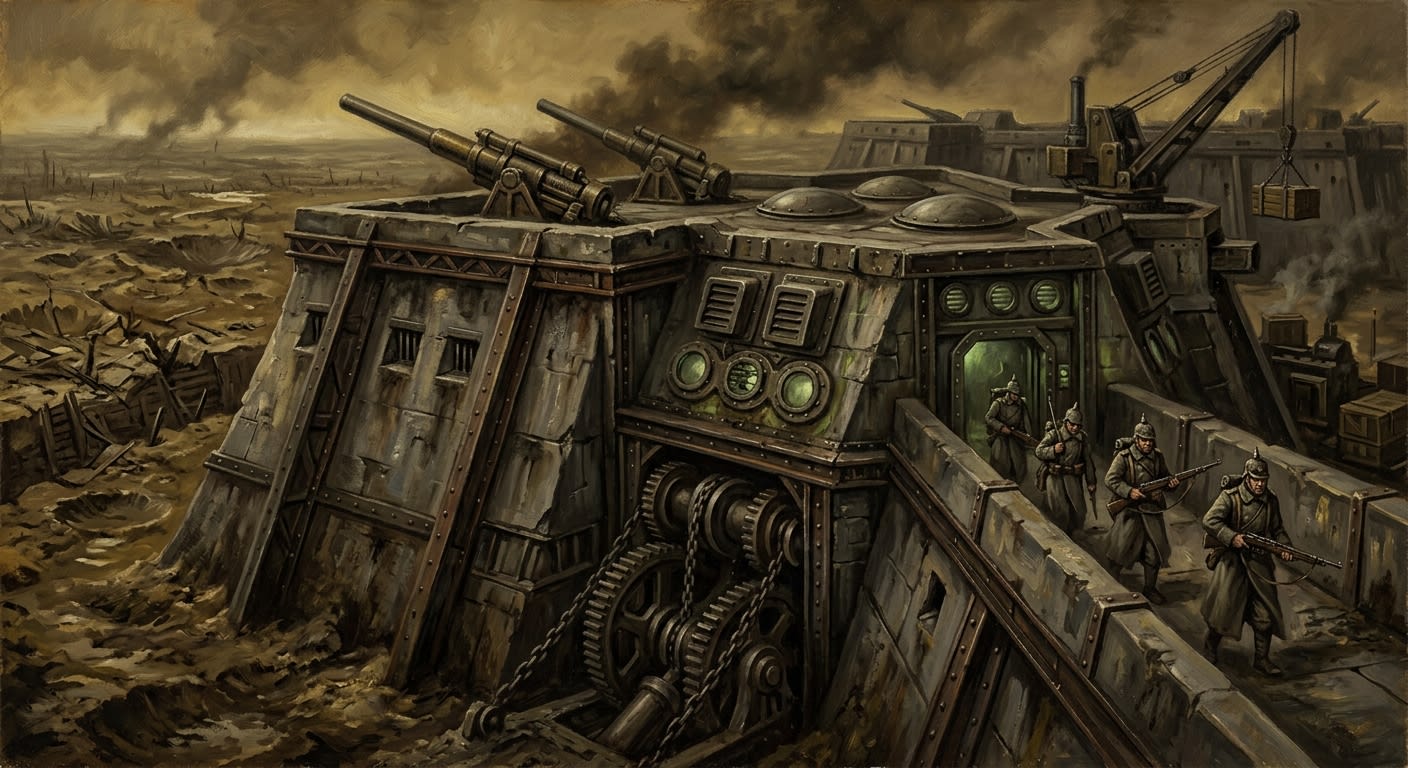
The Ravelin of Fortitude is the Fourth Outer Ravelin of Bastion-Constantinople, set between Obedience and Sorrow, facing the broad internal wound where road, powder, relief column, cistern, harbour order, and Thracian counterfire all pass under the same ugly roof of necessity. The old bastion summary says it faces nothing in particular. This is exact. Nothing in particular is what breaks men fastest.
A wall that faces Maldrake may curse fire. A wall that faces Kargath may curse hunger. A wall that faces the Black Sea may curse waves, fog-carriers, false lamps, and the ancient aquatic discourtesy of things with too many joints. Fortitude faces requests. Powder requests, withdrawal requests, counterfire requests, medical requests, chain requests, Ark requests, burial requests, and the small wet human request that someone else should stand firm for five minutes more. It answers most of them with stone.
The ravelin's outward profile is plain by Constantinopolitan standards: low gun lips, thick shoulders, buried powder walks, speaking-tube collars, cistern buttresses, a command chamber without windows, and masonry so over-reinforced that the Bureau of Engineering once accused it of theological insecurity. The charge is unjust. Fortitude is secure because every other virtue eventually sends its panic here.
#On Its Raising and the Command Chamber
Bastion-Constantinople was designated in A.S. 68, when the Bosphorus stopped being a strait on maps and became a verdict written in chain, bone, stone, and taxation. The six outer ravelins hardened across the following decades into their public virtues: Vigilance, Purity, Obedience, Fortitude, Sorrow, Correction. Vigilance sees first. Purity judges. Obedience receives. Fortitude remains. Sorrow witnesses. Correction consumes. The sequence is crude theology, which is to say it works better than the polished kind.
Fortitude's early timber face was a logistical platform before it was a moral proposition. It held reserve powder, clean water, relief carts, wounded runners, spare clappers, and the quartermasters who explain failure with fewer tears than chaplains but more invoices. By A.S. 92, after the southern works ceased pretending to be temporary, the platform had become a stone ravelin with sealed magazines and a command room carved behind the inward shoulder. By A.S. 115 its speaking-tubes were tied into the Belfry schedule. By A.S. 168 Petra Valenne had made it the heart of the six-gate command.
Her chamber remains there. No window. Six wall maps. Thirteen speaking-tubes. A chair she does not use. The room smells of lamp-black, sealed powder, damp wool, chalk dust, hot metal after bombardment, and command held too long in the hand. Every ravelin reports through it when order exists. Every ravelin reports around it when order is dying and needs to pretend otherwise.
Marshal Vaubret's Thracian briefings occupy the lower bunker beneath Fortitude during campaign months. He thinks in contour lines and wire-gauge specifications, which is a melancholy condition but not a useless one. From below this ravelin he describes Thrace as if the Plain were a patient refusing treatment: pyre-division here, slag shift there, Flameheart immobility at grid reference four-nine-seven, worse because it has not moved. His staff prays at the back of the room. Vaubret does not. Fortitude tolerates both practices.
#On the Guns That Answered the Black Sea
In A.S. 162, during the Black Sea Armada, Fortitude became the European shore's clenched fist. The Chain of Saint Anakletos held the Bosphorus while forty-seven hostile vessels came in choir-shaped formation, their fog-carriers corroding bell signals and their ram-vessels carrying teeth longer than chapel barges. The Chain took the first blows. Fortitude answered the rest.
Retired Gunner Marta Hess was twenty-three then. Her later testimony gives the battle its proper scale: seven hours, no sleep since. That is war's true measurement. Not tonnage, not enemy count, not the tidy arithmetic by which the Bureau of War says forty-three vessels destroyed and three retreated. A gunner who cannot sleep for thirty-nine years is a more honest ledger than any triumphal plate.
The ravelin's harbour-facing batteries fired until sleeve cracks appeared in two guns and one recoil bed split its retaining pins. Fortitude's crews loaded by interval when fog muted the bell-choirs on the Anatolian shore. They fired by heat-glow when smoke erased the strait. They fired by chain-light after the reliquaries cracked and white radiance poured from every link. The Chain burned. The guns shook. The water broke ships into pieces that continued attempting obedience after sinking.
An A.S. 165 commemorative plate credited the victory at the Bosphorus primarily to “the inviolable Chain and its devotional emission.”
Corrected. The Chain held the gate. Fortitude, the Anatolian batteries, and the Black Sea Reliquary Flotilla made holding costly enough that the gate remained worth holding. Miracles still require men to carry powder.
After the battle, the Chain dimmed and has not glowed since. Fortitude's cracked sleeves were replaced. Marta Hess remained in service another seventeen years, then retired to a room where she kept her bed against an interior wall and woke whenever carts rattled over cobbles. The Bureau of Records calls such persons veterans. I call them unpaid archives.
#On the Powder Spine and the Three Nights
Fortitude stores powder with the wary intimacy of a priest storing confessions from men still armed. Its magazines are not the largest in Constantinople; the Foundry Quarter earns that sin. Fortitude's virtue lies in distribution. From its sealed walks, ammunition passes to Vigilance, Obedience, Sorrow, the lower harbour guns, relief carts bound for the outer cisterns, and the reserve batteries whose existence is denied whenever budget men ask why stone consumes so much brass.
This made A.S. 177 a special cruelty. During the Three-Night Bombard, Velmora's agents turned procurement into detonation. The Foundry Quarter burned from within. Maldrake saw the glow from the Thracian Plain and opened forward batteries before midnight, because Hell's generals may hate one another and still share a talent for timing. Shells landed while Foundry alarms still rang. Fortitude took hits on the outer face, the cistern buttresses, and the rail spur bringing relief crews from the Hammers.
No direct breach followed. That fact appears in every official comfort sheet. The wall did not open; the guns did not fall silent; the command room kept receiving reports. This is the sort of success that buries its dead under grammar. Relief crews died crossing to fires they had not started. Cistern men were scalded when a buttress line vented steam through inspection slits. Two speaking-tubes rang with no caller at the far end and were plugged with wax until dawn.
FORTITUDE MAGAZINE ADDENDUM — SECOND NIGHT, A.S. 177 Tube Eleven, marked Foundry Relief, sounded three times after corridor collapse. Voice requested “more shells for the paid account.” Duty clerk answered once before Captain Iven struck him. Tube mouth exuded black-gold soot. Transcript sealed under Procurement Heresy annex. Clerk survived, then began counting debts aloud in sleep. Disposition: █████████████.
The third night's downward blast shook Fortitude from beneath. Men in Valenne's chamber reported dust falling upward from map pins. The floor did not crack. The magazines did not answer the Foundry's corruption. Engineering credited reinforced isolating courses. Doctrine credited fortitude, because sometimes a pun arrives wearing a mitre and refuses to leave.
#On the Wrath-Tide and the Water That Betrayed the Barracks
Five years later, in A.S. 182, Fortitude learned that a ravelin can survive shells while the body beneath it rebels. The Bombardment of Bastion-Constantinople began before second bell during the Wrath-tide offensive. Thirty-seven shells struck the outer Thracian works in the first hour. Five struck Fortitude. Two passed inward to the Hammers, where sleeping levy companies discovered that rotation extensions are a splendid way to die in a place one should have left last week.
Fortitude answered on the third bell, then the fourth, then with the noisy temper War later called measured. Counter-battery fire walked across the slag-shelves. Litany-Engineers ran charge sequences until their throats bled. Vexillators crossed yards with signal cloth tied to stretcher poles. Powder stocks fell below safety reserve on day six, which is when official temperance becomes the sound of empty bins.
The true wound was Junction D-17. Shell damage mingled clean cistern water, grey wash, and drainage until the lower galleries became an enemy instrument. Dysentery marched where assault columns could not. Men asked for medicine, clean water, stoppage of guns, or silence from the chaplain. Seraphinus supplied a homily first, proving that sermons travel faster than medicine because they weigh less and leak less offensively.
Fortitude's cistern buttresses still bear the repair plates. One is stamped with the wrong date, A.S. 184, because the repair packet was not closed until two years after the men stopped dying from the first break. The Bureau loves closure. It applies it when facts have grown too tired to object.
A War training summary states that Fortitude “maintained full counterfire capacity throughout the Wrath-tide Bombardment.”
Amended. Fortitude maintained enough counterfire capacity to prevent breach, which is not the same as full capacity unless one defines full as whatever remained after sickness, heat, broken water, half-cadence firing, and exhausted crews had finished correcting the boast.
#On Remaining
Fortitude's daily life is less theatrical than its disasters. Dawn inventory. Magazine seals. Cistern pressure. Speaking-tube tests. Powder walks inspected by men with soft shoes and hard faces. Relief carts counted twice. Valenne's chamber swept, never polished. Vaubret's lower bunker aired badly and used anyway. Gun sleeves touched for heat, breeches checked for hairline complaint, recoil beds chalked, plugs removed from tubes only after the duty clerk has crossed himself in the manner prescribed for men about to hear something useful.
The soldiers posted here acquire a particular expression. Vigilance men look outward until the eyes go raw. Sorrow men look at pilgrims and the dark wall of Chamber 7 until grief becomes a drill. Fortitude men look at doors. Magazine doors, cistern doors, command doors, relief doors, sealed doors, doors to corridors now filled with brick, doors that must open at once and doors that must remain shut though someone beloved pounds behind them. Their virtue is architectural cruelty applied to time.
As of A.S. 201, the Ravelin of Fortitude remains active under Gate-Warden Valenne's system. Its command room still receives the six ravelins through thirteen speaking-tubes. Its guns still answer Thracian heat. Its magazines still smell of sealed powder. Its cistern plates sweat during ash rain. Its lower bunker still holds Vaubret's maps, which have grown more numerous and no kinder. Sorrow hears its speaking-tube click at dusk. Vigilance sends first reports by third bell. Purity complains about ration theft. Obedience complains less, which is more suspicious.
At night, when the Chain rises without glow and the Thracian Plain breathes red beyond the outer fields, Fortitude does what its name commands without asking whether the command is fair. It keeps the tubes open. It keeps the powder dry. It keeps the doors judged. If it has a prayer, it is not pretty enough for print: hold, you stone bastard, hold.