

#On Gratitude and Witness
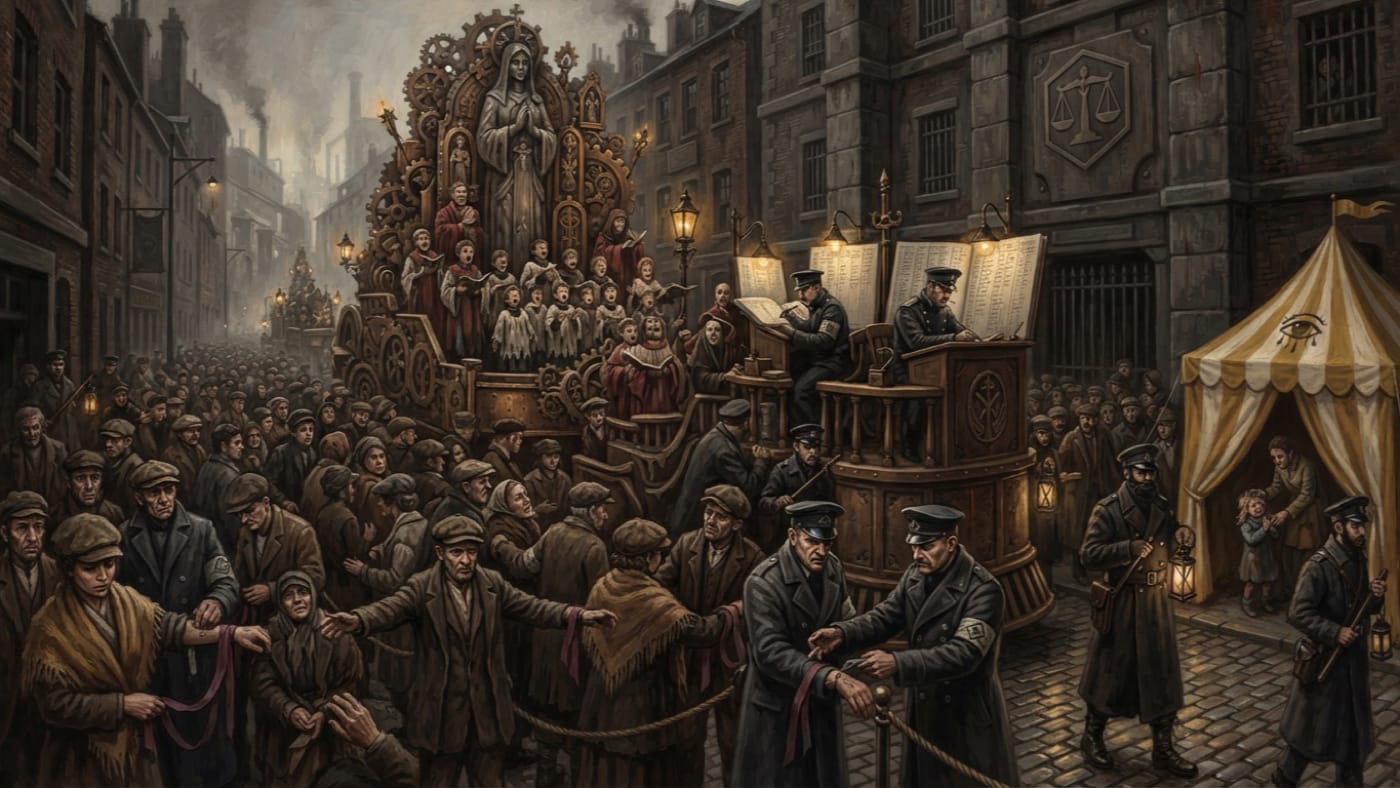
The Receipt-Procession Doctrine holds that unrecorded gratitude is wasted gratitude. A citizen who gives thanks in a cellar has thanked the Creator. A citizen who gives thanks under a saint-cart, in step with a drum, with a stamped ribbon at the wrist, has thanked the Creator before witnesses. The Synod is a government of witnesses.
The whole catechism fits on a float banner: Joy leaves a trace. All gifts require witness. Receipt is remembrance. Children sing the lines without knowing they are reciting procedure. The procession honours provision. The ribbon records who came to honour it, from which district, past which station, and on which day. Thanksgiving and enumeration share the same inch of skin.
No single statute sets the doctrine down in full. I have looked, out of vanity, for the pleasure of quoting it. It lives scattered across permits, route seals, drum codes, the sermons of Festivals chaplains and the reconciliation sheets of Records. The Bureau of Doctrine owns the interpretation. Everyone else owns the arithmetic.
#On the Failure That Taught the Route
The doctrine was born of a bad week that is publicly taught as A.S. 138, though Records and Festivals still quarrel over which disaster the year should be counted from. During the Gray Week Famine the Synod sent open grain audits into Strasbourg, Marseille, Munich and a fourth city all at once. Festivals calls the fourth city Lyon. Records calls it Antwerp. Tithes declines to call it anything. The clerks carried ledgers to hungry doors, and the doors answered with cobblestones.
The catechism needs only one example. In Strasbourg's Marrow Quarter a Ledger Prefect was stripped, papered in his own audit forms with fish glue, and paraded while children read his column headings aloud. He lived. The open audit died in the gutter beside his buttons.
Caldrin of Essen, a junior clerk later raised up as Saint Caldrin the Jubilant Scribe, read the riot reports and saw that the crowds had refused the doorstep, and only the doorstep. People who would stone an auditor would still turn out for drums. His proposal survives in a Festivals abstract and names five required elements: song, ribbon, pause, witness, reconciliation. The first gratitude march after Gray Week was dressed as a relief commemoration, and its stated purpose was to find hidden grain. Cider was poured at the pause points. Bread tokens were displayed.
Festivals commentary on the first gratitude march stated that it "found the grain the open audits could not."
Corrected: the march produced corrected rolls, attendance numbers, anomaly lists and missing households. No return this office has seen records any quantity of recovered grain. The commentary mistook finding the people for feeding them.
#On Ribbon, Pause, and Reconciliation
Take an ordinary procession of the mature practice, in any lower ward, on any feast the permit allows. The work begins days before the drums.
The route. The Captain walks the course with chalk. The beauty of the boulevard does not enter the plan. The plan follows the lanes whose households have gone thin on the parish roll, and those lanes get the loudest band, the brightest float and the cider cart. Where a street narrows beside a chapel, the chalk marks a pause, because a crowd that has to slow down is a crowd that can be read. Route design decides who is forced to be seen.
The ribbon. At the gathering square the Ribbon Runners work down the line with their punches. A widow from the cooperage lane holds out her wrist. Her neighbours are holding out theirs, and a child with no colour at the wrist cannot ride the float. The punch records the procession, the district, the station and the date. It bites. Taking it off later will tear skin. The old paper slip could be burned in a hearth. A wrist cannot.
The curb tally. At the chapel narrows the drum-coders strike the signal and the gratitude pause begins. A Receipt-Chanter lifts the hymn. The floats halt, and each one, beneath its painted saint, becomes an audit desk on wheels. Clerks with ledger boards look down at faces, across at wrists, and back at the roll. The music covers the scratching of their pens.
The exceptions. The widow's ribbon matches the roll. Her lodger, who appears on no roll, wears a ribbon stamped for a district across the river. A boy wears a blank ribbon tied on with string. All of these go onto the exception list: missing persons, wrong stamps, forged ribbons. A child separated from its mother in the crush is walked, kindly, to the lost-child tent. There are sweetmeats there, and a clerk who asks where the family sleeps.
The reconciliation. At night the Captain's clerks combine attendance, discrepancies, confiscations and amended rolls into a single return for the Bureau. The anomaly list is sealed in red wax and the misprints are burned. Any form that would embarrass the route is shredded and kept in sacks for the next feast, when it will fall on the crowd as confetti. The widow goes home with her ribbon. The paper that matters stays behind.
#On the Licensed Hands
The Receipt-Procession Pageant Captain, formally the Processional Comptroller, holds the whole affair in inked hands: performers, Ribbon Runners, route marshals, tally teams and escorts. All of that command is borrowed. The permits are sealed higher up. The paper allotment is rationed by a Ledger Prefect or a Synod Quartermaster, and a Captain's career lasts as long as that patron stays satisfied.
The Bureaus divide the procession between them like a carcass. Festivals licenses the spectacle. Records takes the corrected rolls and the anomaly list. The Bureau of Tithes takes the recoverable households and the evidence of who has been provisioned. Doctrine takes the right to call it thanksgiving.
The Receipt Reform of A.S. 138 gave the method the force of law. Synod Directive 88-F made wrist-ribbon stamps mandatory at Bureau-sanctioned processions and constituted the Captain corps as a licensed profession. The Council of Prefects recorded no dissenting votes. I report the record. I do not report the seating plan.
The Lantern Accord of A.S. 139 came next. It brought the tolerated watches of the Lantern Brotherhood into procession command as official escorts. The Brotherhood existed before the Accord and stayed what it had always been: tolerated, uncommissioned, and stripped of that toleration by any district clerk who tired of it. What it gained was a post at the choke points.
Learned men will tell you the doctrine descends from Concordat Integralism, which makes every civic act a sacrament, or from Processional Humanism, which makes every pageant a catechism. Both currents shaped the climate Caldrin worked in. Neither signed his abstract. The Integralists' Procession of Receipts, where whole neighbourhoods carried their ledgers like relics, is a cousin of the receipt-procession and has never been recorded as its parent.
#On the Count That Pleases
A return can be complete and false at the same time. Every Captain knows it, and none of them says so on the curb.
The ribbon can be forged. Black-market die-cutters sell counterfeit seals. Runners pocket blank ribbons against shortages and sell what is left over. Quiet ink fades by morning, so a wrist that passed the curb at dusk shows nothing at the ration court at dawn. A ribbon total counts punched wrists. It does not count people, still less households, and least of all mouths fed. A man punched at two stations becomes two attendances, which is why mothers warn their children, "Don't get counted twice."
Quotas do the rest. A patron who wants a thick anomaly list gets one. A patron who wants a quiet district gets a clean one. Totals are "adjusted" before the wax goes on, and the adjusted figure becomes the roll.
The danger also comes from below. Crowds surge at the narrows. A troupe improvises, and the street picks up a refrain that is half hymn and half something else. Worst of all is the moment someone in the crowd understands what the pause is for. The surveillance mandate has never been written down, and Captains guard that blank more jealously than their stamps. A festival that discovers it is a census becomes Gray Week again, with better lighting. Confetti can dispose of the paper. It cannot dispose of anything else.
#On Present Application
As of A.S. 201 the receipt-procession is the ordinary furniture of feast-days. It runs along bastion boulevards and pilgrim gates, along the port promenades of Marseille and through the lower wards of Strasbourg. Children ask for ribbons the way they used to ask for sugar. The Gray Week memorial rites are gold by rule. Bread rides high in sealed baskets that are never opened along the route, and the choirs sing "All Gifts Require Witness" while the Bureau counts attendance with particular care.
By its own measure the doctrine has succeeded. The Synod refreshes its rolls without sending clerks to doorsteps. Records reports corrected rolls, Festivals reports joy, and Tithes reports households recovered. Nobody reports whether those households were fed, because no column asks.