

#On the Substance
"Avoid the violet." — Night-counsel of San Vesta, freely given and seldom heeded.
Relic-smoke is incense. I begin there because the Bureau of Doctrine would prefer every description to begin somewhere else. It is pressed into bricks in the Kiln Hall of the Ember-Priory of San Vesta, shipped under seal and burned in rooms where the Church would like its congregation to stay seated. It burns violet. It smells of resin and old churches, and of old bones if one is honest. Underneath is something sharper, which I have compared to the air after lightning because I have no better word and no laboratory has offered one. The comparison is mine. No chemist has ratified it.
Three ingredients are known: volcanic mineral, rendered bone-ash and consecrated resin. The Incense Binders of Relic-Smoke guard the proportions, and they guard the resin's source more closely still. Pilgrims take the word relic to mean that every pinch of ash once belonged to an authenticated saint. The Binders have never said so. They have never corrected it either, and at San Vesta correction is a service supplied on application and at cost.
The records name no inventor. No first brick, founding Binder or maiden shipment appears in any ledger the Bureau of Records has been willing to show me. The substance enters the archive fully formed, like a dogma that was always believed.
Its authorised purpose is spiritual stabilisation: calming doctrinal anxiety in populations exposed to heretical influence. Hold on to that phrase. It will be needed.
#On the Kilns and the Grades
San Vesta rations its volcanic heat the way a cathedral chapter rations candles. The Great Ovens take the first channel and the Scorch-Cure Infirmary takes the second. The Relic-Smoke Kilns draw on the third, and the third will not hold still. Its temperature rises and sags in patterns the Binders read as doctrine and the Vent-Wardens read as rock. Both parties keep records and neither has persuaded the other. The Bureau of Doctrine ruled in A.S. 187 that the fluctuations were "consistent with Providence," which settled the filing fee more thoroughly than it settled the question.
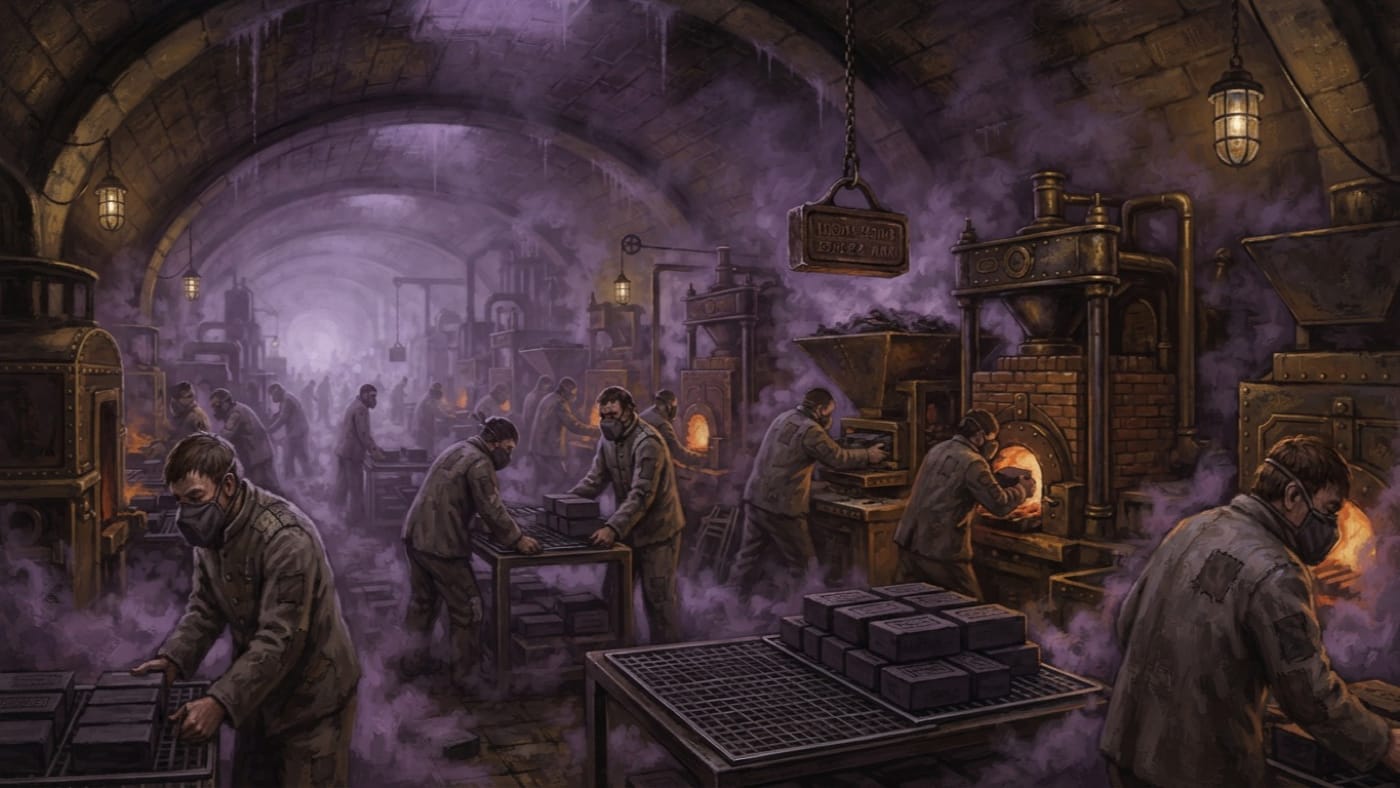
The Kiln Hall is long, low-vaulted and soot-black, and its air is thick enough to chew. The workers wear violet cords as the mark of their craft. They mix, press, fire and wrap. Whatever happens between the mixing and the wrapping, the Binders call craft, and that craft is closed to visitors of every rank, including mine.
The standard shipment carries three grades.
Litany is mild. It is burned in cathedrals, where a congregation needs only to be soothed through a long homily and out of the doors in good order.
Vigil is moderate. It rotates through the trench-chapels of the Bureau of War, where men who spent last night watching the dark must be persuaded to watch it again tonight.
Contrition is strong. Its uses are those the Bureau of Purity prefers not to set down in writing, and I honour that preference by not guessing in print at what the Bureau would not commit to paper.
No dosage tables accompany these names. No document available to me gives exposure periods, recovery times or thresholds of harm. The grades are relative strengths, and their destinations are the only commentary on them.
#On Spiritual Stabilisation
That phrase again: spiritual stabilisation. It is the official function. The practical function is sedation. In sufficient quantity, relic-smoke produces a compliant docility that internal memoranda of the Bureau of Purity describe as "ideal for public assembly management." I quote them because I could not improve on them. The Binders know what their bricks do and calibrate the blends to suit. San Vesta itself doses incense into its public spaces whenever the priory's arithmetic suggests a crowd is nearing the hour when crowds become riots. The smoke does not dissolve the grievance. It dissolves the timing.
A doctrinal distinction must be drawn here, and I draw it as a man whose office depends on it. A sedated congregation is quiet. A converted congregation is faithful. From the pulpit the two look the same, but before the Creator they are entirely different, and the Bureau of Doctrine has not established that the Creator is susceptible to incense. The man kneeling in Vigil-smoke has not renounced the Great Deceiver. He has simply lost interest in standing up. Nothing in the record suggests that the effect lasts, compels truthful confession, erases memory or protects the breather against heresy. It produces calm, and calm is what was ordered.
There is also dependence. The priory's people know a type: docile when they have the scent and violent without it. The Binders list addiction among their methods with the candour of tradesmen listing their tools. No document I have seen says what the addiction does to the body or how a man is weaned off it. The Synod orders the bricks by the crate regardless. The priory's own lore speaks of incense-dependent tribunals, and their reorders reach San Vesta as punctually as a tithe.
#On Permission and Labour
The bricks are made under the dispensation known as Innovation Permitted Under Stamp, whose doctrine is set out under Acceptable Innovation. A Binder who wants to alter a blend must first propose the change in writing. The Infirmary Tribunal reviews it, the Priorate Council approves it, and both stamp it. The regional office of the Bureau of Alchemical Standards counter-stamps it, and the Ledger Cloisters file it in triplicate before a single brick of the new formula is pressed. The careful reader will notice that the Oven Quartermastery, the third member of the priory's governing tri-compact, has no seal in this procedure. The third stamp belongs to a Bureau. San Vesta governs itself in threes and may innovate in threes, but the two threes are different, and the difference is where the Synod keeps its hand.
Routine shipments of established grades need none of this ceremony, or none that the record shows. I decline to invent paperwork. The Synod has enough.
The labour is another matter. Patients cured in the Scorch-Cure Infirmary owe recovery service, which the Tribunal sets according to the cost of their treatment, and the kilns are among the posts where that debt is worked off. A man whose lungs the Sister-Physics saved may repay them by breathing the Kiln Hall. The ledger balances, though the man does not always.
The workers wear cool-masks of cloth and charcoal bound across the mouth. They strain the worst of the particulate from each breath. Whether they strain out anything else has not been established.
Most replacements come from the Cool Mask Brotherhood, which salvages its materials in the canalworks and hands out its masks along routes the Bureau of Purity has mapped and left open. The reasoning is administrative, and therefore sound. Without masks the workers stop breathing, without workers the kilns stop, and without the kilns the tribunals and bastions run short of calm. Purity's tolerance covers the masks. No document admits that it covers the medicine and the people the Brotherhood also moves through the lava tubes, and no pact between the Brotherhood and the Binders has ever been sealed. The Bureau looks away from one cargo at a time.
The kilns produce one more thing: ingredients for the other bread. Resurrection-bread is adulterated with bone-ash, consecrated mineral salts and the resinous substance the Binders call theological, all drawn from the Kiln Hall. The kinship ends at the supply. Finished bricks are not crumbled into dough, and the two recipes are not one recipe. Nothing in the record suggests a pilgrim can buy three days by standing downwind of a censer.
#On the Smoke's Accusations
"If the smoke writes you, don't read it." — Saying of San Vesta
The heat-visions have been reported, and I record them as reported. Workers, pilgrims, patients and now and then provosts describe doctrine moving as text through the shimmer and names and faces taking shape in smoke. Some describe people following the writing into places no sane catechumen walks, the ovens among them. The priory confines the vision-struck in the Cool Rooms. It also uses incense dampeners, silence masks and mirror-prayers. I invite the reader to dwell on the first of those: a town that manufactures incense keeps a device for suppressing it.
That proves nothing. The visions occur in a town full of shimmer, vent-heat and more than one smoke, and any of these could be their author, or none. The priory's informants say the Binders fear one day above all others: the day someone proves the violet smoke is the cause. That day has not come. The question has not been answered, only reclassified.
The Bureau of Alchemical Standards classified San Vesta's heat-visions in A.S. 187 as "a localised atmospheric phenomenon consistent with volcanic mineral sublimation."
The classification was withdrawn in A.S. 199. The current classification is "Category Two Visual Disturbance, Doctrinal Origin Not Excluded." The revision names no cause. Relic-smoke appears in it neither as culprit nor as acquitted.
The reader must also keep the smokes apart. The Infirmary's antiseptic smoke burns blue-white and is a different preparation with a different purpose. The relic-ash of the processional censers, the curfew-fumes and the black-diesel script-smoke of the front belong to other offices and other entries. The Bureau of Purity polices prohibited incense across the Synod's reach. It has never claimed that every forbidden fume in the Church comes from one Iberian hall, and neither shall I.
#On the Present Application
As of A.S. 201, the bricks leave San Vesta at whatever rate the tribunals and bastions require. Trench Bastion Las Cadenas, a day or two away, takes incense along with its bread and sends back wounded. In time those wounded will owe service, and some will work it off in the Kiln Hall. The arrangement needs no conspiracy, only a schedule.
The priory's survey reports that the vent has grown warmer since A.S. 199, and the third channel still feeds the kilns. No assay I have seen says whether the product has changed. The Binders call the fluctuations doctrinal and the Wardens call them geological. The Bureau of Doctrine calls them Providence and collects the fee.
Burn as directed.