

#On the Kilns and Their Permission
"Avoid the violet." — San Vesta night-saying, given to pilgrims free of charge
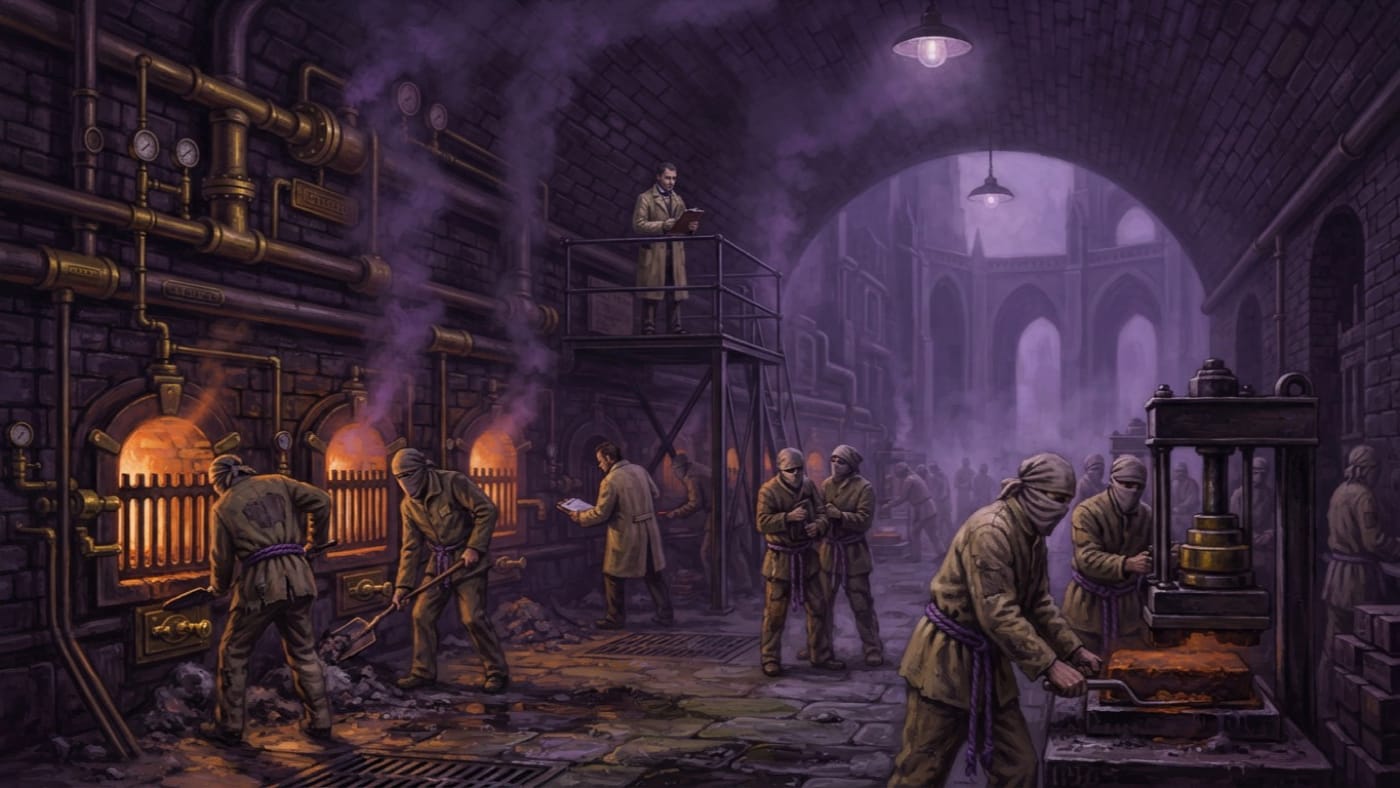
The Relic-Smoke Kilns have their own district in the Ember-Priory of San Vesta, and the worst of that district is the Relic-Smoke Kiln Hall. It is a long, low-vaulted interior of basalt brick. Its kiln mouths sit behind iron grates, and its slag-glass lights have gone cloudy with a soot no deacon has yet been ordered to scrub. The air is thick enough to chew. It smells of resin and old bones, so the place at least smells like what it makes.
The priory itself struggles to keep three things apart. The kilns are the installation: stone, iron, heat and kiln-ceramic. Relic-smoke is the product, pressed into bricks and burned somewhere else. The Incense Binders of Relic-Smoke are the craft order that works the first to make the second. A reader who confuses them will be corrected. A Binder who confuses them in writing will be corrected more slowly.
All of it runs under one word of permission: stabilisation. The Church swung censers long before it had Bureaus to audit them, and the Bureau of Doctrine has never objected to sweet smoke in a sanctuary. San Vesta's smoke does a great deal more than sweeten, and that has been filed under the same heading. Once a heading is stamped, it can hold almost anything.
#On the Third Channel and the Binding
Heat at San Vesta is rationed like bread, and the kilns come third in the queue. The Great Ovens take the primary flow from the sealed vent. The Scorch-Cure Infirmary takes the secondary flow, which keeps its blue-white antiseptic smoke at the proper density. That smoke is a different preparation from relic-smoke, and anyone who calls both "the smoke" should be sent to the infirmary to learn which one is which. The kilns draw from a third channel whose temperature rises and falls on no schedule the Ledger Cloisters can publish.
The Binders say the fluctuations are doctrinal. In their view the vent keeps its own hours of devotion. The Vent-Wardens say the fluctuations are geological, and they keep thermometers. According to the companion survey of the priory, the Bureau ruled the fluctuations "consistent with Providence" and charged both parties a filing fee. The fee was paid. The argument goes on.
Old hands in the canalworks say something under the vent breathes, and that the third channel is where it breathes out. No Bureau has classified that claim. I record it the way a Warden records a tremor: noted, and not explained.
The Binders work three materials into the brick: volcanic mineral, rendered bone-ash and consecrated resin. There is plenty of mineral, because the priory is built on it. The Binders describe the bone-ash only as rendered and consecrated. The Bureau of Records has no entry naming a saint, a donor or an ossuary as its source. They say even less about the resin. Its provenance is guarded as jealously as the Oven Quartermastery guards its ash, and its share of the blend is kept in people's heads rather than in any ledger. Provosts have asked about it. The provosts were given incense.
According to the companion survey, finished bricks leave in three grades. Litany is mild and goes to cathedral chapters. Vigil is moderate and goes out with the trench-chapel rotations. Contrition is strong, and its uses are ones the Bureau prefers not to put in writing. I respect that preference and will not guess at them. All three travel to tribunals, bastions and cathedral chapters across the Iberian theater and beyond.
#On Spiritual Stabilisation
Officially, relic-smoke calms the doctrinal anxieties of populations exposed to heretical influence. In practice, breathed in sufficient quantity, it produces a compliant docility. Internal memoranda of the Bureau of Purity call this state "ideal for public assembly management." The Binders know exactly what the smoke does and blend for it.
A riot needs a moment: one shout, one stone, one man deciding before his neighbours that the queue is over. The Binders' trade is to remove that moment. Incense is dosed into public spaces to dull a crowd's timing until the shout comes a breath too late and nobody follows it. In the dormitory quarters this is called calm fog. In the ledgers it is called stabilisation. Both terms describe the same violet haze rising along the same walls.
There is a limit to what the smoke can do. It does not make a heretic faithful, and no tribunal has shown that it draws out the truth. What it does is make him quiet. The Synod has found quiet sufficient for most purposes.
The trouble is the second dose. The Binders use addiction as a method, not as an accident. The congregant docile by scent becomes, as the priory's own saying has it, violent without it. The same holds for institutions on a larger scale. A cathedral chapter that burns Litany at every Vigil service soon dreads the Vigil service without it. A trench-chapel that has rotated on Vigil grade orders Vigil again. In San Vesta's own lore, the garrison at Las Cadenas is listed as dependent on the priory for bread and incense. The Bureau of War does not put the incense on its requisition sheets. The Bureau of Purity keeps that order in its own files.
#On the Labour That Breathes
The bricks are made by people who owe. A patient cured at the Scorch-Cure leaves with a debt of recovery service, sized by the Infirmary Tribunal to the severity of the illness and the cost of the cure. A broken arm costs three weeks. A lung infection costs six. A full scorch-cure costs a year, counted from the day the Tribunal declares the patient well. The kilns are among the assignments. Shifts are tied to ration quotas, and rations are tied to the stamped token that proves a person exists. That is cure-as-contract, and the kiln roster is one of its collection offices. In the recovery schedules I have read, nothing keeps a newly mended lung off that roster.
Kiln workers wear violet cords as insignia and cool-masks as survival. The masks are cloth-and-charcoal filters that strain the worst particulate out of each breath. They are supposed to be replaced weekly. In practice they are replaced when they fall apart.
The Cool Mask Brotherhood fills the gap. It is a mutual-aid network working out of the canalworks, and it makes replacement masks from salvage and moves them through routes the Bureau of Purity has mapped and left open. Purity's reasoning is short. Without masks, the workers stop breathing. Without workers, the incense stops. Without incense, the tribunals start writing in a hurry.
That tolerance covers the masks and nothing else. The Brotherhood's other business, which includes forged slips, bribes, tunnels and the movement of medicine and people out of locked wards, enjoys no exemption I can find. Purity has sealed tunnels and will seal more. Nor does this make the Brotherhood an ally of the Binders. One side sells the air. The other sells a way to survive it.
#On the Smoke That Writes
Heat-visions appear all over San Vesta, not only in the kilns. Witnesses report doctrine moving as text through the shimmer, names spelled in the air, and faces forming in the smoke. Some witnesses follow the writing, and some have followed it into the ovens. The listed countermeasures are confinement in the Cool Rooms, silence masks, mirror-prayers and incense dampeners. That a priory would fight one kind of smoke with another kind is the most San Vesta thing I know.
The heat-visions of San Vesta constitute a localised atmospheric phenomenon consistent with volcanic mineral sublimation.
The Bureau of Alchemical Standards has revised its classification, as recorded in the companion survey. The visions are now a Category Two Visual Disturbance, Doctrinal Origin Not Excluded. The revision contains no finding against relic-smoke. The Incense Binders have read that sentence many times.
The Binders do have one fear, and it is specific: that someone will prove the smoke causes the visions. Nobody has. Their fear is a fact about the Binders, not about the smoke, and I will not certify more than the evidence holds.
New blends cannot be made on a Binder's own initiative. Any experimental work at the kilns falls under Innovation Permitted Under Stamp. It needs a written proposal, review by the Infirmary Tribunal and approval by the Priorate Council, with stamps from both. The regional office of the Bureau of Alchemical Standards must counter-stamp it, and it must be filed in triplicate at the Ledger Cloisters before the first trial is lit. The Oven Quartermastery sits on the priory's governing tri-compact but has no stamp in this procedure. Routine Litany bricks do not pass through it at all. The procession applies to new smoke, not to the familiar kind.
The kilns also supply the other bread. Resurrection-bread includes bone-ash, consecrated mineral salts and a guarded resinous substance, all from the Kiln Hall. A dying person who eats it lives for three more days. How the materials are combined, and whether the bread and the smoke share any working principle, has not been entered in any ledger I am permitted to read. Breathing the incense does not buy anyone extra days, and nobody at San Vesta has claimed that it does. Anyone who does claim it should be given Litany and seated somewhere ventilated.
#On the Present Application
As of A.S. 201, the year of the companion survey, the kilns are working and orders are rising. The Vent-Wardens report a warming vent, and the Bureau of Alchemical Standards has filed a preliminary notice of concern. The third channel still fluctuates on its own schedule. The Binders still call this devotion, and the Wardens still write down numbers. Masks still wear through before their replacement date. The Brotherhood still brings new ones up from the canalworks, and Purity still lets them pass.
Text keeps appearing in the shimmer that no Bureau wrote, approved or can stamp. The kilns have not been blamed for it. The Bureau of Doctrine has not cleared them either. Until the Doctrine Bureau does one or the other, the bricks will keep leaving San Vesta in their three grades, carried by people who owe, toward congregations that have learned to breathe deeply.
Nihil obstat.