

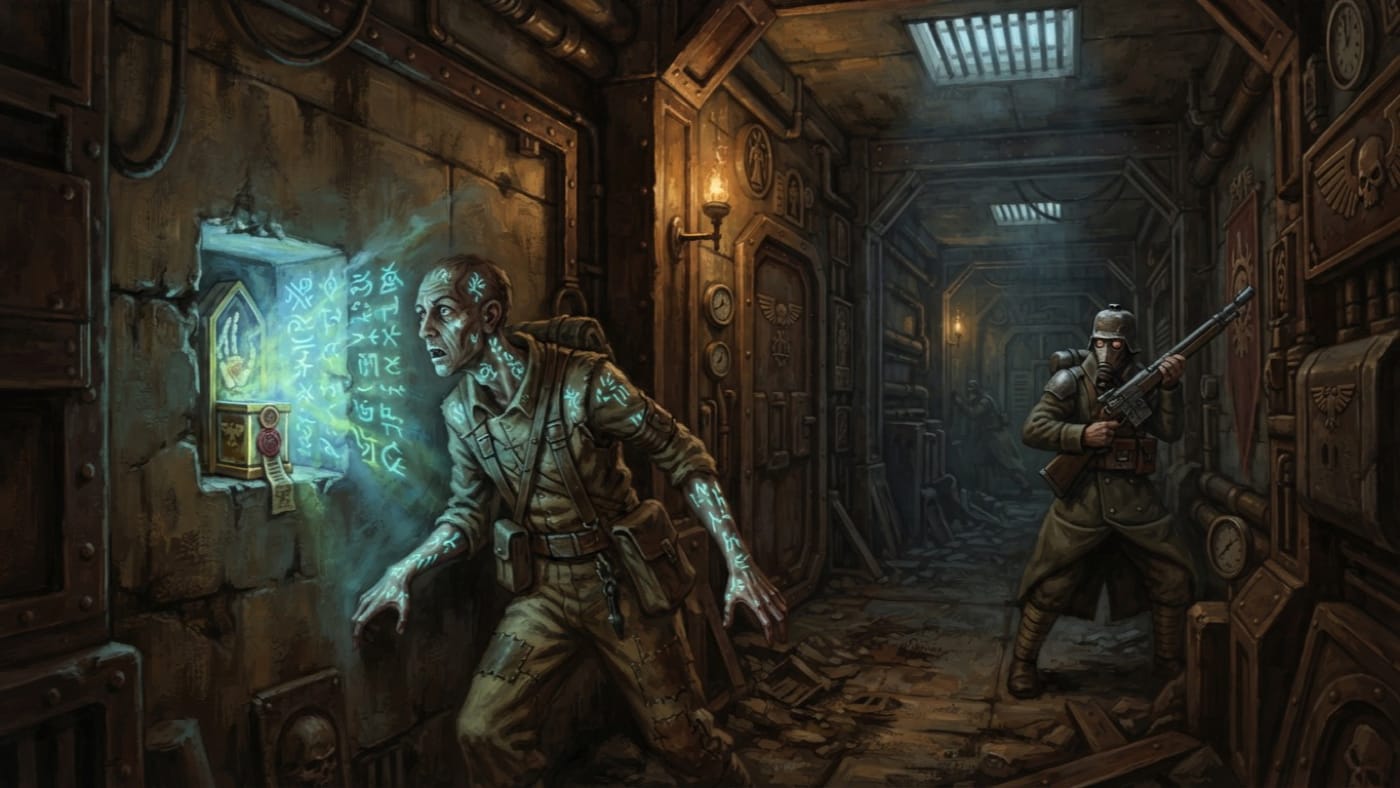
Reliquary Proximity Wards
Being a Survey, Made in A.S. 201, of the Sealed Bones Set in the Line's Walls Against the Concealed Enemy, With Their Custody, Their Invoice, and the Limits of What They Are Known to Do
#I. On the Bone in the Wall
A Reliquary Proximity Ward is a finger-bone. That is the whole of the apparatus, and the Church has seldom fielded a weapon so modest in appearance or so costly in upkeep. The bone belongs to a minor saint. The record does not say which saint, and I shall not supply a name for the convenience of pilgrims. It is blessed, sealed, and set into a niche cut in a trench wall, where it does nothing whatever until a particular kind of visitor passes.
That visitor is the Veil-Stalker. He is a mortal auxiliary of the Shadow Court, starved and inscribed with concealment glyphs that eat what remains of his life in exchange for passage unremarked. The glyphs have several modes. One lets the eye slide past him, one flattens him into shade, one drowses the watch, one wears the face a sentry longs to see, and the costliest bends sight around the body outright. The knife at the end is the same in every case. A sentry does not shoot at what he has decided is a fencepost.
The ward exists to take that decision away from him.
#II. On the Flare and Its Range
The documented effect is narrow, and I record it narrowly. When the bearer of concealment glyphs passes within three metres of a sealed ward, the glyphs flare with visible light. The countermeasures account that governs this tract claims nothing beyond that. The bone does not seize the intruder, burn him, or halt him in the passage. It makes his inscriptions visible to a man who is already watching.
Everything practical about the device follows from that. At the moment of passage, a sentry at his post sees writing where there ought to be wall, or rubble, or nobody. What he does next is soldiering, and soldiering is the Bureau of War's affair. A ward in an unwatched passage performs its miracle for the masonry.
The theology I leave to its owners. The Bureau of Relics holds that sanctity, properly authenticated, will not abide the Great Deceiver's grammar at close quarters, and that the flare is the inscription's own discomfiture. Perhaps. A sentry can attest to something smaller: the bone was in its niche, the passage was empty, and then the passage contained glyphs. I have read a great many depositions. Not one sentry offered an opinion on discomfiture.
The published record leaves several particulars open, and I decline to fill them for the sake of a tidier page. It does not say how long the flare persists once the bearer moves out of range, or whether it reveals the whole man or only his cut lines. Nor does it say whether the effect is equally reliable against all five modes, and no separate trials by mode are on file. Nobody has yet asked whether a Fog-Walker's drowsed audience attends to the flare at all.
#III. On Custody, Rotation, and the Invoice
The bones come from Relics. They come quarterly and on rotation, so the bone in a given niche at midsummer is not the bone that sat there at Lent. The record does not say why the rotation is quarterly. The sanctity may tire, the vault may want its property back for inventory, or some clerk may once have found the number pleasing. The Bureau has not volunteered an answer.
Relics supplies. The Bureau of Tithes charges. The arrangement has the elegance of every great Synodal partnership: one office owns the saint, a second owns the bill, and the soldier in the trench owns nothing but the wall the niche is cut into. I expect Tithes to find a way of assessing the wall. The countermeasures dossier records that Tithes bills for the wards "with characteristic enthusiasm." I have seen Tithes ledgers. The enthusiasm is gilded at the corners.
What enters the niche enters under the general discipline of holy remains. The Bureau of Relics will not let a shrine display so much as a knuckle without an Authenticity Writ. Its examiners, the Relic Authenticators, grade what crosses their benches on the familiar scale: Ward-safe, Votive, Contaminant, Fraud. One presumes that a bone sent to the Line has been graded at the top of that scale. The presumption is the soldier's comfort and the grading is the authenticator's livelihood. Where the two part company, the soldier finds out first.
The same dossier judges the wards the most effective of the three principal material countermeasures against the Stalker, and the most expensive. No price list, comparative trial or detection rate accompanies that judgement. The two words arrive as a pair, and the Synod has never been known to separate them when invoicing.
#IV. On the Ravelin of Sorrow
The densest ward network on the Line belongs to Bastion-Constantinople, the southern anchor where the Sagittal meets the Bosphorus. Within that bastion it belongs to the Ravelin of Sorrow, the Fifth Outer Ravelin, which stands between Fortitude and Correction. No humorist chose those names, though they read as if one had.
The Ravelin keeps one relic per eight metres of corridor. It has suffered no confirmed Veil-Stalker penetration since A.S. 196. Counted by the year, that is five years to the present survey. The record supplies no day for an anniversary, so the garrison must do without the cake.
I insist on the word confirmed. The record states what was found, filed and accepted. It cannot speak for a knife that was never discovered, for the rest of the city, or for any other ravelin of the bastion. Nor does it say when the network was first set into the walls. A.S. 196 marks the edge of the record, not the date of the masonry.
Two offices claim the record. Relics attributes it to sanctified efficacy: the bones are holy, the glyphs flare, the Stalker is seen. War attributes it to the enemy's intelligence, holding that no Stalker with his wits intact walks into the most heavily warded position on the continent while softer passages exist elsewhere. An empty casualty column fits both explanations equally well. Nobody has separated one from the other, because nobody has proposed thinning the Ravelin's wards to see which office was right, and nobody who values the Ravelin ever will.
Then there is the geometry, which I set down because an archivist who omits arithmetic deserves the clerks he gets. A ward reaches three metres, and the wards stand eight metres apart. Laid in a straight line along a corridor, each reaches three metres toward its neighbour, which leaves two metres between them that neither reaches. The dossier supplies no plan of the corridors. Their turns, their widths and the placing of the niches may change that figure in practice. I have no drawing and will not invent one. I record only that densest and continuous are different words, and the Bureau of Relics has used only the first.
#V. On the Ward Among Its Fellows
The ward is one of three principal material countermeasures. Each tells a garrison something different.
Ash-dusting records displacement. Blessed ash is laid on floors and thresholds. A concealed body still has feet, and the feet leave prints. At Bastion-Brest, under Standing Order 88-H, the ash has shown where intruders walked. On three occasions it showed this only after the killing was done. Ash testifies after the fact. Against Mirror-Fade, whose bearer leaves no impression in soft ground by the parent dossier's own account, it has less to say.
Bell-pulse counter-rhythms act on the concealment itself. Bellwardens sound them at the bastions south of Przemyśl, and a sharp, irregular peal makes the glyph-field flicker for perhaps two seconds. In those two seconds a watchman may see what was there all along. The pulse comes on the Bellwarden's schedule, wherever the intruder happens to be standing.
The ward reverses that bargain. It waits in a fixed place for the intruder to come within three metres, then reports him at that place and in that moment. Ash tells you where he has been. The bell tells you where he is for two seconds, if you happened to be looking. The ward tells you he is here, provided that "here" is within three metres of a niche.
Desire-Cloak has a procedure of its own. The Bureau of Purity's Directive 31-D posts checkpoint personnel in pairs, each watching the other's face rather than the visitor's, because the Cloak works through the observer's longing. That is a discipline of men, and it is paid for in morale rather than tithes.
I am asked whether the three methods used together seal a passage. No combined trial is on file, and no doctrine prescribes a ratio of ash to bell to bone. Garrisons use what they are issued and what they can pay for. At the Ravelin of Sorrow, they have paid for bone.
#VI. On the Present Disposition
At the time of this survey, A.S. 201, the wards remain in service. The bones still rotate quarterly out of Relics' vaults, and Tithes still bills for them. The Ravelin's record stands as reported. It is the record of a single ravelin, held under a single word, confirmed. The Bureau of Records may file it under as many headings as it likes, provided every heading keeps that word.
The men whom the bones expose require an entry of their own.
ERRATUM (Bureau of Records, 3rd Revision, A.S. 199), applied to this tract: Previous assessments describing Veil-Stalker inscription as "voluntary" are amended. The process is correctly classified as "conscription under duress, Category 7-F." Every bearer whose glyphs flare before a ward in these pages is to be read under that classification.