

#On the Present Survey and Its Ground
This entry is a documentary survey of the Chapel of Widows' Light, compiled in A.S. 201 / 1911 CE from what the Ledger, the Bureaus and the published Codex presently hold. It describes the chapel as it stands in that compilation. It certifies no founding, consecration or inspection, because the papers supply none. A compiler who invents a cornerstone will soon find a clerk ready to charge rent on it.
The chapel sits inside the inward shoulder of the Ravelin of Sorrow, the Fifth Outer Ravelin of Bastion-Constantinople. Sorrow stands between Fortitude and Correction at the Bosphorus, the southern anchor of the Sagittal Line. The Bastion was designated in A.S. 68 / 1778 CE, and that date belongs to the Bastion. The chapel's own record begins later and says less. By A.S. 140 / 1850 CE, Sorrow had already acquired its chapel of widows, along with its lamp stair and its lower casemates. Who built the chapel, who dedicated it and in what year, the Ledger does not say. I will not say it on the Ledger's behalf.
The Quarter of Widow's Light is another place. It is a district of warehouses and trench-support behind the Rope Roads, and Sorrow faces it. The Widows' Syndicate is a third institution, a consortium of lending-houses, relief offices and unofficial archives. The chapel is a room in a ravelin. The three share a noun and no management. Gate-Warden Petra Valenne commands Sorrow under Bastion command, and the papers name no administrator of the chapel itself.
#On the Altar and the Ward-Niches
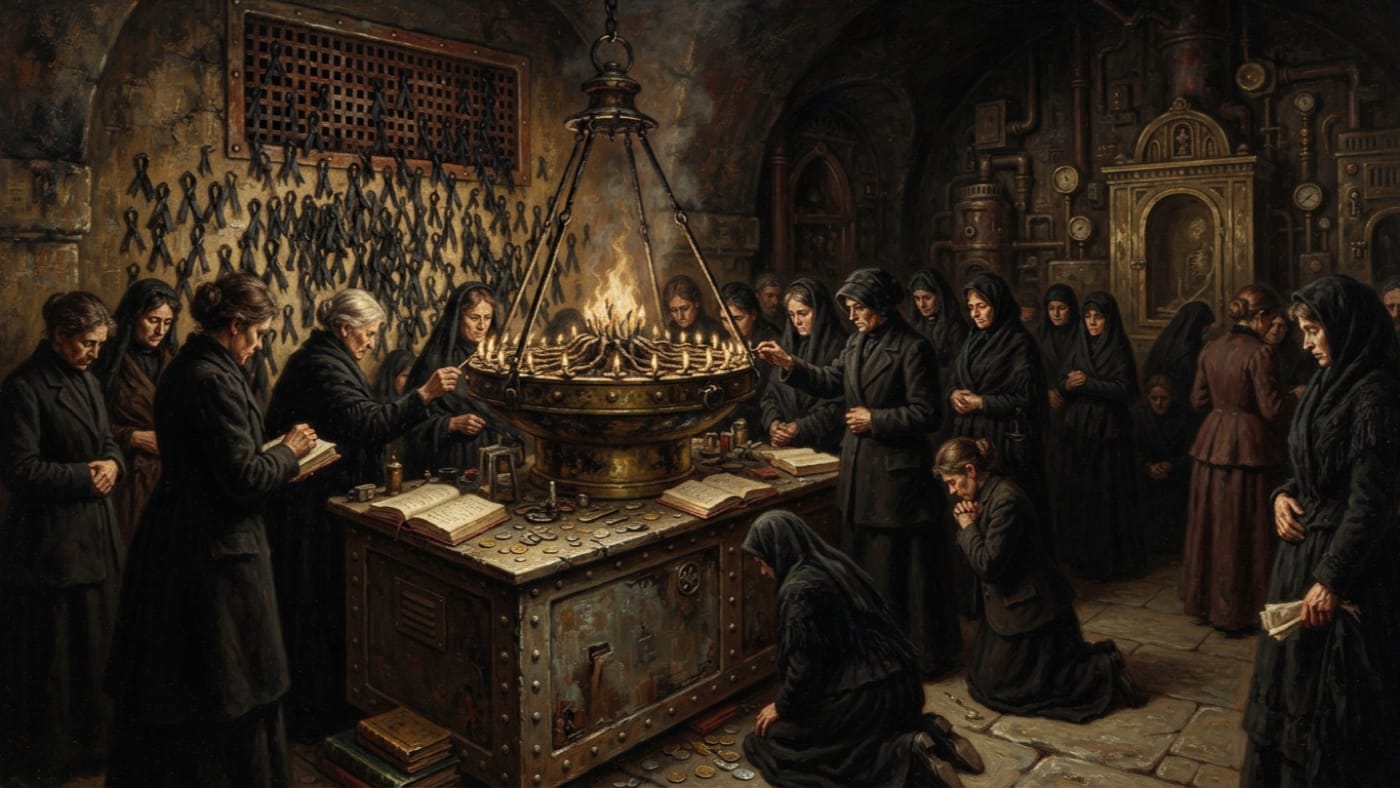
The ceiling is low. Oil smoke has blackened the walls. The blackening is the chapel's only generous ornament: every lamp ever lit there has added to it, and no one has been charged for it. The papers give no measurements, no pews and no plan. They give an altar, and they record what is not on it.
The altar holds no body relic. In A.S. 172 / 1882 CE someone asked that it should hold one, and the Bureau of Relics declined. Its stated reason was that a relic placed so near the ward-niches might cause "jurisdictional confusion." The niches belong to the Reliquary Proximity Wards in Sorrow's corridors. There the finger-bones of minor saints sit in brass-lipped recesses, one every eight metres, and flare when concealment glyphs pass. The network has been the densest on the Line since it was tripled after the penetration of A.S. 196. The papers give neither its full geometry nor the year the first niche was set into Sorrow's walls.
The person who made the request is unrecorded. The saint is unnamed. The relic stayed wherever it already was. The refusal survives in a single phrase, and the phrase rewards slow reading. Relics chose the word confusion, and qualified it as jurisdictional, which is the only kind of danger the Bureau holds to be fully real. The phrase predicts paperwork. No office has said what a body relic on that altar might have done beside the niches, and this survey will not say it for them. The bones in the corridor walls are catalogued, rotated quarterly and billed. They are not the refused relic, and they never became it.
#On the Oil and Its Remittance
Public doctrine holds that the chapel's lamps burn oil rendered from widows' tears. The chapel's own account describes something else. The oil is bought through a widow-tithe remittance to the Bureau of Tithes and made up with candles from the Bureau of Pilgrimage. It is scented with ash-rose from the Ash Gardens and then sold back to the widows as devotional fuel.
Follow the coin. A woman's husband is entered among the lost, and she pays the tithe owed on her widowhood. The tithe buys oil, Pilgrimage's candles stretch it and the Gardens perfume it. Then the chapel sells the oil to her, and she lights it for him. Her grief has passed once through the books and come back to her as a flame with an invoice attached. No paper I have handled gives a rate, a recipe, a proportion, a price or a supplier. I decline to supply one, because a figure printed in the Codex becomes a figure collected in the parishes.
Older Bastion descriptions and devotional summaries state that the lamps of Sorrow burn oil "distilled from tears," rendered from the weeping of widows.
Corrected. Tears do not burn. The oil is bought with widow-tithe remittance, made up with Pilgrimage candles and scented with ash-rose. The tears reach the lamp by way of the account book. Doctrine may keep the phrase as devotion. The Codex may not keep it as chemistry.
#On the Widows, the Ribbons and the Books
The widows light lamps for men lost at the wall, in the harbour and in the Warrens. They light them for men lost to Administrative Dissolution, and for men who came home alive and were no longer the men who left. That last category has no death certificate behind it, and the chapel admits it anyway. Flame does not ask for papers.
The Bureau of Records does. Records tried to regularise the intention slips on which the widows named their dead, and the attempt failed. A second attempt failed, and so did a third. On the fourth, the widows answered without any slip at all. They replaced every official form with black ribbons tied through the ventilation grate, and the ribbons are still there. No date attaches to the fourth attempt. No name attaches to the first woman who tied a ribbon, and no statement survives from either side. The grate says enough.
The chapel keeps no official petition book. It keeps three unofficial ones. Some petitions meant for the forty-seven of Chamber 7 end up here rather than in the service-ditch fire: papers thrown short from the parapet, and papers carried in by hand. A petition proves that someone asked. It proves nothing about who listened. The forty-seven hold no title of sainthood or intercession in any register I keep. The papers do not say who holds the books, how entries are made or who may read them.
#On the Forty-Seven Wicks
On 23 Argent, A.S. 170 / 1880 CE, forty-seven persons were sealed into Chamber 7 in the Sixth Ravelin, called Correction, as consecrated cement closed the breach. They were soldiers, civilians, confessors, ammunition-handlers, Records clerks and one widow. Whatever the chapel's name invites a pilgrim to assume, they were not forty-seven widows.
In A.S. 172 the Bureau of Rites proposed forty-seven candles, one for each of the dead. Records objected. The Bureau of Doctrine objected to the objection, then approved it under another heading. The settlement was a single lamp with forty-seven wicks bound into one braid, kept in the Chapel of Widows' Light. It is trimmed at Matins, at Vespers and at the fourteenth bell. The papers do not name the hand that trims it.
The braid burns unevenly, and three explanations are on file. Engineering blames wick variance. Rites blames devotional irregularity. The widows observe that forty-seven persons are not one person. That is crude theology and the best argument in the folder. Doctrine has not ruled, and by not ruling it keeps all three explanations licensed at once.
#On the Lamp at the Vigil
Once a year the lamp leaves the chapel. At the Vigil of the Hollowed, on 23 Argent, Pilgrimage Day Three, it is carried up to Sorrow's parapet in a brass box with nine shutters. From the parapet, pilgrims look across the intervening works to the darker section of Correction's curtain. The chapel has no view of that wall, so the lamp is taken to where the view is.
The garrison choir sings the Antiphon of Endurance, all thirty-two verses, and the box opens by verse. One shutter opens at the twenty-seventh. In A.S. 170 that was the verse at which the cement reached the mouths of the shorter volunteers. A second shutter opens at the thirtieth, the verse by which one woman was left singing alone. Her identity is disputed between the widow entered as K. and one of the confessors, and Records has sealed both files. The brass does not choose between them, and neither does this survey. At the final verse every shutter opens.
As the choir of A.S. 170 fell silent, voice by voice, the box lets out more light. The papers do not record who designed the sequence.
At that point the flame leans toward the Sixth Ravelin, even when the wind runs out to sea. The published accounts report it. The Bureau of Bells has measured it twice and filed both measurements under Candle Behaviour, Acceptable. No office has assigned a cause. Bells has assigned a category, and in Constantinople a category is the greater power.
#On the Present Condition
As compiled in A.S. 201, the chapel stands as the papers leave it. The ceiling is low and the walls are black. The altar has no body relic, and the niches in the corridors keep their bones. The widows buy back the oil their tithe paid for and light it for the dead, the dissolved and the changed. The ribbons are still tied through the grate, and the three books are still unofficial. The braid is trimmed three times a day and burns unevenly, and once a year it goes up to the parapet in its brass box.
The ravelin's current-condition register records that the chapel's unofficial petition books are "tolerated." Tolerance is the Bureau's warmest word for a thing it cannot put on a form.