
#On the Fifth Gate and Its Unlovely Office
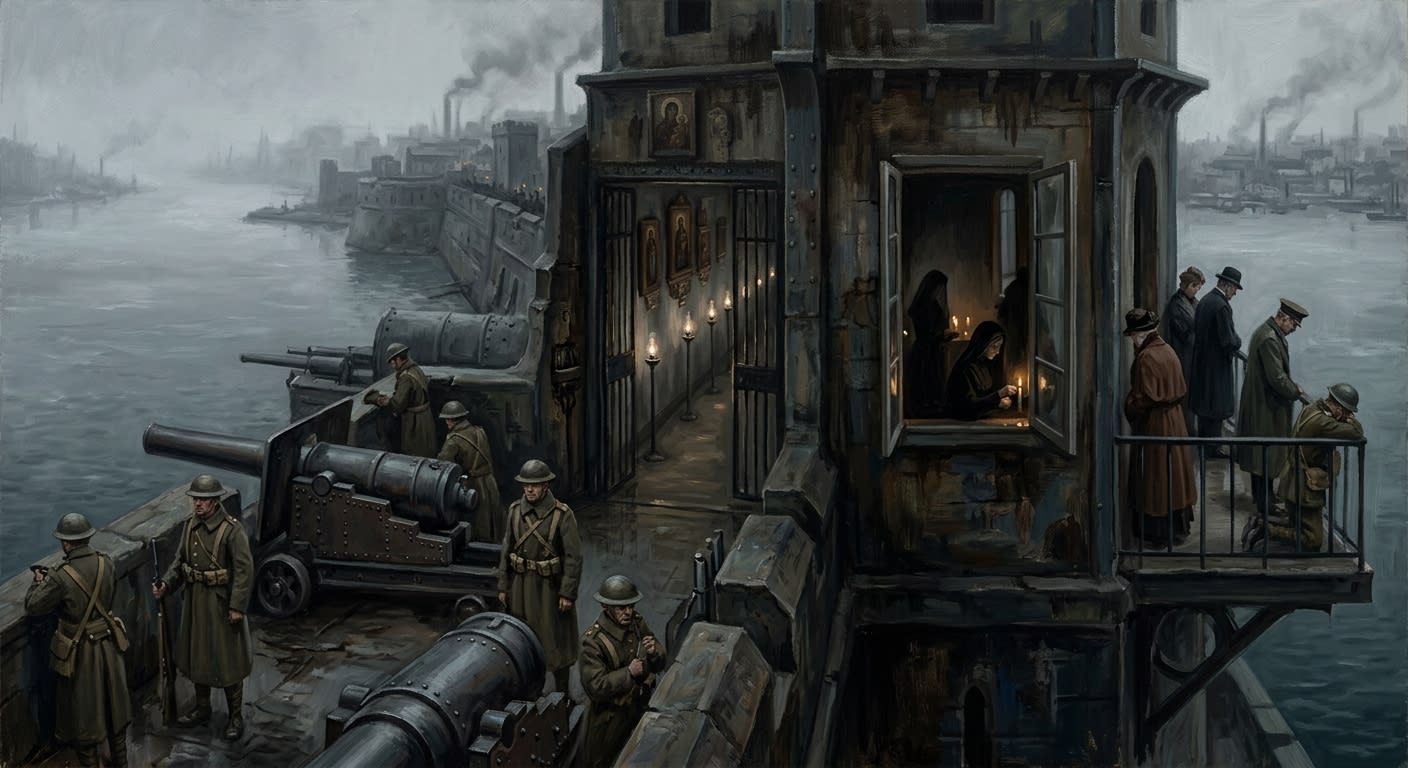
The Ravelin of Sorrow is the Fifth Ravelin of Bastion-Constantinople, set between Fortitude and Correction, facing the Quarter of Widow's Light, the pilgrim lanes, the lower harbour approaches, and that particular portion of the southern anchor where grief has been converted into military architecture and charged admission on three days of the year. It is called Sorrow because the Synod, in one of its rarer moments of precision, declined to give it a prettier lie.
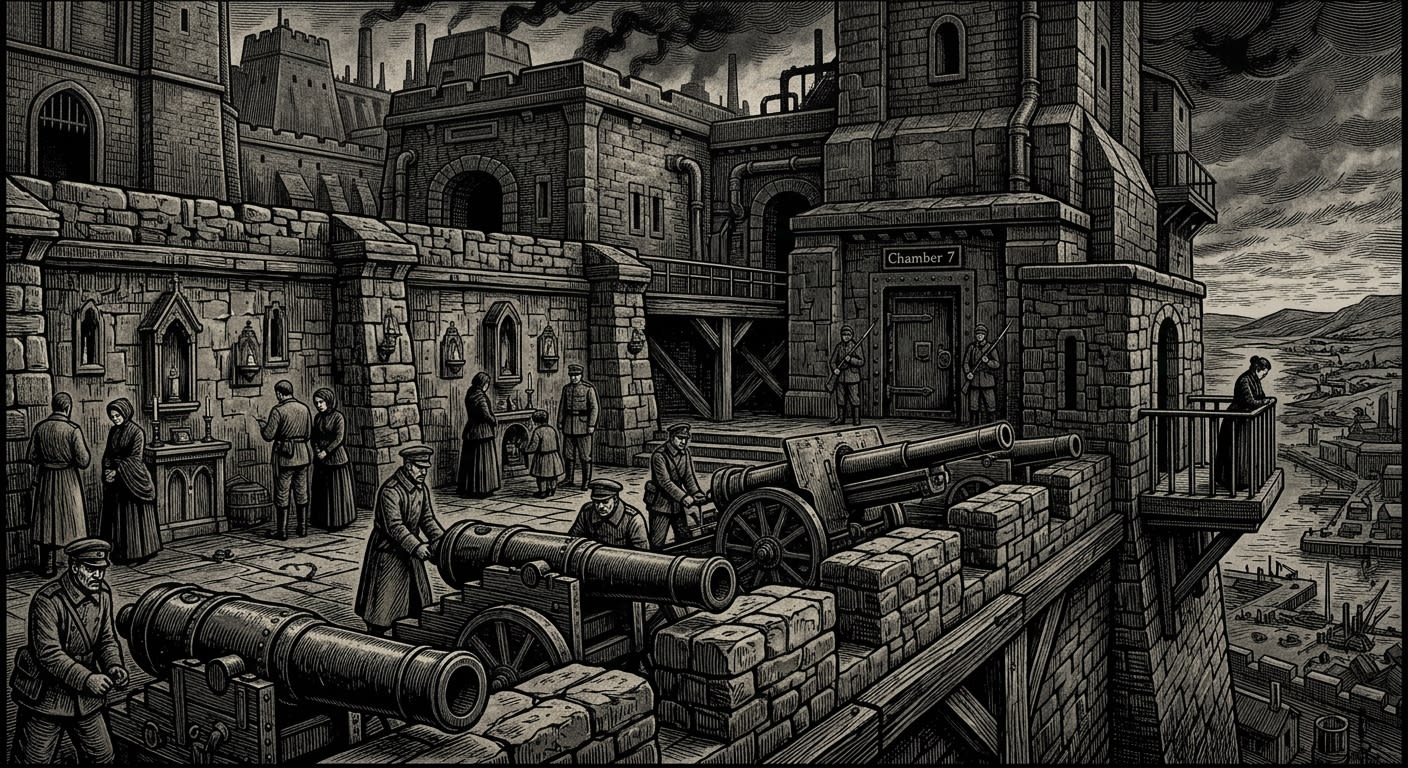
The ravelin is an outer work, yes. Stone, ditch, counterscarp, gun deck, inner gallery, postern mouths, relic niches, watch steps, drainage vaults, pilgrim parapet, and lower gun casemates whose embrasures look toward water that has learned too many lights. Yet its true function is neither artillery nor procession. The Ravelin of Sorrow governs the distance between what Constantinople must remember and what Constantinople is permitted to name.
From its upper walk pilgrims see Chamber 7 across the intervening works during the Vigil of the Hollowed. They see a darker section of the Sixth Ravelin's southern curtain. They hear the Antiphon of Endurance. They kneel. They are told forty-seven servants offered themselves to the wall, and they are not told the forty-seven names, the full dispatch sequence, the Night Paper's surviving copy, or the exact reason Strasbourg has allocated only seven public words to the structure those persons became. The Ravelin of Sorrow is the balcony from which omission is made devotional.
The lamps of Sorrow are said to burn oil distilled from tears. This is not chemically true. It is fiscally true, which is the stronger category.
#On Its Raising and the Sixfold Virtues
Bastion-Constantinople was designated in A.S. 68, when the Bosphorus ceased being merely a strait and became the southern hinge of the Sagittal Line. The early works were harbour chains, curtain walls, emergency palisades, and the practical panic of men who had watched the world crack eastward and concluded that stone, iron, prayer, and taxation should be stacked until the sea itself felt supervised. The six outer ravelins hardened over the next decades into a sequence of virtues: Vigilance, Purity, Obedience, Fortitude, Sorrow, Correction.
The official order is sunwise from the north. The spiritual order is less tidy. Vigilance sees first. Purity judges. Obedience receives command. Fortitude remains. Sorrow witnesses. Correction consumes. The Bureau did not intend this theology. The walls discovered it by standing long enough.
Earlier instructional charts describe the Ravelin of Sorrow as a “secondary ceremonial platform attached to the southern commemorative route.” This is what happens when a clerk meets a fortification only through a schedule. The Ravelin existed before the route, bled before the route, watched before the route, and would remain useful if every pilgrim in Europe were mercifully delayed by paperwork. Ceremony was attached to it later, like lace sewn over a scar.
Sorrow's position made it suitable for witness. It does not contain Chamber 7; that honour and burden belong to the Sixth Ravelin, Correction. Sorrow stands near enough to see, far enough to keep civilians from touching, and high enough for priests to turn architecture into sermon without allowing sermon to trespass upon Engineering's maintenance gallery. This distance is not accidental. The Bureau of Pilgrimage calls it reverent separation. The Bureau of War calls it crowd control. Doctrine approves both nouns because both keep hands off the wall.
By A.S. 140, after the Burning of the North Gate, Sorrow had already acquired its chapel of widows, its lamp stair, and its lower casemates. By A.S. 162, during the Black Sea Armada, its harbour guns fired until their sleeves cracked. By A.S. 168, when Petra Valenne integrated the Vigil Ark Saint Barachiel into Constantinople's defence, Sorrow received aerial signal marks and roof-baffles for sermon-horn interference. By A.S. 170, it became the appointed witness to the breach that made Chamber 7. A place may have many foundations. Some are dug with shovels. Some arrive as disaster and refuse to leave.
#On the Stone, the Guns, and the Lower Watch
The upper face of Sorrow is broad by ravelin standards, built for guns, processions, and crowds pretending those are different loads. The parapet bears iron sockets for storm screens, ash shields, relic torches, and temporary Pilgrimage rails. Its paving stones are worn smooth where thousands of knees have pressed during the Vigil. The Bureau of Engineering replaces cracked stones in winter so pilgrims may kneel on good masonry. Compassion, when expressed through procurement, has the texture of granite.
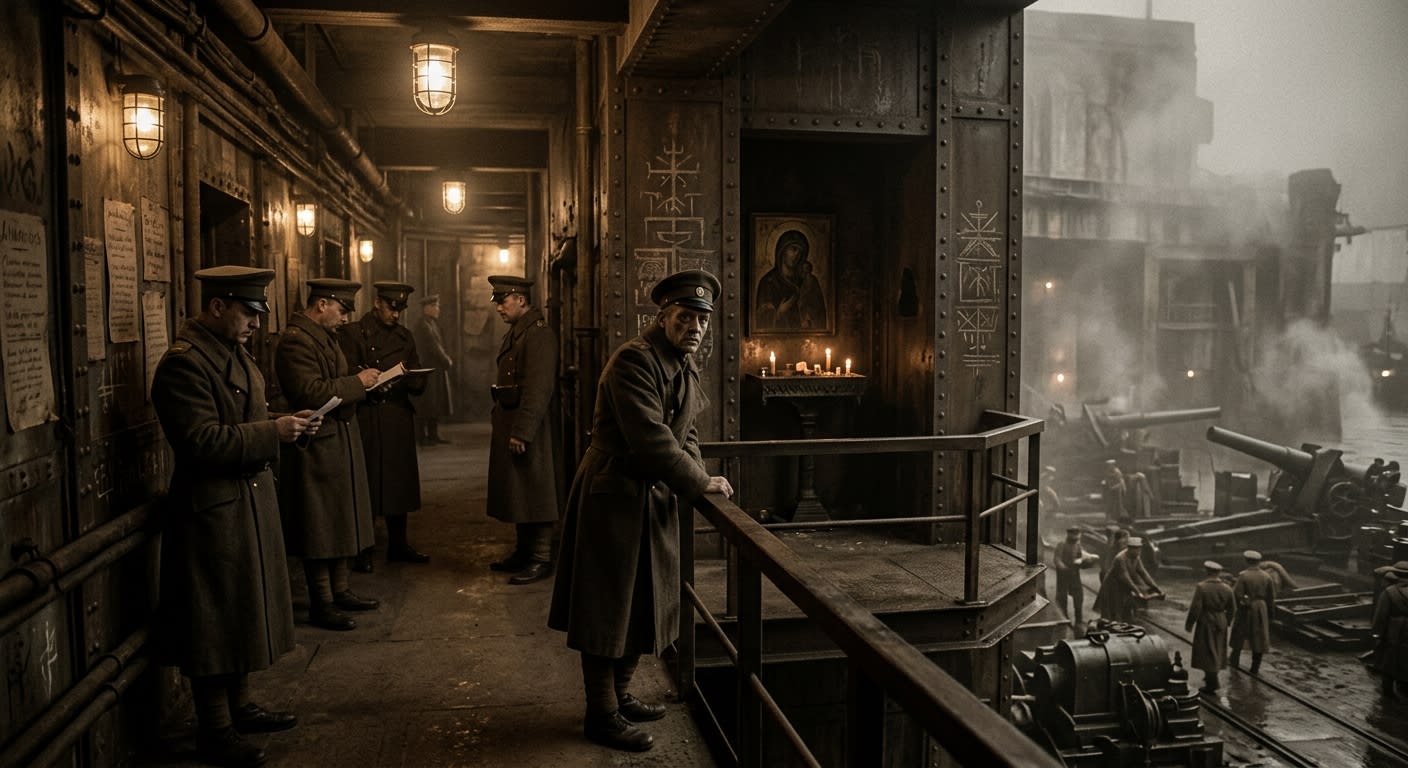
Below the parapet run three levels. The first is the public pilgrim gallery, opened only under permit and guarded by men who have been trained to distinguish tears from theatrical fainting, both being common near fee tables. The second is the gun deck, with lower harbour embrasures, mirror covers, black-lamp shutters, powder recesses, and bell-click chains leading to Valenne's speaking-tube room. The third is the under-gallery, where the Reliquary Proximity Wards sit in niches every eight metres and where no one walks alone after last peal.
The structural note is plain enough to wound vanity. Upper parapet: pilgrimage and observation. Middle deck: lower harbour guns, lamp discipline, signal chains. Under-gallery: Reliquary Proximity Ward network and restricted watch. Current hazard: concealment attempts, mirror-light anomalies, crowd grief pressure. Engineering wrote it in dry ink. War underlined the hazard line twice. Pilgrimage requested a friendlier copy and was ignored, one of the few mercies granted that office.
Sorrow's guns are not the largest at Constantinople. They are placed where they can embarrass enemies who mistake harbour approaches for soft geometry. The lower casemates can rake the quay approaches, the dead-water pockets below the Chain of Saint Anakletos, and the service lanes by which food, wounded men, pilgrims, condemned persons, and lies enter the southern anchor. The guns also watch the water, which is less obedient than earth and more inclined to return what has been thrown into it.
During the Silence of Harbor Lamps in A.S. 185, the Ravelin of Sorrow reported lights in the water below the quay: count exceeding known lamps, one reflection moving against current. The request to withdraw from lower guns went to Valenne. Her answer returned: hold, cover mirrors, count men, not lights. That order remains in the under-gallery drill book. The mirror covers are checked twice a week. No one explains to recruits why a fortress gun deck requires mirror discipline. Recruits learn after asking once.
LOWER WATCH ADDENDUM — A.S. 185 At third dark hour the water presented ███ lamps in ranks corresponding to no pier chart. Gunner Marek counted his own face among the reflections while standing with his back to the embrasure. Valenne order received: COVER MIRRORS. COUNT MEN, NOT LIGHTS. After covers fixed, one crewman absent. His boots remained warm. Casualty entered under Harbor Spiritual Contamination Protocol.
The Ravelin of Sorrow burned no lamps that night and still kept watch. This is one of those sentences that sound simple until a reader with imagination places himself inside it: stone underfoot, dead lamps, water showing false lights, guns loaded by touch, orders passed by hand, men counted again and again because one count might include a reflection.
#On Ward-Niches and the Enemy the Eye Abandons
The Ravelin of Sorrow maintains the densest Reliquary Proximity Ward network on the Line: one relic per eight metres of corridor, finger-bones of minor saints blessed, sealed, catalogued, rotated quarterly, and billed with an enthusiasm that proves the Bureau of Tithes believes in miracles when miracles invoice cleanly. The ward-niches are small, brass-lipped, wax-sealed, and numbered in red. Each contains a reliquary no larger than a clenched child's fist. Each makes concealment glyphs flare when a Veil-Stalker passes within three metres.
The relics do not discriminate. This is their virtue and their inconvenience. They flare for hostile glyphs, smuggled ward-scraps, illicit saint-dust, certain Purity brands, and once for a captain's tattoo acquired in his youth during a tavern brawl in Marseille. The captain objected. The relic did not revise its opinion.
Sorrow earned this network through failure. Veil-Stalker pressure at Constantinople increased in the A.S. 190s: one officer here, one bell aide there, never more than one per week, never the same sector twice, every death three days before a probing action. The knives did not merely kill. They rearranged timing. A dead bell aide delays a signal. A dead powder clerk stalls a gun. A dead runner leaves a route uncorrected. The Stalker cuts minutes, and minutes cut walls.
The last confirmed Veil-Stalker penetration of the Ravelin of Sorrow occurred in A.S. 196. The creature entered by Peripheral Erasure through the pilgrim stair after second Vespers, dressed in a cloak borrowed from a penitent whose body was later found behind the candle rack with his tongue bitten through. The Stalker reached the under-gallery before Ward Niche 5-F flared. Its glyphs shone blue-white through cloth and skin. Two sentries looked directly at it and, according to deposition, “understood that the corridor was wrong.” One fired. One rang the bell-click. The Stalker cut one throat, struck the ward niche, and burned visibly for six seconds before collapsing into ash that retained the outline of kneecaps.
War summaries state that the A.S. 196 penetration was “repelled without loss of functional personnel.”
Corrected. Sentry Halden Rusk died with his hand on the bell-click chain. The phrase functional personnel is an obscenity deployed by officers who have forgotten that function can bleed.
Since that night, Sorrow's ward-density has tripled. The Bureau of Relics attributes the absence of confirmed penetrations to sanctified efficacy. War attributes it to the enemy possessing the wit not to enter the most heavily warded corridor in Europe. Both explanations are acceptable. The dead sentry receives neither explanation in his grave, which may account for the restless lamp near his plaque.
Ash-dusting follows the evening peal. Two orderlies scatter blessed ash across the under-gallery floor, smooth it with boards, and retire walking backward so their own prints do not confuse the pattern. The practice is old, cheap, humiliating, and useful. Nothing irritates a proud fortress like admitting that its safety depends on a layer of swept dust.
#On Pilgrimage Day Three
The Vigil of the Hollowed draws pilgrims to Sorrow on the 23rd of Argent. They arrive through the Bureau of Pilgrimage route from the Cathedral of Perpetual Registry, past permit tables, Purity glances, Tithes collection points, candle allotment desks, confession screens, and the small gate where children are instructed not to ask whether the people in the wall can hear them. The instruction fails often enough that chaplains have prepared answers. Prepared answers are never good answers; they are only safe ones.
The formal procession carries the Bone-Censer of Saint Thaddeus, one of seventeen Bone-Censers of Saint Thaddeus, all notarised, all authenticated, all genuine according to the Bureau of Relics' magnificent rule that duplication becomes sanctity when properly sealed. The censer swings. Incense crawls along the parapet. The garrison choir begins the Antiphon of Endurance. Thirty-two verses. By verse twenty-seven, the shorter volunteers of A.S. 170 would have had cement at their mouths. By verse thirty, only one woman's voice remained. The pilgrims know this because the chaplains do not say it and everyone in Constantinople knows what is left out.
The Ravelin of Sorrow manages the crowd as a military operation. Grief has tides. The first surge comes when the sealed section becomes visible. The second when the Antiphon reaches verse twenty-seven. The third when the official account says their names are with the Creator, a phrase that soothes visitors and insults relatives, since the Creator has not been asked to administer annuities. Pilgrim marshals brace the rail. Confessors stand behind the fainting line. Tithes men keep the collection boxes behind guards because sorrow does not abolish theft. It sharpens it.
Children throw folded papers toward Chamber 7. The papers fall short. The wind almost always carries them down into the service ditch between Sorrow and Correction, where soldiers retrieve and burn them unread. A few papers are smuggled into the Ravelin chapel. They ask the forty-seven to intercede for sons, husbands, sisters, uncles, missing clerks, lost hands, failed crops, bad dreams, and the kind of fear that comes when a wall is warm thirty-one years after the dead entered it. The chapel keeps no official petition book. It has three unofficial ones.
A Pilgrimage brochure once described the view from Sorrow as “the perfect vantage for contemplative gratitude.”
Withdrawn after a mother of one sealed volunteer struck the brochure clerk with a candle tray. The current phrase is “authorised sightline for commemorative devotion.” It is uglier and less likely to provoke accurate violence.
At the close of the rite, the Ravelin Chaplain reads the sanctioned account. Three pages. Forty-seven servants. Spirit of Obedience. Sacrifice accepted. Wall endures. The names do not appear. The cement does not rise in the text. The Night Paper receives one sentence. The burned regiment receives none. The pilgrims cross themselves. Some believe every word. Some believe the space between the words. Sorrow accommodates both, being stone and accustomed to weight.
#On the Ditch Between Sorrow and Correction
Between Sorrow and Correction lies the service ditch, a narrow cut of stone, slag ballast, drain grates, stretcher ramps, cable troughs, and old impact scars where the public eye is barred and truth has less need to comb its hair. Pilgrims see over it. Soldiers cross it. Engineers curse it. Runners know which three steps flood after ash rain and which handrail heats before Maldrake's artillery finds its range. The ditch is the throat through which messages, stretchers, powder carts, censers, reprimands, and unsanctioned questions pass from witness to wound.
The ditch acquired its present discipline after A.S. 170, when Chamber 7 made Correction too sacred for civilians and too useful for priests to control. Before that, the passage between the Fifth and Sixth works had been a military service lane with poor drainage and worse manners. After the sealing, it became a border. On one side, grief arranged for viewing. On the other, grief sealed into load-bearing material. The Synod loves borders. Borders tell the hand where it must stop before touching a thing it would rather not understand.
During the Vigil, folded petitions fall into the ditch like paper birds shot for trespass. Children throw them toward Chamber 7 because children have not yet learned that sincerity has range limits. Soldiers retrieve them with hooked poles. Officially, the papers are burned unread, lest the forty-seven acquire private patronage and become local saints by accumulation. Unofficially, some are read first. I know this because one petition reached my desk in A.S. 199, folded into a powder requisition and smelling of candle soot. It asked the wall to remember a brother who had forgotten his own name after three months in the Hammers. I returned it to the fire. I did not correct the grammar. There are courtesies even Doctrine should preserve.
The ditch also keeps secrets for the garrison. Men vomit there after their first Vigil detail, not from wine but from hearing thirty-two verses and seeing, across the gap, the place where the cement rose. A captain once ordered buckets set discreetly behind the signal cable housings. Pilgrimage objected to the smell. Valenne answered that if pilgrims wanted clean devotion they might try prayer at a distance. The buckets remain during the rite and vanish before the fee collectors pass.
At night the service ditch changes office. Its drain grates breathe warm air from Correction's lower galleries. The ward-niches in Sorrow sometimes answer the warmth with a faint amber pulse, though no Stalker has been found on those occasions. Engineering calls this sympathetic relic response. The gun crews call it the forty-seven shifting in sleep. Rites calls the phrase unsuitable. Soldiers continue using it, proving again that unsuitable language is often the only language with boots.
No civilian may enter the ditch. Exceptions are made for corpses, fallen pilgrims, wounded chaplains, and one Tithes collector in A.S. 188 who slipped while counting candle receipts and survived with a broken hip and improved theology. He later proposed a ditch access fee. Valenne refused in language so brief that the refusal has been copied into command training as an example of efficient fire.
#On the Chapel of Widows' Light
The Chapel of Widows' Light sits inside the inward shoulder of the Ravelin, small enough to seem humble and profitable enough to prove otherwise. Its ceiling is low. Its walls are blackened by oil smoke. Its altar holds no body relic because Relics declined the request in A.S. 172, fearing that a relic placed too near the ward-niches might cause jurisdictional confusion, by which it meant that the saint might do something without a form.
The chapel lamps burn the famous oil. Public doctrine says the oil is rendered from the tears of widows. Practical reality is more ordinary and more cruel: the oil is bought through a widow tithe remittance, compounded by Pilgrimage candles, mixed with ash-rose scent from the Ash Gardens, and sold back as devotional fuel. Tears do not burn. Account books do.
Widows of Constantinople have treated the chapel with that special reverence citizens reserve for institutions that exploit them accurately. They come to light lamps for men lost at the wall, men lost in the harbour, men lost to the Warrens, men lost to Administrative Dissolution, men who returned alive and were not the men who left. The chapel tolerates all categories because flame is mercifully imprecise. Records has attempted to regularise the intention slips. Three attempts failed. On the fourth, the widows replaced every official form with black ribbons tied through the ventilation grate. The grate remains decorated.
The Chapel also houses the single forty-seven-wick lamp for Chamber 7. It is trimmed at Matins, Vespers, and the fourteenth bell. The braid burns unevenly. Engineers blame wick variance. Rites blames devotional irregularity. Widows blame the fact that forty-seven persons are not one person, which is theologically crude and more persuasive than both departments.
During the Vigil, the lamp is carried to the parapet in a brass box with nine shutters. At verse twenty-seven, one shutter opens. At verse thirty, another. At the final verse, all shutters open and the flame leans toward the Sixth Ravelin even when the wind blows seaward. The Bureau of Bells measured this twice and filed both measurements under Candle Behaviour, Acceptable. I admire the courage of the comma.
#On Valenne's Discipline
Sorrow answers to Valenne's office with unusual obedience, which is to say it has learned obedience from a commander who does not confuse theatrical calm with command. Valenne uses Sorrow as witness-post, lower-watch node, ward-network test bed, and pilgrim pressure valve. She has walked its parapet in rain, ash, and full public hymn. She does not kneel during the Vigil. She stands behind the crowd and counts exits.
Her orders after A.S. 185 remain drilled into the lower watch: cover mirrors, count men, not lights. Her orders after A.S. 196 are shorter: if the ward flares, fire. The second order caused quarrels among chaplains, who objected that a relic might illuminate a penitent, a branded friendly, or some poor fool with an old contraband charm. Valenne's answer was filed as a training note: “Then shoot low and ask Rites whether the knee is doctrinally recoverable.”
The Ravelin captains dislike pilgrim days. Valenne dislikes captains who confess dislike where their men can hear. Sorrow's garrison must become three things at once on those days: soldiers, ushers, and liturgical furniture. They hold rifles under ceremonial cloaks. They watch the crowd for fainting, blades, false tears, Stalker shimmer, lost children, genuine prayer, and that most suspicious of civic phenomena, sudden silence in a large group. The Antiphon rises. The ward-niches hum faintly. Across the works, Chamber 7 darkens under sunlight as if remembering a shadow cast from inside.
Valenne has kept Sorrow from becoming purely ceremonial. This is harder than it sounds. Ceremonial spaces rot quickly. Officers stop inspecting drains. Chaplains requisition storage for banners. Pilgrimage requests railings where ammunition needs passage. Tithes asks whether a guardroom might become a fee office. Valenne denies, denies, denies, and occasionally allows a concession so ugly that no department asks again. One proposed commemorative kiosk now serves as a sandbag locker. I have rarely seen policy improved so elegantly.
#On the Present Ravelin
As of A.S. 201, the Ravelin of Sorrow remains active, overburdened, watched, warded, profitable, resented, necessary, and better maintained than three more glamorous parts of the southern anchor. Its upper stones are replaced before pilgrim season. Its lower stones sweat salt during ash rain. The ward-niches flare during quarterly tests with a colour the Relics men call amber and the soldiers call piss-gold because soldiers are frequently better at description. The chapel grate still carries widows' black ribbons. The lower gun crews still drill without lamps once a month. The under-gallery ash is swept smooth before last peal.
Chamber 7 remains visible from its parapet. That fact alone gives Sorrow its peculiar authority. A ravelin that sees a miracle daily becomes insufferable if not disciplined. Sorrow is disciplined by grief, by Valenne, by the ward network, by the under-guns, and by the living knowledge that it is not the wall containing the forty-seven. It is the wall forced to look at them.
A foolish pilgrim asks whether the Ravelin of Sorrow is holy. The question misunderstands both holiness and ravelins. It is not holy because people weep there. People weep everywhere in Constantinople; the city would be a cathedral if salt water sufficed. Sorrow is holy because it performs the Bureau's preferred miracle: it makes grief stand in the correct place, face the correct wall, sing the correct hymn, pay the correct fee, and leave before the guns need the parapet.
At dusk the lamps are trimmed. The Chapel flame leans toward Chamber 7. The ward-niches hold their little bones in brass mouths. The under-gallery ash lies flat, awaiting the footprint that will prove absence has weight. Valenne's speaking tube clicks once from Fortitude. The lower watch counts men, not lights. Across the ditch, the dark wall keeps its heat.