

#On the Installation Beneath the Hearing Hall
Report Two is the second paper in the Gate Nine folio, and it is the only one in which someone other than a Synod officer is seen at work. Its documented filing year is A.S. 194, and that year is the only date on the face of the document I will certify. The report gives no day or month, and it gives no date for the descent it describes. I will not supply one from the stock of plausible days that clerks keep for emergencies.
The room it describes had been found sixteen years earlier. In A.S. 178, Bureau of Engineering Team Gamma-9 went looking for the source of a vibration on the Queue Road. They drilled forty-two feet beneath the Gate Nine Hearing Hall and broke into a hexagonal chamber of dressed stone under a ribbed vault. A basalt slab sixty feet across lay on its floor, cut with six radiating channels. Above it hung a vertical wheel twelve feet across, and the wheel was turning. The full account belongs to the Apparatus of Gate Nine and to Report One, and I will not drill that hole twice. The aperture was sealed within forty-eight hours. The public reason given was structural instability.
Report One calls the wheel "a mechanism." Report Two calls it "the installation." An engineer says mechanism of a thing he has found. Installation is what a man writes once he understands that somebody put the thing there, keeps it there and works to a schedule. The change of noun is the report's first finding. The author makes it without comment, the way a confessor changes his tone when the penitent mentions a name.
The record does not say who ordered the second descent. It does not say how the escort entered a chamber whose only known opening had been plugged, or how long they stayed. I list these gaps here so that nobody can later accuse me of burying them in the footnotes.
#On the Three at the Axle
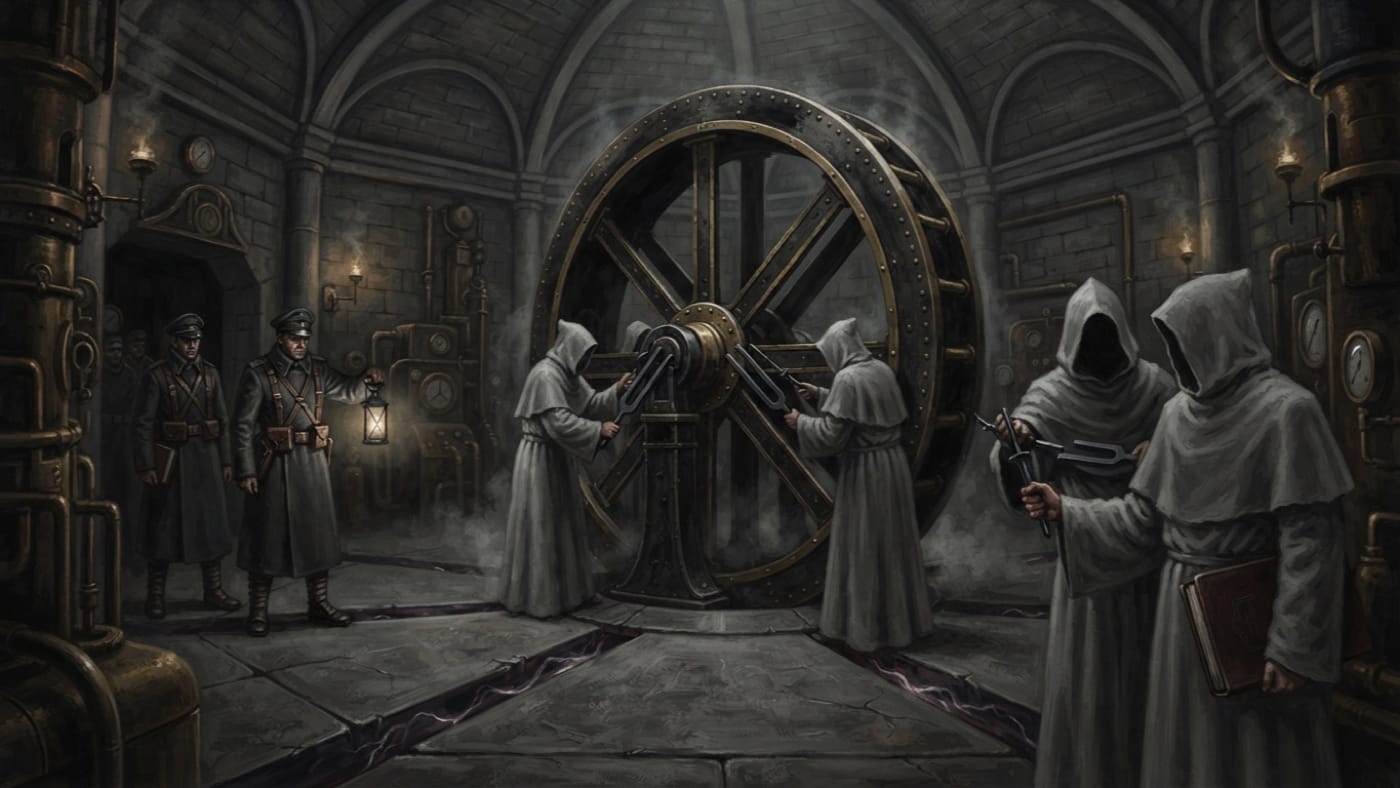
At the axle of the wheel the escort found three figures in grey robes, and the three were working.
That is the whole incident, and it is the whole horror. The three were applying infrasonic fork-forms to the bearings. These are instruments shaped like tuning forks and sounded below the range of hearing. No Synod workshop issues them, and no Synod rubric describes them. The report records the bearings as outside Synod manufacture. Engineering knows fork-work. Doctrine's Bell-Accountants test wax by resonance and are tediously proud of it. Neither office has a procedure for tuning a bearing on a wheel older than its own charter, and the report does not pretend that one exists.
The figures did not challenge the escort. They paid no attention to the Bureau of Shadows operative who came with it. Shadows rarely suffers that discourtesy and never forgives it. The nearest of the three turned toward the operative, and the observer read recognition in the turn, a recognition with no interest in it. Then the maintainer went back to the bearing.
I file the observation and the reading separately. The escort saw a head turn and the work resume. "Recognition" is the observer's word for how that turn felt from the wrong end of it. It does not prove that the maintainer knew the operative's name, face, office or rank. No word passed between them, and no instruction was given. Nobody was arrested, threatened, questioned or followed. I have read three cheap retellings from the Strasbourg copy-shops that add a dialogue, a struggle and a hood falling back. Those retellings have been confiscated, and their authors have been invited to write about drainage.
What the report records is maintenance. Workers with tools serviced a machine while an armed party from the most feared office in the Synod stood a few yards off, and the work went on at the same pace. An inquisitor expects flight, defiance or a bribe, and he has a form for each. He has no form for being treated as weather.
#On Seals and Whom They Bind
The aperture of A.S. 178 was sealed against structural instability. In practice that meant it was sealed against Engineering's curiosity. By the time Report Two was filed, sixteen years later, three grey robes had been seen at the axle with their instruments warm. A narrow conclusion follows, and I state it at full height. Closing the discovery opening did not secure the installation against everyone who wanted to reach it.
That conclusion is all the report supports. It produces no second entrance, no passage, no map, no door in the basalt and no trick of transport. It records only that the three were present. How they got there lies outside the paper. Any reader who has drawn tunnels in the margin has drawn private anxieties, and may keep them.
The sealing of the Gate Nine drill aperture within forty-eight hours of discovery secured the chamber beneath the Hearing Hall.
Corrected. The seal closed one hole made by one Bureau. Report Two records three maintainers at work inside the chamber in or before A.S. 194. Whatever else the seal secured, it did not keep them out of the room.
Custody follows the same rule. Shadows holds Report Two, as it holds the whole folio, under the irregular hyphenated filing sequence. Holding a paper gives control of the document and nothing more. The encounter offers no evidence that Shadows commands the grey robes, pays them, schedules them or has ever been consulted by them. If the one recorded gesture between a maintainer and a Shadows operative points anywhere, it points the other way.
The third report later speaks for "the unnamed bureau," and it is tempting to dress the three maintainers in that office's livery. I resist the temptation, because the report records no livery. The Unnamed Bureau is my working label for a voice in a later document. The report does not say whether the hands at the axle in A.S. 194 answered to that voice.
#On the Six Days
Six days after Report Two was filed, the Minute Drift received its designation: Category Two Localized Temporal-Scribal Disturbance. I give the interval as the record gives it, counted from the filing. It cannot be counted from the descent, whose date is unknown.
On the road itself the Drift needs no designation. People waiting in the Barricade Maze between Gates Three and Five swear they have stood there a week when the sun allows a day. Bells ring twice for one stroke, and ink dries before the pen lifts. Shadows fall at the wrong angle to the lamps, and the stomach keeps an older hour than the bell. These are the complaints of people whose time is the only thing the road lets them own. The Queue Road counts waiting in bell-marks and trades the result as minute credit. Fines, lapses and failed audits run the other way, into minute debt, which compounds and ends in conscripted labour at Gate Nine itself. Credit and debt are separate ledgers kept by separate clerks. I have watched men confuse them on the way to the collar.
The classification gave the symptom a number and gave the cause nothing. Above the chamber, the public account stayed what it had been since A.S. 178: a maintenance incident, resolved. An office of the Synod could stamp the Drift within six days. No office of the Synod could stop three strangers from tending its source.
The sequence is documented, and the mechanism is not. Report Two and the designation sit six days apart in the record. Being close in time does not show that the maintainers' calibration started the Drift. It does not show that the report prompted the classification, or that the Drift first appeared in A.S. 194. Restricted analysis has read the installation as an engine of extraction and the Drift as its leakage. That reading is held under seal, and I report only that it exists.
#On the Report's Place in the Folio
Report One found the room. Report Three, filed five years after this one, gives a figure and names a phase. Report Two sits between them, and three things appear only in it: the maintainers, the active servicing, and a measured limit on what a visiting authority could command beneath its own road.
Before this report, the wheel could be filed as a relic that happened to turn. After A.S. 194 it has staff. The Clock Heretics call the wheel the Grindstone and preach against it from the culverts. The report offers them nothing, because it is silent on the wheel's purpose. It offers the Synod even less, because it says a great deal about the wheel's upkeep.
The questions the report leaves open are the ones it raised. Who issues the fork-forms? Who made the bearings? Where did the three go when the escort left? The record answers none of them, and I will not let the Codex pretend otherwise for the sake of a tidy plate. As of A.S. 201, the Apparatus still turns under the Hearing Hall. The folio as I have it records no later sighting of a maintainer. That is a fact about the record, and it offers no comfort about the room.
The paper has gone back to the deep archive under its wrong punctuation. My notes have not.