

#On the Commission
"Sub-grade vibrations were interfering with stamp-press calibration." — the commission, as transmitted in the Apparatus dossier
Report One is a maintenance file. I say so first because every reader since has tried to make it grander, and a document deserves to be met at its own rank before anyone promotes it. In A.S. 178 the Directorate complained that the presses of the Gate Nine Hearing Hall would not hold their calibration. Stamps landed askew and wax cracked as it cooled. The Bureau of Engineering sent Team Gamma-9 to the Queue Road with drills and plumb-lines to find the vibration and stop it. Nobody asked them to look for a mechanism. Nobody asked them to look for anything beyond a loose foundation and someone to invoice.
That modest purpose is the report's whole authority, and it is also why the report is worth anything. In A.S. 178 Gate Nine was a court and a stamping-house, and its complaint came from clerks whose seals would not set. The discovery, the sealing and the dispersal of witnesses are told in the Apparatus of Gate Nine, at the volume that story requires. This entry is about the paper: what the first surviving record establishes, and what it cannot.
#On the Measurements
Engineering drills until somebody tells it to stop, and nobody told Gamma-9. Forty-two feet beneath the Hearing Hall's foundation stones, the bit broke through into air. At that point the report is still in good engineering order, still a civil servant's document, and it begins to record a room.
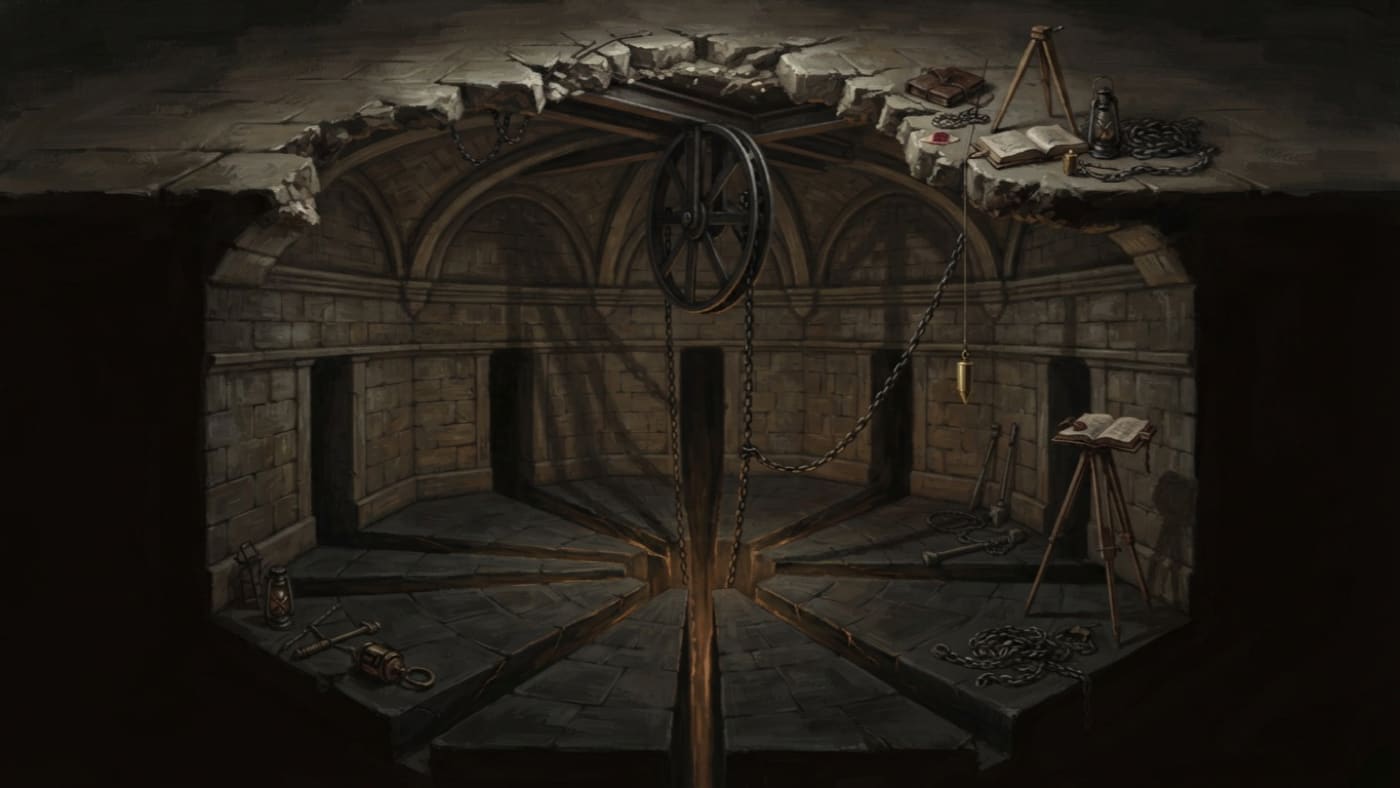
The chamber is hexagonal, with dressed stone walls. The surveyors called its ribbed vault late-Romanesque. That describes a style and nothing else, since any age that owns a pattern-book can build a vault in an old manner, and I will accept no dating from masonry until someone shows me a builder's receipt. The floor is a basalt slab lying in limestone country. The transmitted figures make the chamber sixty feet across at its widest. Six channels, nine inches wide and nine deep, are cut into the basalt and run from the centre to six shafts in the walls.
Above the slab hangs a vertical wheel about twelve feet across. Its chains are of a metal the report calls "iron-adjacent but spectrally non-conformant." The report calls the wheel "a mechanism." That is Engineering's word, and I keep it. The Clock Heretics gave it a name later, from a culvert pulpit, and a survey file does not borrow from pulpits.
Then the shafts. Gamma-9 tested three. Two plumb-lines returned readings consistent with surface gate positions. I will not say which gates, because the accounts disagree and Engineering's arithmetic has suffered enough from its admirers. The third line went down on forty feet of chain, and at thirty-seven feet the chain went taut sideways. Forty-two feet is the depth of the breach. Thirty-seven feet is a length of chain in a shaft. Any reader who merges the two figures will be reported.
The chain was cut. That left three shafts, and the report surveys none of them. It gives no reason.
#On the Change of Hand
I do not claim the handwriting changes. I have no certified sample to compare it against, and the Bureau of Records would enjoy catching me practising palaeography without a licence. I claim that the register changes, which is worse. Up to the moment it records that the wheel turns, the report keeps the measured diction of its office: depth, diameter, chain tension, the hardness of basalt. After that, it confesses.
The channels glow amber. One assistant hears bells, though the chamber has no tower. Another bleeds from the left ear. The phrase "almost a revolution" appears, underlined three times, and no sentence follows to say what almost turned or why the "almost" was the frightening part. The team tried to copy the glyphs on the rim. Later readers found the copies did not match the metal. The dossier counts seventeen glyphs in Report One's sketch. I record that count with a warning: it counts a drawing, and a drawing is the only thing anyone has ever managed to count here.
Then comes the final paragraph. I reproduce it from the Codex's existing text without restoring a single letter. Restoration is a vice of forgers.
REPORT ONE — FINAL PARAGRAPH FRAGMENT The mechanism turns in relation to █████████ rather than time; the channels receive ███████████████; surface waiting may constitute ████████████████; recommend immediate suspension of Gate Nine throughput pending █████████████████████████ [paragraph terminates mid-word]
Look at what survives: a surveyor recommending that the busiest court on the road stop work. Engineering does not ask for throughput to be suspended over a cracked footing. No suspension followed, and Gate Nine kept its hours.
#On the File's Removal
The drill aperture was sealed within forty-eight hours. That means a hole in a floor, plugged. Nothing in the record says the Hall closed for those two days. I will flay the next clerk who writes that it did, and the one after who confuses it with the sanitation closure of autumn A.S. 200.
Drill aperture beneath the Gate Nine Hearing Hall sealed on grounds of structural instability.
Corrected. Report One records dressed walls, a standing vault and a level slab. The only instability it records is in its author's prose. The Directorate's files keep the public explanation uncorrected. It is corrected here.
The file did not stay with Engineering. Report One entered the Bureau of Shadows' deep archive under a sequence of digits split by hyphens, where every honest archive in the Theocracy uses periods. I do not print the sequence. Nobody has given me the right to.
The engineer who cut the chain was posted to Bastion-Brest, on the Bug River, within the week. His name is in the report and missing from the Records personnel registry. The Codex will not supply it. A man the registry has lost by accident deserves at least one office that leaves him lost on purpose.
Custody is not command. Shadows held a folder. Nothing in the file shows Shadows giving orders to the room the folder describes, and the dossier says only that Report One refers to "the authorising party," with no name attached. In the parent entry I read the sealing as Engineering obeying an authority it had not identified and yet recognised. That reading is mine. I sign it, but I do not stamp it as a finding.
The published accounts treat this handling as the precedent for the cleaner removals of the Year of Smoke at Lübeck in A.S. 180, two years later. Precedent is the right word. No one has produced a manual written at Gate Nine and opened at Lübeck, and I have looked.
#On What Later Reports Added
Two later reports sit in the same folio. Gamma-9 wrote neither.
Report Two, from A.S. 194, records three grey-robed maintainers at the axle. Report One records no one there. Six days after Report Two, the Bureau of Rites classified the Minute Drift as a Category Two Localized Temporal-Scribal Disturbance, with the Bureau of Doctrine reading over its shoulder, as Doctrine reads over every shoulder. Anyone who wants grey robes in A.S. 178 has to carry them back from A.S. 194, and must declare them at the gate.
Report Three, from A.S. 199, reports throughput up eleven percent after a spring rate adjustment. It recommends continued non-disclosure pending completion of Phase Nine. Its fourth sentence has not been reproduced, here or anywhere I can certify. The rate adjustment it mentions is a different spring from the price doubling of A.S. 200. I leave Phase Nine as I found it. Its scope is unstated and its completion uncertified. No document I hold ties its numeral to the gate's, and the number nine proves no eight phases before it.
The idea of extraction, meaning time drawn out of the road rather than merely slowed upon it, comes from later Hourglass analysis recorded in the dossier. Gamma-9 measured a wheel and diagnosed nothing. The body that maintains it I file under the unnamed bureau, and nowhere else.
#On the Surviving Record
The list of what Report One cannot establish is longer than the report. It cannot say who built the chamber or when, or who set the wheel turning, or since when. The vault dates a fashion and nothing else. My claims of operation before the road are deductions, labelled as such in the dossier and labelled as such here. It cannot say what enters the channels, what words the bars of ink replaced, or why three shafts were left untested.
The last paragraph ends mid-word. People with larger seals than mine have asked me what the word would have been. I told them the Codex prints records, and this is the record.