

#On the Third Report
"The mechanism continues to operate within projected parameters." — Report Three, first sentence
Report Three is dated A.S. 199 and is four sentences long. Those are the only physical facts about it that I will certify. Four sentences tell you nothing about the number of pages, and they need not fill four lines. Anyone who has drawn it as a neat quatrain on a single card has drawn his own expectations, and he should sign them.
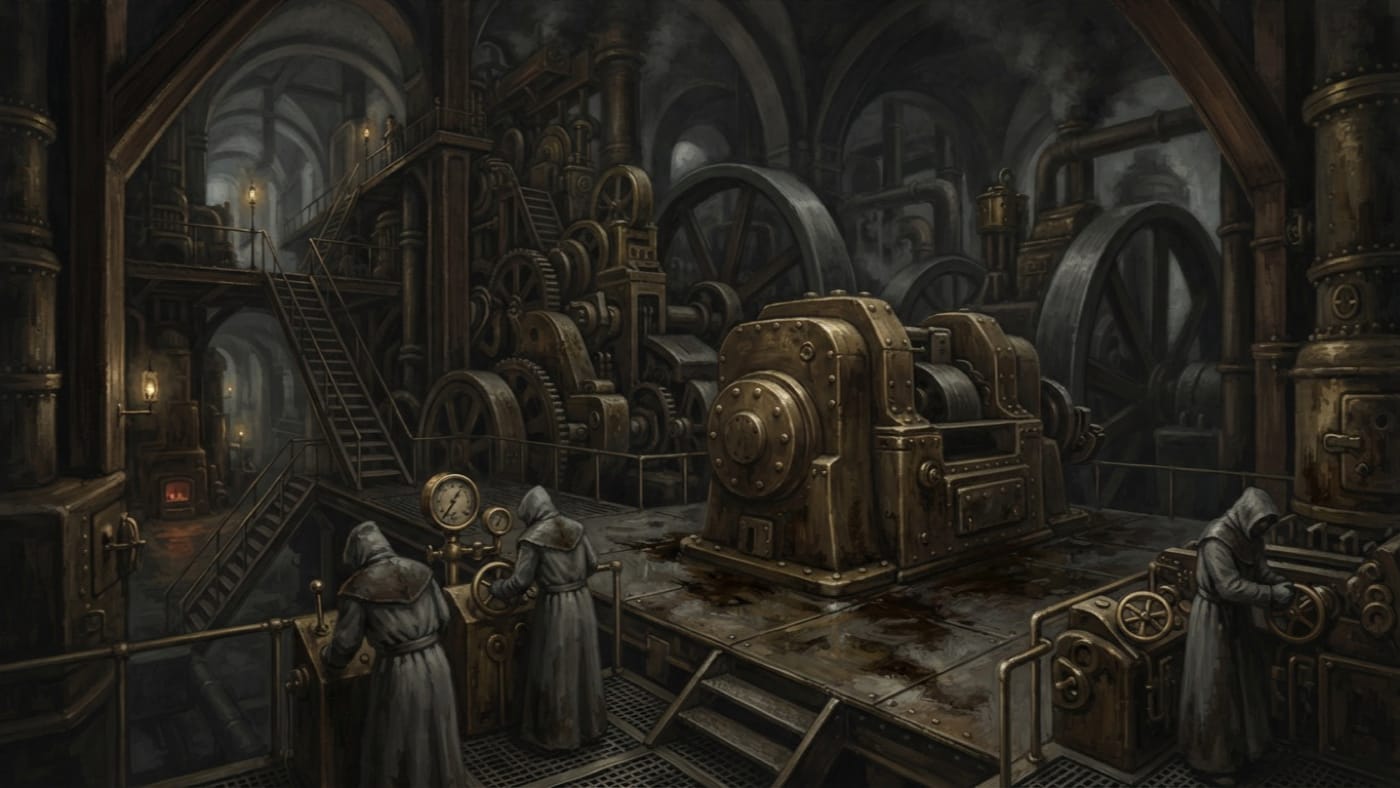
The earlier papers in the same folio were written by Synod men who went below Gate Nine and came back changed. Report One, from A.S. 178, is an Engineering survey that starts with measurements and ends in the middle of a word. Report Two, from A.S. 194, records three grey-robed maintainers at the axle of the Apparatus, along with an escort they did not bother to notice. Six days after that report, the Minute Drift received its Category Two classification. Both earlier reports are observations. Report Three observes nothing. It states a condition, reports a figure, makes a recommendation and names a product, in that order, all in the tone of a quartermaster confirming that the boots have arrived.
The discovery is told in the Apparatus of Gate Nine, and the designation has its own tract. This entry is about the paper. The indexers have filed it under Places, next to its older sibling, because it describes the room beneath the Hearing Hall more exactly than the room describes itself.
#On the Three Reproducible Sentences
Each sentence is the operator's claim about the operator's own work. It should be read the way a tribunal reads a defendant's account of his own conduct: slowly, and with the door locked.
"Projected parameters" assumes that projections exist. None come with the report. Nobody outside the chamber has seen the tables, if there are tables, and a man can operate within any parameters he keeps in his own drawer. The sentence claims competence and hides the standard of competence. I have signed sentences like it, and I know what they are for.
The second sentence holds the only number. Eleven percent of what? The report gives no unit, no baseline and no method of measurement. Throughput might be counted, weighed, poured or timed. The paper does not say which, and it could not say without leaning toward the noun its fourth sentence holds back. The figure records an increase in throughput and nothing beyond that. It does not show higher tariff revenue at the gates. It does not show a thicker crowd on the Queue Road, a more efficient wheel or a nearer end to Phase Nine. Clerks in three offices have used it to prove each of those things. Each clerk has been sent a copy of the sentence with throughput underlined, along with the invoice for the ink.
The third sentence names an office and gives it a verb. The office appears as "the unnamed bureau," in lower case. I set it in capitals elsewhere for convenience, but the Unnamed Bureau is my working label and is not a sanctioned title from any register. The verb is recommends. A recommendation binds nobody. This one names no recipient, carries no seal of command and certifies no completion. It asks, with perfect manners, for the silence to continue.
#On Continued Non-Disclosure
REPORT THREE — SENTENCE FOUR Subject: product of the Apparatus Text: ████████████████████████████████████████ Reproduction: not authorised under present seal
The fourth sentence names what the Apparatus produces. Every Codex account describes it that way, and I will add no other description. The Codex has never printed the sentence. Some readers write to ask whether I have seen it, whether I have read it, or whether I could recite it at table. They receive a printed card stating that the fourth sentence is not reproduced. The card is accurate, and it is all they will receive.
Phase Nine enters the record here. The report proves the designation was in use by A.S. 199. It does not date the start of the phase, define its scope or set its term. "Pending completion" shows that someone expected the work to finish, and says nothing about when. No files for Phases One through Eight have turned up in any concordance Doctrine has been allowed to search. Their absence does not prove that eight earlier stages took place, and the numeral does not prove the work has nine parts in total. The chamber does lie beneath the ninth gate. Until a document connects the two nines, the match is coincidence, and no document connects them.
My own reading is that Phase Nine marks the point at which the product becomes sufficient. That reading appears in the Phase Nine tract, labelled there as inference, and I do not repeat it here as fact. A wheel that keeps turning tells nobody how far along it is.
#On Custody and Receipt
Report Three is held in the deep archive of the Bureau of Shadows with its two predecessors. All three carry the same irregular filing sequence, with digits separated by hyphens where the Bureau's own archive uses periods. I do not print the digits. I have seen them, the punctuation is wrong, and that is all the reader needs to know.
Custody proves possession, and Shadows holds the paper. Nothing in the file shows Shadows commanding the chamber, directing the grey robes or approving the phase. The voice of the report is also not the voice of Shadows. It refers to the unnamed bureau in the third person, the way an office refers to itself when writing for a reader it outranks. The report identifies no author. It names no signatory and no patron, and it shows no chain of command. The office has a voice and no face, which is the arrangement most Hierarchs pray for.
The three reports arrived on my desk together on 3 Corvus, A.S. 200, in a folio sealed with wax the colour of old bone. No courier was logged and no receipt was requested. That date is when I received the packet. The year on the report's face is the only date I can certify for Report Three's writing or its original filing. Who sent the folio, and why it came to me, are questions it did not answer.
#On the Two Spring Adjustments
The second sentence treats "the spring rate adjustment" as something already done. The published Hearing Hall and Directorate records place that adjustment in the spring of A.S. 199, the same year as the report. The sentence itself gives no year. This is the adjustment Report Three measures its increase from.
Another spring followed. In A.S. 200, minute prices on the Queue Road doubled without a published decree, and the Drift spread into the Shed Wards that same season. The Permit Directorate sets the price bands, and Director Othmar Vell moved them. Nothing in hand shows that Vell has read Report Three, received a copy or acted on its wording. The sequence of events is documented. The line of authority between them is not.
Report Three triggered the spring minute-pricing doubling of A.S. 200, the Minute Drift's first expansion into the Shed Wards, and the delivery of the bone-wax folio to the Hieromnemon's desk.
Corrected. Report Three comes before all three events. It contains no instruction to the Directorate, no rate for the following year and no delivery order. The earlier chronology entry read a recommendation of silence as if it were a price writ. The two springs are separate, and the first never mentions the second.
The Bureau of the Hourglass separates the losses on the Road from the slowing that comes with Syrion. One makes time heavy, and the other makes it disappear. That distinction belongs to Hourglass, and Hourglass drew it from symptoms because it has never been admitted to the chamber. Report Three draws no such distinction. It only counts.
Brother Senn and the Unstruck break bell schedules and foul the lanes. Published accounts link their interference to weaker extraction surges and to Purity's remarkable failure to catch him. Senn has not read Report Three. He curses the wheel from a culvert pulpit on general principle and knows nothing of phases. Whatever use the Road gets out of him, nobody has thanked him for it.
#On the Unclosed File
As of A.S. 201 the wheel beneath the Hearing Hall still turns, and the road above it still pays. No Report Four has come up from the deep archive. No maintainer has been recorded since Report Two, and no document anywhere records that Phase Nine is complete. The recommendation in the third sentence has never been revoked. Revoking it would require some office to admit that it had received it, and every office on the Queue Road would sooner admit to heresy, which at least comes with a hearing.
The report asked for silence pending completion. It got the silence, and no completion has been recorded.