

#On the Survey and Its Poverty
This survey is dated A.S. 201, 1911 CE, by order of commission. The date belongs to the survey. It is not the founding date of the Ribwalk Watch, which no record before me establishes. Nor is it the year of the nine days the Watch lent to Booth 77, which the surviving account does not give. Readers who need a founding should apply to a poet. The Bureau has only paper, and here the paper is thin.
What the paper does say fits inside one sentence of the published Booth 77 account. The sealed booth's original guard detail "was drawn from the Ribwalk Watch: men accustomed to drunk penitents, forged tokens, queue fights, mule panic, under-deck knives, and the peculiar civic music of Brest after curfew." From that sentence, and from the nine days after it, this office must assemble a faction. I have raised whole cathedrals of doctrine on less. I have rarely been made to raise one on so little that was also true.
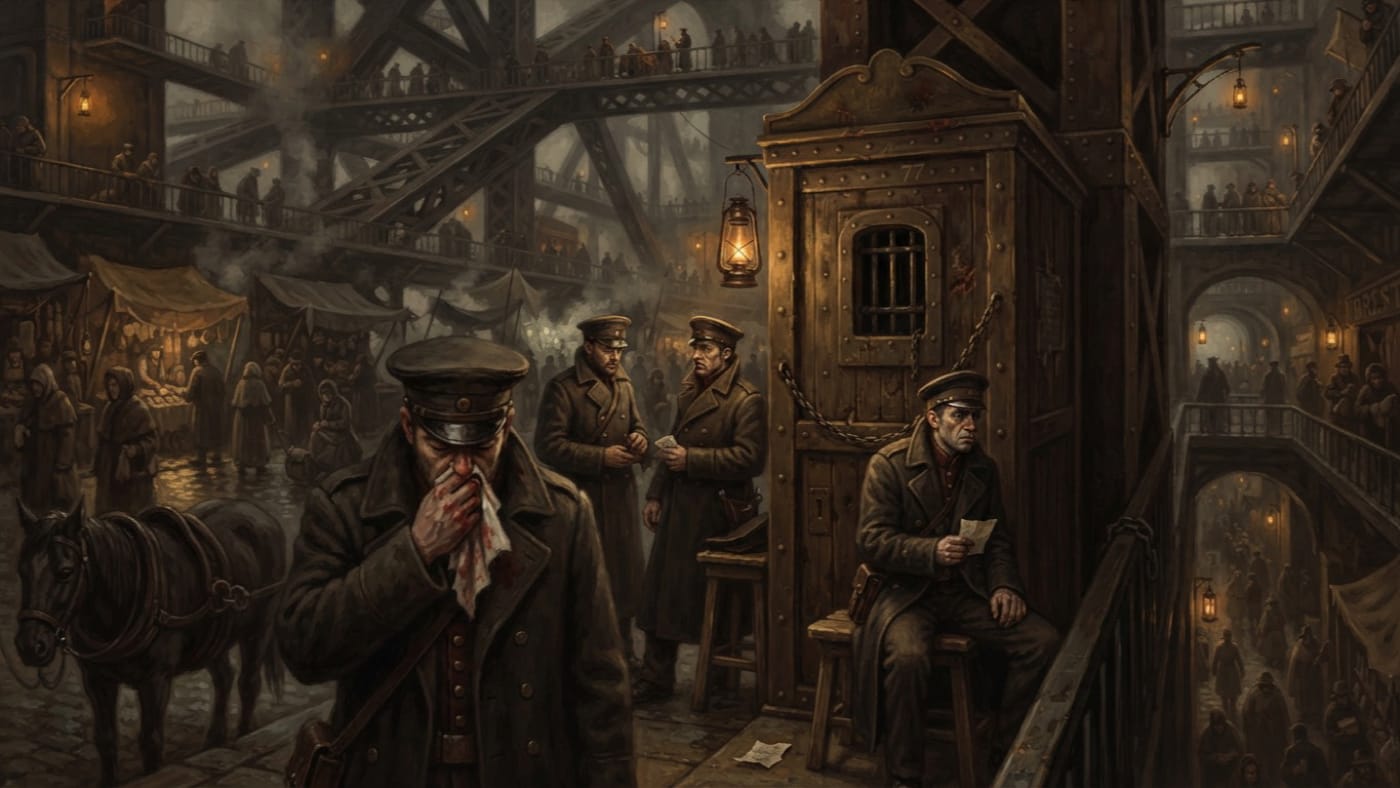
The Watch takes its name from the Ribwalk. This is the upper deck of the Brass Ribs at Bastion-Brest, where the bridge-fortress carries a market, a troop road, a queue channel and a curfew route over the Bug at the same time and with the same bad temper. Below it lie the Casemate Galleries, the Confessional Lanes and the under-deck spaces where Brest keeps what it would rather not inventory. Whether the Watch holds that deck alone, under whose warrant, in what ranks and at what strength, I cannot say. Its establishment roll has not reached me, and neither has its chain of command. I decline to guess its numbers, because a guessed number in the Codex turns into a requisition within ten years.
#On the Work of the Deck
The account lists five nuisances. Each one is a description of the Ribwalk itself.
Drunk penitents come up from the lanes and the Absolution Hall steps, light in the soul and heavy in the boots. Some celebrate their absolution and some mourn its price. Some have mixed up the two and want to argue it out with a stranger. Forged tokens come from the gap between what an absolution token costs and what a desperate crosser can pay, and older Brest working papers place a counterfeit-token stall in the Ribwalk market itself. Queue fights are what queues produce when the bridge narrows, the bells run late and the man ahead has a cousin in the stamp room. Mule panic belongs to a deck where animals stand chained to cargo rings beside gun limbers, coffin queues and vendors frying onions in borrowed fat. Under-deck knives belong to the moorings, the dice and the token swaps beneath the planks, where a blade settles disputes faster than a magistrate and charges less.
The bridge's own papers describe this pressure: dawn toll bells, a midday convoy surge, a curfew cordon, and single-file night lanes. They describe the deck. They are not the Watch's manual. Nobody has shown me a Watch standing order or a Watch arrest ledger, and I will not write one for them from the smell of the place. All the account certifies is what these men were accustomed to, which is a statement about their education, not their regulations. A Brest watchman learns his trade the way a censer learns smoke, by being swung through it.
The fifth item is the strangest in the list and the most exact: "the peculiar civic music of Brest after curfew." No ordinance defines it. Anyone who has stood on the bridge after the cordon falls knows it anyway. Brass ticks as it cools. Rope creaks in the under-rib netting. A drunk misremembers a hymn. A boot sounds wrong on the plates. Somewhere below, a sentence breaks off when a lantern passes. A watchman who knows that music can hear a wrong note before he can name it. The account found it worth recording. So does this survey.
#On the Nine Days
Then the Watch was posted to the sealed booth in the north Confessional Lane, third pylon from the west. Their assignment was nine days.
The account records three of those days, and I give them in its order.
By the fourth day, two of the detail had nosebleeds.
By the sixth day, one of them answered a question before Presiding Judge Elsbeth Krail had asked it.
By the ninth day, the senior watchman asked for a transfer, in handwriting so cramped that the scribe who received it took it for a confession.
Nothing else from the nine days survives in public form. Days one through three, the fifth, the seventh and the eighth are silent. The account does not say whether the two who bled included the one who answered early, or whether the senior watchman was among either. It names nobody. It gives no physician's report. It does not say what question Krail meant to ask, what the answer was, or whether the answer was right. Readers who join these three entries into one diseased man are doing their own carpentry. The Bureau will not pay for the timber.
Krail's part in this record is narrow. In the account she presides over the Bridge Tribunal, and on the sixth day she was asking a watchman questions. That shows a magistrate examining a guard. It does not show that the Ribwalk Watch serves under her, takes her orders, or answers to the Tribunal outside the North Lane. A judge may question a carter without becoming the carter's colonel.
The booth's reputation is not in doubt. The account says Booth 77 repeats confessions before they are spoken, and that it first did so in A.S. 199, eleven days after the Confession Echo began at Brest. The Bureau of Doctrine withholds its interpretation of that anomaly. Accordingly, this survey withholds any diagnosis of the watchmen. That the men were near the booth is a fact. Saying the booth caused their symptoms would be a verdict, and no court has issued it. I have seen too many clerks hang a cause on a coincidence because the coincidence was standing conveniently close.
#On Transfer, Anonymity and the Guard Who Became Evidence
The account says four transfer requests remain under review. Four is a count of requests. It is not the strength of the detail and must never be cited as such. A rumour reading of "four requests" turns into "a four-man detail," then "a section of four," then a table of organisation, and before long an unborn faction has its own quartermaster.
The same account calls one man the principal guard and says his name is kept off the public rolls at his own petition. The petition was granted. This survey honours it. He should not be assumed to be the senior watchman of the ninth day, or the man who answered early on the sixth, or either of the two who bled. Any of those may be true. None of them is recorded.
The account also reproduces an exchange from a sealed Tribunal annex, and I repeat it here as the account's extract and nothing more. Asked what the booth had said, the guard answered: "My name, Your Honour." Told that his duty name was in the lane rolls, he answered: "It used the one I had before my father bought papers." Three lines follow and were removed under Tribunal seal. I do not know what they said and will not pretend to. After them comes a note attributed to Krail: "Do not rotate him west. He is evidence."
"Under review means the requests have been read, copied, sealed, cross-indexed, discussed, attached to the Booth 77 variance packet, and denied without the discourtesy of a denial."
(Booth 77, published account, "On the Guard Who Became Evidence")
Corrected for this survey. The recorded status of the four requests is under review. The denial was the Warden's reading of that status, not a document. The Warden keeps his reading and now files it under his own name, where readings belong.
This is where the faction's problem turns institutional. A watchman's trade is looking at other people's hands: the token passed too smoothly, the knife held too low, the drunk whose sorrow is a little too well rehearsed. According to the account, the principal guard is now the one being watched. He is fed, paid, kept no farther off than the outer chair, and forbidden to confess within the booth's hearing. Scribe-Mother Hal, who already complains of what the North Lane costs her clerks, sends him broth. Marshal Vonn sends soldiers past him more often than any route requires. These are kindnesses or surveillance, depending on who files them. Neither makes Hal or Vonn an officer of the Watch.
#On the Present Survey
In A.S. 201 the Booth 77 account describes the booth as barred, sealed, watched and active, with the principal guard still keeping his own small rules beside it: salt under the tongue on third watch, the hour written on his palm. This survey can certify that the account says so, and no more. It holds no record that the rest of the original detail is still posted at the pylon, has gone back to the deck, or has gone anywhere at all. It holds no record of the Watch being disbanded, and none of a fresh muster. Above the North Lane, the Ribwalk goes on producing drunk penitents, forged tokens, queue fights, frightened mules and knives under the planks, with the Nameless Tide pressing on the far bank and the Blank-Sheet Circle teaching Brest's paper new ways to lie. Someone polices the deck. The survey cannot swear on any document that the someone is still called the Ribwalk Watch.
What can be sworn is this. A body of men trained on ordinary Brest disorder was sent to stand beside the least ordinary box on the bridge. They were sent for nine days. On the fourth, the sixth and the ninth, things happened that the record noted and did not explain. Four requests to leave were written and are still being read. One man asked that his name be kept out of the rolls and got his wish, and in return the court kept him.